
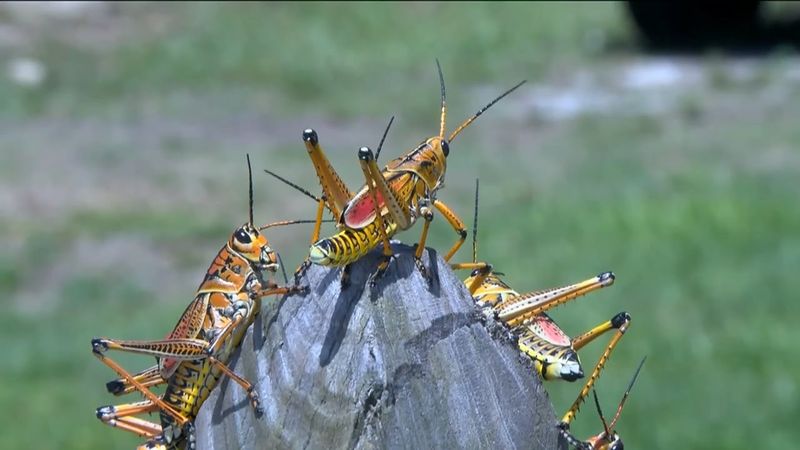
Florida gardeners spotting large, slow-moving yellow, orange, or black grasshoppers on their ornamental plants, citrus, or vegetables are likely looking at eastern lubber grasshoppers. These native insects can appear in noticeable numbers during late summer, particularly in parts of northern Florida and along the Gulf Coast.
Understanding what you are dealing with, and which control methods actually match the insect’s life stage, makes the difference between protecting your plants and wasting time on sprays that rarely work on mature adults.
Those large Florida grasshoppers may be eastern lubbers
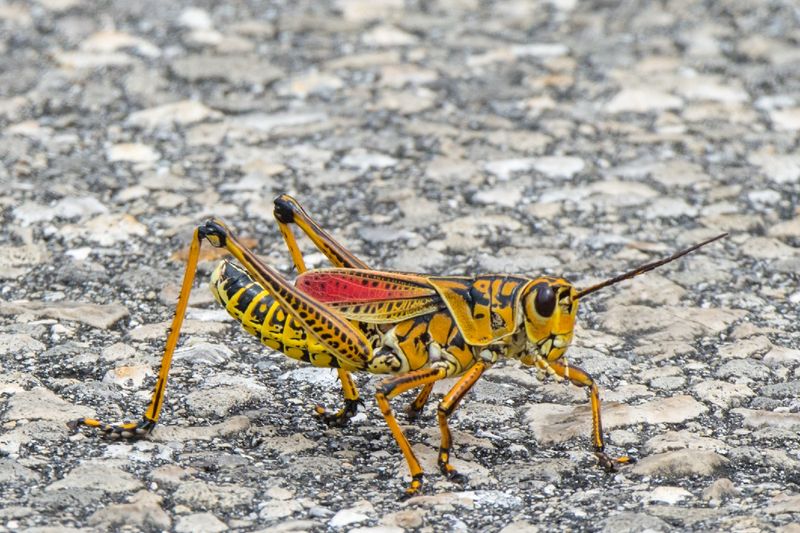
Spotting a grasshopper the size of your thumb lumbering across an amaryllis bed tends to stop gardeners cold. The insect you are most likely looking at is the eastern lubber grasshopper, Romalea microptera, a native Florida species that has been part of the state’s ecosystem for a very long time.
Florida’s Department of Agriculture notes that adults are especially noticeable in late summer, and UF/IFAS identifies July and August as months when numbers tend to peak in northern Florida and along the Gulf Coast, though timing varies with region, weather, and local habitat.
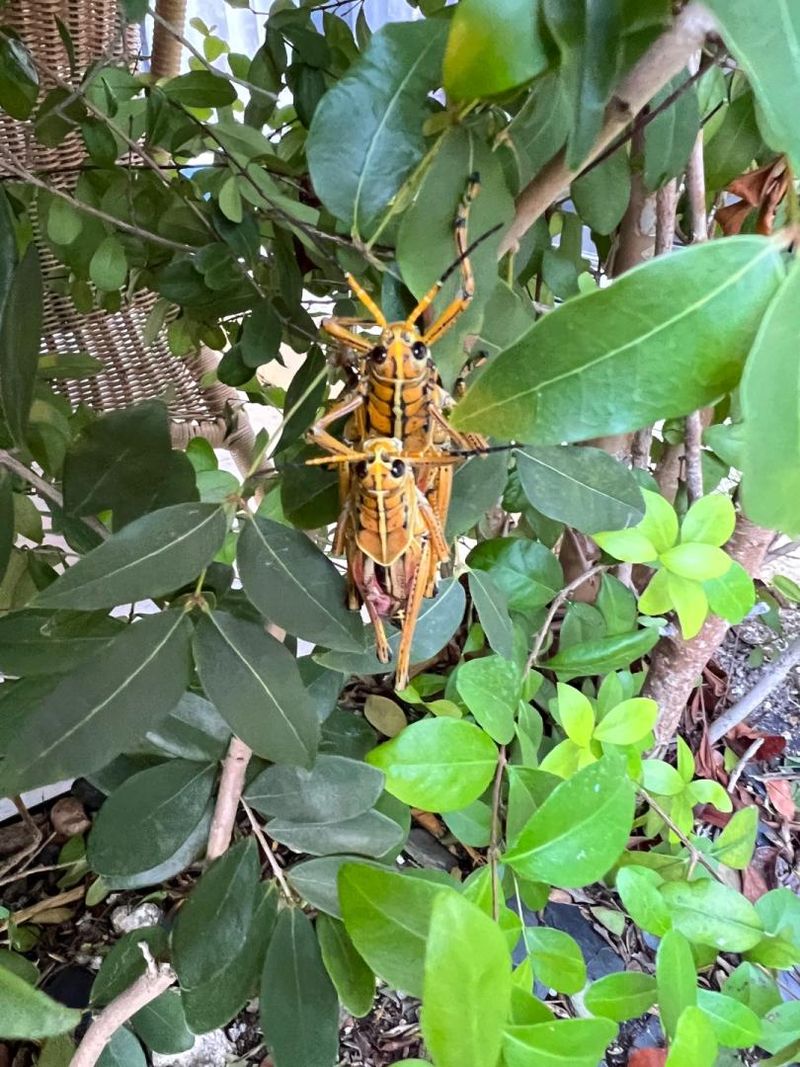
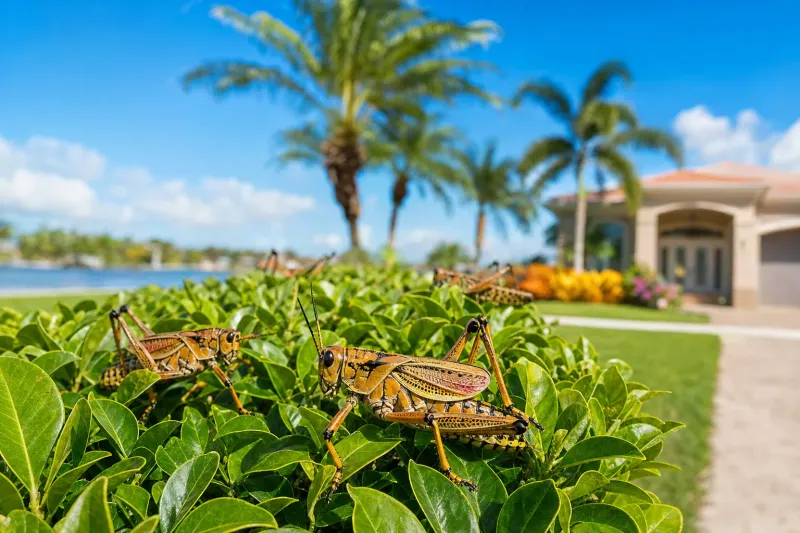
Adult lubbers are hard to miss. Females can reach roughly 3.5 inches in length, and both sexes are flightless, moving with a slow, deliberate walk rather than leaping away like other grasshoppers.
Their coloring ranges from bright yellow with black markings to orange, black, or mixed patterns depending on the individual and its age. UF/IFAS Gardening Solutions confirms the large size, short wings, and slow movement as reliable field clues.
Not every large Florida grasshopper is a lubber, though. The American grasshopper and other species also live in Florida, can fly, and may differ noticeably in color and body shape.
If the insect is flying readily, it is probably not a lubber. UF/IFAS pest identification guidance recommends relying on the lubber’s distinctive size, short wings, flightless behavior, and coloration before deciding how to respond.
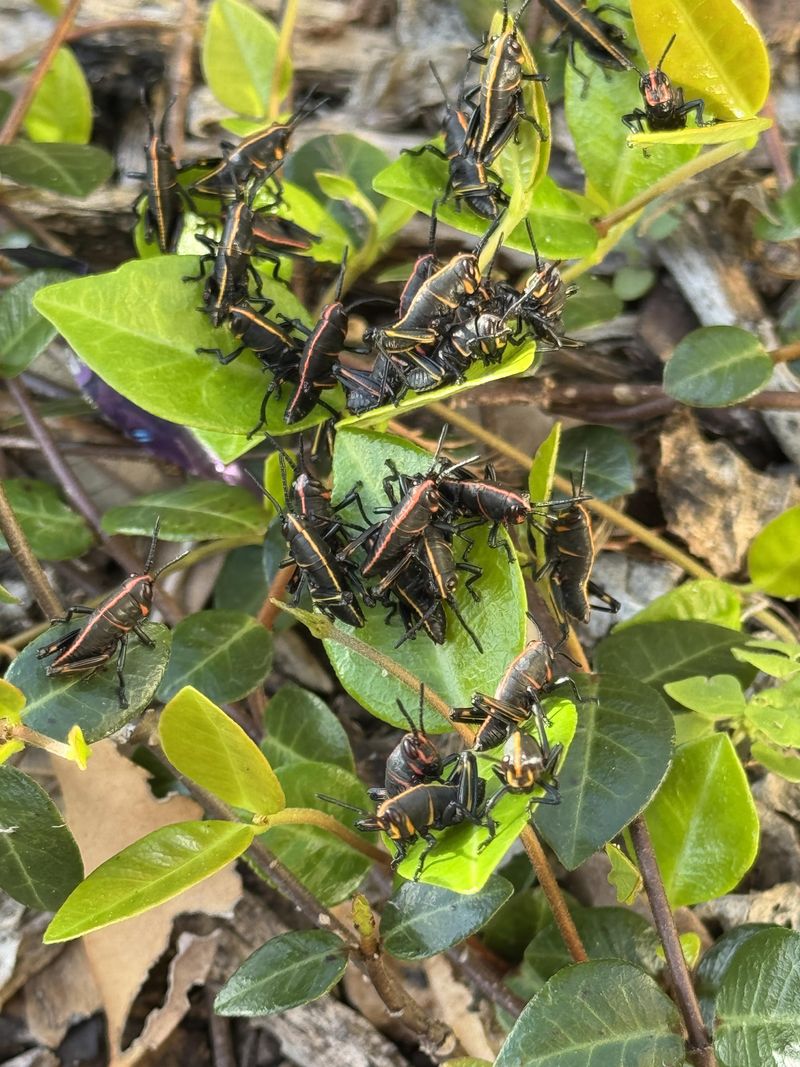
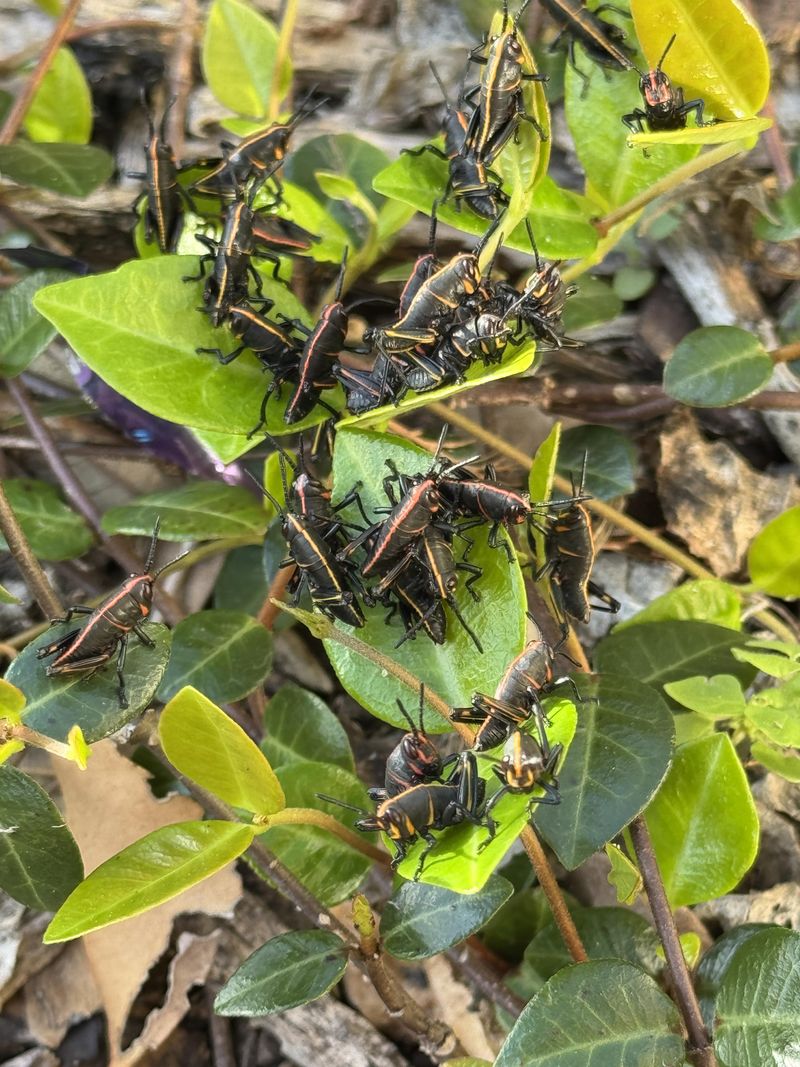
Earlier in the season, lubbers look completely different. Young nymphs are typically black with a yellow, orange, or red stripe and appear in tight clusters on host plants.
Those clusters are a useful early-season flag. Being a native species does not make lubbers harmless: they feed on amaryllis relatives, crinum, canna, lantana, citrus, vegetables, and many other broadleaf plants, and large groups can cause significant damage to garden beds.
Why mature lubbers make spray-first control unreliable
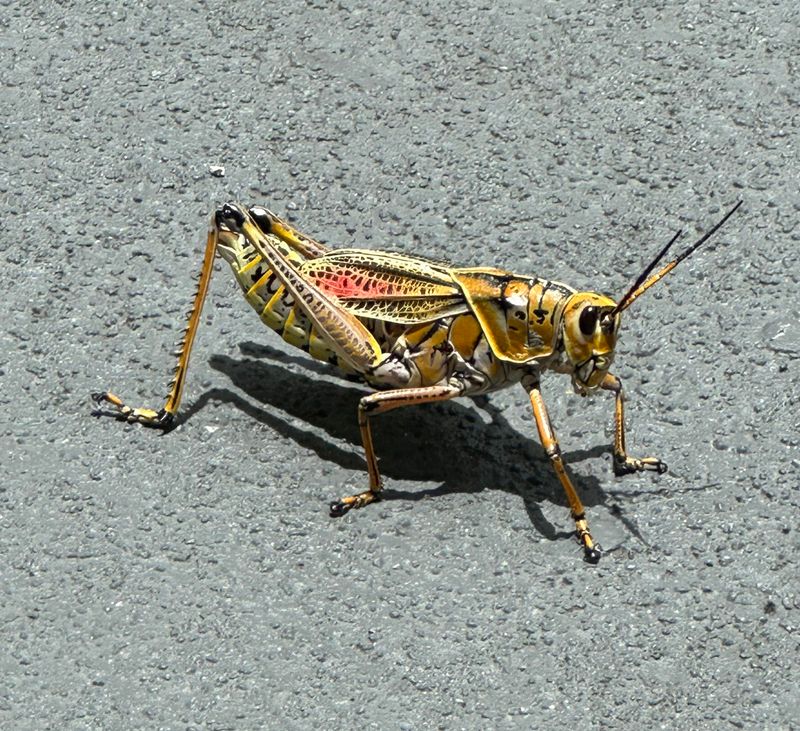
Reaching for a spray bottle is a natural first reaction when you find a big grasshopper chewing through your cannas, but mature lubbers are genuinely difficult to knock back with foliar insecticides. UF/IFAS extension research on eastern lubbers describes adults as often poorly controlled by foliar treatments, a finding tied to their large body size, mobility, and the defensive biology that makes them unpleasant to predators as well as resistant to many surface-applied compounds.
Size alone plays a role. A large, thick-bodied insect absorbs and tolerates more chemical exposure than a small, soft-bodied nymph.
Lubbers also move readily between plants, so an insect that was on a treated leaf an hour ago may have walked to an untreated plant before the product even dries. Their defensive secretions, which they release when threatened, reflect a broader chemical resilience that is unusual among common garden grasshoppers.
UF/IFAS experts advise that sprays work much more dependably against young nymphs than against mature adults, and that increasing spray coverage on adults rarely compensates for the life-stage difference. That does not mean no product ever causes mortality in adults, but it does mean that spraying as the primary strategy for mature lubbers is unlikely to produce reliable results in a home garden setting.
Damage expectations matter here too. Lubbers can chew irregular holes or strip plants severely, but how much harm actually occurs depends on how many insects are present, which plants they are on, the size of those plants, and how long the insects stay.
A few adults feeding briefly on a large citrus tree may leave cosmetic damage. A larger group working through a small bed of amaryllis is a more serious problem.
Matching your response to the actual situation, rather than treating the whole yard on principle, is the more dependable approach.
How to remove adult lubbers from plants now
For adults already feeding in your garden, direct removal is more dependable than any spray. The simplest approach is hand-picking: put on a pair of gloves, grab the insect firmly, and drop it into a container of water with a small amount of dish soap added.
UF/IFAS recommends placing removed lubbers into soapy water or sealing them in a bag and freezing them for several days as the two safest disposal methods for homeowners.
Gloves are not optional here. Lubbers can release defensive secretions when handled, and while UF/IFAS notes that handling is not harmful to people, the spray can irritate skin and eyes.
The toxins in the insect’s body are primarily a concern for predators or pets that might try to eat one, which is why captured lubbers should go into soapy water or a sealed bag rather than being tossed to chickens, dogs, or wildlife.
If hand-picking feels slow, try shaking or tapping plants firmly over a bucket so insects fall in. A strong stream of water from a garden hose can dislodge lubbers from stems and leaves, making them easier to collect from the ground.
A handheld vacuum with a removable canister works well for reaching insects on taller or more delicate plants where shaking is not practical.
For high-value plants such as a prized crinum lily or a container citrus, physical barriers like row cover fabric can protect individual specimens while you work through the rest of the garden. Repeated scouting every few days is worth the effort because lubbers move between plants and new ones can walk in from surrounding vegetation.
Florida’s agriculture department acknowledges that lubbers can disperse from nearby habitat, so clearing adults from your plants today does not guarantee none will arrive tomorrow. Consistent scouting and removal, rather than a single intervention, is what keeps pressure manageable through the late-summer period.
Target clustered spring nymphs before they become adults
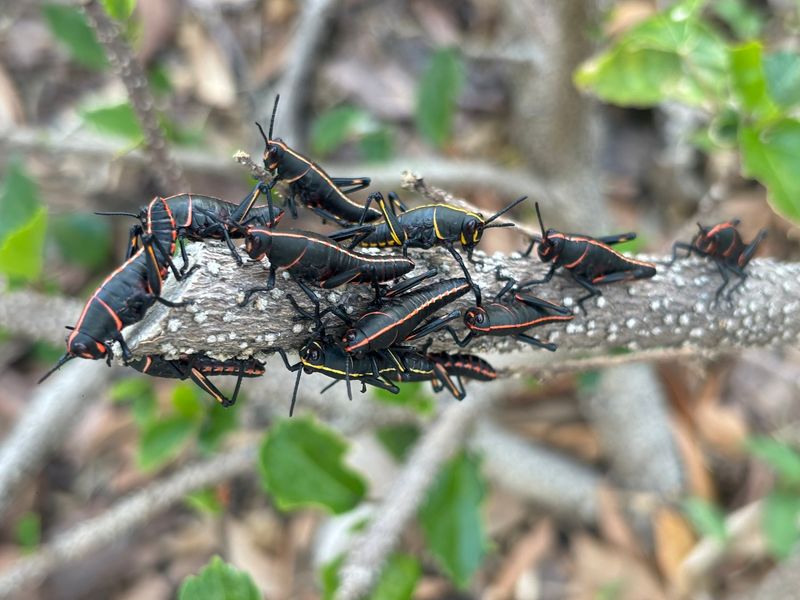
The most practical control window for eastern lubbers is not late summer, when adults are already large and mobile. It is spring, when newly hatched nymphs are small, clustered, and far more susceptible to both physical removal and carefully applied insecticides.
Florida lubbers generally produce one generation per year, with eggs overwintering below the soil surface and nymphs hatching as soil temperatures rise after the cooler months. UF/IFAS experts emphasize that early intervention during the nymph stage is where control efforts pay off most reliably.
Spring nymphs look nothing like the adults you may be dealing with now. They are black with a bold yellow, orange, or red stripe and tend to stay huddled together on host plants in groups that can number in the dozens.
That clustering behavior is actually an advantage for the gardener: finding and removing a group of nymphs in one spot is far easier than tracking down individual adults scattered across the yard.
Hand removal works just as well on nymphs as on adults, and the same soapy-water disposal method applies. If the infestation is large enough that physical removal is not keeping up, UF/IFAS lists several active ingredients that can be effective against young nymphs, including carbaryl, bifenthrin, cyhalothrin, permethrin, esfenvalerate, and spinosad.
These are active ingredients, not universal product endorsements. Any product you use must carry a current label that specifically authorizes use on the target pest, the plant or site where you plan to apply it, and the application method you intend to use.
EPA guidance makes clear that the pesticide label is a legally enforceable document covering required protective equipment, reentry intervals, harvest intervals, and environmental precautions.
Spinosad deserves a specific note. It is sometimes marketed as a biological or natural option, but the National Pesticide Information Center reports that spinosad is highly toxic to bees while wet and can harm aquatic organisms.
Applications should avoid times when pollinators are actively foraging, and the product must never be applied where runoff could reach ponds, drains, or waterways. Follow the label exactly, regardless of how the product is marketed.
When a labeled bait or pesticide approach may make sense
When a lubber infestation is large enough that hand removal is not keeping pace, a labeled bait or targeted pesticide treatment may have a role. One approach that has been studied specifically for eastern lubbers is a bait combining carbaryl with wheat bran and oil.
A University of Florida field-cage study found that this formulation caused mortality under particular conditions, but the results depended heavily on bait acceptance, what other plants were available nearby, and the specific formulation used. When highly preferred host plants were present, bait acceptance dropped and effectiveness was reduced.
That research context matters a great deal. The study used an experimental formulation under controlled field-cage conditions, not a ready-to-use consumer product.
Homeowners should not attempt to mix carbaryl, bran, oil, or any other pesticide ingredients at home. Improvising pesticide mixtures is illegal unless a registered product label specifically authorizes that preparation and use, and no registered label currently supports a homemade carbaryl bran bait for residential garden use.
If you are considering a commercial pesticide product for a larger infestation, start with the label. EPA guidance on reading pesticide labels explains that the label governs every aspect of legal use: which pests and sites are covered, how the product may be applied, what protective equipment is required, reentry and harvest intervals, and environmental precautions.
You can search for registered products through the EPA Pesticide Product and Label System to verify current registrations before purchasing.
For extensive infestations that go beyond what a homeowner can reasonably manage, consulting a licensed pest control professional is a sensible next step. A professional can assess site-specific conditions, recommend legally registered products appropriate for your situation, and apply them in ways that reduce risk to pollinators, beneficial insects, and nearby water.
Broad yard spraying as a default is not recommended by UF/IFAS and can harm the beneficial insects and natural enemies that provide background pressure on lubber populations.
Manage garden edges without promising next year’s control
Cleaning up weedy borders and mowing around garden edges is worth doing, but it is habitat management, not a cure. Reducing dense, weedy vegetation near your garden beds can make the area less favorable for lubbers and expose any insects present to more sun, wind, and predator activity.
UF/IFAS acknowledges this as a reasonable preventive measure while also noting that lubbers can disperse into gardens from surrounding vegetation, so mowing alone is not a reliable barrier against immigration.
Underground egg pods are the other limiting factor. Female lubbers deposit egg pods below the soil surface, often in open, sunny spots or areas where the soil is not waterlogged.
Peer-reviewed management research reports that each pod can contain a range of eggs, though reported numbers vary across sources and no single figure applies universally. Those eggs are not affected by what happens above ground during fall cleanup, which means removing adults or clearing vegetation this season does not reliably reduce next spring’s starting population.
New lubbers can also move in from adjacent properties and natural areas regardless of how tidy your own yard is.
What fall and winter cleanup can do is give you a cleaner canvas for early-spring scouting. If you know which areas of your yard tend to produce nymph clusters, you can watch those spots closely as temperatures rise and remove groups before they disperse.
Florida’s Department of Agriculture notes that activity varies with habitat and that lubbers are associated with open, sunny edge areas, so paying attention to fence lines, garden borders, and areas adjacent to natural vegetation is time well spent in spring.
Natural enemies, including loggerhead shrikes and certain parasitic flies, do exert some population pressure on lubbers over time. These are background factors in your garden’s ecology, not tools you can deploy on demand, and they should not be counted on to solve a current infestation.
They are a reason, however, not to treat your entire yard with broad-spectrum insecticides that would also eliminate those beneficial species.
Use a simple plan: remove adults, scout for nymphs
Facing a yard full of large lubbers can feel overwhelming, but the response plan is straightforward. Right now, with adults present, the priority is direct removal: hand-pick, shake, dislodge with water, or vacuum insects off your most valued plants, and dispose of them in soapy water or a sealed bag.
Protect individual high-priority plants with row cover if needed, and scout every few days because new insects can walk in from neighboring vegetation.
Reserve any chemical decisions for targeted, fully labeled applications. UF/IFAS guidance consistently favors spot treatment and physical removal over broad yard spraying, which risks harming beneficial insects while doing little to stop adults that migrate in from surrounding areas.
If a product is on the table, verify the label covers your specific pest, plant, and site before applying anything.
The bigger investment is next spring. UF/IFAS experts point to early nymph removal as the most dependable control window, so mark your calendar to start checking garden edges and ornamental beds as soon as temperatures climb in late winter or early spring.
Eastern lubbers are a native part of Florida’s landscape, not an invasive emergency, and the goal is limiting plant damage through consistent, well-timed action rather than chasing total elimination. Managing them is a seasonal habit more than a one-time fix.