
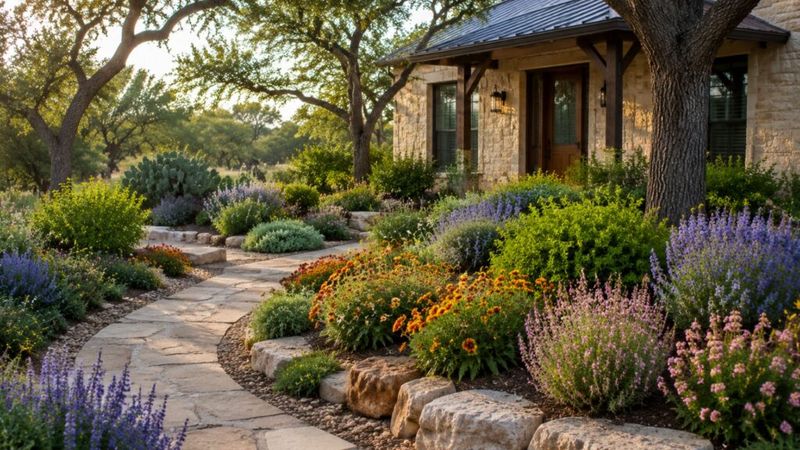
Most front entries in Texas take a beating every summer, and the plants that survive often look scraggly by August. Texas sage, known botanically as Leucophyllum frutescens, offers a different outcome: silvery structure that holds its shape through heat and drought, with seasonal bursts of purple, pink, or lavender flowers that show up when humidity rises.
For homeowners who want a polished front path without constant watering or pruning, this native shrub is worth a close look. The catch is that it only delivers on that promise when the site is sunny, the soil drains well, and establishment watering is handled right.
Texas sage can give a sunny entry a polished structure
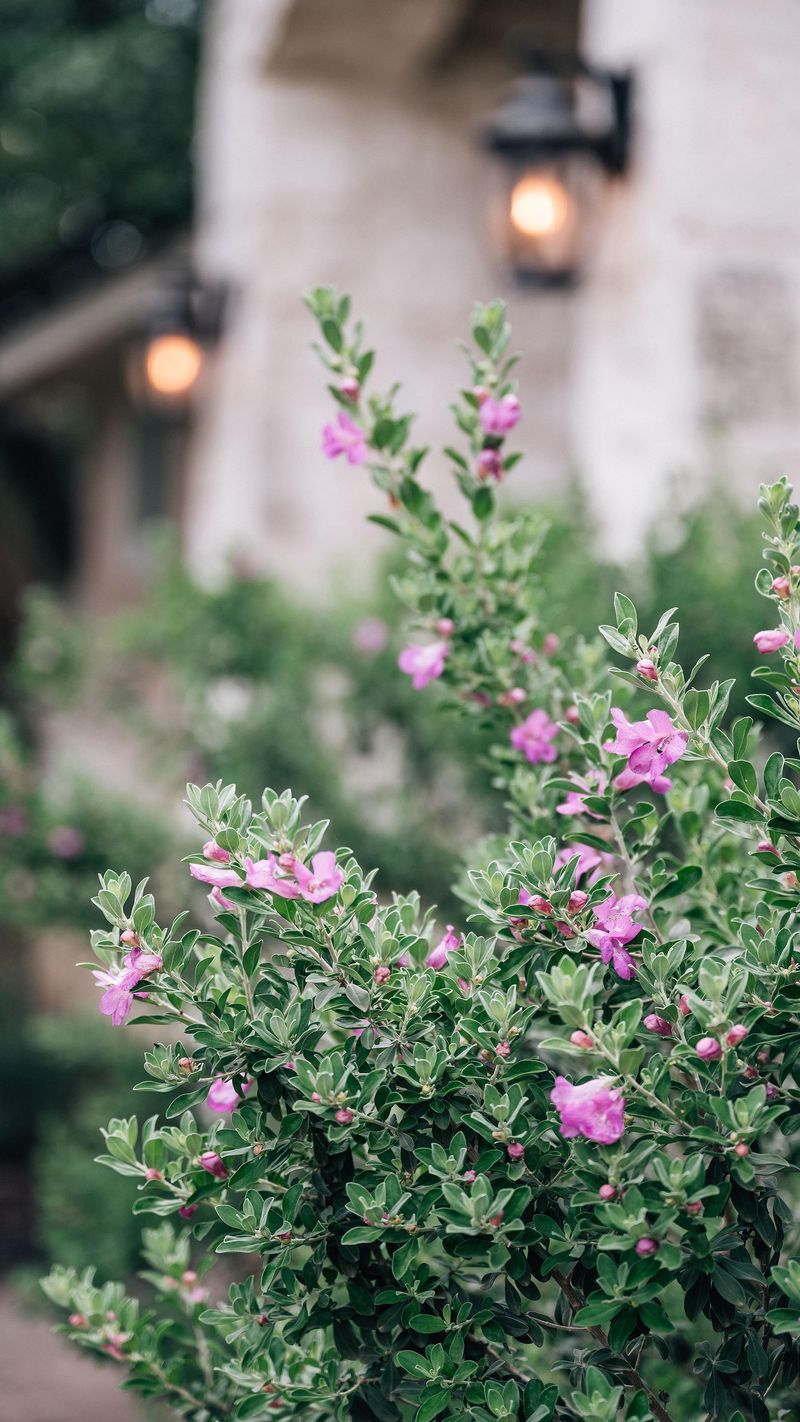
Few Texas-native shrubs combine year-round foliage, seasonal color, and genuine drought tolerance the way Leucophyllum frutescens does. Known by a handful of names, including cenizo, Texas ranger, silverleaf, barometer bush, and rain sage, this shrub has been a fixture in southwestern Texas and northern Mexico landscapes for good reason.
Texas SmartScape classifies it as low-water, evergreen, upright, and native, and Texas A&M materials rate its water requirement as very low, making it a credible anchor for a water-conscious entry planting.
The design case for Texas sage starts with its foliage. The silvery-gray or gray-green leaves catch light differently than most other landscape shrubs, creating a quiet contrast against brick, limestone, and stucco that reads as intentional rather than accidental.
That visual weight holds through the off-season when flowering shrubs go bare, which matters for a front path that you see every day of the year.
Seasonal flowers add a second layer of interest. Pink, purple, white, or lavender blooms appear in summer and fall, often following rainfall or a rise in humidity.
North Carolina State Extension describes the flowering as showy and the overall form as upright and rounded, qualities that translate well to a formal or semi-formal entry composition. When two or more plants are placed with intention along a path, the repeated silvery mass creates a rhythm that can feel curated rather than planted-and-forgotten.
That said, “looks expensive” is a subjective call, not a horticultural guarantee. What the evidence does support is that Texas sage can contribute a refined, architectural effect to a suitable entry, with substantially less routine irrigation and pruning than many conventional flowering shrubs.
Texas A&M range plant resources confirm its native status and adaptation to hot, dry conditions, which underpins that reduced-upkeep potential when the site is right.
Use mature width to create a deliberate path rhythm
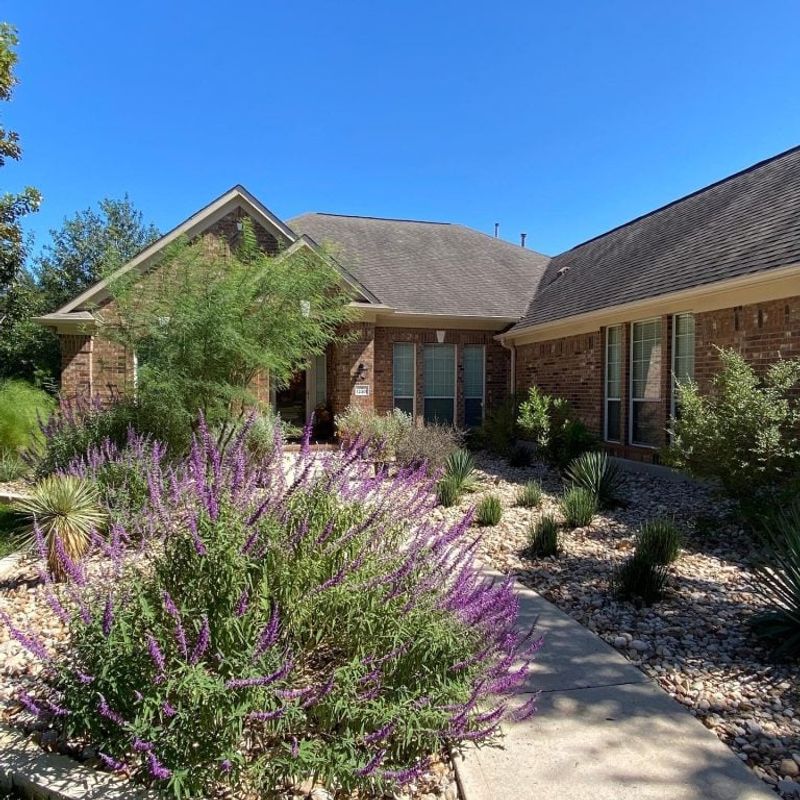
One of the most common mistakes with Texas sage is buying the plant from a nursery and placing it wherever a gap exists beside the front walk. The five-gallon container gives no honest indication of how wide that shrub will eventually grow, and the species can reach six to twelve feet across at maturity.
Texas Tech University’s plant resource sheets document the species reaching significant size, while some named cultivars stay closer to three to five feet wide. The specific plant on the nursery bench, not the common name on the tag, determines how much room you actually need.
A paired planting, one shrub on each side of the path at the same distance from the edge, creates a sense of symmetry that reads as deliberate design rather than random placement. NC State Extension notes the rounded, upright form that makes Texas sage well suited to this kind of mirrored composition.
When the path is long enough, repeating the pairing at measured intervals reinforces that rhythm and makes the entry feel organized from street to front door.
Narrow beds call for a different approach. If the planting strip between the walkway and the property edge is tight, a compact cultivar is a better starting point than the species.
Texas SmartScape lists Texas sage as suitable for hedge use, which suggests it can anchor a defined border, but only when the bed is wide enough to accommodate the mature spread without the plant crowding the walking surface or requiring constant cutting back to stay in bounds.
Use mature width as the controlling measurement when planning spacing, not the container diameter or a rough estimate from memory. Allow enough room on all sides so the shrub can reach its natural shape without being pushed into the path or into neighboring plants.
A well-spaced planting that fills out gracefully over two or three seasons will look more intentional than a tightly packed row that has to be sheared every few months to keep the walkway clear.
Choose full sun and well-drained soil
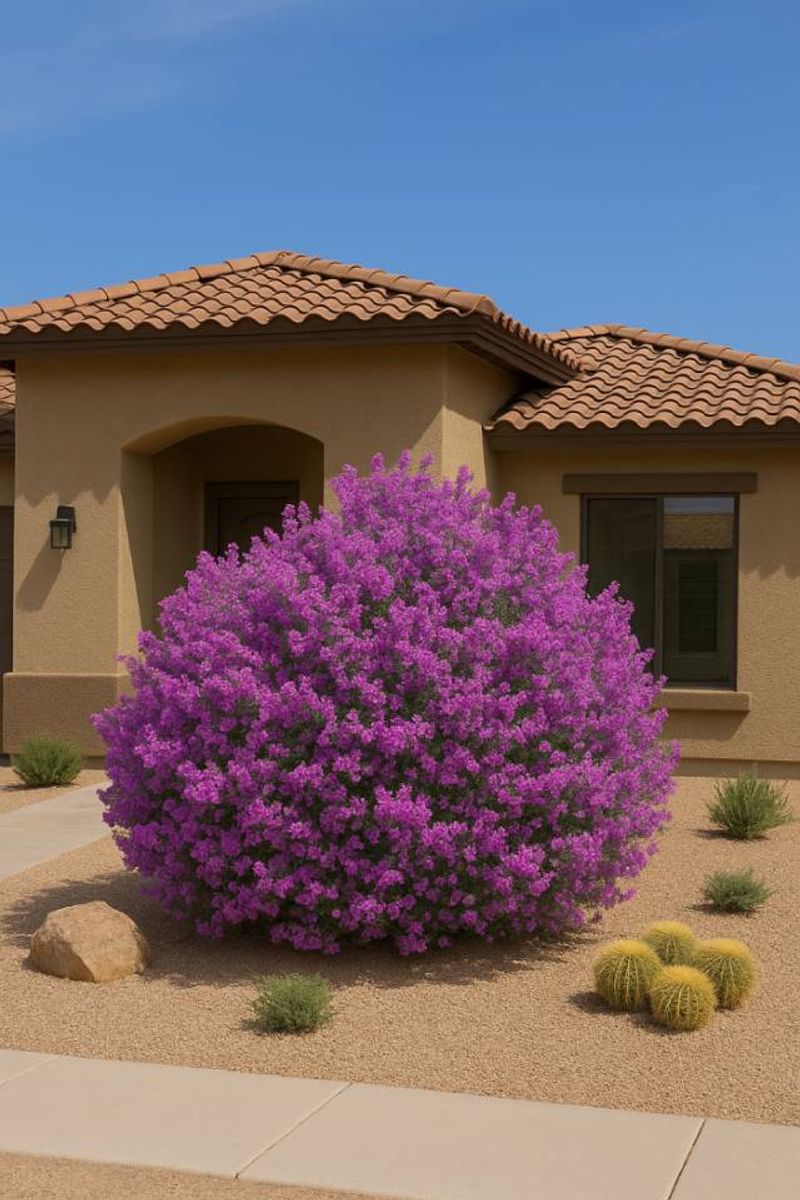
Before any discussion of watering schedules or pruning techniques, the site itself has to pass a basic test. Texas sage earns its low-maintenance reputation only when two conditions are met: full sun and well-drained soil.
Compromise on either one, and the plant’s performance will likely disappoint regardless of how carefully you water or fertilize. Texas Tech’s landscape information sheet confirms that the shrub thrives in full sun and tolerates rocky, alkaline, or calcareous soils, conditions that describe much of central and west Texas naturally.
Full sun means at least six hours of direct sunlight daily, and more is generally better for this plant. Partial shade can lead to a looser, more open form and reduced flowering, which works against the structured entry effect you are trying to achieve.
If the front of your home faces north or is shaded by a large tree for most of the day, Texas sage is probably not the right plant for that spot.
Soil drainage matters just as much as sun exposure. NC State Extension notes that the plant is sensitive to poorly drained or overly moist soils, and persistent saturation or chronic overwatering can cause root problems that undermine the whole low-upkeep premise.
Rocky, sandy, or naturally alkaline soils are favorable. Heavy clay that holds water after rain is a red flag.
Raised beds can help in locations where drainage is poor, but they are not a guaranteed fix for every poorly drained yard. The goal is to keep roots from sitting in water, and a raised bed achieves that only if the soil mix inside it also drains freely.
UF/IFAS extension materials include Texas sage in Florida-friendly plant resources but specify full sun and very well-drained alkaline soil as requirements, a reminder that inclusion in a recommended plant list does not mean the plant works in every yard. Humid or wet sites in Florida, or in wetter parts of East Texas, still require the same drainage standard.
The UF/IFAS invasive species assessment for Leucophyllum frutescens further underscores that site suitability, not just regional inclusion, should drive the planting decision.
Water through establishment before expecting drought tolerance
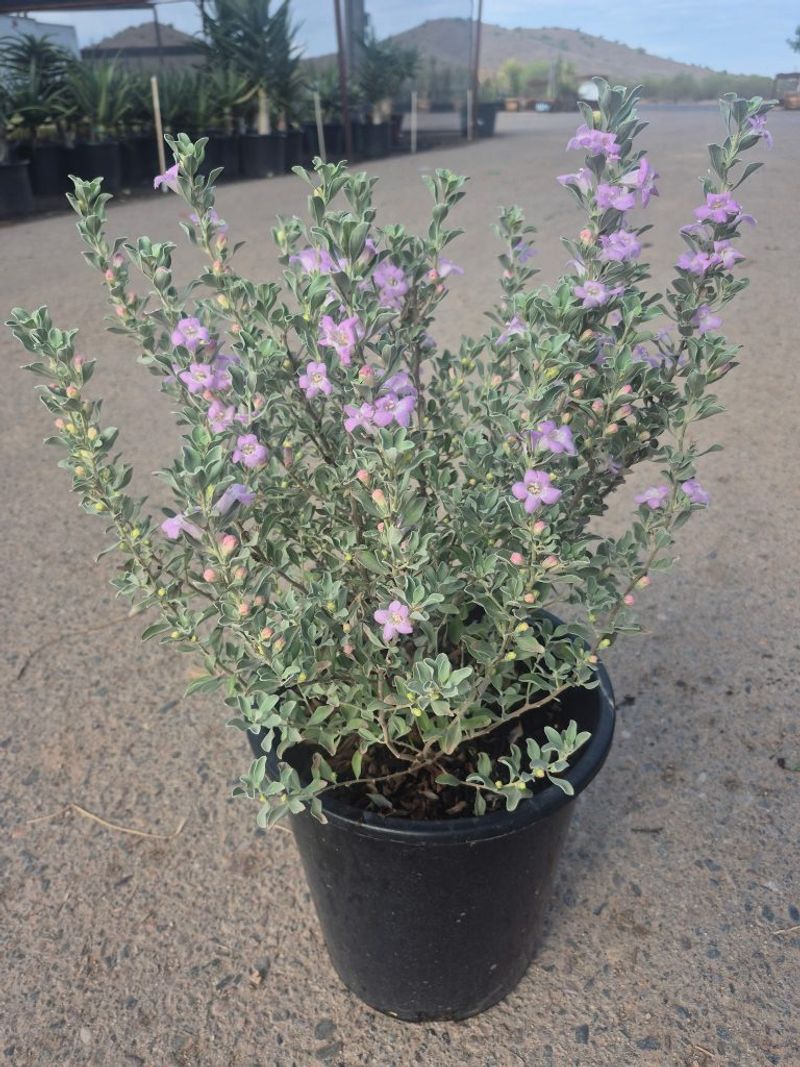
Drought tolerance is a long-term characteristic, not an immediate one. A newly planted Texas sage has a root system confined to the nursery container, and it cannot access the soil moisture that an established plant can reach.
Treating the plant as water-independent from day one is one of the most reliable ways to lose it. University of Georgia Extension guidance on native plants and drought tolerance emphasizes that newly planted shrubs need supplemental irrigation while roots establish, regardless of how drought-tolerant the species will eventually become.
During the first growing season, water deeply and regularly, paying attention to soil moisture rather than the calendar. TCEQ’s landscape irrigation consumer guide recommends waiting until the top two inches of soil have dried before watering again, and suggests deep, infrequent irrigation to encourage roots to grow down into the soil profile.
That approach builds the root depth that makes the plant genuinely drought-resilient over time.
Where and how you apply water also affects how the planting looks and how much water you use. EPA WaterSense notes that microirrigation delivers water directly to the root zone and can use 20 to 50 percent less water than conventional sprinkler systems.
Drip emitters or soaker hoses placed at the base of each plant keep water off the walkway and off the foliage, which also reduces the risk of fungal issues in humid conditions. Spraying the path or the shrub canopy is not an efficient approach for this plant.
A layer of mulch around the base of each plant helps reduce evaporation between waterings and suppresses weeds that would otherwise compete for soil moisture. EPA WaterSense home maintenance guidance supports mulching as part of water-smart landscape management, and the EPA WaterSense Home Builder Resource Manual identifies roughly two to three inches as an appropriate mulch depth.
Keep mulch pulled back from the trunk so it does not hold moisture against the bark or create conditions that impair drainage right at the root crown.
Keep maintenance light with selective pruning and little fertilizer
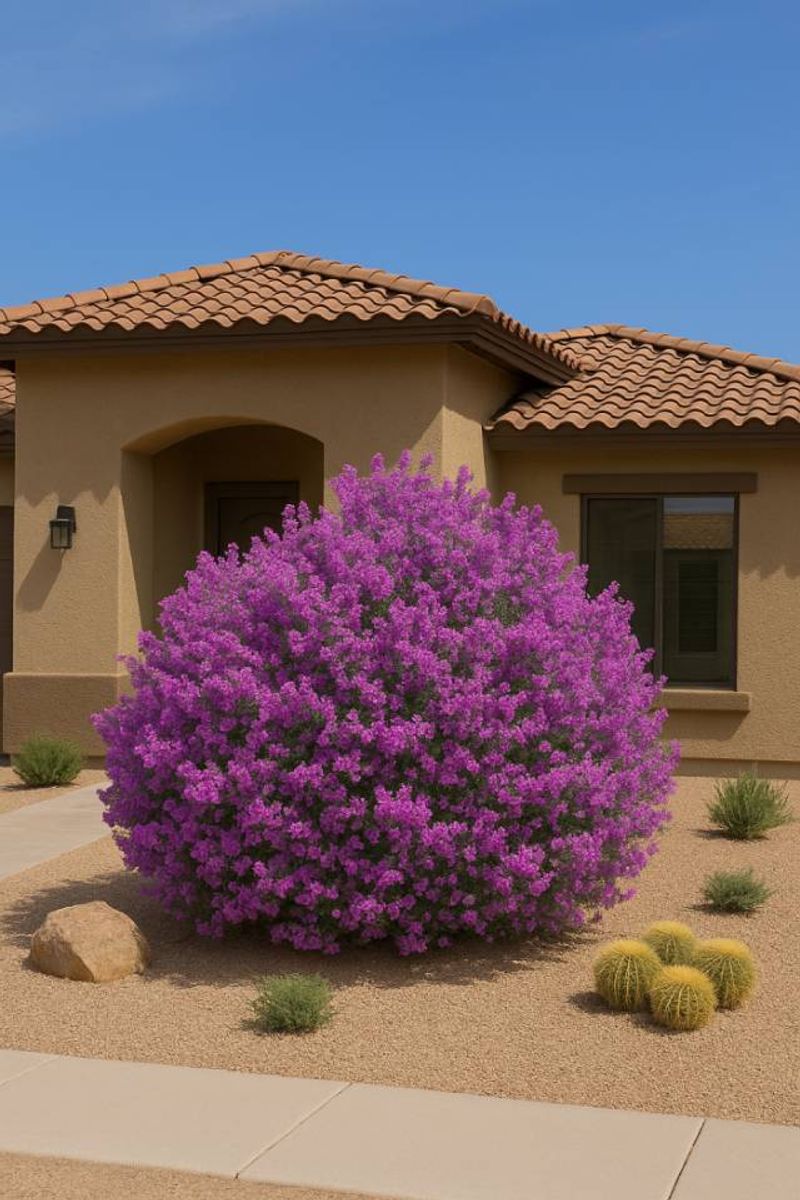
After establishment, the day-to-day care for Texas sage is genuinely lighter than for many conventional flowering shrubs, but lighter does not mean absent. Watering decisions should still be based on soil moisture, current weather, and how the plant looks, rather than a fixed schedule.
During a prolonged stretch of heat with no rain, even a well-established plant may benefit from a deep soak. The goal is to respond to conditions rather than to irrigate on autopilot.
Fertilizer is one input that Texas sage rarely needs and can actually do without. Texas Tech’s plant resource sheet cautions that Texas sage does not tolerate overfertilization, and NC State Extension specifically recommends against fertilizing it.
Pushing the plant with nitrogen can produce lush, soft growth that performs poorly in heat and may increase the plant’s water demand. Skip the fertilizer and let the plant grow at its own pace.
Pruning is where the biggest misunderstanding tends to arise. Texas sage does not need to be sheared into a box or a ball on a regular schedule, and frequent shearing can actually work against you.
The University of Arizona Campus Arboretum warns that repeated shearing damages the shrub’s natural form and can increase its water requirements. The better approach is selective pruning: remove branches that have grown out of bounds, crossed awkwardly, or extended beyond the space you planned for the plant.
For summer-flowering shrubs like Texas sage, Texas A&M AgriLife’s pruning guide recommends pruning while the plant is dormant, since flowers develop on new wood. A light trim in late winter or early spring, before active growth resumes, gives the plant time to push new growth and set flower buds before summer arrives.
Check TCEQ irrigation guidance for local watering rules if you plan to water after pruning to help recovery.
Treat rainfall-linked flowers as an uncertain seasonal accent
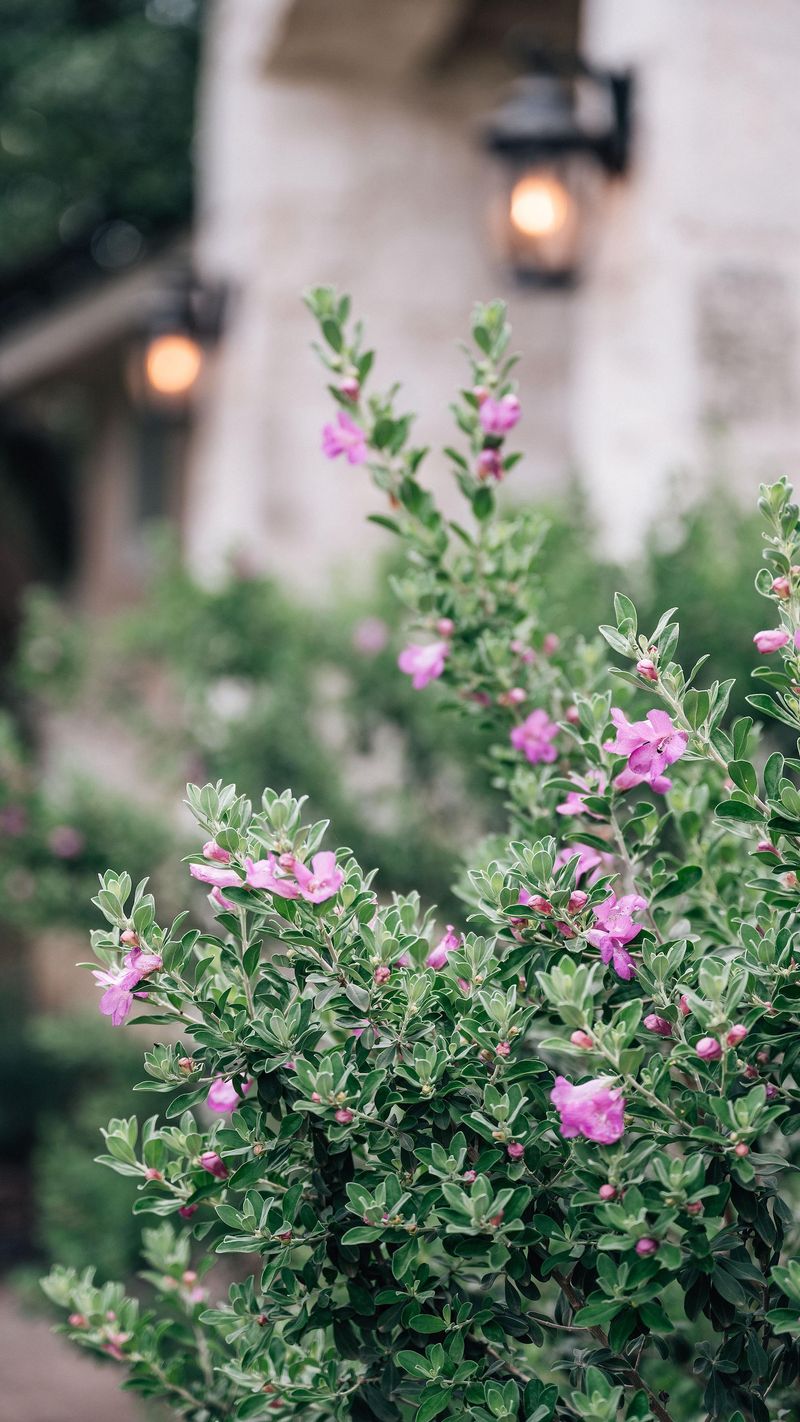
One of the more talked-about traits of Texas sage is its tendency to flower heavily in the days following rain or a rise in humidity. The plant has earned the nickname barometer bush for exactly this reason, and plenty of Texas gardeners have noticed the bloom flush that seems to arrive with a weather change.
Texas Standard reporting on whether Texas sage can predict rain finds that the connection is real but not perfectly reliable, and expert commentary stops short of calling it a dependable forecast tool.
Texas A&M range plant resources describe flowering as occurring in summer and fall, which aligns with the peak humidity and monsoon-influenced weather patterns across much of the state. NC State Extension also notes that timing and frequency can vary, so expecting a predictable bloom calendar is likely to lead to disappointment.
Think of the flowers as a welcome seasonal accent rather than a scheduled event.
What the flowers do reliably is attract pollinators and other wildlife when they appear. Texas SmartScape lists butterflies, birds, bees, and hummingbirds as potential visitors, and the UC Davis Arboretum notes that cenizo can attract beneficial insects and honey bees.
These are potential outcomes rather than guaranteed visitors every season, but a planting that supports pollinators adds ecological value on top of its visual role.
The more important point is that flowering complements the shrub’s structure rather than being the whole reason to plant it. The silvery, evergreen-to-semi-evergreen foliage does the everyday work of framing the path, and the flowers are a periodic reward that shows up on the plant’s own schedule.
Let local rules and regional climate guide the decision
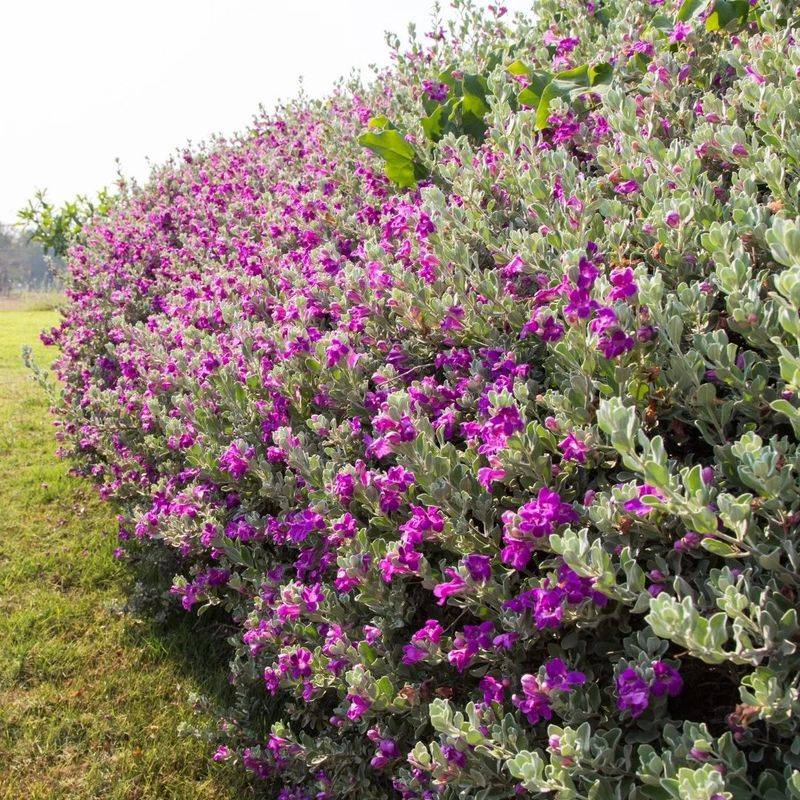
Water restrictions in Texas are not set by one statewide calendar. They vary by city, water utility, and water district, and they can change with drought conditions.
TCEQ’s landscape irrigation consumer guide advises homeowners to check with their local water provider before setting up any irrigation schedule, and TCEQ’s irrigation rules and publications page outlines how local programs are structured. Checking those rules before you plant, not after, keeps you from inadvertently violating restrictions during the establishment period when the plant genuinely needs water.
Regional climate variation across Texas also matters more than the common name on a plant tag. University of Georgia Extension guidance on native plants and drought tolerance makes the point that native status alone does not guarantee low water use; the plant still has to match the site’s sun, soil moisture, drainage, and climate.
Kew’s Plants of the World Online places Leucophyllum frutescens’ native range in southwestern Texas and northern Mexico, which is hot, dry, and alkaline country. East Texas, with its heavier rainfall, more acidic soils, and higher humidity, is a different environment, and the plant may not perform the same way there.
Foliage retention is another variable worth understanding before you commit. Texas SmartScape describes the plant as evergreen, while UF/IFAS extension materials describe it as semi-evergreen.
The honest answer is that it is evergreen to semi-evergreen depending on conditions, selection, and how severe the winter is. A hard freeze can cause significant leaf drop, which is worth knowing if you are counting on the plant for year-round structure.
A practical decision test: plant Texas sage at your front entry when the location gets full sun all day, the soil drains freely after rain, the bed is wide enough for the cultivar’s mature spread, and you can legally water during establishment. If any of those conditions are missing, the plant’s low-maintenance reputation may not translate to your specific yard.
A polished path depends on the right plant in the right place
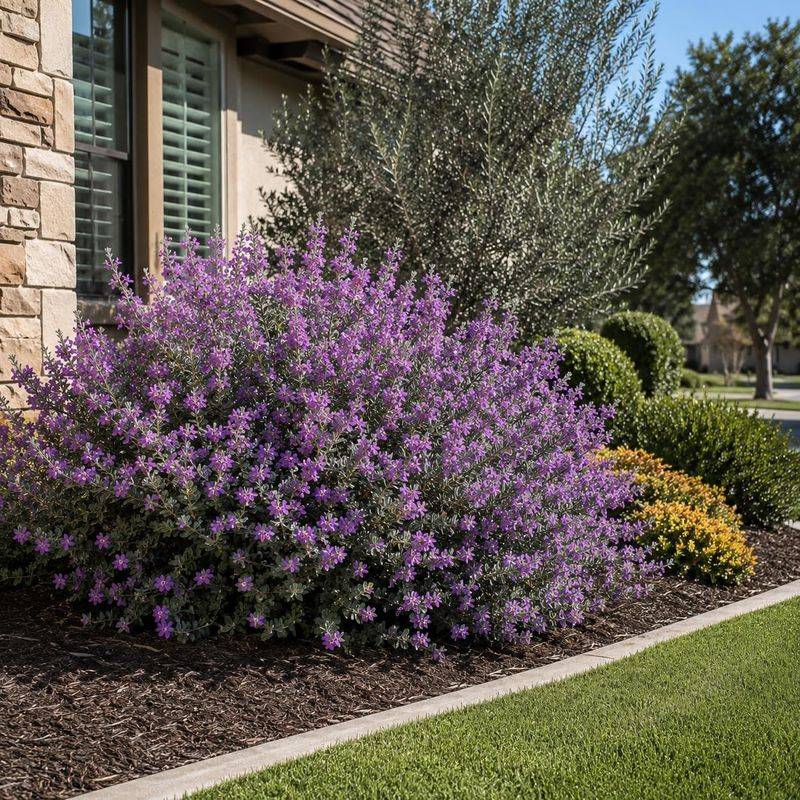
Texas sage earns its place along a front path through a combination of qualities that work together: silvery foliage that holds structure year-round, seasonal flowers that add color without demanding constant attention, and a naturally upright, rounded form that suits a paired or rhythmic composition. Texas SmartScape’s low-water, native, and upright classifications confirm the functional basis for that design role, while NC State Extension’s profile of Leucophyllum frutescens supports the assessment that the shrub can create a refined, architectural effect in the right conditions.
The conditions are the nonnegotiable part. Full sun, well-drained soil, room for the selected cultivar’s mature spread, establishment watering that complies with local TCEQ-regulated irrigation rules, light and purposeful pruning, and no routine fertilizer: these are the inputs that make the low-upkeep promise realistic.
Skip a site requirement, and the plant will require more intervention, not less.
Texas sage is a strong hero-plant choice for an appropriately sited Texas entry. A shaded yard, soggy soil, a cramped bed, or a location under heavy irrigation is simply not the right match.
Choose the site first, then choose the cultivar that fits it, and the path will take care of most of the rest on its own terms.