
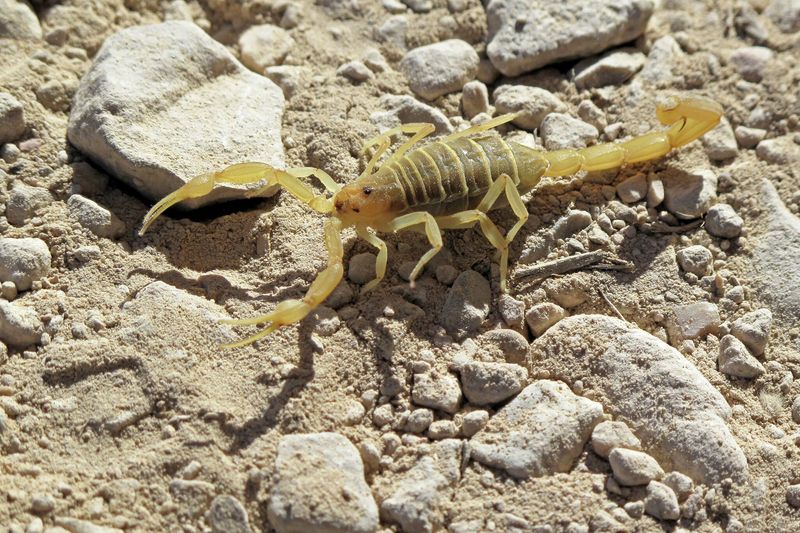
Spotting a scorpion near your back door or porch light can stop you cold, especially when you are not sure what you are looking at or how worried to be. Texas is home to roughly 18 scorpion species, and knowing which one you have found can change how you respond.
Late summer is one of the more common times to notice them around yards and outbuildings, though sightings depend heavily on where in Texas you live and what the local conditions have been like. A calm look at a few key features will tell you more than color alone ever could.
The striped bark scorpion is a strong first possibility
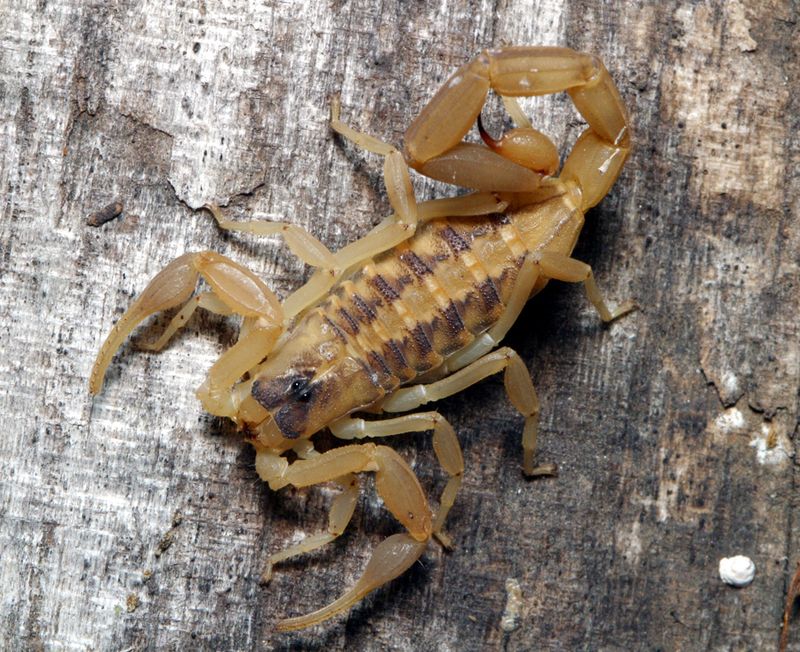
For many Texas homeowners who find a scorpion near a wall, under a log, or crawling across a porch, the striped bark scorpion, Centruroides vittatus, is a reasonable first candidate. Texas A&M AgriLife Extension identifies it as the state’s most common scorpion and notes that it is the only scorpion species recorded throughout eastern Texas.
That statewide footprint makes it a useful starting point, though it is not the only species you might encounter, especially once you move west of the I-35 corridor.
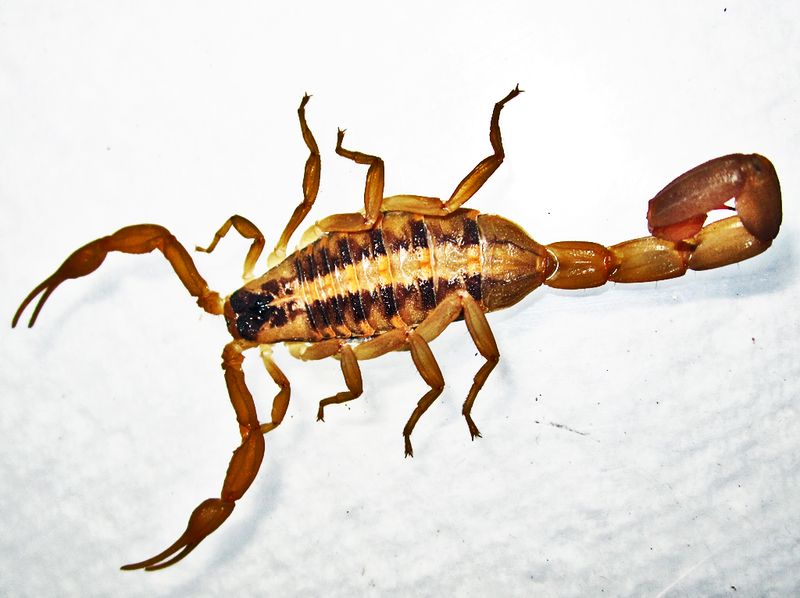
Adult striped bark scorpions typically measure about two to three inches long. The body is yellowish-tan to brown, and the back carries two broad, dark longitudinal stripes that run from just behind the head toward the tail.
Near the front of the head, just above the eyes, look for a small dark triangular marking that functions as one of the more reliable field clues. The pincers are noticeably slender compared to heavier-bodied species, and the tail is long and thin rather than thick and stocky.
Behavior matters as much as appearance when you are trying to narrow things down. The Texas A&M Field Guide to Common Texas Insects describes the striped bark scorpion as a climbing, non-burrowing species that associates with dead vegetation, fallen logs, loose debris, tree bark, walls, and attics.
Unlike burrowing scorpions that stay underground, this species moves vertically and often ends up in places where people live and store things. Activity is mostly nocturnal, so an evening sighting near a light source or a doorway is consistent with its habits, not evidence of unusual behavior.
Keep in mind that “most common in Texas” does not mean “guaranteed at your address.” Location, habitat, and regional species composition all affect what you are likely to find. Homeowners in western Texas or the Big Bend area should treat a striped bark scorpion match as a possibility rather than a certainty before looking more carefully at the details.
Texas has many scorpions, especially in the west
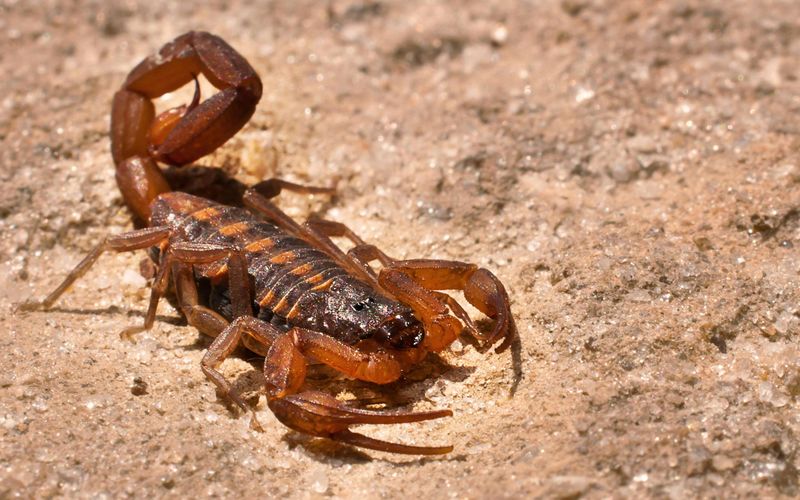
A single mental image of “the Texas scorpion” does not hold up once you travel west of the Hill Country. Texas A&M AgriLife Extension reports approximately 18 scorpion species statewide, and that figure may reflect older taxonomic treatments, meaning the real count could shift as classification is updated.
What is consistent across sources is that species diversity is heavily concentrated in western Texas and the Big Bend region, where terrain, elevation, and climate create conditions that suit multiple genera.
Genera such as Vaejovis, Diplocentrus, Chihuahuanus, and Paruroctonus have been recorded in parts of west Texas, and University of Texas at El Paso biotic resource surveys document the regional complexity of scorpion assemblages in the Trans-Pecos area. Local species records differ substantially depending on whether you are near Austin, Amarillo, Abilene, Fort Stockton, Fort Davis, Langtry, or Big Bend.
A yard in Fort Davis may host species that simply do not occur in Houston, and vice versa.
One distinction worth making clearly: the general term “bark scorpion” does not automatically mean Arizona bark scorpion. The striped bark scorpion is itself sometimes called a bark scorpion because of its climbing habits, but it is a different species from Centruroides sculpturatus, the Arizona bark scorpion associated with the Sonoran Desert.
Texas A&M School IPM guidance describes the medically significant Arizona bark scorpion as associated with Sonoran Desert areas, while Texas A&M AgriLife’s Texas-specific materials state that no Texas scorpion is considered deadly. Avoid labeling any pale or lightly marked scorpion an Arizona bark scorpion without more information and, if you are in far western Texas near the border, consult a local extension office or pest professional for a confident identification.
Late-summer sightings reflect conditions, not a proven statewide surge
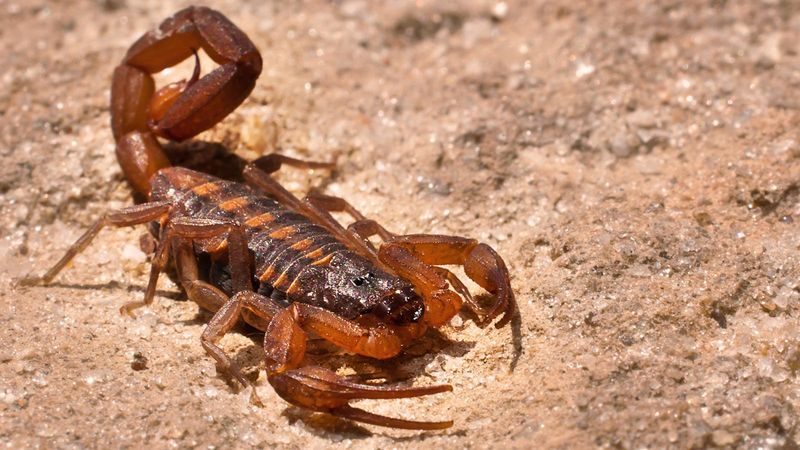
Seeing more scorpions in late summer does not mean Texas is experiencing an unusual outbreak. Scorpions are nocturnal and can remain active year-round in the state’s warmer regions, so the real question is what conditions make them more visible at any given time.
Texas A&M Veterinary Medicine reports that scorpion sightings often peak during the hottest and driest months, typically July and August, when heat stress may push animals toward cooler, moister microhabitats near structures.
A separate study adds an important regional wrinkle. Research on a West Texas scorpion assemblage found that surface density for striped bark scorpions and Vaejovis waueri was highest in spring and fall rather than midsummer.
Those two findings are not contradictory; they reflect the fact that peak activity depends on which species you are watching, what the local climate looks like, and what the specific habitat offers in terms of shelter and prey.
What this means practically is that “often seen during late summer” is accurate for many Texas homeowners, but it is not a statewide rule backed by verified 2026 data. There is no confirmed evidence of an unusual scorpion surge this year.
Weather patterns, prey availability, local habitat, and construction or landscaping changes near a home can all influence how often a particular family notices scorpions. If sightings seem frequent at your address, the more productive question is what conditions around the yard are attracting or sheltering them, rather than assuming a regional event is underway.
Confirm several features without handling the scorpion
Scorpion identification works best when you combine several features rather than relying on one clue. Color is the easiest thing to notice and also the most misleading.
The Texas A&M Field Guide notes that striped bark scorpion coloring can vary considerably, and individuals from the Big Bend area may be faintly marked or nearly pale, making a confident color-only call unreliable. Body proportions, markings, and regional context carry more weight.
When you can observe the scorpion safely from a distance, work through a short checklist. For a striped bark scorpion, look for two broad dark stripes running lengthwise down the back, a small dark triangular mark near the front of the head between the eyes, slender pincers (not thick or crab-like), and a long thin tail rather than a short stocky one.
Body length is roughly two to three inches. If the scorpion is on a wall, under a piece of bark, or climbing rather than digging, that climbing behavior is consistent with the striped bark scorpion.
A scorpion that is dark-colored, heavily built, or located near a burrow in western Texas deserves more caution before you attempt any identification at all, because the Trans-Pecos region hosts several genera with distinct body forms.
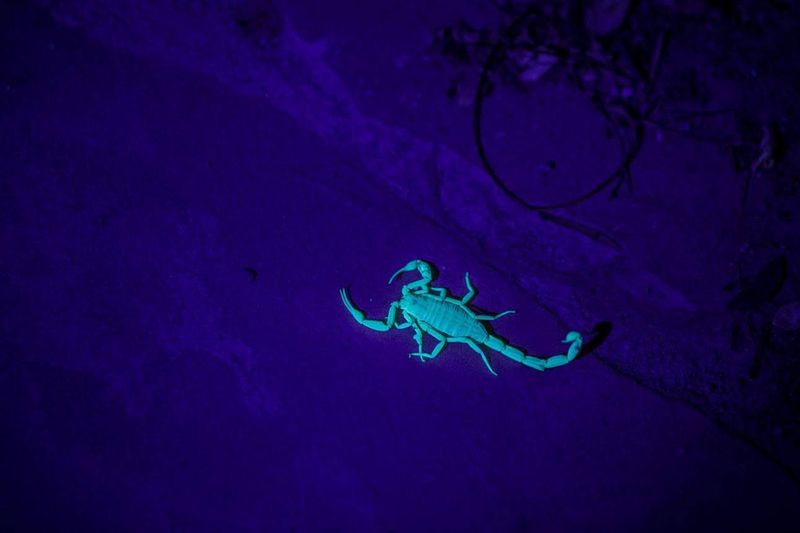
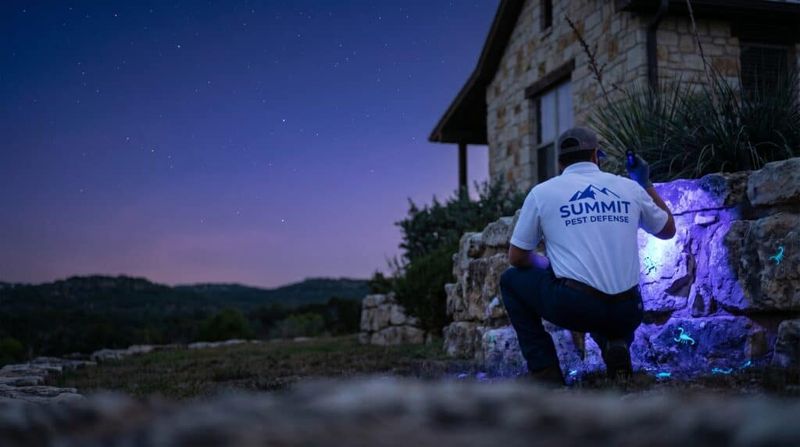
A UV black light is a useful nighttime tool for locating scorpions because their exoskeletons fluoresce a blue-green color under ultraviolet light. Texas A&M AgriLife Extension confirms that fluorescence under UV light is a reliable detection method, though it cannot tell you which species is glowing.
Do not look directly into the UV light source, and keep children at a safe distance during any nighttime inspection.
Photographing the scorpion from a few feet away is the safest way to document what you saw. MedlinePlus recommends photographing the scorpion from a safe distance rather than attempting to capture or handle it.
A clear image that shows the back stripes, head, pincers, and tail from above gives an extension agent or pest professional enough detail to help with identification if you remain uncertain after your own look.
Look for shelter, prey, and entry routes around the house
A scorpion heading toward your door is not on a mission involving you. Scorpions hunt small arthropods, including insects, spiders, centipedes, and occasionally other scorpions, and they move through whatever openings or spaces offer access to prey, shelter, or a more comfortable temperature.
Texas A&M AgriLife Extension describes the striped bark scorpion as closely associated with dead vegetation, fallen logs, loose debris, walls, trees, and human dwellings, all of which happen to be common features of a Texas yard and home exterior.
The climbing habit of the striped bark scorpion is worth keeping in mind when you inspect your property. Tree branches or vines touching a roofline, stacked firewood against an exterior wall, boards or stones near the foundation, and debris piles near a door all function as scorpion habitat and potential access routes.
A scorpion that reaches the wall of your house can travel upward and find its way through a gap in an attic screen, a crack around a pipe, or a poorly sealed soffit before you ever see it inside.
Rain is sometimes offered as a universal explanation for indoor scorpion sightings, but weather is only one of several factors. Temperature gradients, prey movement, construction activity, irrigation changes, and simple access through existing openings can all contribute to indoor encounters.
Texas Parks and Wildlife notes that scorpions are predators of insects and other arthropods, so a yard with abundant prey and plenty of shelter is more likely to host scorpions than one that has been cleaned up and sealed. Focus your attention on the conditions around the house rather than trying to assign a single motive to any individual scorpion’s movement.
Use exclusion and cleanup before considering pesticides
Preventing scorpion encounters around a Texas home is mostly a matter of removing what draws them in and closing off how they get inside. Start with the yard itself.
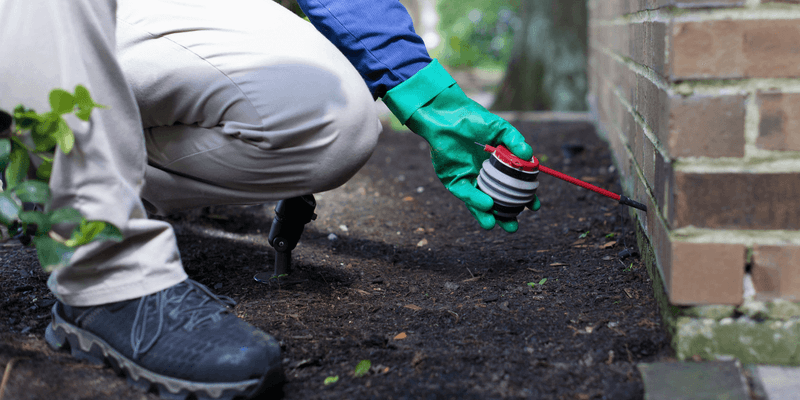
Move boards, logs, stones, bricks, yard waste, and other debris away from the foundation, because any piled material near the house creates exactly the kind of sheltered, dark hiding spot a scorpion prefers. Texas A&M AgriLife Extension’s scorpion control guide recommends keeping grass closely mowed near the structure and pruning shrubs, vines, and tree branches away from walls and the roofline, because branches that touch the house give climbing scorpions a direct route upward.
Firewood deserves its own rule: store it away from the house, not stacked against an exterior wall. Never carry firewood indoors unless it is going directly onto the fire, and wear gloves when moving any yard materials.
Scorpions can hide between pieces of wood or under bark and are not visible until disturbed. The same caution applies to any material that has been sitting on the ground or in a corner for a while.
Inside the home, the exclusion checklist covers door sweeps, weather-stripping on all exterior doors, window screens, and attic and soffit screens. Gaps around pipes where they enter the wall, cracks near roof eaves, weep holes in brick veneer, and openings around electrical wiring are all common entry points that are easy to overlook.
Seal or screen them before fall arrives.
One daily habit that costs nothing: shake out shoes, clothing, bedding, towels, and gloves that have been left on the floor or outdoors, particularly in a garage or outbuilding. Poison Control notes that scorpions hide in shoes and clothing, and most stings inside the home happen during exactly that kind of accidental contact.
Pesticides are a secondary tool, not a solution by themselves. Texas A&M AgriLife states that scorpions are difficult to control with insecticides alone and puts habitat modification and exclusion first.
If you choose to use a pesticide, the product label must specifically list scorpions and the treatment site; follow the label precisely. Do not assume that spraying the yard will eliminate a scorpion population or prevent future sightings on its own.
Treat a sting calmly and recognize emergency symptoms

Most Texas scorpion stings produce immediate pain at the sting site, along with localized swelling, itching, numbness, or some discoloration of the skin. Texas Parks and Wildlife describes typical Texas stings as similar to a bee sting and usually not serious for healthy adults, though individual reactions vary and allergic responses are an important exception that should not be dismissed.
First aid is straightforward. Wash the sting site with soap and water, then apply a wrapped cold pack to manage pain and reduce swelling.
Do not use a tourniquet at any point. Poison Control recommends calling 1-800-222-1222 for case-specific guidance after any scorpion sting, and that call is worth making even when symptoms seem mild, because a trained specialist can help you decide whether to monitor at home or seek care.
Certain symptoms require urgent medical attention rather than watchful waiting. Seek emergency help immediately if you or someone else develops trouble breathing or swallowing, drooling, slurred speech, abnormal eye movements, muscle twitching or spasms, seizures, severe vomiting, major changes in heart rate, or any rapidly worsening symptoms after a sting.
Young children are at higher risk for serious reactions and should be evaluated by a medical professional after any scorpion sting, even if they initially seem fine. People with known severe allergies should treat a sting as a potential emergency from the start.
MedlinePlus advises photographing the scorpion from a safe distance if you can do so without getting closer to it or attempting to handle it. A photo can help a medical provider or Poison Control specialist understand what you encountered, though treatment decisions are based on symptoms rather than species identification.
Never pick up the scorpion, attempt to collect it bare-handed, or return to the area without footwear and awareness of where it went.
Start with the striped bark scorpion, then respect regional uncertainty
For most Texas homeowners, particularly those in eastern and central Texas, the striped bark scorpion is a reasonable first possibility when a scorpion turns up near the house. Texas A&M AgriLife Extension confirms it as the state’s most common scorpion and the only species recorded throughout the eastern part of the state.
If the features line up, including the twin dorsal stripes, the triangular head mark, slender pincers, and a long thin tail, the identification has solid support.
Readers in western Texas and the Big Bend region should hold that match more loosely. A pale, faintly marked, heavily built, or otherwise atypical scorpion in those areas may belong to a different species or genus entirely, and color or size alone is not enough to settle the question.
When identification matters, a photograph shared with a local extension office or pest professional is a safer route than guessing.
The two practical priorities stay the same regardless of species: observe from a distance and improve the conditions around your home. Exclusion and habitat cleanup reduce encounters more reliably than pesticides alone.
If a sting produces anything beyond localized pain and swelling, call Poison Control at 1-800-222-1222 or go to an emergency room without delay. Scorpions have been navigating Texas yards long before any of us built houses there, and knowing what you are looking at is the first step toward coexisting with them safely.