
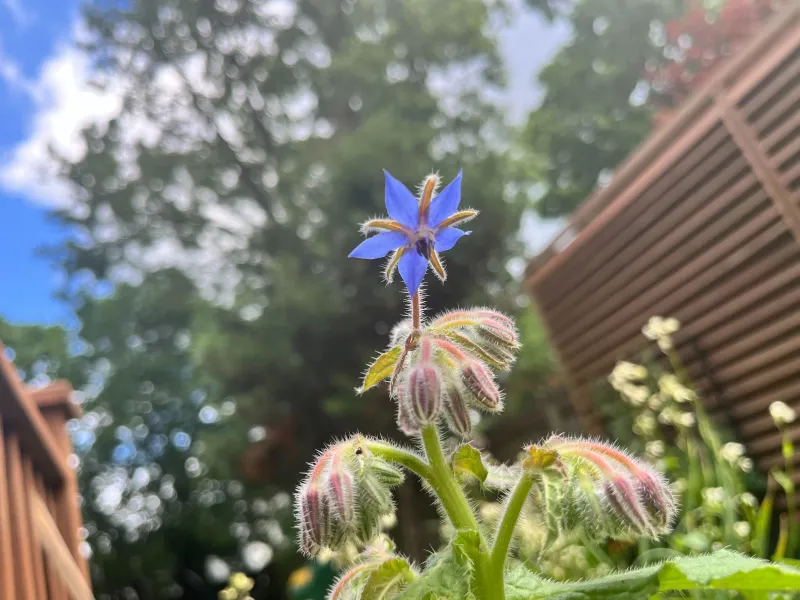
Borage is a Mediterranean herb with bright blue, star-shaped flowers that most North Carolina gardeners walk right past at the nursery without a second glance. That oversight might be worth reconsidering, especially if you have a sunny, informal bed that needs color, bee activity, and a little personality without demanding constant attention.
This article lays out eight honest reasons why borage may earn a spot in your front yard, along with the real limits every gardener should know before seeds hit the soil.
Borage can add a relaxed blue focal point
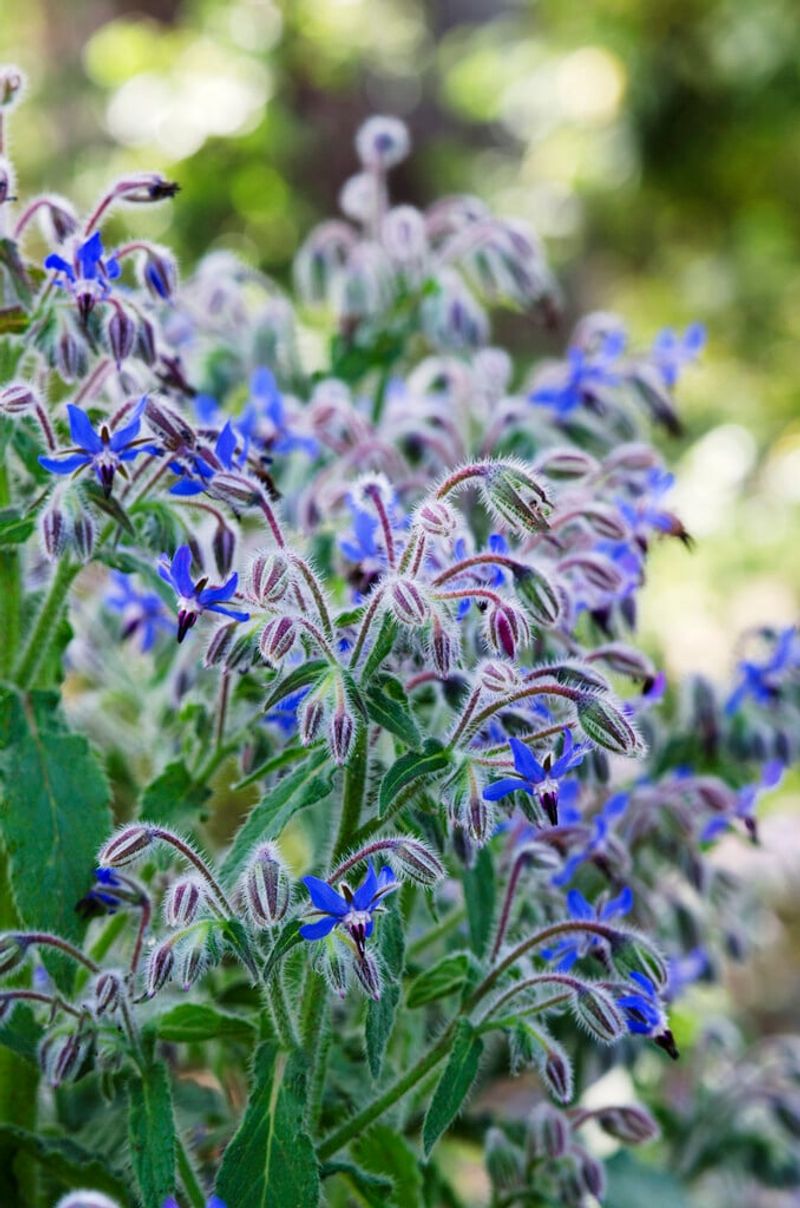
Few annuals offer a blue as clear and true as borage. The star-shaped flowers sit in loose clusters above gray-green, hairy leaves that catch morning light with a silvery sheen.
Mature plants reach roughly 1 foot 7 inches to 3 feet 2 inches tall and spread about 1 to 1 and one-third feet wide, according to NCSU Extension’s plant profile, so the form is open and relaxed rather than tight or formal.
That relaxed habit is a feature in some settings and a drawback in others. Borage fits naturally into a cottage-style border, an informal herb garden, a pollinator patch, or a container where a bit of sprawl reads as abundance.
In a tightly clipped, symmetrical front-yard design, the coarse, hairy foliage and loose branching can look out of place quickly, so honest placement matters before the first seed goes in the ground.
The practical move is to position borage behind shorter edging plants, where its height adds layering without crowding the sidewalk or obscuring a house number. Placing it alongside other informal plants, such as zinnias, cosmos, or native wildflowers, lets the blue flowers contribute color without making the whole bed look unkempt.
University of Maryland Extension notes the same spreading habit and recommends giving each plant adequate room to develop fully.
Gardeners who prefer a manicured curb presentation may find borage more satisfying in a side-yard herb bed or a backyard pollinator corner than front and center. Choosing the right spot upfront saves the frustration of pulling out an otherwise healthy plant because the look does not match the neighborhood aesthetic.
Its strongest case is the flowers bees visit
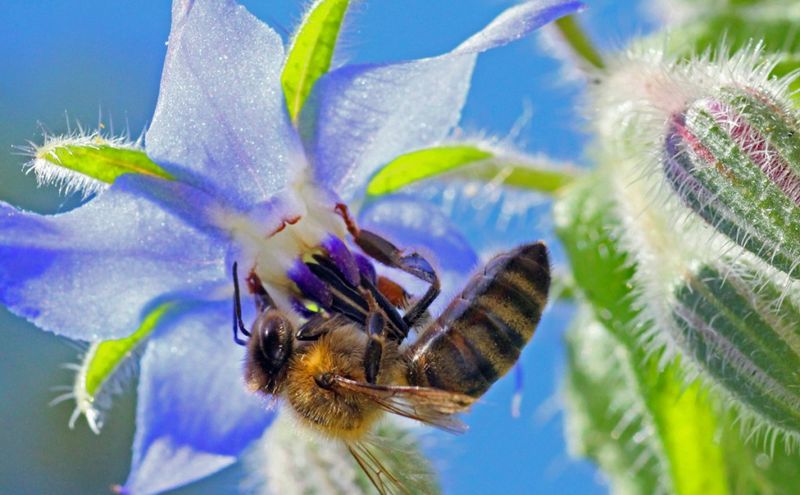
Walk past a blooming borage plant on a warm morning and you will almost certainly hear it before you see the bees. Honeybees, halictid bees, and bumblebees visit the flowers with notable frequency, drawn by both nectar and pollen.
Research published in a Royal Society study on pollination services documents this consistent visitation pattern, and a separate Oxford University study on bee visitation to borage confirms how reliably the plant draws foragers across multiple bee groups.
For a front-yard gardener, that activity has practical value. Pollinators working borage near a vegetable bed or fruit planting may carry pollen to crops nearby, and visible bee activity makes a yard feel alive in a way that a flat lawn or a bed of evergreen shrubs simply cannot match.
Planting borage where foot traffic passes gives the whole household a close-up look at pollinator behavior that most people rarely see at ground level.
The ecological claim, though, needs a clear boundary. Borage offers floral resources to adult flower visitors, and that is a real contribution.
What it does not provide is the broader habitat complexity that a diverse planting of North Carolina native plants supplies. Native species can serve as host plants for caterpillars, produce seeds and berries that birds and small mammals rely on, offer nesting structure, and support the region-specific food webs that keep local insect populations stable.
The North Carolina Wildlife Federation specifically encourages native plants for these reasons, and NC Wildlife’s suburban backyard guidance makes clear that stabilizing local insect food webs depends on native choices, not imported annuals.
Borage earns its spot as a nectar and pollen source that brings bees to the yard. Treat it as a useful addition to a planting that already includes native species, not as a standalone solution to pollinator habitat loss.
Nearby strawberries may benefit, but the evidence stays narrow
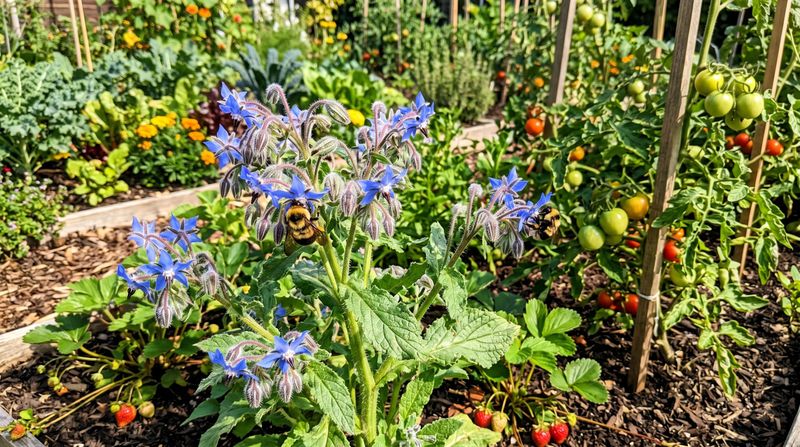
Gardeners who grow strawberries sometimes wonder whether companion plants can nudge a better harvest. Borage has earned attention in that conversation, and there is one peer-reviewed experiment worth knowing about.
A Wiley companion-planting study on borage and strawberries found that strawberries planted directly beside borage produced 35 percent more fruits and 32 percent greater yield by weight compared with strawberry plants positioned three meters away from borage.
Those numbers are specific and meaningful, but so is the context. The experiment was conducted in the United Kingdom under particular soil, climate, and pollinator conditions that do not automatically translate to a North Carolina backyard.
The researchers attributed the difference largely to increased pollinator visitation near borage, which makes sense given how consistently bees work the flowers. However, one study in one location does not establish a dependable outcome across different crops, soils, and pollinator communities.
The honest translation is that borage may improve pollination or fruiting in some crop-and-site combinations, including possibly a strawberry patch in a sunny North Carolina bed with active bee populations. Researchers at the University of Minnesota have also explored borage as a flowering resource meant to draw pollinators near berry crops, as described in their Berries, Bees, and Borage project, and their specialty oilseed and pollen research confirms borage as an abundant pollen source for managed bees.
These are promising signals, not guarantees.
If you already grow strawberries or other small fruits near your front-yard herb bed, placing borage nearby is a reasonable experiment. Expect possible benefit rather than certain improvement, and watch whether local bee activity actually increases near the planting before drawing conclusions about what drove any change in your harvest.
It can handle a sunny, imperfect garden spot
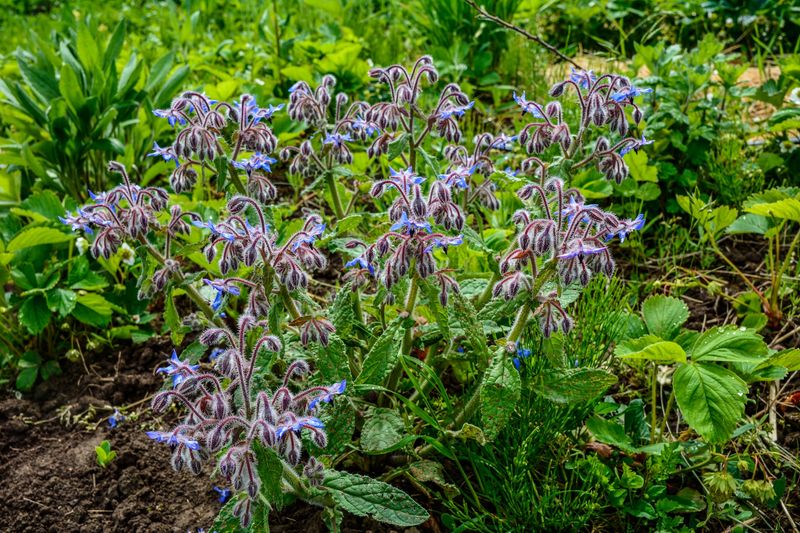
Most front yards have at least one problem spot: a strip along the driveway that bakes all afternoon, a slope where topsoil has thinned, or a bed that gets watered inconsistently. Borage tolerates those conditions better than many ornamentals.
NCSU Extension lists borage for all three North Carolina growing regions, covering the Coastal Plain, Piedmont, and Mountains, and describes the plant as performing best in full sun while tolerating light shade and poor soil. Good drainage is the one condition it genuinely needs.
That combination of regional coverage and site flexibility makes borage a reasonable candidate for beds where a more demanding ornamental might sulk or fail outright. A sunny, well-drained spot with average or even sandy soil is close to ideal.
Standing water or consistently waterlogged ground is a different story: borage will not thrive there, and planting it in poorly drained soil invites root problems rather than solving a difficult spot.
Summer performance is worth thinking about honestly. Research on borage found that increased temperature and water stress altered flower traits and floral rewards, as documented in a peer-reviewed study on temperature and water stress in borage.
That means a North Carolina plant pushing through a dry July heat wave may produce fewer or less attractive flowers than the same plant in cooler, wetter spring weather. Supplemental watering during extended drought can help, but borage during peak summer stress is not the same plant you see in April or September.
Use borage in a spot that drains well and catches most of the day’s sun, and treat its summer performance as variable rather than guaranteed. For the right imperfect bed, it fills a gap that few other easy-to-grow plants can match across all three of North Carolina’s growing regions.
Direct-sow a small patch instead of forcing a transplant

Borage has a taproot that dislikes being moved once it has settled in, which means buying a transplant and shifting it from pot to bed often results in wilting, slow establishment, or outright failure. N.C.
Cooperative Extension’s herb-growing guidance recommends direct-seeding borage for this reason. Pushing seeds into a prepared, well-drained bed and letting them germinate in place sidesteps transplant shock entirely and gives each plant a chance to develop its root system without interruption.
Spacing matters once germination happens. University of Maryland Extension recommends about 12 inches between plants and 18 inches between rows.
In a front-yard pollinator patch or informal border, those spacing guidelines keep plants from crowding each other out while still allowing the bed to fill in with reasonable density by midsummer. Thin seedlings early rather than waiting until plants compete for light and moisture.
Successive sowings at four-week intervals are sometimes mentioned as a way to extend the harvest period for gardeners who want to use borage leaves or flowers in the kitchen. For a front-yard planting focused on appearance and pollinator value, a single well-timed sowing in early spring is usually enough.
Starting with a deliberate, manageable patch, rather than broadcasting seed across a large bed, keeps the experiment contained and makes it easier to assess whether borage suits your particular site before committing more space to it.
Easy sowing does not mean the plant runs itself. You still need to prepare the soil, water seedlings through the first dry stretch, thin to proper spacing, and monitor for powdery mildew as the season progresses.
Treating direct-sowing as the beginning of a low-maintenance plant relationship rather than a hands-off guarantee sets more realistic expectations for what the first season will actually look like.
Reseeding offers convenience and demands control
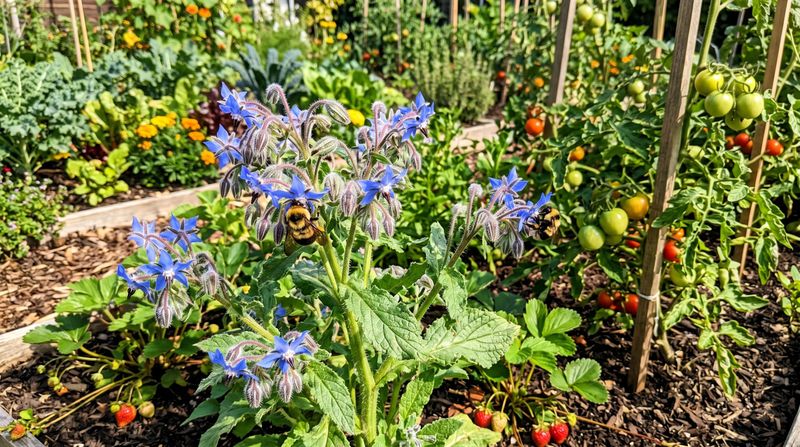
One of borage’s most talked-about traits is its tendency to reseed itself. Mature plants drop seeds freely, and in a favorable spot those seeds can produce a new generation the following season without any effort from the gardener.
For an informal bed or a pollinator patch where some year-to-year variation is welcome, that self-seeding habit reduces the need to purchase or sow new seed each spring.
The trade-off is real, though. Reseeding does not guarantee that borage will return in a given location.
Winter conditions, summer drought, soil disturbance, and routine bed cleanup all affect whether volunteer plants appear and where they land. NCSU Extension and University of Maryland Extension both document the self-seeding behavior without framing it as a reliable annual return.
Some years you get a flush of volunteers; other years the spot stays bare and you start from seed again.
Volunteer seedlings also do not always land where you want them. A borage plant that reseeds into a path, crowds a shorter perennial, or pops up at the front edge of a bed where taller plants belong can create more work than it saves.
Removing spent flowers before seed drop is the simplest way to limit where volunteers appear, and pulling unwanted seedlings while they are small takes far less effort than relocating a plant that has already set its taproot.
The practical rule: let borage reseed in the parts of the bed where looseness is acceptable, and deadhead consistently in areas where you want a cleaner design. Treating self-seeding as a tool you manage rather than a feature that manages itself keeps the front yard looking intentional rather than accidental.
Pair the nonnative annual with stronger native habitat
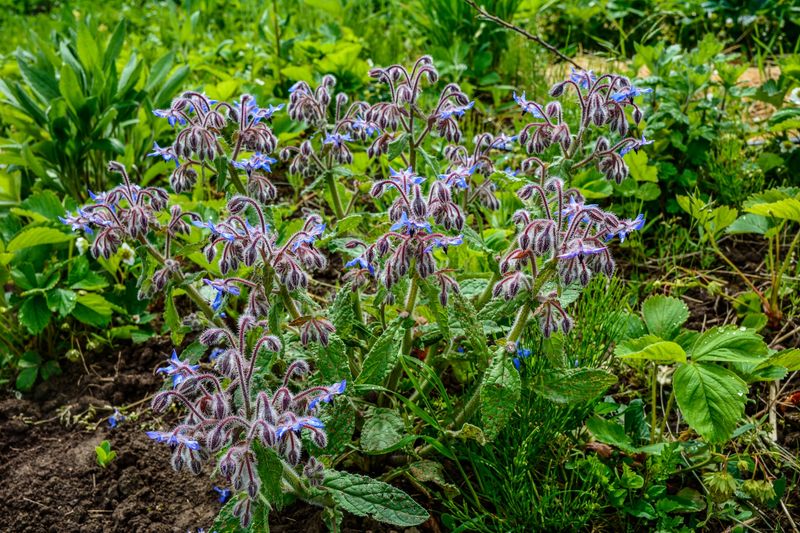
Borage originates from the Mediterranean region. That origin matters when considering its role in a North Carolina front yard, because a nonnative annual does not carry the ecological relationships that native plants have built with local insects, birds, and other wildlife over thousands of years.
Placing borage in a bed already anchored by native species is a very different decision from replacing native plants with borage, and the distinction is worth keeping clear before the first seed goes in.
The North Carolina Wildlife Federation’s native pollinator plant guidance and the broader NC Wildlife Federation pollinator resources both make the case for native plants as the foundation of a functioning yard habitat. NC Wildlife’s suburban backyard guidance reinforces that native choices stabilize local insect food webs in ways that a single nonnative annual simply cannot replicate.
On the spread question, EDDMapS records borage as introduced across parts of the United States. Borage does not currently appear on North Carolina’s regulated noxious-weed list, but absence from that list does not make the plant native, harmless, or guaranteed to stay tidy in every yard.
Monitoring self-seeding and removing unwanted volunteers remains the gardener’s responsibility.
On deer and rabbit pressure, NCSU Extension lists borage as resistant to both, and Ask Extension’s deer-resistance guidance notes that hungry animals will sometimes eat plants they normally avoid. Treat resistance as a useful tendency rather than a reliable fence.
The strongest front-yard planting uses borage as a seasonal accent within a bed that is mostly native, not as a substitute for the habitat complexity that native plants provide.
Plant it only when the household and maintenance plan fit
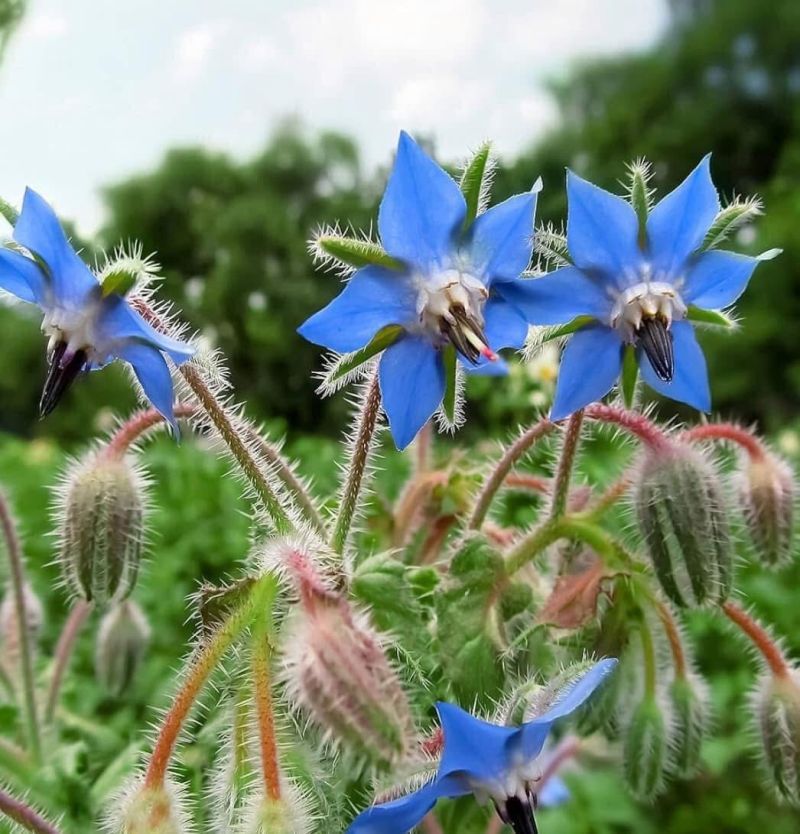
Before borage goes in the ground, two household questions deserve a straight answer: Are there pets who chew garden plants? And is there a realistic plan for midsummer upkeep?
ASPCA lists borage as toxic to dogs, cats, and horses, with possible vomiting, diarrhea, and dermatitis reported after exposure. A front yard where dogs roam freely or cats browse low plantings is not the right setting for borage.
If ingestion occurs, contact a veterinarian or an appropriate poison-control service right away rather than waiting to see whether symptoms develop.
The edibility question for people also needs careful framing. NCSU Extension describes borage leaves and flowers as edible but notes that they should be used sparingly because liver damage can occur.
UK government plant-toxin guidance advises against borage-leaf infusions specifically because they can contain high levels of pyrrolizidine alkaloids, compounds linked to liver damage and possible carcinogenicity. A 2025 Food Control study on pyrrolizidine alkaloids in borage found substantial variability in alkaloid levels across leaves, flowers, and microgreens.
Routine consumption, borage-leaf tea, and home-produced borage seed oil are not recommendations supported by current safety evidence.
On the maintenance side, cutting the plant back by half in midsummer can encourage fresh growth for fall, and powdery mildew may appear as the season warms. Neither issue is catastrophic, but both require attention.
Heat and water stress can also reduce or alter floral rewards, as the temperature and water stress research on borage documents, so a plant that looked spectacular in May may need supplemental watering to stay presentable in August.
When pollinators are actively working the flowers, avoid routine insecticide applications on or near blooming plants. N.C.
State Extension’s bee and pesticide guidance and N.C. Cooperative Extension’s pollinator planting advice both recommend applying any necessary insecticides only when pollinators are less active, keeping product away from open flowers, and following EPA pesticide label directions exactly.
The verdict: borage works best as a small, sunny, monitored accent planted alongside native habitat plants in a yard where pets cannot reach it and where midsummer attention is genuinely available. Where those conditions do not fit, a native alternative will serve the yard, the wildlife, and the household more reliably.