
Blueberry bushes are patient plants, but years of skipped pruning can slowly work against them. An overcrowded, aging bush does not suddenly quit producing, but it can drift toward smaller berries, weaker growth, and a tangled canopy that gets harder to manage every season.
For North Carolina homeowners with mature rabbiteye or highbush plants, late-winter selective pruning is the corrective that puts the bush back on track. Understanding exactly what to cut, what to keep, and when to do it makes all the difference.
What late-winter pruning can—and cannot—fix
Skipping one late-winter pruning will not cause a blueberry bush to stop fruiting overnight. Blueberries are resilient, and a single missed season rarely produces a dramatic result.
What happens instead is more gradual: over several years without any renewal work, a bush can become overcrowded, push out weaker new growth, and shift toward producing smaller or lower-quality fruit rather than shutting down entirely.
NC State Extension’s small fruits guidance notes that unpruned blueberry bushes eventually become less productive and produce smaller, less flavorful berries. The problem is not a sudden collapse but a slow drift toward a congested canopy where light cannot reach interior fruiting wood and where older, less productive canes crowd out younger replacements.
Selective dormant-season renewal pruning is the appropriate response for an aging or congested plant. The goal is to remove specific canes and weak wood while preserving the bush’s productive structure.
That is a different job from shearing the top of the plant, cutting the whole bush to the ground, or removing every gray-looking cane in sight.
Shearing only the upper growth does not replace aging framework wood at the base. Cutting the entire bush down eliminates the current year’s crop and can be unnecessarily harsh on a plant that simply needs selective thinning.
Removing every old cane at once risks leaving the plant without enough established wood to support a balanced recovery, especially if vigorous young replacement canes are scarce.
Renewal pruning, done carefully and spread across several seasons, gives the bush a better age structure, improved light penetration, and stronger young canes to carry future crops. Penn State Extension recommends gradual renewal when preserving the coming crop matters, rather than severe renovation that sacrifices a full season’s harvest.
Read the bush before choosing a cut
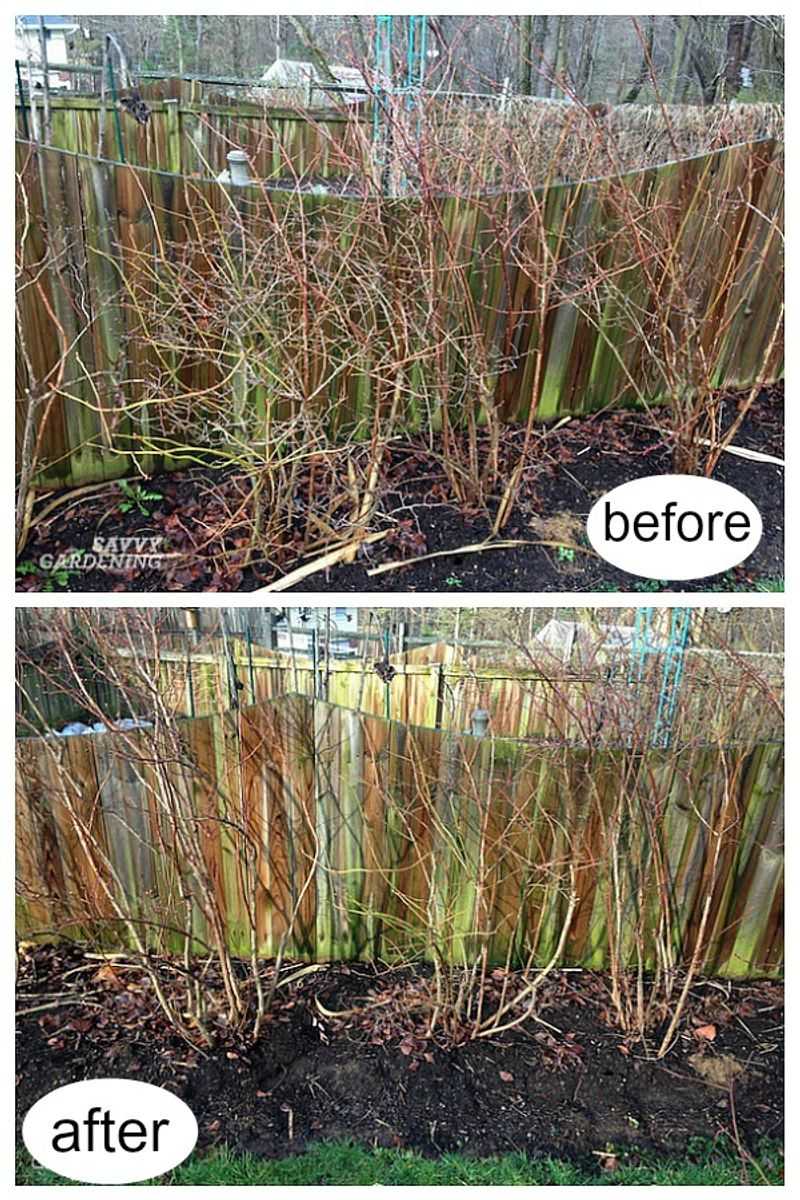
Before any pruning tool touches the plant, spend a few minutes reading the bush from the outside in. Look for how many canes are coming from the base and whether they vary in age and diameter.
A well-managed bush should have a mix of young, smooth-barked canes alongside a few older, thicker ones. A neglected plant often shows a cluster of thick, gray, heavily branched canes in the center with little room for younger growth to develop.
Check for dead or damaged wood first. Dead canes are brittle, have no live buds, and may show discoloration or cracking bark.
Damaged wood from winter cold or physical injury is also easy to spot once you look for it. Next, scan for crossing canes that rub against each other, low branches that would drag on the ground under the weight of a summer fruit load, and any suckers or shoots pushing up outside the main crown.
Then assess the vigor of the new growth the plant produced last season. Are there strong, upright shoots – sometimes called whips or replacement canes – rising from the base or from the lower portions of existing canes?
Or is most of the new growth thin, short, and repeatedly branched? A plant with abundant vigorous young canes can tolerate more aggressive removal of old wood.
University of Maine Cooperative Extension’s highbush blueberry guide points out that a plant with sparse new cane development may need old canes cut back to short stubs rather than removed entirely at the base, because the plant still depends on that older wood for a portion of its canopy.
Pruning intensity should follow what the plant actually shows you. NC State Extension confirms that cultivar, growth habit, age, and plant vigor all affect how much removal is appropriate.
A weak or recently transplanted bush is not a candidate for heavy cane removal. A vigorous, well-established plant with plenty of young replacements is a much better candidate for meaningful renewal work.
Start with cleanup at the base
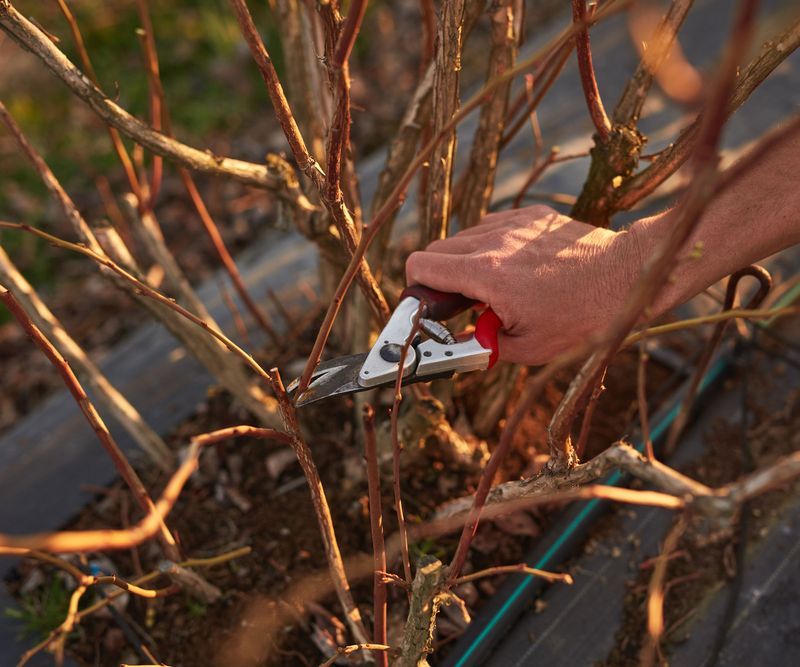
The first pruning pass belongs at ground level, not at the top of the plant. Starting at the base gives you a clearer view of the whole canopy structure and removes the wood that does the most harm to airflow, light penetration, and fruit quality.
Working from the bottom up also prevents the common mistake of shortening the tallest shoots first and then realizing the center of the bush is still a tangled mess.
Remove dead, diseased, and broken canes first. Dead wood is easy to confirm by scratching the bark lightly; living tissue shows green underneath, while dead tissue is brown or tan all the way through.
Diseased wood often shows discoloration, cankers, or unusual lesions. Get these out of the plant entirely and dispose of them away from the garden rather than leaving them in the mulch.
Next, cut out any crossing canes that press against or rub other canes. Rubbing creates wounds that invite disease.
Then remove low branches – those that angle outward and downward enough that they would rest on the ground once a full crop of berries weighs them down. Fruit sitting on the soil invites rot and pest pressure, so removing these branches early is a practical investment.
Pull out or cut back suckers and shoots emerging outside the main crown. These can drain the plant’s energy and expand the footprint of the bush in ways that compete with nearby plants or make mowing difficult.
Keeping the crown tidy at its base also makes it easier to spot new replacement canes rising from the right locations in future seasons.
NC State Extension’s guidance recommends making clean cuts at the base without leaving stubs, and notes that pruning cuts on blueberries do not need wound dressing or sealant. A clean cut heals more reliably than a ragged stub, which can become a site for disease entry.
After this first pass, step back and look at the plant again before moving on to cane renewal.
Renew rabbiteye and highbush plants differently
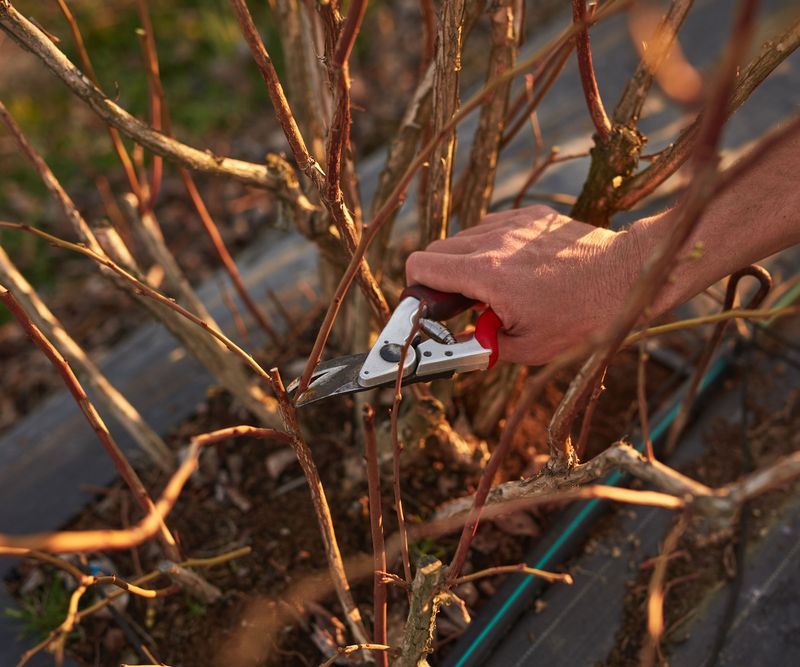
Once the cleanup pass is done, the framework-renewal decision comes next, and the right approach depends on which type of blueberry you are managing. North Carolina grows highbush, southern highbush, and rabbiteye blueberries, and their pruning needs are meaningfully different.
Rabbiteyes dominate much of the Piedmont and Coastal Plain; highbush types are better adapted to many mountain sites and some coastal locations. Treating them the same way leads to either under-pruning one or over-pruning the other.
For mature rabbiteye plants, University of Georgia Cooperative Extension’s home garden blueberry guide recommends removing one to three of the largest, oldest, least productive central canes each winter – roughly 20% of the canopy – as a way to renew the bush gradually over approximately five years. The canes to target are the thickest, grayest ones near the center of the plant, where heavy branching has accumulated over many seasons and where light no longer reaches the interior well.
Cutting these at or near the base opens the canopy and makes room for younger replacement canes to develop into the plant’s next productive framework.
Rabbiteyes can grow quite tall, and some canes may also need to be reduced in height if they have extended well beyond a manageable reach. However, height reduction alone is not renewal; the cane-removal step is what actually improves the plant’s age structure.
Highbush pruning is more conditional. NC State Extension recommends removing old wood from highbush plants while retaining vigorous younger canes.
Highbush plants also benefit from thinning short, congested laterals and, when overcropping is a concern, from reducing the flower-bud load – sometimes by as much as 50% on mature plants. The specifics depend on the cultivar, the plant’s current condition, and how heavily it has been managed in prior years.
No fixed cane count applies to every plant regardless of type. A vigorous rabbiteye with seven or eight strong replacement canes can handle removing two or three old ones comfortably.
A plant with only sparse young growth needs a more conservative approach: retain more old wood, or cut some of it back to shorter stubs rather than removing it entirely at the base.
Thin weak wood without cutting away next year’s berries
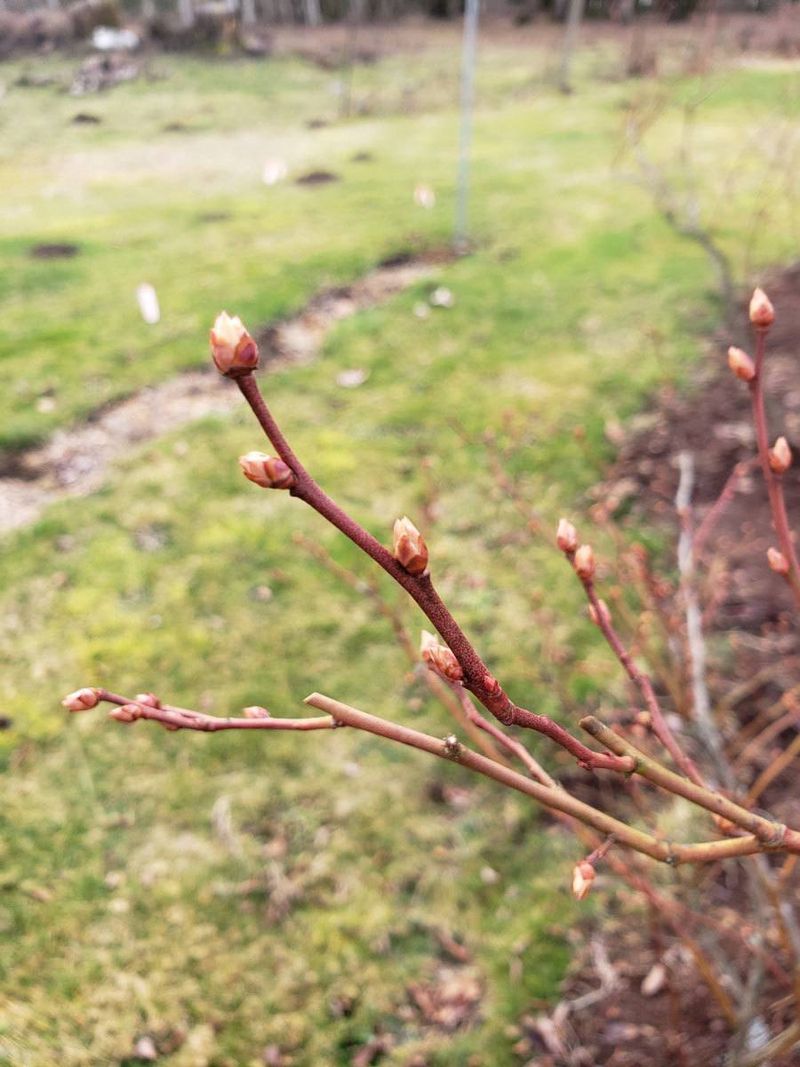
After the major cane decisions are made, attention shifts to the smaller wood inside the canopy. Blueberries produce most of their fruit on one-year-old wood, specifically on the lateral shoots that developed during last season’s growth.
Those laterals carry the flower buds that will open in spring and set the coming crop. Cutting them indiscriminately is one of the most common pruning mistakes backyard growers make.
Flower buds and vegetative buds look different, and learning to tell them apart protects the harvest. UGA Extension’s guide to blueberry bud phenology explains that flower buds are plumper, rounder, and larger than the smaller, more pointed vegetative buds that will produce leaves and new shoot growth.
When you shorten a lateral without checking the bud type, you may be cutting off a cluster of plump flower buds that would have become berries.
The wood worth removing is the dense, short, repeatedly branched material that NC State Extension describes as matchstick-sized laterals. These thin shoots can carry fruit, but they tend to produce small berries and add excessive crop load without contributing much supporting vegetative growth.
Removing a portion of this congested weak wood concentrates the plant’s energy on stronger laterals that are more likely to produce larger, better-quality fruit.
The approach here is selective, not wholesale. Look for clusters of thin, repeatedly forked shoots where the branching has gotten so dense that light cannot reach the interior.
Remove the weakest and most congested of these while leaving the stronger, better-positioned laterals intact. A lateral that grew six to twelve inches last season and carries well-spaced, plump buds is worth keeping.
A short, thin shoot with crowded buds and little room to develop is a candidate for removal.
Heading cuts – shortening the tips of otherwise healthy fruiting shoots – should be used sparingly. Cutting back an excessively long shoot that carries too much fruiting wood in one location can make sense, but heading every fruiting branch as a routine step strips the plant of useful one-year wood and reduces the coming crop without the structural benefit that base-level cane removal provides.
Choose the North Carolina timing window
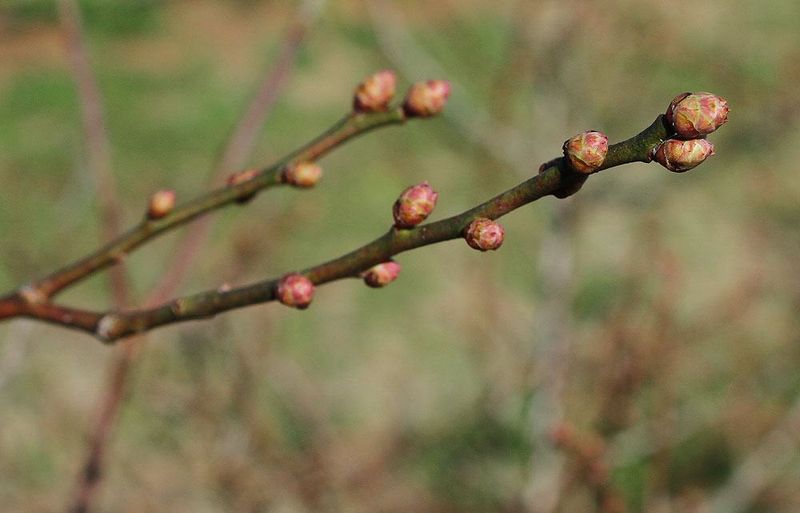
Timing matters as much as technique. Prune blueberries while they are still fully dormant, after the coldest part of winter has passed but before substantial spring growth begins.
Cutting too early in winter can expose fresh wounds and any growth those cuts stimulate to additional cold injury, which is a real concern in the North Carolina mountains and in years with unpredictable late freezes in the Piedmont.
NC State Extension’s blueberry production guide identifies late winter as the desirable pruning window, with February to early March serving as a practical starting reference for many parts of the state. That range is a guide, not a statewide rule.
A homeowner in the mountains near Boone should wait longer into late winter than someone in the Coastal Plain near Wilmington, where temperatures moderate earlier and spring growth often begins sooner.
NC Cooperative Extension’s Yadkin County office reinforces that pruning during dormancy, once the harshest cold has passed, gives the plant the best combination of wound healing and minimal risk from cold injury on freshly cut tissue. Watching the buds helps: if they are still tight and fully dormant, conditions are usually still good for pruning.
Once buds begin to swell noticeably and show color, the window is narrowing.
Fall pruning is a different matter and generally should be avoided for ordinary home blueberry bushes in North Carolina. Cutting in fall can push new growth that has little time to harden before winter, leaving tender tissue vulnerable to cold damage.
NC State Extension recommends late winter rather than fall for home plantings. Stick to the dormant late-winter window and adjust by a few weeks based on your location in the state and what the weather has actually done that year.
Balance the crop as well as the canopy
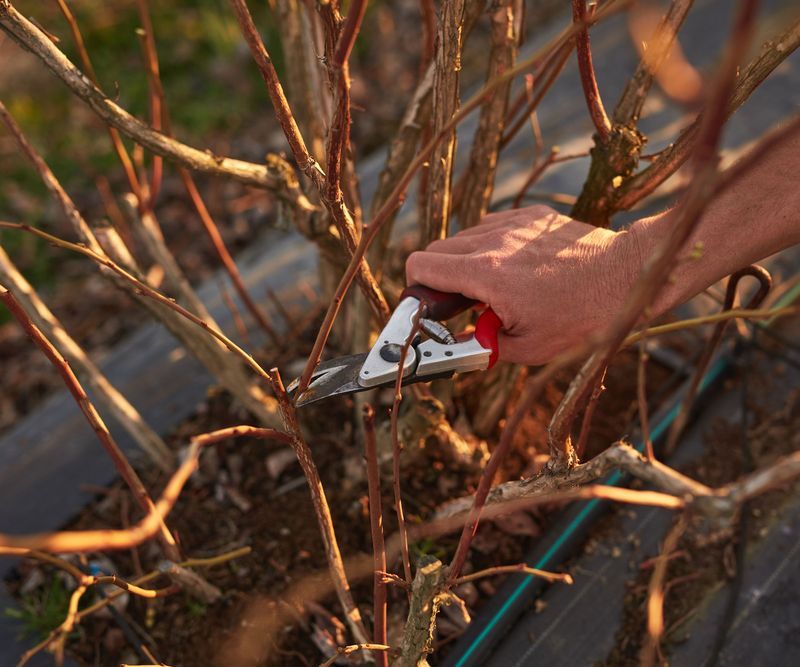
Once cane removal and lateral thinning are done, take a final look at the overall flower-bud load before putting the tools away. A bush that still carries an enormous number of plump buds after structural pruning may be set up to overcrop, which stresses the plant, drains its reserves, and often produces a heavy load of small, mediocre berries rather than a moderate crop of larger, better-tasting ones.
NC State Extension advises that proper winter pruning should remove at least one-third of the flower buds as part of the overall process. For mature highbush plants where overcropping is a concern, the recommendation goes further: reducing the flower-bud load by roughly 50% can improve berry size, fruit quality, and the plant’s ability to produce strong new growth for the following season.
That is not a loss – it is a trade of quantity for quality and long-term plant health.
This does not mean counting individual buds. It means stepping back after pruning and asking whether the remaining lateral wood still carries an overwhelming density of flower buds.
If the answer is yes, selectively remove a few more of the most congested laterals or thin buds from shoots that are already carrying more than the plant can ripen well.
UGA Cooperative Extension notes that maintaining a reasonable crop load is part of sustaining plant vigor across seasons, not just a single-year concern.
For tools, NC State recommends long-handled loppers for canes that have grown to roughly two inches in diameter and hand pruners for smaller finish cuts and lateral thinning. Make cuts clean and close to the base or parent branch without leaving stubs.
Wound sealants and dressings are unnecessary; NC State’s guidance is clear that blueberry pruning cuts do not require any treatment beyond a clean cut.
Know when pruning is not the whole problem
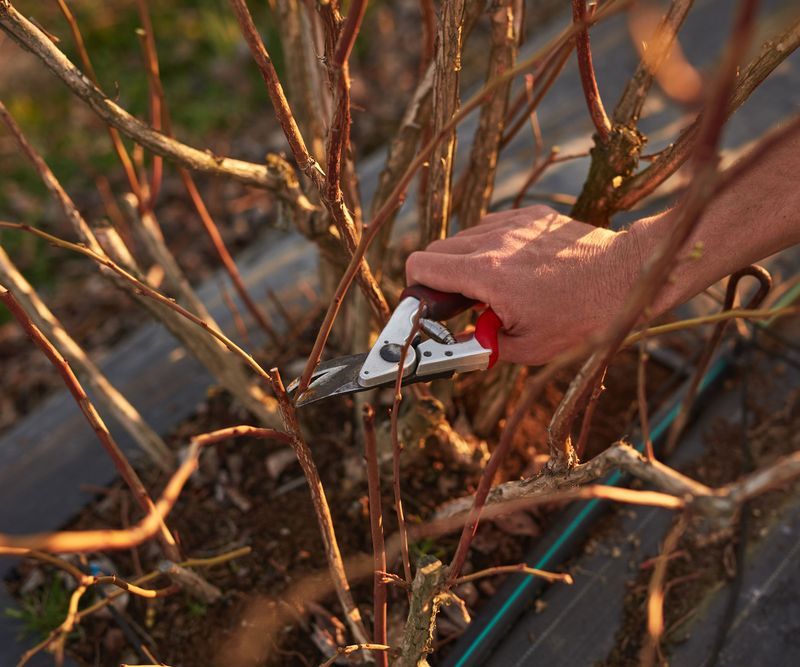
Selective, base-first renewal pruning can improve canopy structure, berry size, fruit quality, and the plant’s capacity to grow productive new wood over time. What it cannot do is guarantee a larger immediate harvest or fix problems that originate somewhere other than the plant’s structure.
Pruning reduces flower-bud load and removes unproductive wood; it does not compensate for poor soil conditions, inadequate sunlight, or missing pollinators.
Newly planted or weak young bushes are a separate case entirely. UGA Cooperative Extension recommends removing flowers or fruit from young plants during their first year so the plant can put energy into root and shoot development rather than carrying a crop it is not yet ready to support.
Weaker young plants may need flower-bud removal for a second season as well. The renewal-pruning approach described in this article is meant for mature, established plants, not for bushes that are still finding their footing.
When poor fruiting or weak growth persists despite appropriate pruning, check the basics. NC State Extension identifies soil pH as a critical factor: blueberries need an acidic pH, typically between 4.5 and 5.5, and a pH even slightly outside that range can limit nutrient uptake and overall plant performance regardless of how well the bush is pruned.
Sunlight matters too – a bush shaded by maturing trees may decline in productivity no matter how carefully it is managed.
Pollination is another common culprit. NC State notes that most blueberry cultivars require insect pollination and that having at least two compatible varieties nearby is important for reliable fruit set in many situations.
A bush pruned perfectly but lacking a compatible pollinizer nearby may still underperform. Spring freezes that damage open flowers, drought stress during fruit development, and fungal diseases like mummy berry can all reduce yields in ways that no amount of pruning will correct.
When the bush looks structurally sound after a good late-winter cleanup and still disappoints at harvest, the answer is usually in the soil, the sky, or the surrounding planting – not in the pruning plan.