
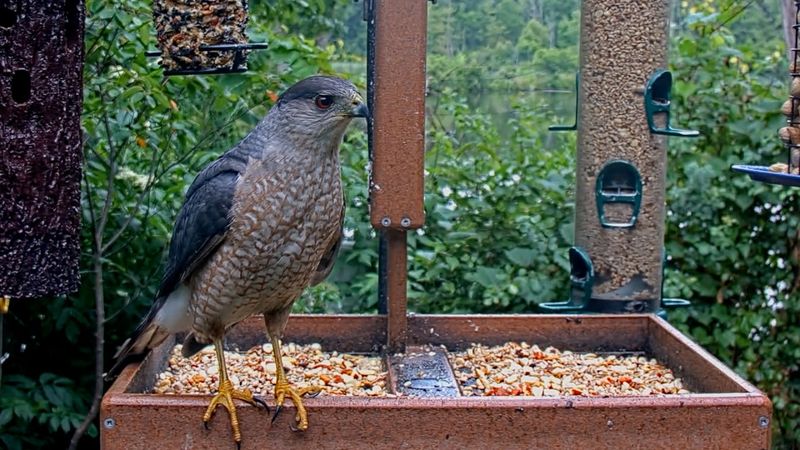
A Cooper’s Hawk dropping into your backyard while you are watching the bird feeder is one of those moments that stops you cold. Most North Carolina homeowners who feed birds eventually see it happen, and the first instinct is to wonder what changed.
The answer is less dramatic than it feels, but it is worth understanding so you can respond in a way that actually helps the birds you care about.
A sudden hawk visit usually points to a concentrated food opportunity
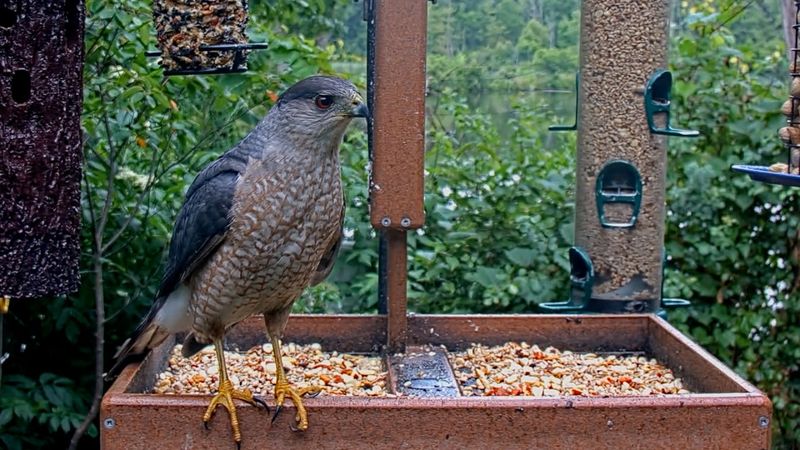
Spotting a Cooper’s Hawk near your feeders feels like an alarm, but the visit usually comes down to something straightforward: your yard is offering a concentrated, predictable supply of bird prey. Feeders pull mourning doves, house sparrows, starlings, and other birds into a tight space on a regular schedule.
Project FeederWatch research on predation at feeders found that hawks were especially drawn to feeders with high bird activity, which makes the logic plain: the seed is not what the hawk wants. The birds gathering around it are.
That framing is the most useful way to read the visit. Your feeder may have created a temporary prey concentration, or it may have made an existing hunting opportunity easier to exploit.
Either way, the hawk is responding to what it can find and catch, not to anything inherently wrong with your yard.
Where the interpretation gets tricky is in assuming too much from a single sighting. One visit does not prove you recently changed the yard, that the hawk has established a permanent territory on your property, or that your feeder has become a problem.
Cornell Lab’s Cooper’s Hawk life history account describes these birds as regular hunters in wooded neighborhoods and suburban areas, so a brief appearance can reflect nothing more than a hawk working its normal range and finding a useful hunting spot that day.
Research linking prey abundance to urban raptor presence, including a published study on prey availability and urbanization in avian predators, supports the idea that concentrated prey matters, but it does not tell you that your specific yard changed in a specific way. The sections that follow explore what may have shifted in the hunting opportunity and what, if anything, you might want to do about it.
The seed is not the target; the birds around it are
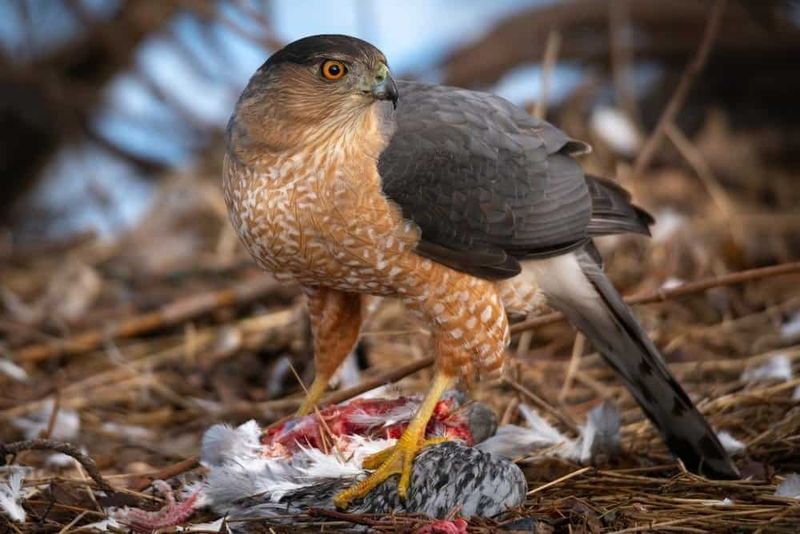
Cooper’s Hawks eat birds. That is not a generalization but a precise description of how they make their living.
Cornell’s life history account for the species lists European Starlings, Mourning Doves, Rock Pigeons, American Robins, jays, and Northern Flickers among their documented prey, covering much of the lineup you would expect to see around a typical North Carolina feeder setup. The hawk is not interested in sunflower seeds or millet.
It is interested in the animals eating those seeds.
The mechanism works like this: every time you fill a feeder, you are reliably gathering prey birds into a small, open area. For a hunting Cooper’s Hawk, that is a meaningful advantage.
U.S. Fish and Wildlife Service guidance on Cooper’s Hawks and feeders makes this connection explicit, noting that feeders indirectly attract hawks by concentrating the birds they hunt.
The feeder does not call the hawk in the way it calls a finch. It just makes the hunting math easier.
Ambush style matters here too. Cooper’s Hawks are built for maneuvering through tight spaces at speed, using cover to get close before a prey bird can react.
Penn State Extension’s guidance on hawks at feeders describes how nearby trees, shrubs, and fences give an accipiter the approach cover it needs to stage a surprise attack. A feeder positioned near dense vegetation or with clear flight lanes may be easier to hunt around, though no single landscape feature guarantees a visit.
Understanding the mechanism matters because it shapes every sensible response. If the hawk is there for the prey birds and not the seed, then the relevant question is whether you want to keep concentrating those birds in that spot at that time, not whether you need to protect the feeder from the hawk itself.
Why the pattern can change from one week to the next
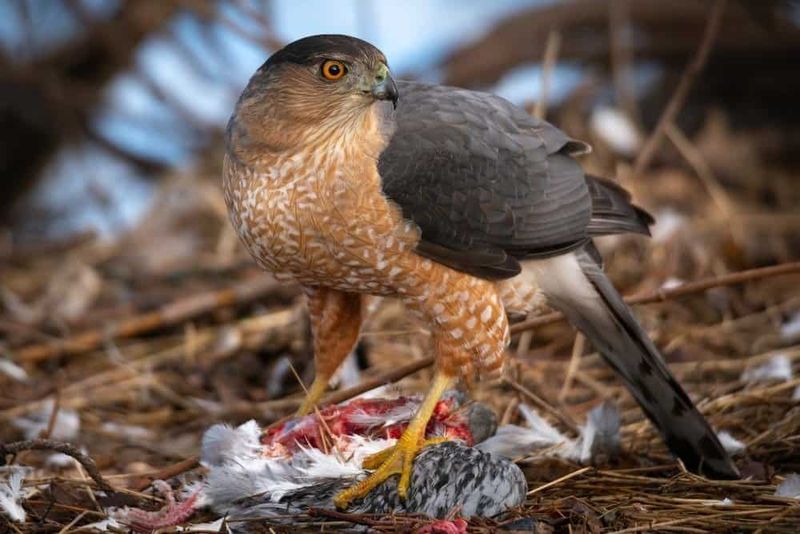
Hawks do not follow fixed schedules, and a bird that shows up every morning for two weeks may vanish just as quickly. Several things can shift the pattern, and most of them have nothing to do with decisions you made in the yard.
Understanding the range of possibilities keeps you from reading too much into either the arrival or the disappearance.
Seasonal movement is one of the most common drivers. Cornell’s Cooper’s Hawk range map shows that the species occurs across North Carolina in both breeding and wintering seasons, with some birds resident year-round and others moving through.
A hawk that appears in late fall or early spring may simply be passing through on a broader circuit rather than settling in.
Juvenile dispersal adds another layer. Young Cooper’s Hawks leave their natal territories in late summer and fall, and newly independent birds exploring unfamiliar areas can turn up almost anywhere.
They are often less experienced hunters, which means they may attempt feeders more boldly and less successfully than adults before moving on. Research on prey abundance and urbanization in avian predators supports the broader pattern that raptors respond to prey concentration in suburban environments, but individual birds vary widely in how long they stay.
Feeder traffic itself can shift week to week. A cold snap that drives more birds to your yard, a neighbor who stops feeding, or a flock of starlings moving through the area can all temporarily increase the prey density at your feeders and make them a more attractive hunting ground.
Weather that limits hunting elsewhere – heavy rain, ice, or strong wind – can also push a hawk toward an easier, more reliable target.
Cornell Lab’s article on seeing more hawks in yards notes that Cooper’s Hawks have become increasingly common in suburban and urban areas over recent decades, so a visit that feels sudden may simply reflect a population that is more present in residential neighborhoods than it used to be. Local habitat and seasonal conditions vary across North Carolina, so the timing and frequency of hawk appearances at feeders will differ depending on where you live in the state, but a new sighting is rarely evidence of an ecological problem or the start of a permanent resident.
A U.S. government regional species account for Cooper’s Hawks in the Southeast confirms the species’ presence across the region in multiple seasons, reinforcing that a visit at almost any time of year is within normal range for North Carolina.
Before interpreting the visit, confirm which hawk you saw
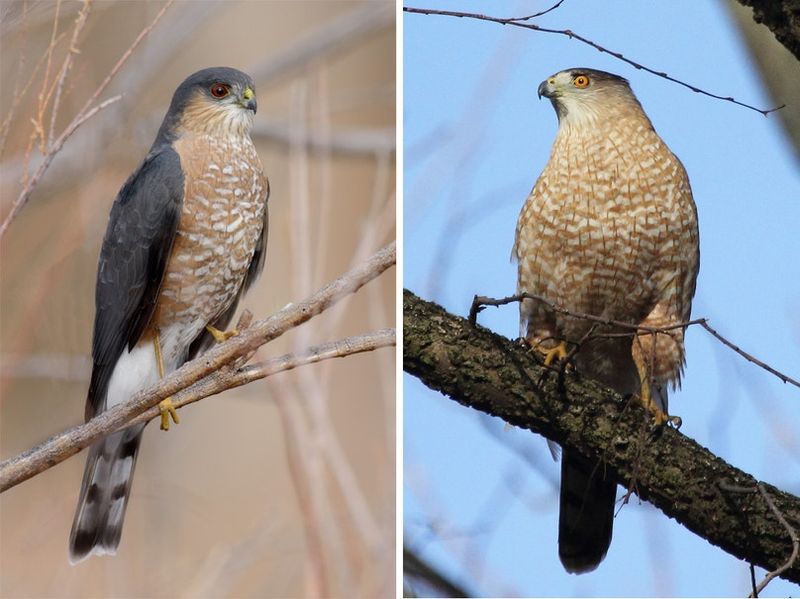
Most of the conclusions people draw after a hawk appears at the feeder rest on an identification that happened in a few seconds through a window. That is a real limitation, because Cooper’s Hawks and Sharp-shinned Hawks look strikingly similar, hunt in the same places, and both show up at feeders.
Before deciding what the visit means for your yard, it helps to know which bird you actually saw.
The two most reliable field marks are size and tail shape. A Cooper’s Hawk is generally larger, closer to the size of a crow, with a head that projects noticeably in front of the wings in flight, giving it a flying-cross silhouette.
Audubon’s guide to telling Cooper’s and Sharp-shinned Hawks apart points to tail shape as one of the most useful clues: Cooper’s Hawks typically show a rounded tail tip, while Sharp-shinned Hawks have a squared or notched tail. The Sharp-shinned Hawk is smaller, roughly the size of a jay, with a smaller, less projecting head.
Cornell’s life history for the Cooper’s Hawk acknowledges that even experienced observers regularly misidentify these two species, especially when sightings are brief, the bird is backlit, or it moves through quickly without offering a clean perch view. Juvenile plumage adds more overlap, and size can be misleading when you have no reference object for scale.
The practical implication is simple: hold your interpretation loosely until you have a solid look. If you saw a fast-moving accipiter for three seconds between the fence and the feeder, you may not know which species it was, and that is fine.
What matters is not letting an uncertain identification drive a story about yard changes, prey populations, or long-term hawk residency that the evidence cannot support.
What the hawk does—and does not—say about your yard
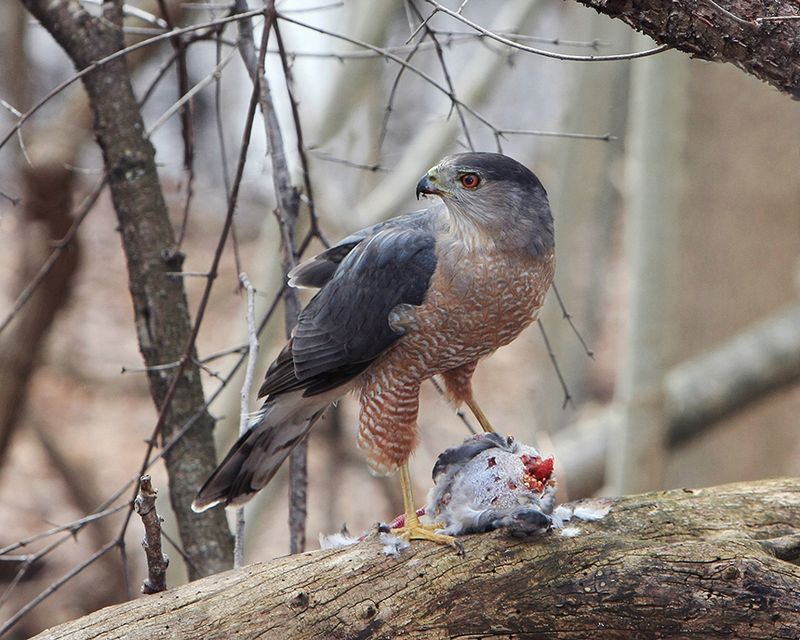
A hawk hunting at your feeder is a predator-prey interaction, not a report card on your yard’s health. The visit does not mean the yard is damaged, that your feeding setup is irresponsible, or that local songbirds are declining.
One observation cannot measure population health, and the presence of a hunting hawk does not tell you whether the birds visiting your feeder are thriving or struggling at a broader scale.
Project FeederWatch’s research on predation at feeders found that the overall feeding environment does not necessarily expose birds to greater predation risk than they face without feeders. Hawks hunt in natural settings too, and prey birds that visit feeders are not automatically at higher risk than birds foraging elsewhere.
The feeder concentrates them, but it also gives them access to food that supports their condition through winter.
Cornell Lab’s summary of 30 years of Project FeederWatch data notes that many prey populations have remained stable even as Cooper’s Hawk observations at feeders have increased, which challenges the assumption that more hawk visits equal more songbird trouble. A hawk appearing more often at your feeder says something about the hawk’s hunting behavior and the prey concentration at that spot.
It does not confirm a trend in your local bird population.
One claim worth correcting directly: a Cooper’s Hawk will not reduce your tick load, control mosquitoes, or keep rodents out of the garden. Cornell’s Cooper’s Hawk life history is clear that birds are this species’ principal food.
Unlike opossums or bats, Cooper’s Hawks are not providing a meaningful service against the insects and small mammals that concern most North Carolina homeowners. Appreciating the hawk for what it is, a skilled bird hunter moving through a suburban landscape, is more accurate than assigning it a pest-control role it does not fill.
The practical takeaway from Penn State Extension’s feeder guidance is that supporting feeder birds and accepting normal predator-prey interactions can coexist. A hawk eating a sparrow in your yard is not a failure of the yard.
It is the yard functioning as part of a larger ecosystem.
If hunting repeats, pause feeding instead of removing the hawk
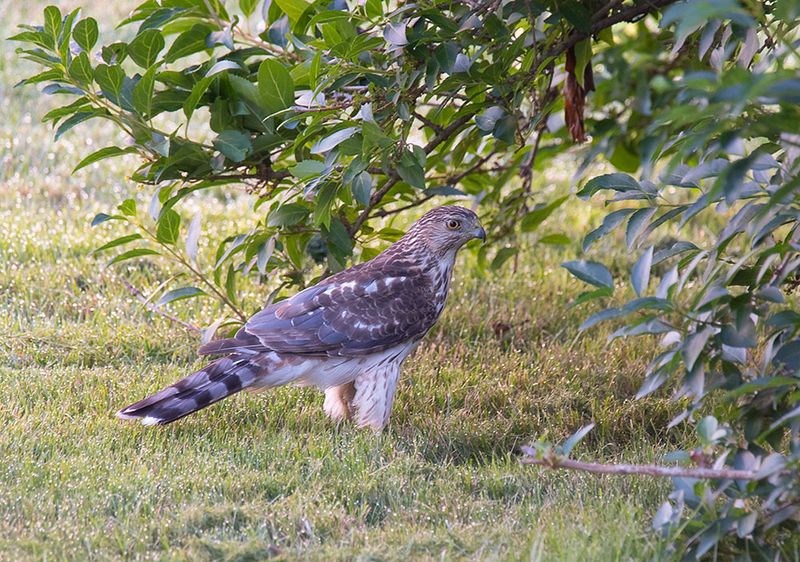
When a Cooper’s Hawk visits once and moves on, no action is needed. Watching a hawk perch, hunt, or eat naturally is not a problem that requires a solution.
The question of whether to respond only becomes relevant when the hawk is returning repeatedly and the repeated hunting is causing distress, visible injuries among feeder birds, or disease concerns that make continuing to concentrate birds in one spot a bad idea.
The most proportionate response is a temporary feeding pause. Penn State Extension recommends taking feeders down or leaving them unfilled for several days when a hawk is repeatedly hunting the feeder area.
Cornell Lab’s guidance on hawks in yards suggests leaving feeders down for a couple of weeks if necessary, then reassessing once the hawk has stopped making regular hunting visits. Removing the prey concentration removes the reason for the hawk to return to that specific spot.
Cornell Cooperative Extension’s guide on bird feeder pests and predators supports the same approach, framing a temporary pause as a management choice rather than a permanent solution. After a break of several days to two weeks, you can reinstall feeders and see whether the hawk has moved on.
Dense shrubs or escape trees near the feeder may give smaller birds a place to flee during an attack. Audubon recommends placing escape cover, such as shrubs or brush piles, within roughly 15 to 20 feet of feeders as a way to give feeder birds more options.
This is habitat support, not a guarantee that predation will stop, but it can tilt the odds slightly in favor of smaller birds.
Regular feeder hygiene also matters independent of the hawk. Cornell recommends cleaning seed feeders about every two weeks, more often during heavy use or wet weather.
Removing spilled or spoiled seed reduces disease risk, including Salmonella, which CDC outbreak records have linked to wild songbirds at feeders. A sick or lethargic bird at the feeder is easier for a hawk to catch, so clean feeders support the birds you want to protect.
One thing homeowners should not do is attempt to remove the hawk themselves. Cooper’s Hawks are protected migratory birds under federal law.
Federal regulations list Cooper’s Hawks among protected migratory species, and additional federal rules govern the possession and handling of raptors. Capturing, harassing, killing, or relocating the hawk is not a legal option for homeowners without applicable federal authorization.
The practical choice is always about managing the feeder and the habitat, not intervening against the bird itself.
Read the signal, then let the yard settle
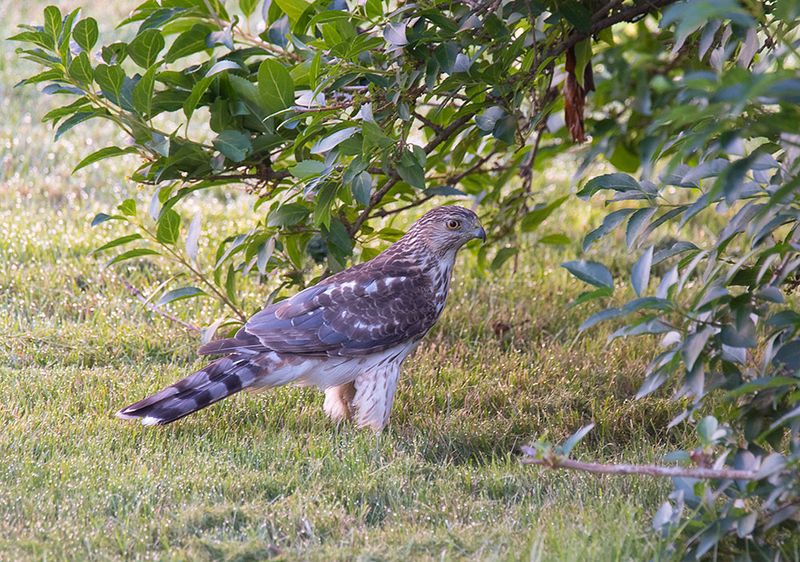
A Cooper’s Hawk appearing at your feeder is carrying a simple message: feeder birds have become findable at that spot, at that moment. That is worth knowing, but it is not a verdict on your yard, your choices as a bird feeder, or the health of your local bird community.
Reading the signal accurately means holding that interpretation without inflating it.
The practical decision tree is straightforward. If the visit was occasional and you can tolerate watching predator-prey interactions, keep feeding and let the hawk work its normal range.
Penn State Extension is direct on this point: homeowners do not need to intervene when a hawk is simply perching, hunting, or eating naturally. The yard is doing what yards do when they support wildlife.
If repeated hunting is causing real concern, whether from visible injuries, disease pressure, or your own comfort level, a temporary feeding pause is the most supported response. FeederWatch research reinforces that feeders are not inherently dangerous places for birds, and pausing is a reset, not a permanent shutdown.
Reinstall after a week or two and see whether the pattern holds.
The hawk is not a problem to solve. Cornell’s Cooper’s Hawk account describes a bird that has adapted well to suburban landscapes across North America, finding prey where people have inadvertently concentrated it.
Your feeders are part of that landscape now, and the hawk is reading the same signals you are. The more useful habit is directing your attention toward feeder hygiene, escape cover, and informed management choices rather than toward the hawk itself.
A yard that supports songbirds well enough to attract a hunting accipiter is, by any reasonable measure, doing something right.