
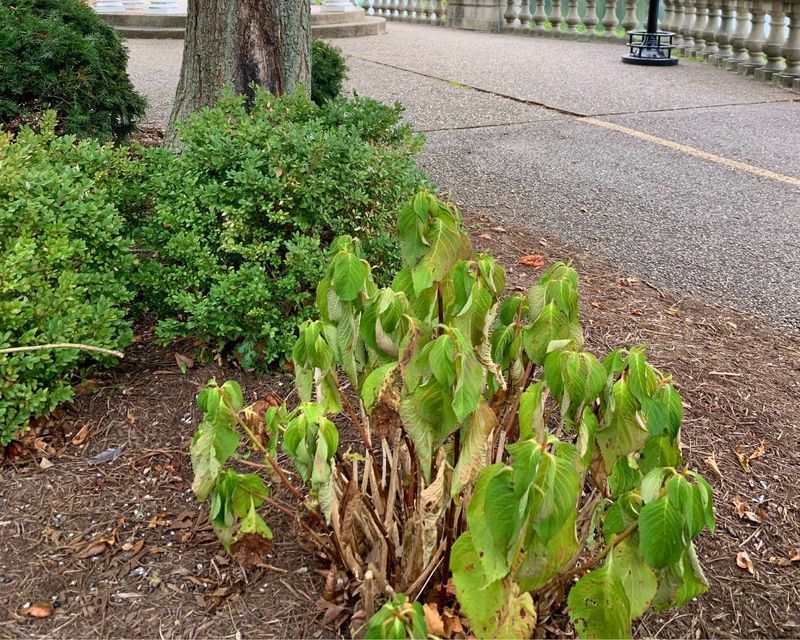
Watching a hydrangea droop in the afternoon heat is one of those moments that makes every Southern gardener reach for the hose. But more water is not always the right answer, and sometimes it can make things worse.
Understanding what is actually happening inside the plant and below the soil can save your shrub and spare you a lot of guesswork.
Morning recovery offers a clue, not a diagnosis
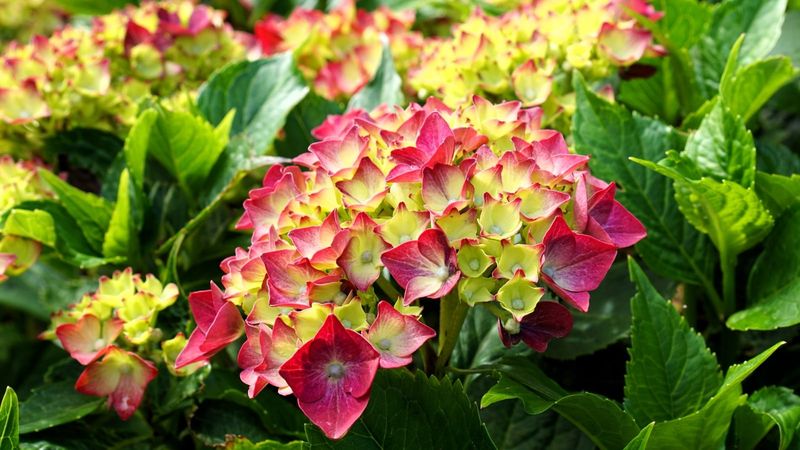
Walk out to your hydrangea first thing in the morning before the heat builds, and take a good look. If the leaves that drooped dramatically by mid-afternoon are now standing upright again, that overnight recovery is a useful clue.
UGA Extension guidance on landscape watering notes that plants can lose water through their leaves faster than roots can replace it during hot, dry, or windy weather, and bigleaf hydrangeas are especially prone to this pattern because of their large leaf surface area.
Recovery by morning suggests heat stress may be involved, but it does not rule out an underlying site or root-zone issue. A plant can bounce back overnight and still be dealing with shallow roots, poor drainage, or a location that puts it under more heat stress than it can comfortably handle day after day.
The contrast that matters most is between temporary afternoon flagging and wilt that stays through the night. Illinois Extension’s overview of heat stress in plants describes how afternoon drooping that resolves by the next morning can reflect temporary transpiration imbalance rather than a water deficit at the roots.
If the leaves are still limp when you check before sunrise, that is the signal to inspect the soil and consider whether drainage, root health, or something else is contributing.
Shallow watering can worsen recurring afternoon stress
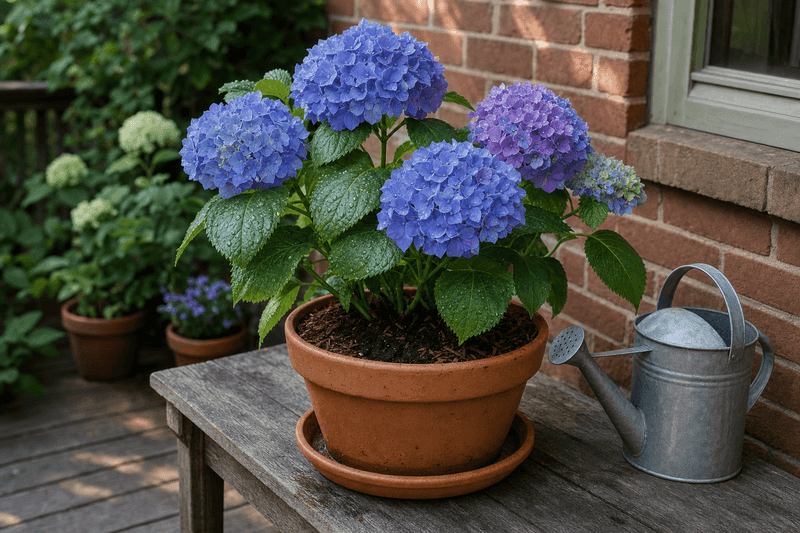
Plenty of gardeners water their hydrangeas faithfully every day or let an irrigation timer run on a fixed schedule, and still find the plants drooping by 2 p.m. The habit that quietly compounds the problem is watering lightly and frequently without ever checking whether the moisture is actually reaching the root zone.
UGA Extension’s Best Management Practices in the Landscape points out that shallow, frequent irrigation can encourage roots to stay near the surface, where soil dries out fastest during hot afternoons.
A timer set to run for a few minutes each morning may wet the top inch of soil without ever moistening the deeper zone where established roots need to draw water. Over weeks and months, the root system can become concentrated near the surface, making the plant progressively more vulnerable to afternoon heat stress even when the garden looks well-watered from the outside.
That said, frequent watering is not always wrong. Penn State Extension guidance on planting ornamentals recognizes that new transplants, container-grown shrubs, and plants in very sandy soils often need more frequent monitoring and irrigation during establishment, especially through their first growing season.
The concern is routine shallow watering applied without checking conditions, not careful frequent watering adjusted to actual root-zone moisture.
Check several inches down before watering
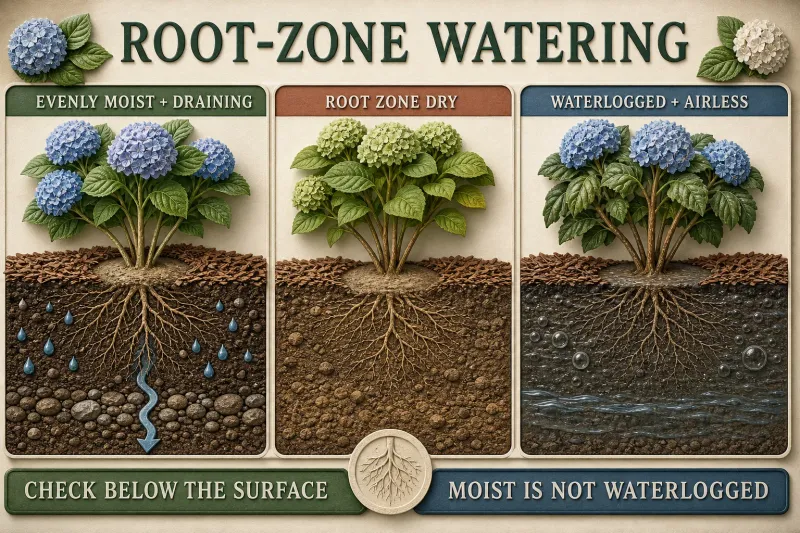
Surface soil is a poor guide to what is happening where roots actually live. After a quick sprinkle, the top layer can feel damp while the soil four to six inches down remains powder-dry.
The opposite is also true: the surface can dry and look dusty within hours of a thorough soaking while adequate moisture still exists below.
UGA Extension’s Goldilocks Dilemma guide on landscape watering recommends checking approximately 4 to 6 inches below the surface before deciding whether to irrigate established landscape plants. A finger, a wooden dowel, or a simple soil probe pushed into the ground near the root zone gives a far more reliable reading than a glance at the surface or a look at a drooping leaf in the afternoon heat.
For an established hydrangea, water when the root zone at that depth feels genuinely dry, and hold off when it still feels moist. Containers and newly planted shrubs are a different story: their confined or limited root systems can dry out much faster than an established in-ground plant, so they may need more frequent checks.
Sandy soils common in parts of Florida dry more quickly than clay or loam, and recent rainfall, mulch depth, drainage quality, and root size all affect how often the check is needed. The goal is to make the decision based on actual conditions rather than a fixed calendar or the appearance of the leaves alone.
Water slowly enough to wet the main root zone
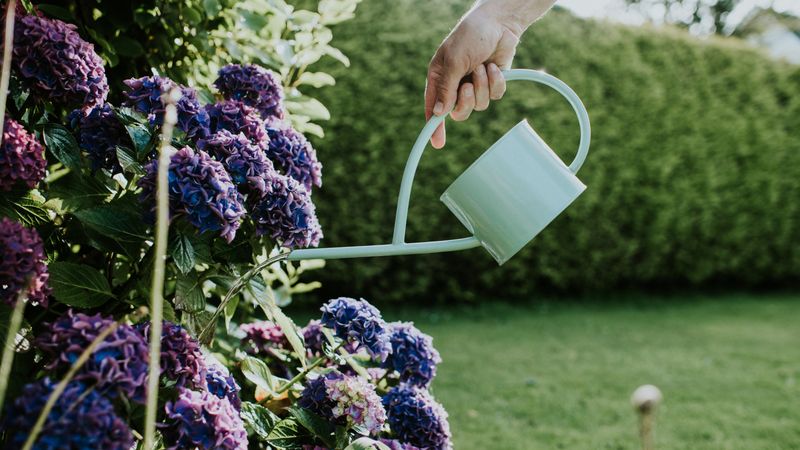
When the root zone is genuinely dry, the correction is straightforward: apply water at the base of the plant slowly and thoroughly. The goal is to moisten the main root zone, often roughly 6 to 10 inches deep, rather than just wetting the top layer.
UGA Extension’s landscape management guidance describes deep, thorough watering as a practice that supports deeper rooting over time and helps maintain adequate moisture between irrigation sessions.
There is no universal number of minutes that works for every situation. Hose flow rate, soil texture, slope, mulch depth, recent rainfall, plant size, root depth, and drainage all change how long the water needs to run before it reaches the right depth.
Rather than trusting a timer, check penetration by probing the soil after watering to confirm moisture has moved down to where the roots need it.
Morning irrigation is worth choosing when practical. Watering early reduces evaporative loss and gives any wet foliage time to dry before evening, which matters for disease management.
A severely drought-stressed plant should not be left to sit without water just because it is afternoon, but making morning the routine for regular irrigation is a reasonable efficiency habit. Finish the setup with a 2 to 5 inch layer of organic mulch spread around the root zone, kept a few inches clear of the stem and crown.
UGA Extension’s guide to growing bigleaf hydrangea notes that mulch helps reduce evaporation and moderate soil temperature, both of which support moisture retention between waterings.
Afternoon exposure may matter as much as irrigation
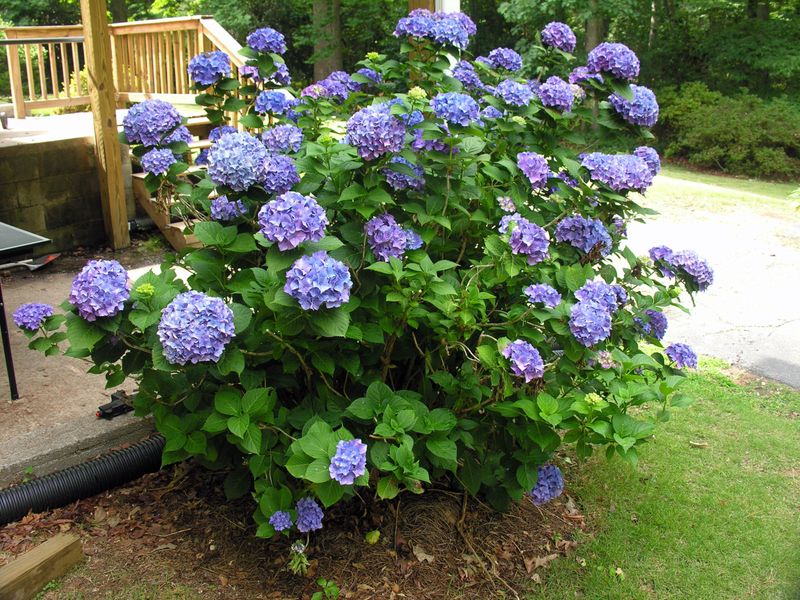
Fixing the watering routine will not stop afternoon droop if the plant is baking in several hours of intense western sun, catching reflected heat from a wall or pavement, or sitting in a spot where drying wind pulls moisture from its leaves faster than roots can replace it. For bigleaf hydrangeas specifically, site exposure can be just as influential as irrigation frequency.
UGA Extension’s bigleaf hydrangea guide describes the ideal conditions as morning sun with afternoon shade or filtered light, combined with moist but well-drained soil. A location that delivers full western sun through the hottest part of a Southern summer afternoon creates predictable afternoon stress even when the soil holds adequate moisture.
Practical adjustments depend on what is feasible. A container plant can be moved to a more protected spot.
A shrub near a west-facing wall may benefit from added filtered shade from a nearby tree or shade structure. Avoiding a hot western exposure at planting time is easier than correcting it later.
NC State Extension’s profile of Hydrangea macrophylla confirms that bigleaf types are more sensitive to hot afternoon exposure than some other hydrangea species. Panicle hydrangeas and certain other types generally tolerate more sun, so shade recommendations written for mophead or lacecap varieties should not automatically be applied to every hydrangea in the yard.
Persistent wilt calls for a different investigation
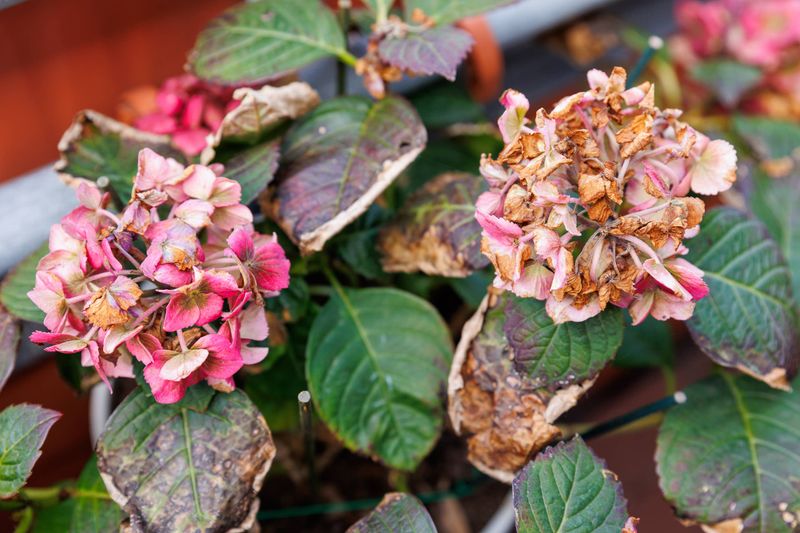
A hydrangea that is still wilted in the morning, showing yellowing leaves, dieback, stunted growth, or leaves that look sick rather than just heat-tired, is telling you something beyond ordinary afternoon heat stress. Before adding more water, check the soil and look more carefully at what is actually happening.
Waterlogged or poorly drained soil deprives roots of the oxygen they need to function, and that oxygen deprivation can produce wilting even when the soil feels wet. UGA Extension’s landscape best practices publication warns that overwatering and poor drainage can be just as damaging as drought.
Foul-smelling soil, constantly saturated conditions, or roots that appear brown and mushy rather than firm and white point toward a drainage or root health problem that extra irrigation will worsen. Penn State Extension’s hydrangea disease guide and their Phytophthora root rot resource describe how root disease can cause wilting, yellowing, and decline in plants sitting in wet or poorly aerated soil.
Newly planted and container-grown hydrangeas occupy a separate category. Penn State Extension’s ornamental planting guide explains that limited or confined root systems dry faster and need more frequent monitoring than established shrubs.
Illinois Extension also notes that persistent wilting, as opposed to temporary afternoon drooping, calls for a closer look at soil conditions, root health, and contributing site factors rather than an automatic increase in watering.
Let root-zone conditions guide the next watering
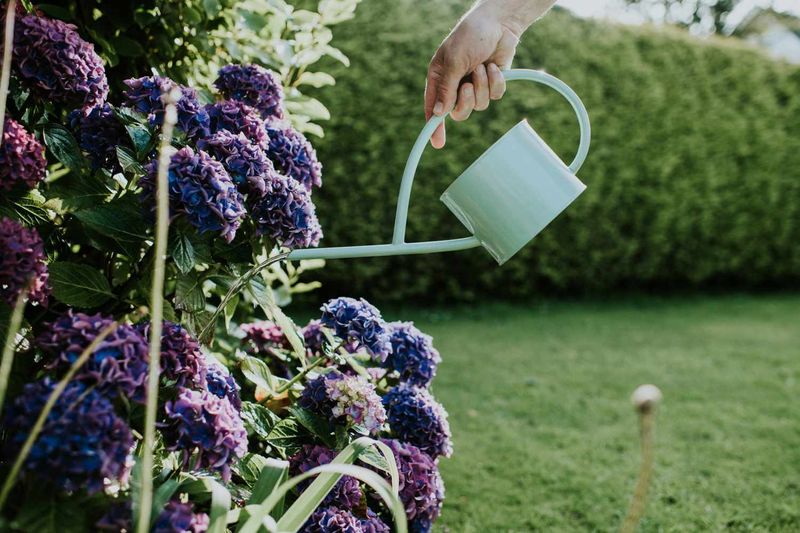
Pulling the afternoon droop problem into a practical routine comes down to a short sequence. Check the plant in the morning to see whether it has recovered.
If it has, probe the soil several inches down before deciding whether to water. UGA Extension’s watering guidance supports this moisture-first approach rather than watering on a fixed schedule regardless of conditions.
When the root zone is dry, water slowly and thoroughly at the base, then verify penetration by checking the soil afterward. When moisture is still present, hold off and reassess the site: afternoon shade, mulch, and drainage may need attention before the watering routine can do its best work.
UF/IFAS irrigation guidance for Florida reinforces that local soil type, rainfall, and regional conditions shape how any watering routine should be adjusted, and Texas gardeners face their own range of soils, heat patterns, and seasonal rainfall that call for the same site-specific thinking.
The real goal is a healthy, adequately moist root zone, not perfectly upright leaves through every hot Southern afternoon. Some afternoon sag on a bigleaf hydrangea during a heat wave is a plant doing its best, and a gardener who checks before watering is already ahead of the problem.