
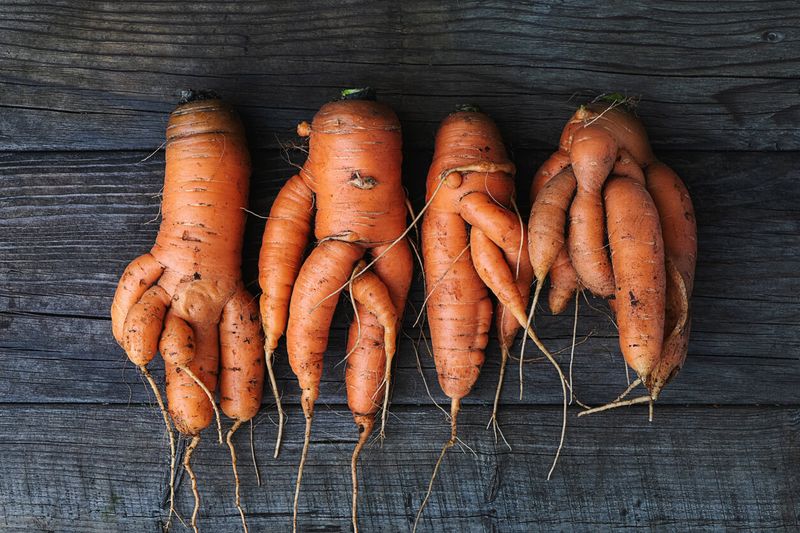
Pulling your first fall carrots and finding a tangle of forked, twisted roots instead of smooth, straight ones is one of those genuinely baffling garden moments. The good news is that the shape of those misshapen roots can tell you a lot about what went wrong underground.
Compacted, rocky, or debris-filled soil is the first place most extension services point, but moisture swings, crowding, excess nitrogen, pests, and disease can all produce a similarly gnarled harvest. Knowing how to read the clues helps you fix the right problem before the next planting.
Compacted or obstructed soil is the first place to look
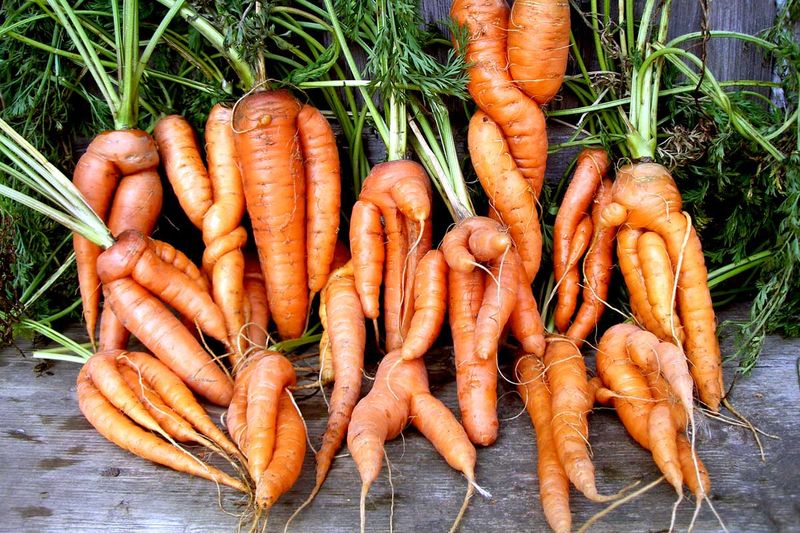
When carrots come up gnarled and branched, the most logical first suspect is what the root ran into on its way down. University of Minnesota Extension’s carrot diagnosis guide identifies dense or compacted soil as a primary cause of forked and misshapen roots, and UC IPM’s dense or rocky soil resource echoes that finding for home landscapes.
A taproot that meets a hardpan layer, a buried rock, a clod of compacted clay, or an old plant root has nowhere to go but sideways, and that redirection shows up at harvest as a fork or a curl.
That said, compacted soil is not the only explanation. Iowa State University Extension notes that irregular moisture, overcrowding, excessive nitrogen, nematode pressure, and disease can each produce roots that look just as irregular.
Blaming the seed or the season before you check the soil skips the most correctable variable.
The practical first step is to dig into the carrot zone after harvest and feel for resistance. Push a trowel or a soil probe 10 to 12 inches straight down and notice where it meets unexpected friction.
That friction is often the story behind the harvest you just pulled.
A carrot root bends when it cannot push straight down
Carrot development starts at germination and moves in one direction: straight down. The taproot is the main storage organ, and it depends on finding a continuous column of loose, workable soil.
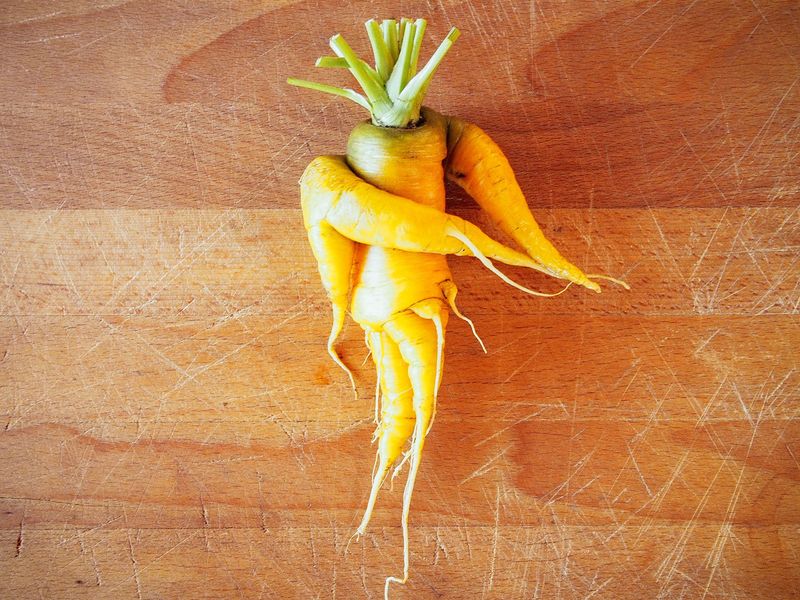
When a hardpan, a buried stone, a stick, a clod, or even a dense tangle of old roots blocks that path, the growing tip deflects and the root branches around the obstacle. The result at harvest is exactly what Southern gardeners describe: a root that looks like a two-pronged fork or a twisted rope.
What catches many gardeners off guard is that the surface can feel perfectly fine while a problem layer sits several inches below. University of Minnesota Extension’s soil compaction guidance explains that traffic, repeated tillage at the same depth, and working wet soil can all create a dense layer just beneath the tilled zone, a layer that looks invisible from above.
Carrots, which need 8 to 12 inches or more of clear growing space, are particularly sensitive to that hidden restriction.
Texas A&M AgriLife Extension’s carrot guide and University of Georgia Cooperative Extension both stress removing rocks, sticks, clods, and other debris from the full root zone before planting. Clearing that path is the most direct way to give the next crop a straight run from seed to harvest.
The shape of the harvest can separate soil trouble from look-alikes
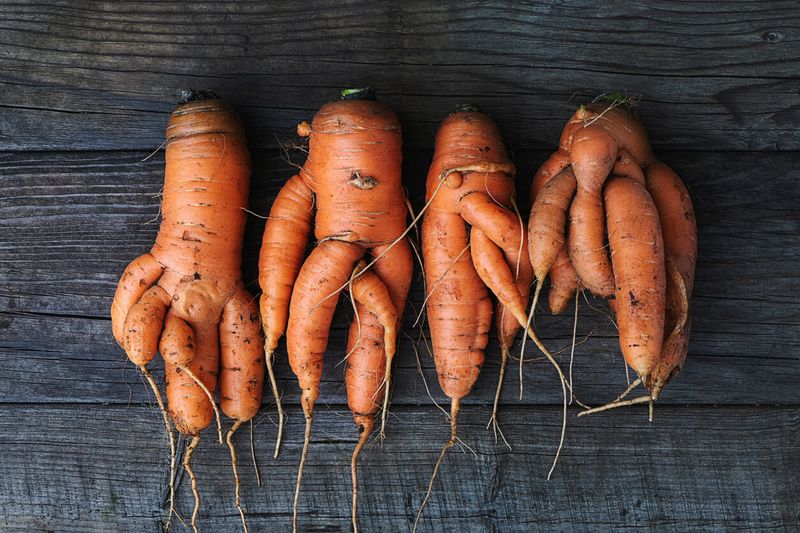
Not every misshapen carrot points to the same problem, and reading the shape carefully can save a lot of misdirected effort. Branching or forking, where the root splits into two or more prongs, is most often linked to physical obstruction, compaction, excess nitrogen, root injury during germination, nematodes, or Pythium.
Long cracks or splits running down the side of an otherwise normal-looking root tell a different story: Oregon State University’s Ask Extension resource on carrot malformation points more strongly to irregular moisture, especially a heavy rain or deep irrigation that follows a dry stretch.
Lush, dark-green tops paired with undersized roots are a prompt to look at spacing and nitrogen levels first. University of Minnesota Extension’s carrot-growing guide notes that too much nitrogen encourages leafy growth at the expense of root development.
That said, a hardpan or obstacle can also restrict root size while foliage stays perfectly healthy, so lush tops do not rule out a soil problem.
Florida and Southeast gardeners should pay particular attention to roots with small knobs, galls, or an unusually hairy appearance. UF/IFAS nematode management guidance describes root-knot nematodes as a serious concern in the region, with galls, excessive fine roots, stunting, and patchy poor growth making nematodes more plausible than simple compaction.
Soil or root testing is needed to confirm that diagnosis.
Short, blunt roots without branching may not be deformed at all. Texas A&M’s carrot variety guide notes that Nantes and Chantenay types are naturally compact; comparing the harvest to the cultivar’s expected mature shape rules out a false alarm.
UC IPM’s root dieback and forking resource adds that Pythium becomes more plausible when roots show lesions, stubbing, or yellowing tops alongside poor drainage conditions, not from shape alone.
Prepare a deeper, cleaner path for the taproot
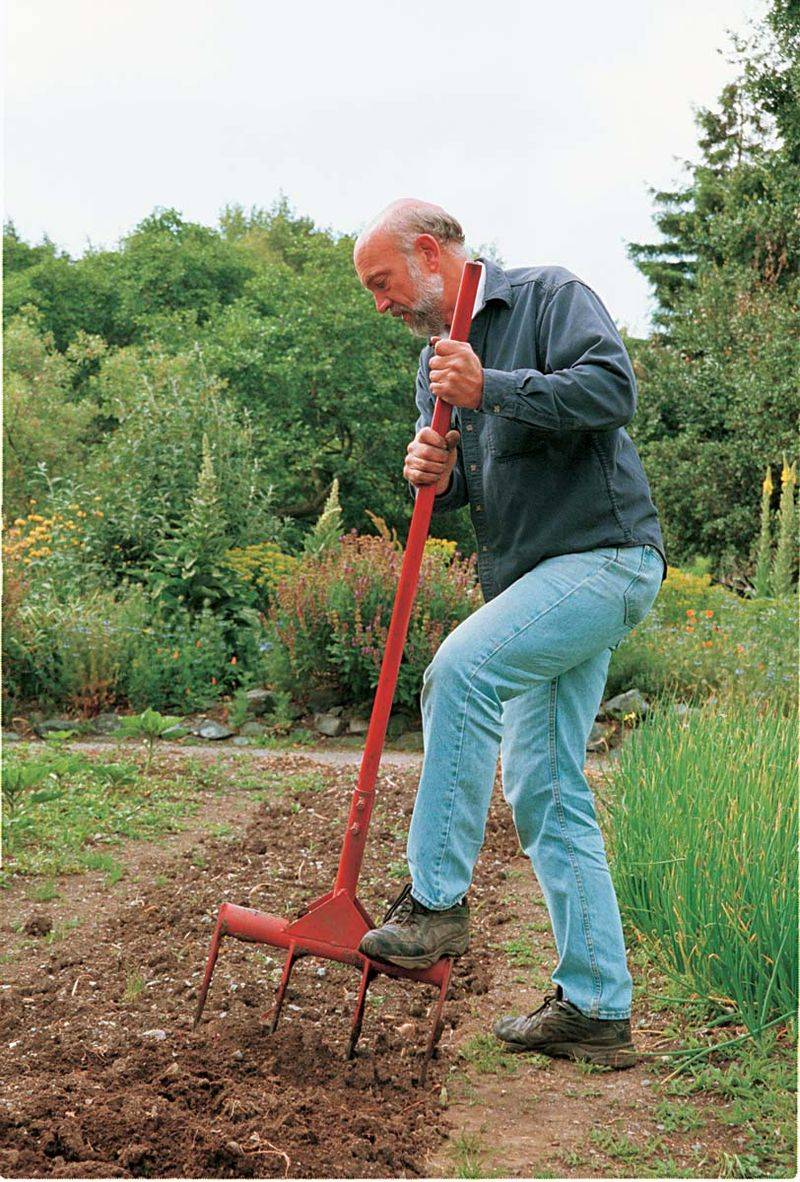
Fixing the soil before the next planting is the most dependable correction available. Texas A&M AgriLife Extension recommends spading carrot beds 8 to 12 inches deep, while University of Georgia Cooperative Extension calls for a loose soil profile of 12 to 14 inches.
The range reflects different soil types and production systems, but the shared goal is giving the taproot a clear, unobstructed column to follow all the way to maturity.
Loosening alone is not enough if you leave behind the objects that caused the problem. Work through the bed by hand or with a garden fork, pulling out stones, sticks, clods, old root fragments, and any other large debris from the full depth of the carrot zone.
Even a single buried rock at 6 inches can split a root that was growing cleanly above it.
The way you loosen the soil matters as much as how deep you go. University of Minnesota Extension’s soil compaction resource warns that repeated aggressive tillage passes at the same depth can create a compacted layer just below the tilled zone, sometimes called a tillage pan.
Work the soil once with appropriate depth rather than making multiple shallow passes, and avoid walking on the prepared bed. Never till when the soil is wet, because that smears and compresses the structure rather than loosening it.
Where foot traffic or heavy rain consistently re-compacts the bed, a raised or mounded planting area can help maintain the loose structure between seasons.
Add organic matter without overfeeding the roots
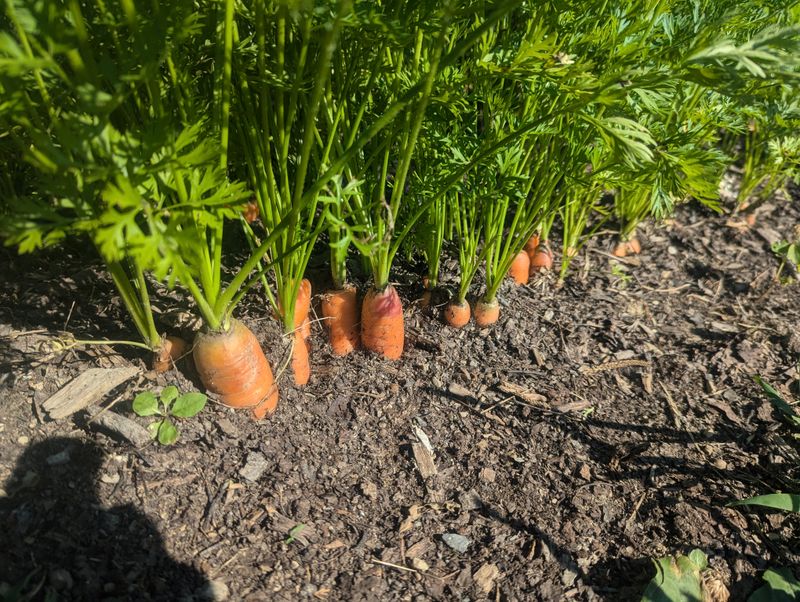
Organic matter can genuinely help carrot beds by improving soil structure, easing drainage in heavy clay, and making it easier for roots to push through the profile. Oregon State University Extension explains that adding organic matter improves aeration and water-holding capacity in most garden soils, both qualities that support straighter root growth.
The catch is that compost is not a guaranteed fix, and the wrong type or amount can make things worse rather than better.
Unfinished compost and excessive nutrient additions can encourage lush top growth at the expense of root development, and they can also introduce pathogens or inconsistent nitrogen loads that harm germinating carrots. Use mature, fully finished compost, and apply it based on a soil test rather than a blanket addition.
Texas A&M’s compost utilization guidance reinforces that compost quality and application rate both affect outcomes, not just the presence of organic matter in the bed.
Fresh manure deserves a specific caution for carrot growers. Iowa State University Extension and University of Wisconsin Extension both advise against applying fresh manure shortly before planting root crops.
The concerns are practical: fresh manure can contribute excessive nitrogen that drives leafy growth over root development, it can injure tender roots directly, and it raises food-safety concerns for crops that contact the soil. If manure is part of your fertility plan, compost it thoroughly well in advance of planting and verify that it has fully broken down before it goes into a carrot bed.
Give each root room and keep moisture steady
Two routine management choices, spacing and watering, can mimic or compound a soil problem in ways that are easy to fix once you recognize them. Carrots must be direct-seeded rather than transplanted; the taproot is sensitive to disturbance, and transplanting almost always produces a deformed root.
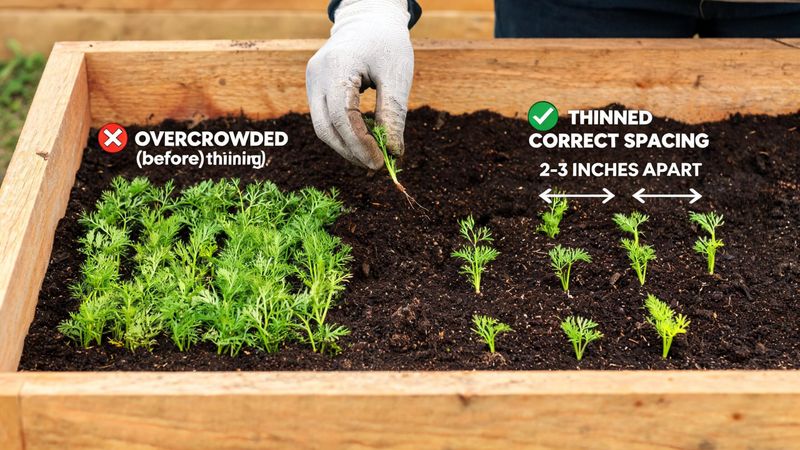
Iowa State University Extension recommends thinning seedlings to roughly 2 to 4 inches apart, depending on the variety and planting system, so that each root has enough lateral space to develop without competing with its neighbors.
Thinning technique matters more than most gardeners realize. Pulling unwanted seedlings out of the ground disturbs the soil around the roots you want to keep, sometimes enough to redirect a developing taproot.
University of Georgia Extension’s home garden carrot guidance recommends cutting unwanted seedlings at soil level with small scissors rather than pulling them, which leaves neighboring roots undisturbed.
Moisture consistency matters just as much as spacing. During germination, water gently enough to keep the soil surface moist without washing seeds away or causing crusting.
After seedlings establish, water deeply enough to reach the full root zone, but avoid leaving the bed saturated. Oregon State University’s carrot malformation resource and UC IPM’s root dieback guide both connect irregular moisture to splitting and disease-favoring conditions.
A long dry spell followed by a heavy irrigation is one of the most common triggers for long surface cracks, which is a different problem from forking but equally frustrating at harvest.
Raised beds can make Southern fall carrot beds easier to manage
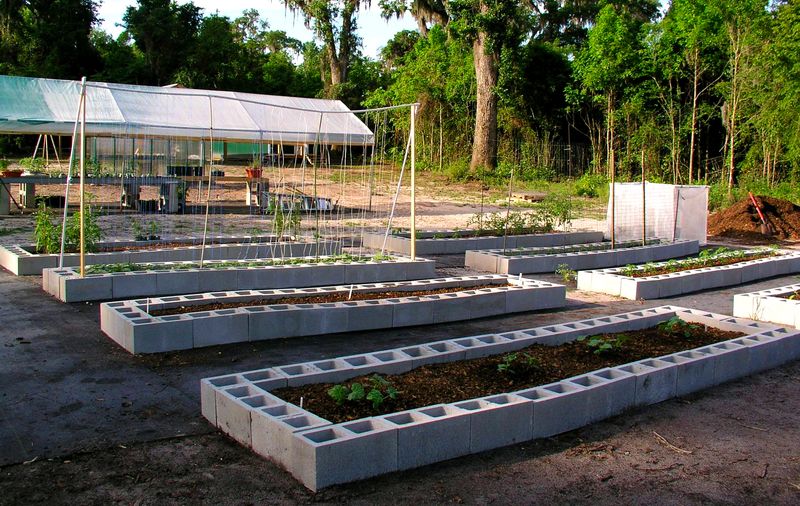
For Southern gardeners dealing with heavy clay, poor drainage, or soil that gets compacted by summer rains and foot traffic, a raised bed can make carrot growing considerably more manageable. UF/IFAS’s vegetable gardening guide for Florida specifically recommends raised beds for carrots, citing the drainage and soil-structure advantages they provide in the state’s often sandy or poorly draining conditions.
Texas A&M AgriLife Extension notes that ridges or raised areas improve air and water movement in spots where flat-ground drainage is a persistent problem.
A raised bed is a useful tool, not a guarantee. Filling one with the wrong mix, over-amending with nitrogen-rich materials, crowding seedlings, or neglecting moisture consistency will produce the same gnarled harvest you were trying to avoid.
Rocks, nematodes, Pythium, and variety-related shape differences travel right into a raised bed if the underlying conditions are not addressed.
Fall planting windows also vary significantly across the South. Texas A&M identifies September through December as a central Texas planting window for winter harvest, while UF/IFAS points to September through November as an ideal seeding period for north Florida under suitable temperatures.
Local extension calendars and current soil temperatures should always take priority over a generalized national timeline.
Handle sound and questionable carrots differently
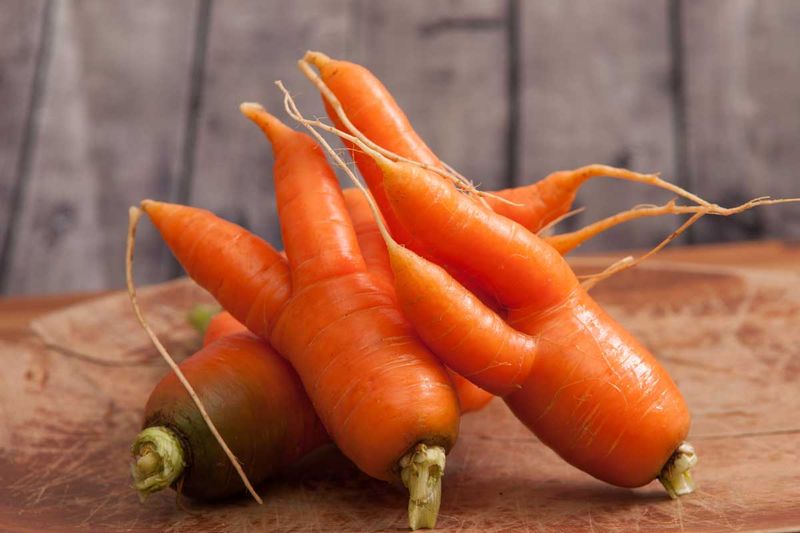
An odd shape does not automatically make a carrot unsafe, but it also does not guarantee that every root in the basket is fine to eat. A firm carrot with no rot, no foul odor, and no signs of disease is generally treated as a quality or appearance issue rather than a health concern.
FDA guidance on selecting and serving produce safely calls for washing fresh vegetables under cool running water before eating. USDA FSIS is equally clear that soap, detergent, bleach mixtures, and homemade produce washes should not be used on produce.
Running water and a clean produce brush are the right tools.
Rotten sections, badly damaged tissue, or roots showing suspicious lesions should be discarded rather than trimmed and used. If you harvested from a bed where nematodes or Pythium are suspected, or where fresh manure was applied close to planting, local extension guidance is worth consulting before deciding how to handle the crop.
For next season, the checklist is straightforward: loosen the bed at least 10 to 12 inches deep, remove every rock and debris fragment from that zone, skip the fresh manure, thin seedlings by cutting rather than pulling, and keep moisture as consistent as possible through the growing period. University of Minnesota Extension’s carrot diagnosis tool is a reliable starting point if symptoms persist and you are still unsure whether compaction, pests, or disease deserves the closer look.
Straight carrots are mostly a matter of giving the root nowhere to go but down.