
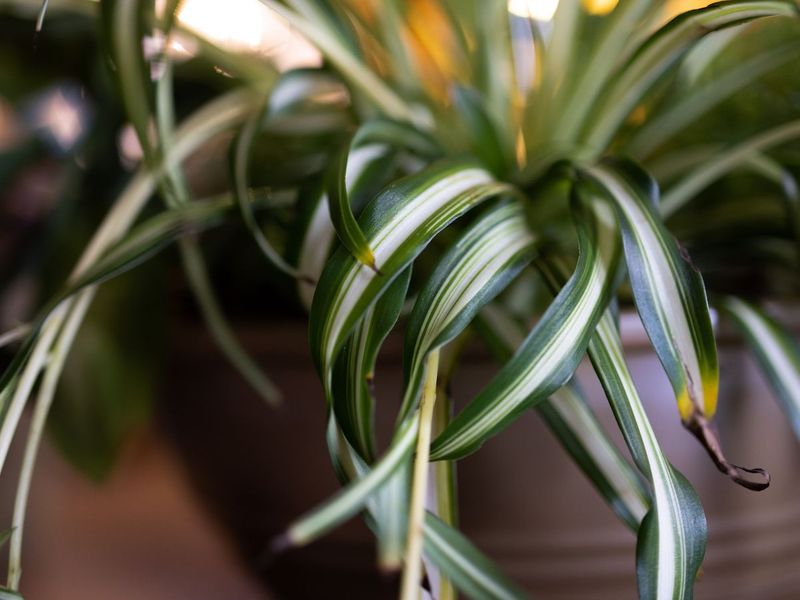
Brown leaf tips on a spider plant are frustrating, especially when you feel like you’re already trying your best. The tricky part is that several different problems can create the same symptom, so a single fix doesn’t always work.
One watering mistake is worth checking first, but water quality, fertilizer buildup, light, and drainage can all play a role too. Understanding what’s actually happening gives you a much better shot at stopping the browning for good.
Brown tips show stress, not one guaranteed diagnosis
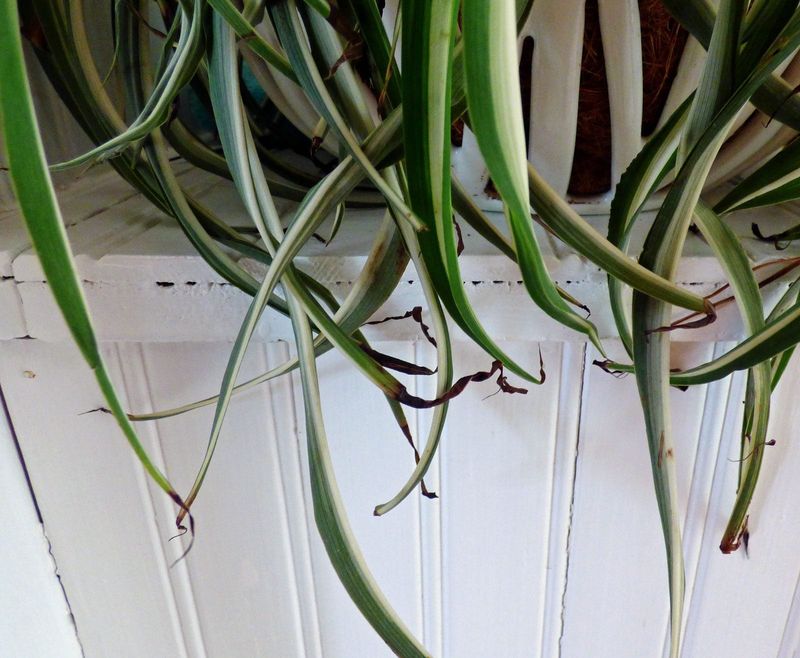
Leaf tips turning brown on a spider plant can mean several different things, and that’s exactly why a single-cause explanation falls short. Iowa State University Extension describes brown tips as a vague symptom that requires investigation across multiple possible causes, including watering habits, humidity, fertilizer salts, and water quality.
Treating it as an automatic sign of one specific mistake can lead you to overcorrect and make things worse.
The documented causes include allowing the potting mix to dry out too far, inconsistent watering patterns, low humidity, fluoride or mineral-heavy water, fertilizer salt buildup, excessive or direct light, and poor drainage. University of Wisconsin Horticulture and Clemson University’s Home and Garden Information Center both list several of these as contributing factors rather than pointing to one root cause.
Any of them can produce the same brown-tipped appearance.
Shallow or inconsistent watering that lets the root ball dry too far is one common, plausible mistake worth checking first. The sections below will walk you through how to evaluate that possibility and then consider the other documented causes if the browning continues after you adjust.
Check shallow or inconsistent watering first
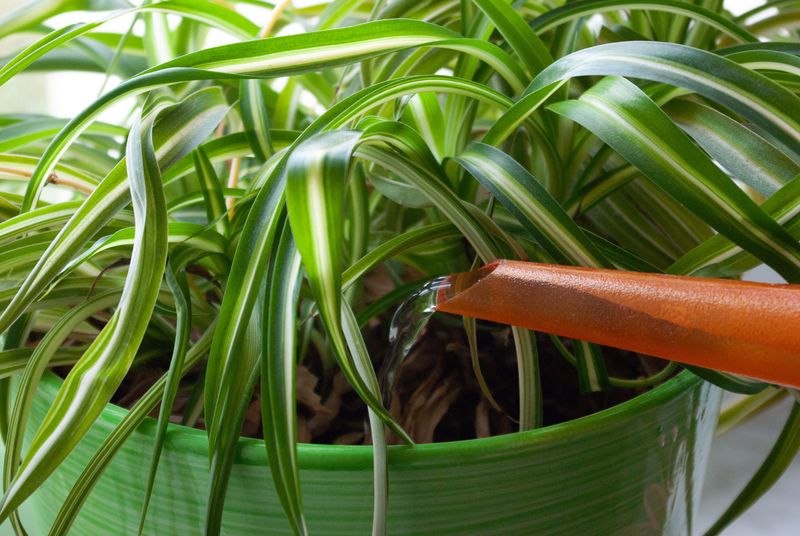
One watering pattern worth checking is whether the plant is getting shallow splashes that wet only the top layer while the lower root ball stays dry, or whether the watering schedule swings between bone-dry soil and soggy periods without a consistent middle ground. University of Illinois Extension notes that watering frequency should be based on soil condition rather than a fixed calendar, because pot size, light levels, temperature, humidity, and the soil mix itself all affect how fast a container dries out.
A weekly schedule that worked well in January may leave roots parched by July in a warm Southern home where heat and air conditioning both pull moisture from the container faster. University of Wisconsin Horticulture describes spider plants as tolerant but notes that allowing the mix to stay too dry for extended periods can stress the plant and contribute to tip damage.
The target pattern is straightforward: let the mix dry slightly between waterings, then water thoroughly rather than giving small amounts repeatedly. Iowa State University’s houseplant care guidance and UF/IFAS both emphasize that the goal is even moisture management, not constant wetness or repeated drought cycles.
This is a possible cause worth checking, not a confirmed diagnosis for every plant.
Water the entire root ball, then let it drain
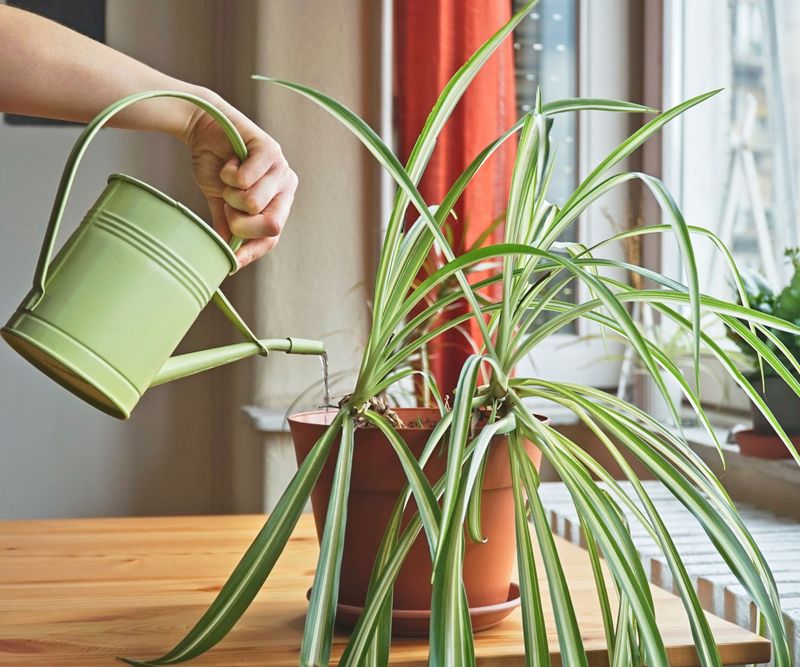
Stick your finger about an inch below the soil surface. If that spot feels dry, the plant is ready for water.
Pour slowly and steadily, working around the base of the plant rather than just the center, until water flows out of the drainage hole at the bottom. Iowa State University Extension recommends this approach specifically to make sure the full root ball gets wet, not just the upper layer.
If the mix has become very dry, the water may run straight down the sides of the pot and out the bottom before it actually soaks in. Colorado State University PlantTalk notes that an extremely dry root ball can repel water, so you may need to water slowly in two or three passes, or set the pot in a shallow basin of water for a short soak and let the mix absorb moisture from the bottom up.
Once it drains, tip out any water sitting in the saucer or cache pot.
Standing water left under the pot is a problem, not a benefit. University of Minnesota Extension advises emptying saucers after watering to avoid keeping roots in contact with pooled water.
Thorough watering means wetting the entire root ball completely, then letting the mix dry slightly before the next session. It does not mean watering more often or keeping the soil perpetually wet.
Rule out wet roots and poor drainage
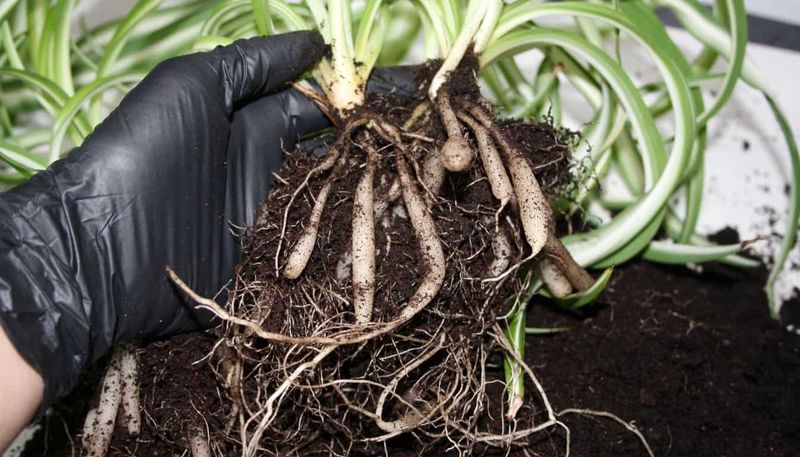
Overwatering and underwatering can look almost identical from the outside, which is why checking the soil before changing your schedule is so useful. Iowa State University Extension’s guidance on houseplant wilting explains that chronically wet soil can damage roots and prevent them from moving water up to the leaves, producing the same browning and wilted appearance that drought stress creates.
Cutting back on water when the real problem is root rot only delays recovery.
Check whether the mix stays wet for several days after watering, whether the pot has a working drainage hole, and whether the saucer holds standing water between sessions. The Royal Horticultural Society’s guidance on houseplant leaf damage connects poor drainage and persistently wet roots to a range of leaf symptoms that can mimic other problems.
If the mix stays soggy, the roots may need attention before any watering-schedule adjustment will help.
A gravel layer at the bottom of a pot is not a substitute for a drainage hole. Iowa State’s houseplant care resource states that this approach can actually raise the water table inside the container and keep roots wetter than intended.
If your pot lacks a drainage hole, consider repotting into one that has proper drainage rather than trying to work around the limitation.
Water quality can cause browning too
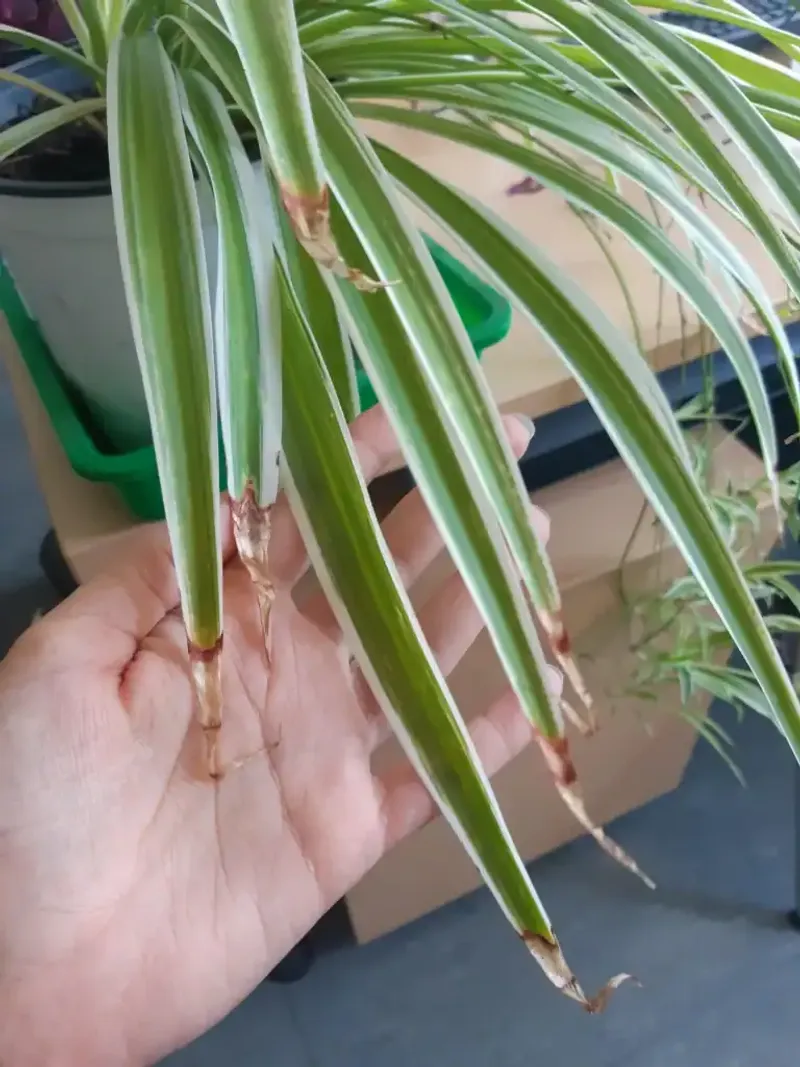
Spider plants are notably sensitive to fluoride, and that sensitivity makes water quality an important competing explanation for brown tips even when your watering technique is sound. UF/IFAS specifically recommends rainwater or distilled water for spider plants when household water contains fluoride, because tip burn can develop regardless of how carefully you time or measure your waterings.
A plant can receive exactly the right amount of water and still develop brown tips if the water itself is the problem.
NC State Extension’s plant profile for Chlorophytum comosum and University of Wisconsin Horticulture both identify fluoride toxicity as a documented cause of tip burn in this species. Well water with high mineral content can produce a similar effect, and the damage often looks like ordinary watering stress.
Tap water is not automatically unsuitable for most houseplants, but spider plants are an exception worth investigating. Check your local utility’s water-quality report to find out what your community water contains.
The CDC’s My Water’s Fluoride tool can help you find fluoride levels by location. Do not assume that letting tap water sit overnight removes fluoride or dissolved salts, and do not assume that every water filter removes fluoride either.
When water-quality injury seems plausible, rainwater or distilled water is the safest option to test.
Check salts, light, and humidity before changing the routine again
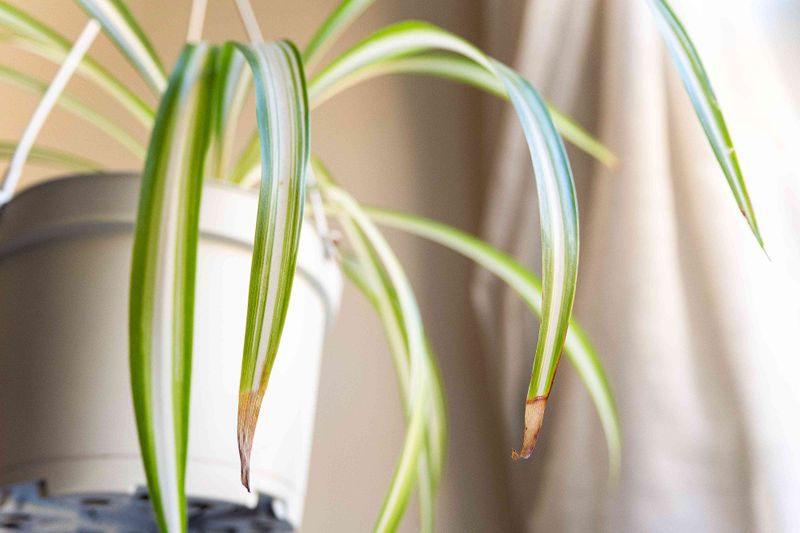
A white crust forming on the soil surface, the pot rim, or the saucer is often a sign of fertilizer-salt buildup, and those salts can burn leaf tips and margins in a pattern that looks similar to drought stress or fluoride damage. Clemson University’s spider plant factsheet notes that overfertilizing is a common contributor to tip burn, and Iowa State’s guide to diagnosing houseplant problems related to poor culture recommends flushing accumulated salts with thorough, clear-water waterings through a properly draining container.
Severe buildup may require repotting into fresh mix.
Light is another variable to check before assuming the watering routine needs another adjustment. UF/IFAS recommends bright to moderate indirect light for spider plants indoors, and strong direct or midday sun through a south- or west-facing window can scorch foliage in ways that mimic watering-related browning.
Moving the plant a few feet from the glass or filtering the light with a sheer curtain is a low-risk adjustment to try.
Very dry indoor air, common in Southern homes running air conditioning for extended periods, is one possible contributor to tip browning. Iowa State Extension notes humidity as a factor in tip browning, but increasing humidity will not correct root rot, fertilizer-salt accumulation, or fluoride exposure.
A humidifier nearby can help with genuinely dry-air situations, but treat it as one piece of the picture rather than a guaranteed cure.
Trim the brown tissue and watch for healthier new growth
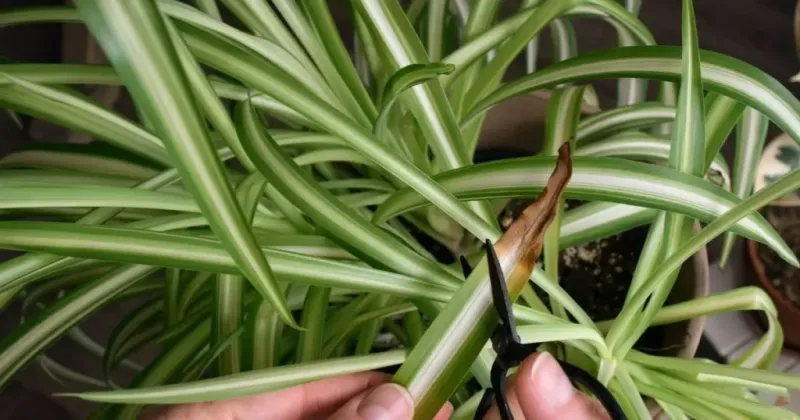
Trimming brown tissue is straightforward and perfectly fine to do for the sake of appearance. Use clean scissors and follow the natural taper of the leaf, cutting at a slight angle so the trimmed edge blends in rather than leaving a blunt, obvious line.
What trimming will not do is turn existing brown tissue green again or stop new browning from developing. Iowa State University Extension is clear on this point: damaged tissue stays damaged, and new tips will continue browning until the underlying cause changes.
The most reliable way to judge whether a correction is working is to watch new growth. If the leaves emerging after you adjusted watering, drainage, water source, light, or fertilizer show less browning than the older leaves, you’ve likely identified the right stressor.
If new growth browns at the same rate, keep investigating the other documented causes rather than cycling through the same adjustment repeatedly.
A practical care sequence to hold onto: check the mix about an inch down before each watering, water the full root ball until excess drains from the bottom, empty the saucer completely, and let the mix dry slightly before watering again. University of Illinois Extension reinforces that soil condition, not a fixed schedule, should drive the timing.
If browning continues despite consistent technique, water quality, fertilizer salts, light, and drainage are the next places to look. A healthy new leaf growing in without brown tips is the clearest sign the plant is moving in the right direction.