
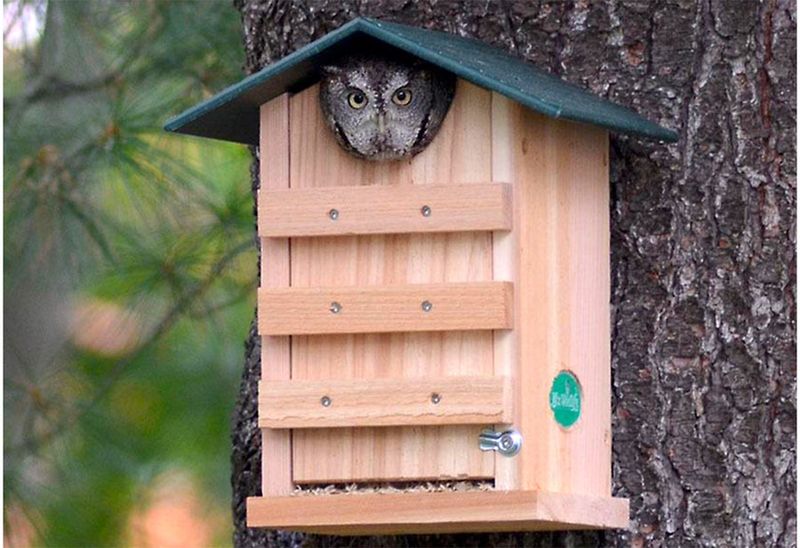
Eastern Screech-Owls are small, year-round North Carolina residents that hunt at night and nest inside tree cavities. Putting up a nest box this fall gives a local owl a possible shelter during cooler months and gets the cavity ready before breeding activity that can start as early as February in the South.
The project will not guarantee a resident owl or solve a rodent problem, but it does give wildlife a real opportunity where natural cavities may be limited. A well-built, well-placed box is one of the most straightforward ways a North Carolina homeowner can actively support native wildlife.
A fall box offers a chance, not a guaranteed move-in
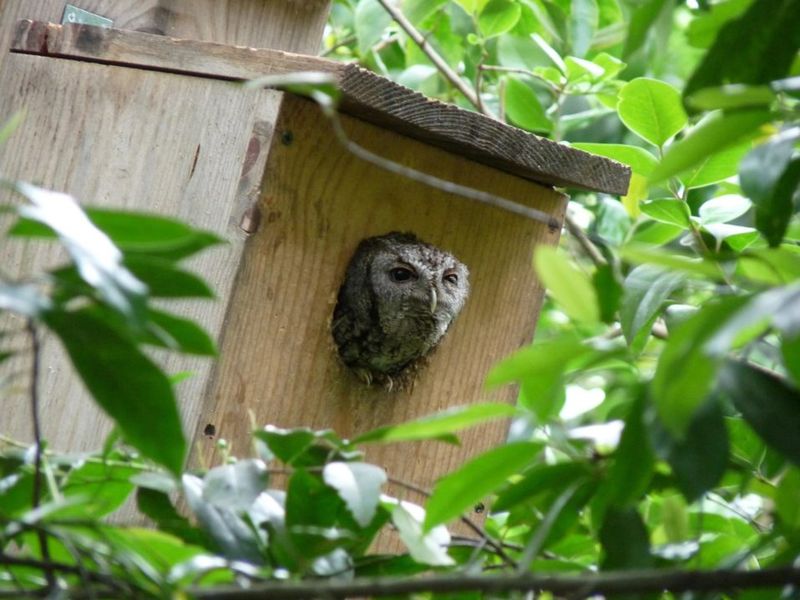
Eastern Screech-Owls are cavity-nesting birds found across North Carolina in wooded neighborhoods, suburban backyards, farms, parks, and woodland edges. They are one of the few owl species that readily accept an artificial nest box, which makes them a realistic target for a homeowner project.
Cornell Lab of Ornithology’s life history account confirms the species uses a broad range of habitats and regularly takes up residence in man-made cavities.
Putting a box up in fall is reasonable for two connected reasons. First, it may offer a local owl a sheltered roost spot during cooler months when finding a dry, protected cavity can matter.
Second, it positions the box before breeding activity that can begin as early as February in southern states. Research on winter roosting behavior of Eastern Screech-Owls in Central Kentucky documented frequent box use during cold months, which supports the idea that fall installation makes sense.
That study, however, comes from a single region and should not be read as a promise of similar behavior across all of North Carolina.
Whether any box gets used depends on factors well beyond the installation date. Local owl presence, the density of natural cavities already available, competing animals like squirrels, surrounding prey populations, and the overall landscape all shape the outcome.
A box in a yard where no screech-owls currently hunt is unlikely to attract one simply because a cavity appeared.
Diet is also worth understanding before expecting pest-control benefits. The U.S.
Forest Service species review for Eastern Screech-Owls describes a generalist predator that eats small rodents, insects, crayfish, frogs, lizards, and small birds, with the mix varying by season and location. Rodents are part of that diet, but the box is not a targeted pest-elimination device.
Think of it as a habitat opportunity for a native species that may already be moving through your property.
Evaluate the whole site before choosing a support
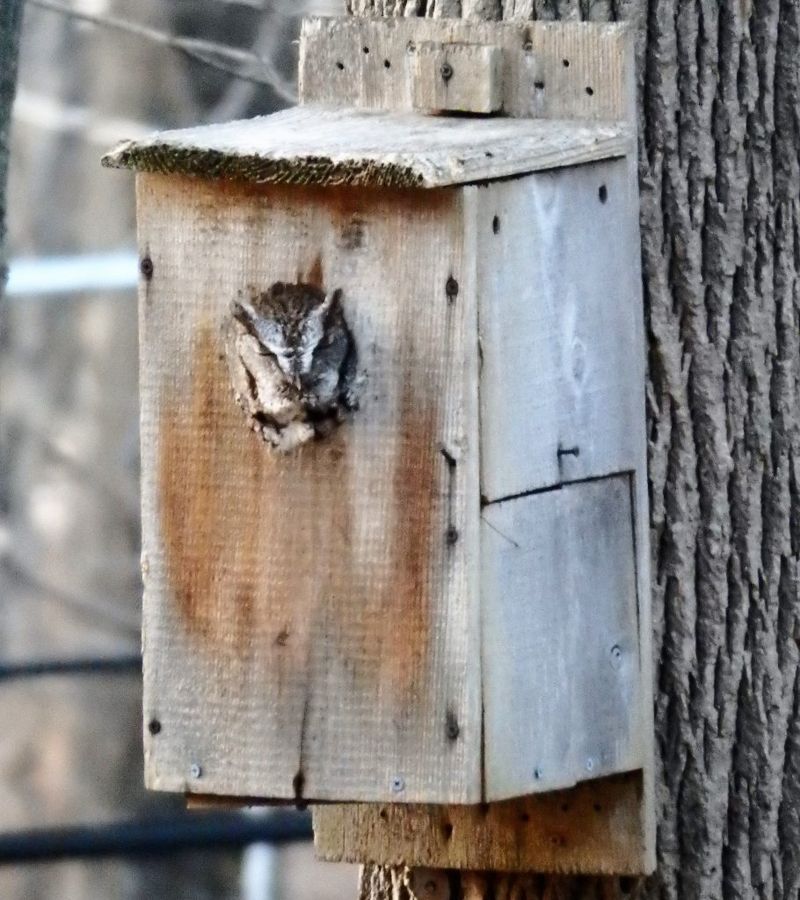
Picking a spot for an owl box involves more than finding the nearest tree. Cornell NestWatch’s Eastern Screech-Owl guidance recommends mounting the box between 10 and 30 feet above ground, near a woodland edge, and close to open hunting areas such as a lawn edge, meadow, pasture, stream corridor, wetland, or open woodland.
Those open spaces matter because the owl needs room to hunt low and quietly over ground where prey moves.
A live tree works well as a support, and so does a sturdy wooden or metal pole. The choice between them is less important than what surrounds the support.
A tree embedded deep inside a dense woodlot with no nearby clearing gives the owl less hunting access than a tree at the edge where canopy meets open ground. A freestanding pole in the middle of an open yard, on the other hand, may lack the shade and weather cover that a tree canopy provides, so weigh those trade-offs together.
Height, shade, weather exposure, prey availability, and predator resistance all connect. A box mounted too low is easier for climbing predators to reach.
A box with no overhead canopy may overheat in summer or collect rain through the entrance. The Forest Service review identifies cavities near open areas with available rodent prey as suitable habitat, reinforcing that the landscape context around the support matters as much as the support itself.
Entrance orientation is a secondary consideration, and published guidance does not agree on a single best direction. Audubon’s nest box guide suggests avoiding north-facing openings and favoring east or south, while NestWatch lists facing direction as open to any compass point.
Rather than following a rigid rule, choose a position where the entrance is shielded from your area’s heaviest rain and wind, receives some morning shade during hot months, and faces toward the open hunting area the owl would use. Habitat suitability and weather protection are more reliable guides than compass direction alone.
Use dimensions that fit an Eastern Screech-Owl
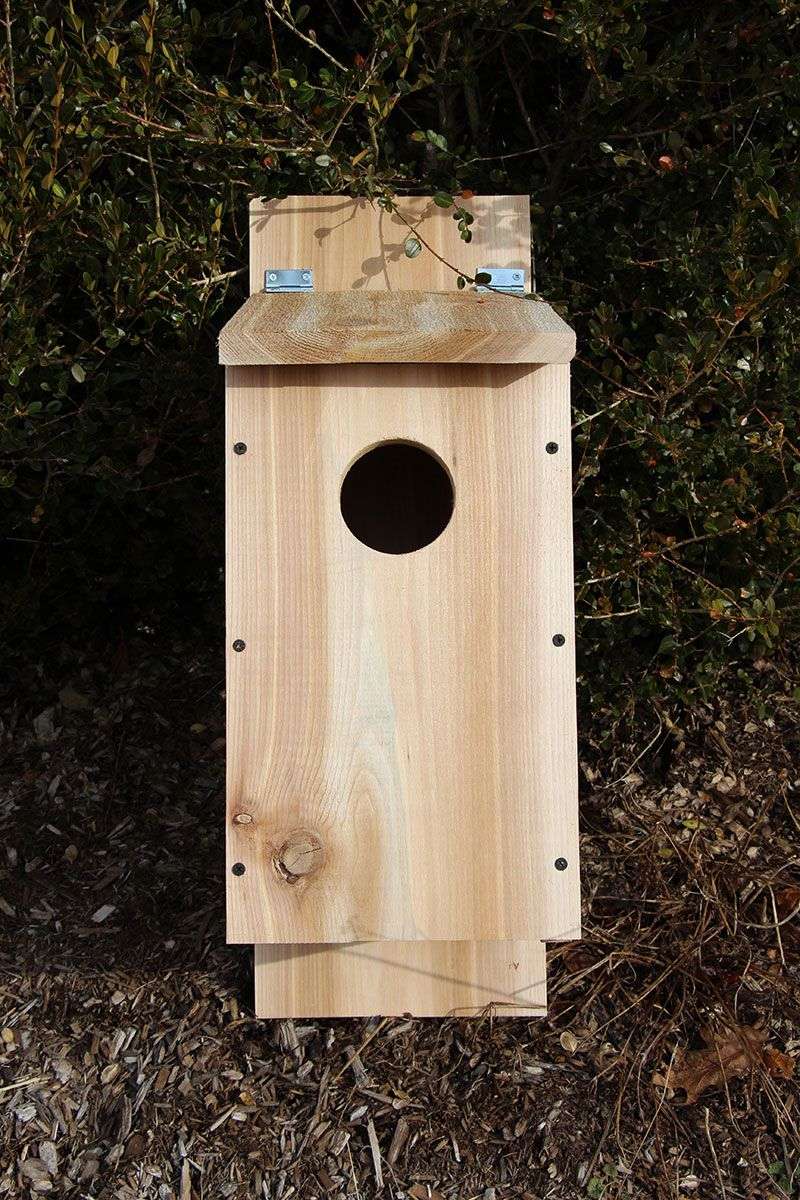
Getting the dimensions right is one of the most important decisions in the project, because a box that is too small may be rejected and one that is too large may attract unwanted tenants. NestWatch specifies a 3-inch round entrance hole, an interior depth of approximately 17 and 3/8 inches, and an interior floor measuring roughly 9 and 5/8 by 11 and 1/4 inches.
Those numbers come from tested plans designed to match the bird’s body size and nesting behavior.
Audubon’s tested design also uses a 3-inch entrance but describes a different floor size of approximately 8 inches square, which demonstrates that more than one workable plan exists. The practical takeaway is to follow one complete, published plan from start to finish rather than mixing measurements from different sources.
Combining a floor dimension from one guide with a depth from another can produce a box that fits no design’s intent.
Eastern Screech-Owls do not gather sticks or weave a cup nest the way songbirds do. They lay their eggs directly on whatever debris or material is at the bottom of the cavity.
Adding roughly 2 to 3 inches of untreated wood shavings or another suitable dry material before installation gives the eggs a stable, cushioned surface and mimics what the owl might find in a natural tree hollow. Avoid cedar shavings marketed for small-animal bedding, as they can contain aromatic oils; plain kiln-dried pine shavings are a safe and widely available option.
If buying a pre-built box rather than building one, verify that the product lists its entrance diameter and interior dimensions before purchasing. Many decorative owl houses sold at garden centers use entrance holes smaller than 3 inches or shallow interiors that do not meet the species’ needs.
A correctly sized box is not a difficult find, but it requires checking the specifications rather than assuming any owl-branded product will work.
Build a weather-resistant box without hazardous extras
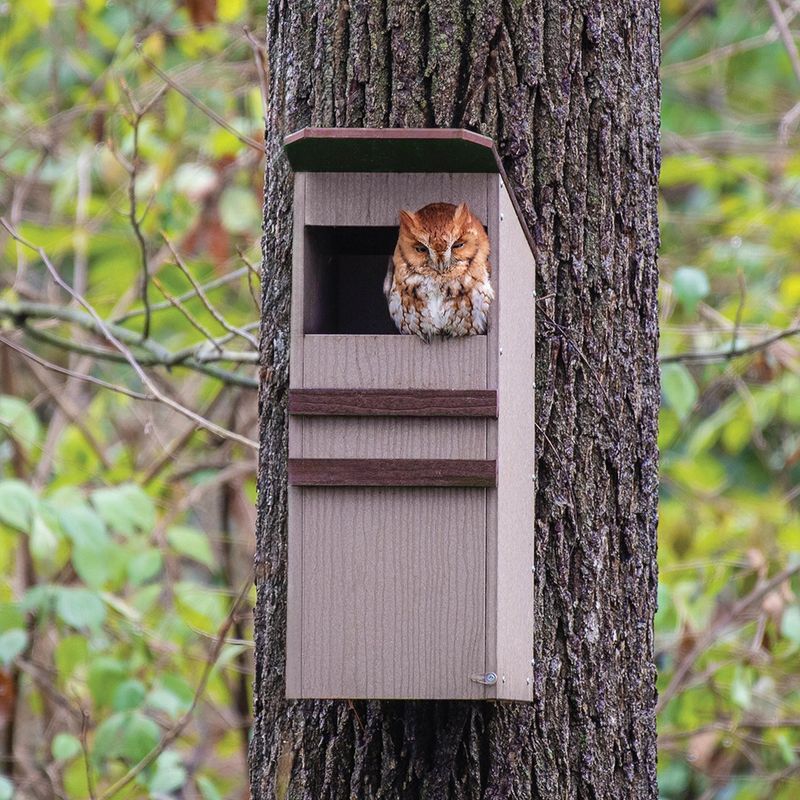
Material choice sets the foundation for a safe box. Untreated lumber, such as rough-sawn pine, cedar, or cypress, is the right starting point.
NestWatch’s birdhouse features guidance is explicit: pressure-treated lumber, interior paint, and chemical preservatives have no place in a nest box. Those materials can off-gas compounds that harm eggs, nestlings, and adult birds spending extended time inside the cavity.
Wall thickness affects temperature regulation. Boards at least three-quarters of an inch thick provide better insulation than thin plywood, keeping the interior cooler on warm spring days and retaining some warmth during cold nights.
Drill several small ventilation holes near the top of the side walls and a few drainage holes through the floor so that any water that enters can escape. A sloped roof with an overhang of at least two inches keeps rain from driving into the entrance and protects the wood from rot.
The interior walls directly below the entrance hole should be roughened or fitted with horizontal saw kerfs so that fledglings can grip the surface and climb out when they are ready to leave. Without that texture, young owls may struggle to exit.
An access panel, typically a hinged or removable side wall, allows you to clean out the box each fall after the nesting season ends and to check for debris, insects, or competing animals that have moved in.
One feature to leave off entirely is an exterior perch below the entrance hole. NestWatch’s screech-owl page notes that outside perches can assist predators and competing cavity users in reaching the entrance.
Eastern Screech-Owls do not need a perch to enter or exit, so omitting it protects the box’s occupants without any trade-off. Keep the exterior plain, unpainted, and free of decorative hardware that could create footholds for unwanted visitors.
Install in fall to make the cavity available
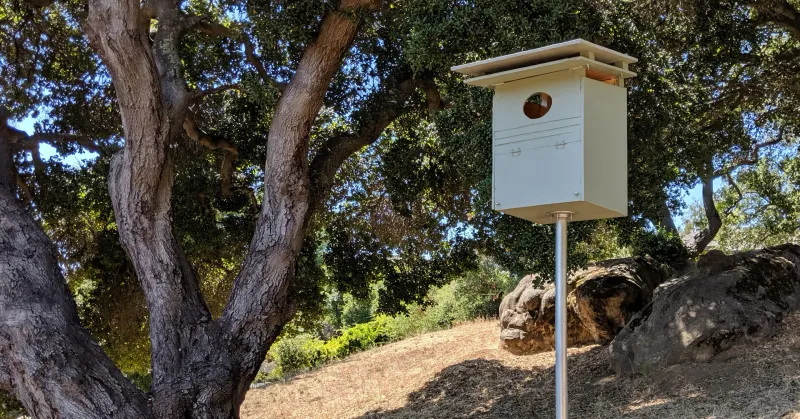
Fall is a practical installation window for several overlapping reasons. A box mounted before temperatures drop may give a local owl a chance to discover the cavity and use it as a daytime roost during cooler weather.
Research on Eastern Screech-Owl winter roosting in Central Kentucky found that owls used boxes regularly during cold months, suggesting that an available, dry cavity can serve a real purpose between fall and early spring. That evidence comes from one region and should not be taken as a guarantee of the same behavior across the Piedmont, coastal plain, or mountains of North Carolina, but it supports fall installation as a reasonable choice.
Getting the box in place before late winter also matters because breeding activity in southern states can begin as early as February. A box that goes up in January may be discovered too late for that season’s pair to evaluate it.
Installing in October or November gives the cavity several months of visibility before any breeding decisions are made.
Secure the box to its support at the recommended height of 10 to 30 feet, using lag screws or mounting hardware that will hold in wind without damaging a live tree’s cambium layer. Avoid wrapping wire tightly around a trunk.
If using a pole, make sure it is set firmly enough that the box does not swing or vibrate, which can disturb a roosting or nesting bird.
One box is a sensible homeowner project. NestWatch notes that boxes should be spaced approximately 100 feet apart because territorial males defend their area and will not simply share it with a neighboring pair.
Installing several boxes close together on a small property does not create multiple owl families; it more likely results in one used box and several empty ones, or competition that keeps all of them vacant.
Protect the box and keep rodent poison away
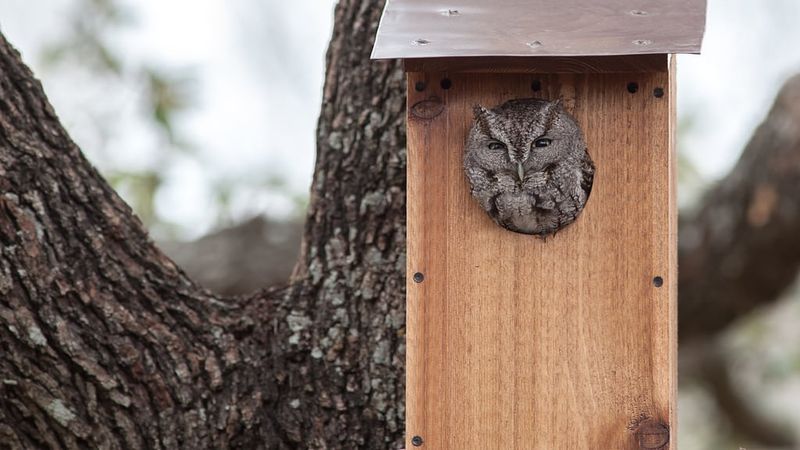
A predator guard is one of the most effective additions to a pole-mounted box. Squirrels, raccoons, rat snakes, and other climbing animals can reach a box that lacks protection, either raiding eggs and nestlings or occupying the cavity before an owl claims it.
A smooth metal baffle or cone mounted below the box on the pole makes climbing significantly harder. NestWatch recommends keeping the pole far enough from nearby trees that squirrels cannot simply leap from a branch to the box, bypassing the guard entirely.
A distance of at least 10 feet from any climbable tree or structure is a reasonable starting point.
Tree-mounted boxes face a different challenge. A guard can still be added, but the tree itself gives predators a natural climbing route.
Choosing a smooth-barked tree with no low branches near the box, and mounting the box on the trunk rather than on a branch, reduces some of that risk without eliminating it.
The connection between rodent control and owl safety is direct and worth understanding clearly. If the goal of putting up a box is partly to reduce rodents around the property, using rodenticide at the same time works against that goal.
EPA’s rodenticide safety review warns that predators and scavengers can be harmed after eating rodents that consumed certain poison products, and research has documented anticoagulant rodenticide exposure in Eastern Screech-Owls and other raptors. A poisoned mouse that crawls into the open is exactly the kind of easy prey an owl will take.
If rodenticide products are already in use on the property, follow EPA instructions for safe handling and prompt removal of any carcasses. The Forest Service’s species review describes Eastern Screech-Owls as opportunistic hunters across a broad diet, so the owl will not selectively avoid poisoned prey.
Eliminating poison use near the box area is the most straightforward way to protect any owl that may begin using the site.
Monitor quietly and judge success realistically
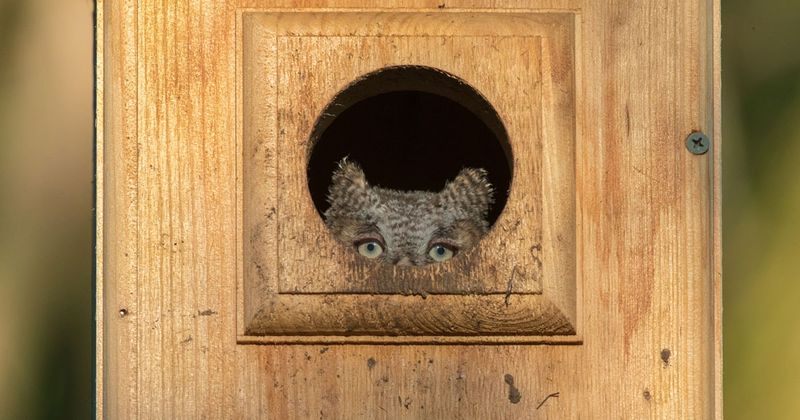
An empty box in the first season is not evidence that something went wrong. Occupancy depends on whether Eastern Screech-Owls are already present and hunting in the area, how many natural cavities compete with the new box, what other animals investigate it first, and whether the surrounding landscape offers enough prey to support a resident bird.
A long-term Pennsylvania study documented a situation where installed boxes remained unused despite owls being present in the area, showing that box availability alone does not determine occupancy. Patience across multiple seasons is a more realistic expectation than a quick move-in.
If signs of activity appear, such as pellets below the box, feathers near the entrance, or an owl face visible in the opening at dusk, resist the urge to open the box and look inside. NestWatch advises waiting at least one week, and preferably two, after discovering a nest before checking its contents, because disturbance during early nesting can cause a female to abandon eggs.
A quick peek for reassurance is not worth the risk of losing a clutch.
Off-season maintenance is the most reliable contribution a homeowner can make. After the breeding season ends and the box is clearly empty, open the access panel, remove old material, check for insect infestations or structural damage, and add fresh untreated wood shavings before closing it back up.
A clean, dry box in good repair is more likely to attract attention the following fall than one left to accumulate debris and moisture year after year.
Providing a safe, well-placed cavity and keeping it in good condition is the full extent of what the homeowner controls. The owl decides whether and when the space becomes useful, and that decision belongs entirely to the bird.