
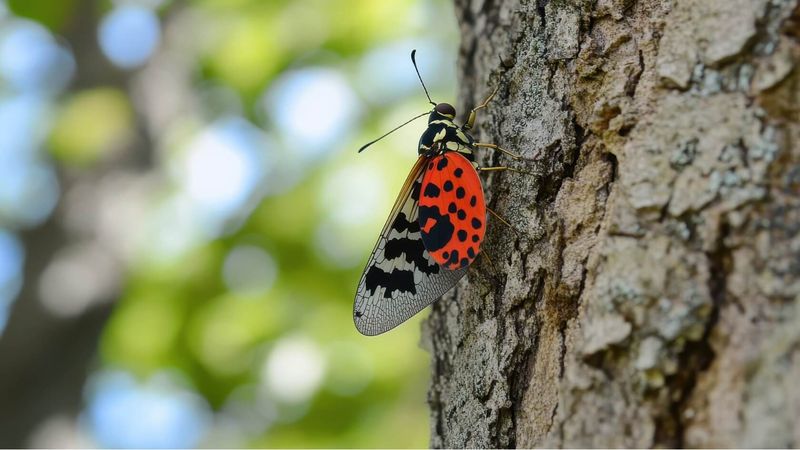
A fast-spreading invasive insect called the spotted lanternfly has found a foothold in North Carolina, and one invasive tree is helping it thrive. That tree is tree-of-heaven, and knowing how to identify and properly control it gives homeowners a real, practical edge.
But there is a catch: simply cutting the trunk will not stop a swarm, and understanding why makes all the difference.
Tree-of-heaven is the host tree to find first
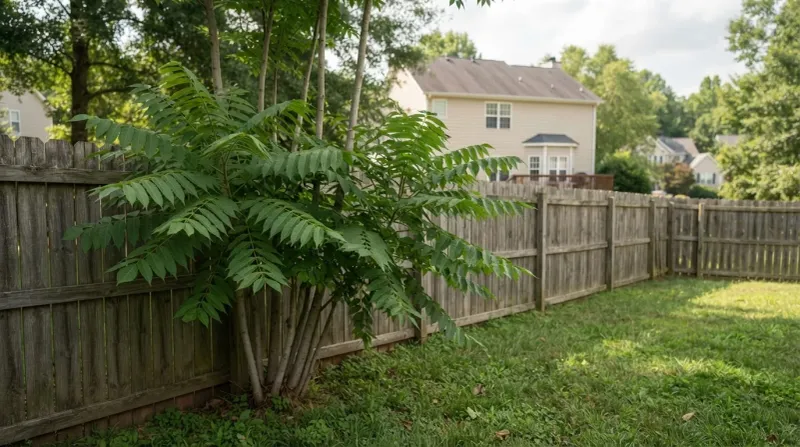
Among the dozens of plants that spotted lanternflies will feed on across North Carolina, one stands out as a clear magnet, especially for adult insects: tree-of-heaven, known botanically as Ailanthus altissima. This invasive tree originally from China has spread across roadsides, vacant lots, forest edges, and disturbed ground throughout the eastern United States, and it has become a key part of the spotted lanternfly story wherever the pest has traveled.
Adult spotted lanternflies show a consistent, measurable preference for tree-of-heaven in both field observations and controlled choice studies. Peer-reviewed host-preference research found that adults returned to tree-of-heaven repeatedly when given options, making it a reliable gathering point during late summer and fall.
That pattern matters to North Carolina homeowners because a single established tree can draw large numbers of insects to a yard and provide a reproductive staging area during the season when populations peak.
The pest’s reach in the state is already significant. As of February 10, 2026, the North Carolina Department of Agriculture and Consumer Services confirmed established populations in seven counties: Forsyth, Guilford, Rockingham, Caldwell, Caswell, Davidson, and Rowan.
The agency continues to ask residents statewide to watch for and report suspect insects and egg masses.
Controlling an established tree-of-heaven on your property can remove a highly attractive local resource for spotted lanternflies. NC State Extension identifies it as an invasive species that competes with native plants and benefits from disturbance.
Reducing its presence is a worthwhile goal, but homeowners should go in with realistic expectations: removing one tree may reduce local pressure, but it will not guarantee that every lanternfly in the neighborhood disappears.
A favorite host is not the only host
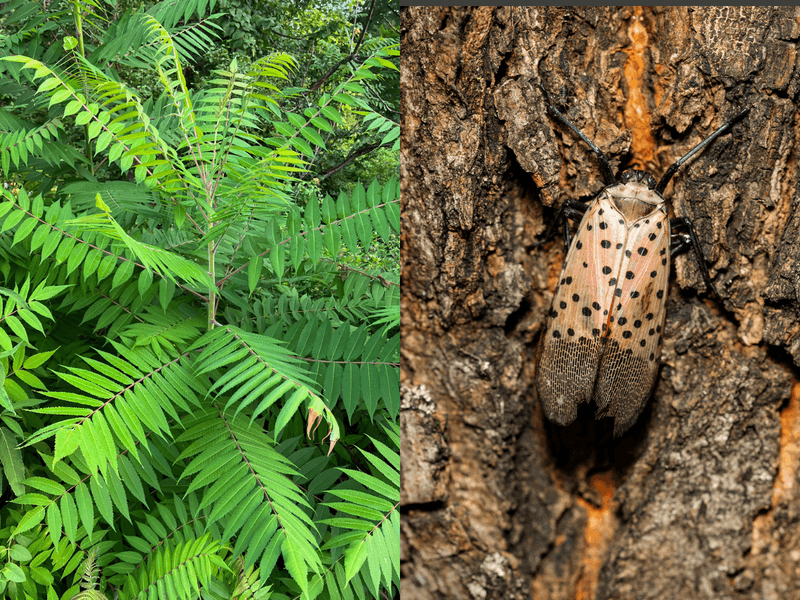
Before pulling out a chainsaw, North Carolina homeowners need to understand one critical point: tree-of-heaven is spotted lanternfly’s preferred host, not its only host. The pest feeds on a wide range of plants, and removing one tree from a yard will not cut off the insect’s options entirely.
NC State Extension’s spotted lanternfly page lists documented hosts that include grapes, apples, peaches, plums, cherries, hops, maples, oaks, black walnut, sycamore, and dogwood, among others. For homeowners with fruit trees, a backyard vine, or mature shade trees, that list covers plants already growing in a typical North Carolina yard.
The lanternfly does not need tree-of-heaven to find something to eat.
The insect’s flexibility also changes by life stage. Younger nymphs are less narrowly specialized than adults and will move across a broader mix of plants as they develop.
Adults eventually concentrate on tree-of-heaven with notable consistency, but that preference does not make other hosts off-limits. Published research confirmed that spotted lanternflies can complete development and reproduce without any access to tree-of-heaven, though performance can vary depending on which alternative plants are available.
A related finding from host-preference studies reinforces this: while adults showed strong preference for tree-of-heaven in choice experiments, multiple other plant species still supported development through to adulthood. That means removing a preferred host may reduce the attractiveness of a yard to spotted lanternflies, but insects already present, or arriving from nearby properties, can shift to other plants and continue feeding.
The practical takeaway here is not that tree-of-heaven control is pointless. Reducing a highly preferred host is a reasonable step.
The takeaway is that homeowners should not treat one tree’s removal as a complete solution and then stop monitoring.
Identify the tree before you remove it
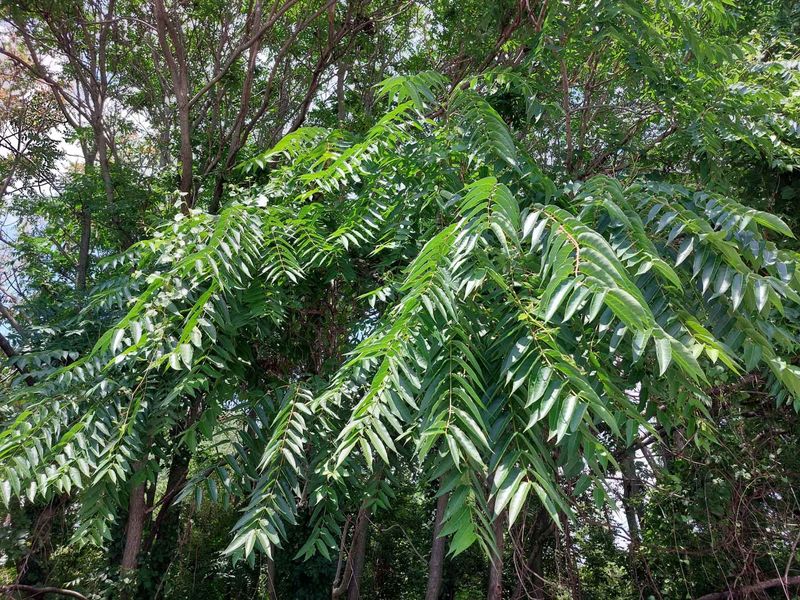
Rushing to remove a tree based on leaf shape alone is how native plants end up getting cut unnecessarily. Tree-of-heaven has several look-alikes growing throughout North Carolina, and a confident identification requires checking more than one feature.
Start with leaf size. Tree-of-heaven produces very large compound leaves, often 2 to 4 feet long, each carrying many individual leaflets arranged along a central stem.
The leaflets themselves are a key diagnostic: their edges are mostly smooth, without the pronounced teeth you would see on black walnut or sumac. Look closely at the base of each leaflet, where you may find one or two small glandular bumps or lobes near the stem attachment point.
That feature, combined with the smooth margin, helps separate tree-of-heaven from similar-looking native species.
The smell test is one of the most reliable checkpoints. Crush a fresh leaf, twig, or piece of bark between your fingers.
NC State Extension describes the odor as strong and distinctly unpleasant, sometimes compared to peanut butter that has gone rancid or burnt rubber. Native look-alikes do not share that odor.
If the smell is absent or mild, reconsider your identification before proceeding.
Native trees commonly confused with tree-of-heaven include black walnut, staghorn sumac, hickory, ash, and certain cherries. Penn State Extension’s guide to tree-of-heaven look-alikes points out that black walnut and sumac typically have leaflets with clearly toothed or serrated margins, while tree-of-heaven leaflets run smooth along most of their length.
Ash leaflets are also smoother but usually fewer in number and arranged differently. Hickory bark and bud structure differ noticeably up close.
If you are not certain after checking leaves, smell, and bark, take a photo and contact your county Cooperative Extension office. Removing a native black walnut or a mature shade tree by mistake has real costs, both ecologically and financially, and a brief confirmation step is worth the time.
Why cutting the trunk can make the problem return
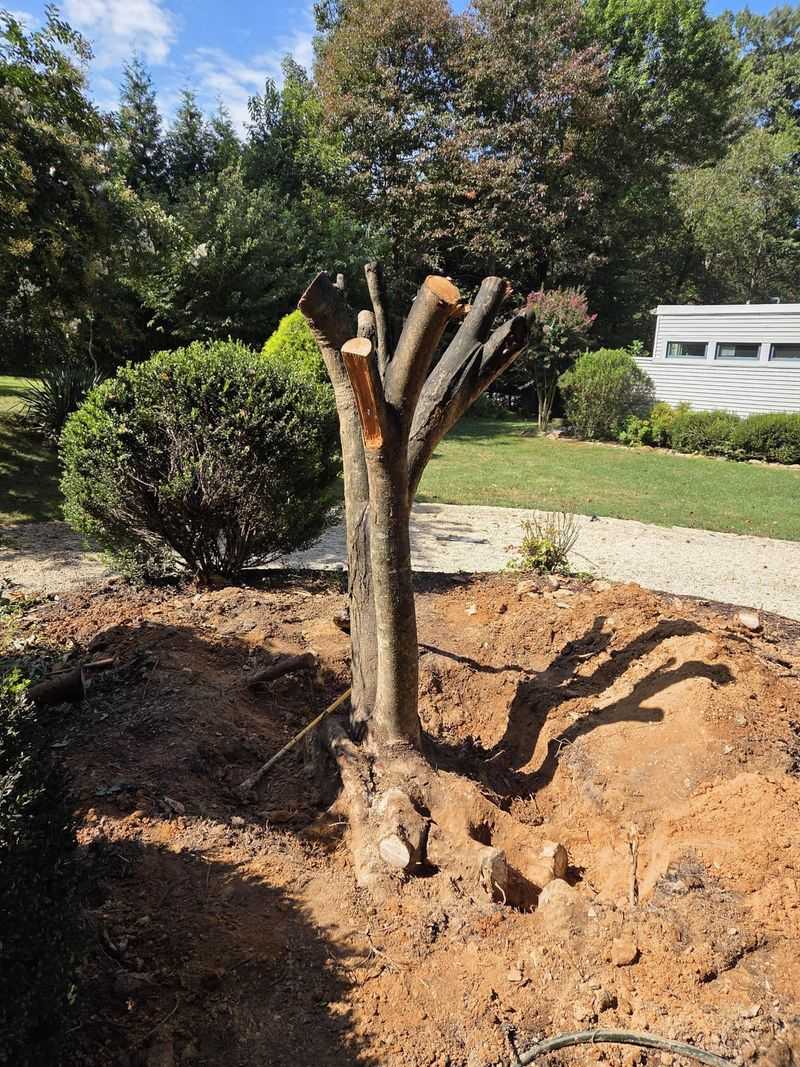
Cutting down tree-of-heaven and walking away is one of the most common mistakes homeowners make with this species. The tree does not simply die when the trunk is removed.
Its root system stays alive underground, and what follows can be a flush of new growth that is harder to manage than the original tree.
Established tree-of-heaven responds to cutting with vigorous stump sprouts, sometimes producing dozens of thin, fast-growing shoots from the cut surface within weeks. At the same time, the connected root system can send up root suckers at varying distances from the original trunk, meaning new shoots may appear several feet away in a lawn or garden bed.
Penn State Extension warns that cutting without treating the root system typically stimulates this kind of aggressive regrowth rather than suppressing it.
University of Maryland Extension’s updated guidance on tree-of-heaven reinforces the same point: established root systems can spread well beyond the visible canopy footprint, and those roots retain enough energy reserves to produce new shoots even after the main trunk is gone. A homeowner who cuts a large tree and sees clean ground for a few weeks may assume the job is done, only to find a ring of fast-growing sprouts appearing by midsummer.
From a spotted lanternfly standpoint, this matters because fresh sprouts are actually attractive to the insect. NC State Extension notes that young, rapidly growing tree-of-heaven shoots can be particularly appealing to spotted lanternflies, potentially drawing more insects to a yard than the original tree did.
Cutting without follow-up root control could, in practice, trade one large host tree for a cluster of smaller, highly attractive ones.
The key distinction to carry into any removal plan is this: removing the above-ground trunk and controlling the living root system are two separate tasks. Only the second one offers any lasting result.
Established trees need a control plan, not a one-day cut
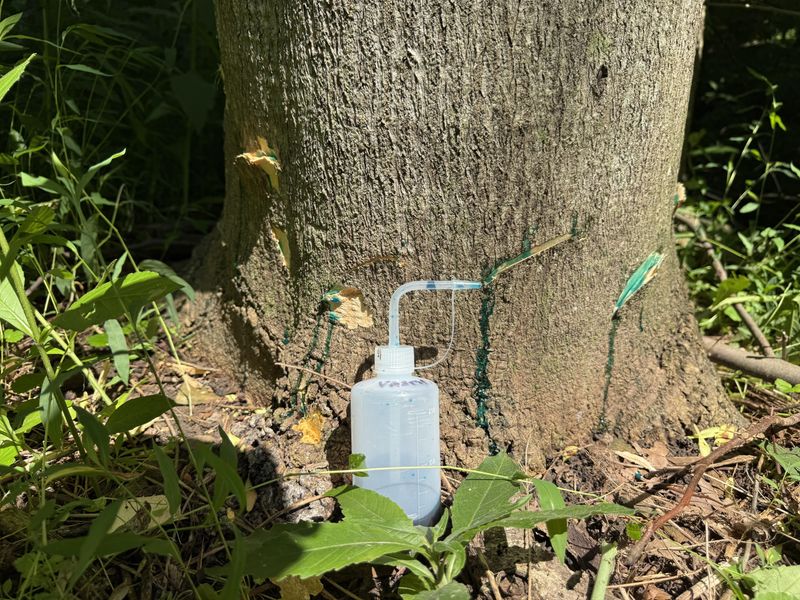
Managing an established tree-of-heaven on your property requires a plan that addresses the root system, not just the visible trunk. Extension guidance from multiple sources consistently points toward a properly timed systemic herbicide treatment as the most reliable approach for established trees.
Two methods frequently recommended by extension professionals are basal-bark treatment and hack-and-squirt treatment. Basal-bark application involves applying an oil-based herbicide mixture to the lower bark of the trunk, where it can move into the vascular tissue without cutting the tree first.
Hack-and-squirt, sometimes called frill treatment, involves making downward cuts through the bark around the trunk and applying herbicide directly into those cuts. Both methods are designed to move the active ingredient into the root system so that the tree declines from the inside rather than simply losing its canopy.
Penn State Extension’s tree-of-heaven management guide describes these approaches and explains when each is most practical depending on tree size and site conditions.
Cutting should generally follow herbicide treatment, after the tree has begun to visibly decline, rather than precede it. Cutting a healthy tree first and then trying to treat the stump gives the root system less time to absorb the herbicide before the tree’s vascular response changes.
NC State Extension’s tree-of-heaven resource recommends treating the stump immediately after cutting if that sequence is used, but also notes that stump treatment alone may not fully address connected root systems on large, established trees.
Penn State’s cut-stump herbicide guidance adds an important qualification: painting a freshly cut stump with herbicide can help prevent resprouting from that stump, but it does not automatically kill root suckers that may emerge from lateral roots beyond the treated area. Follow-up monitoring and retreatment of new growth is part of a realistic control plan, not an optional extra step.
Small seedlings, under a foot or two tall with shallow roots, can sometimes be hand-pulled when the soil is moist, but the entire root system must come out. Even small root fragments left in the ground can produce new shoots.
For larger, established trees, hand removal is not practical, and attempting it without addressing the roots will produce the regrowth problem described in the previous section.
Every product, formulation, timing window, and application method must follow the current pesticide label. EPA pesticide safety guidance is clear that the label is the law, and applying any herbicide in a manner inconsistent with its label creates risks for people, pets, desirable plants, and water.
If you are unsure which product fits your situation, your county Cooperative Extension office or a licensed arborist can point you toward label-compliant options without prescribing a specific rate.
Inspect nearby plants and outdoor surfaces
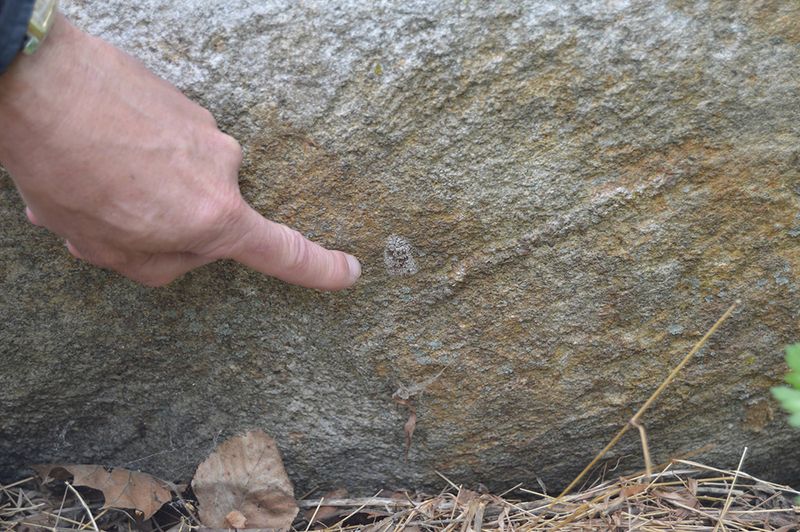
Controlling tree-of-heaven is one part of a broader monitoring routine that North Carolina homeowners in affected counties should be running through the year. Spotted lanternflies do not limit themselves to tree trunks when they lay eggs, and that habit makes outdoor surfaces worth checking regularly.
NC State Extension confirms that egg masses can appear on tree bark, wooden fences, brick walls, stone surfaces, patio furniture, equipment, firewood stacks, and vehicles. Each egg mass contains rows of seed-like eggs covered by a grayish, mud-like waxy coating that can be easy to overlook unless you know what to look for.
In North Carolina, egg masses are most likely to be visible from mid-October through spring, before eggs hatch as the weather warms.
USDA APHIS spotted lanternfly resources emphasize that vehicles and outdoor gear are a primary way the pest spreads to new areas. Checking the underside of a car, a camping trailer, or a piece of outdoor equipment before moving it out of a known infestation county is a concrete action that helps slow the pest’s spread.
Scrape any egg masses you find into a bag with hand sanitizer or rubbing alcohol, seal it, and dispose of it in the trash.
Spotted lanternflies do not bite or sting people or pets, but they do create indirect problems worth watching for: sticky honeydew dripping from feeding sites, black sooty mold growing on that honeydew, and the wasps and ants that gather around it. Heavy feeding can stress grapevines and other plants, though established ornamental trees are not uniformly killed by lanternfly feeding.
If you spot a suspected lanternfly or egg mass outside the seven counties with confirmed established populations, photograph it clearly and report it. The NCDA&CS spotted lanternfly reporting page provides the current reporting tool, and the February 2026 NCDA&CS press release confirms that the state is actively tracking new detections.
For treatment questions about plants on your property, your county Cooperative Extension office or a licensed pest-control professional is the right starting point rather than improvised household sprays.
Removing the preferred host changes the odds, not the outcome
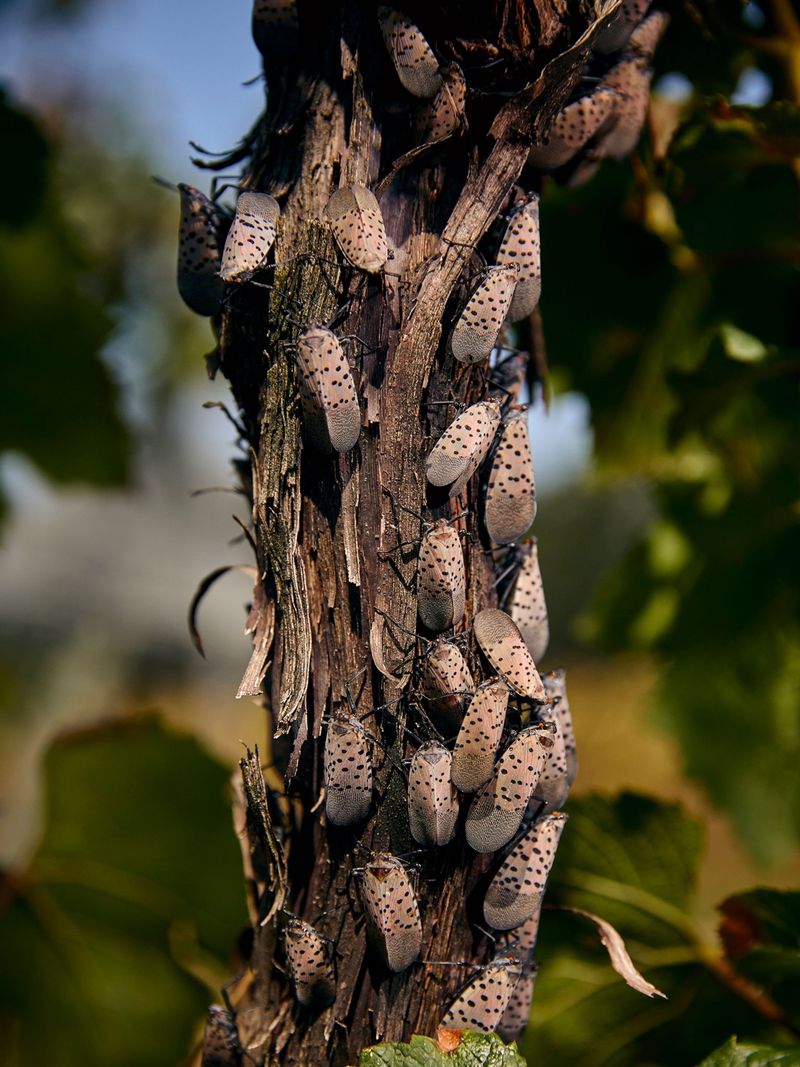
A clear-eyed action sequence matters more here than a simple promise. Identify tree-of-heaven correctly before doing anything else, using the leaf, odor, and leaflet-margin checkpoints covered earlier.
If you are not certain, get a confirmation from your county Cooperative Extension office rather than guessing.
Once confirmed, control established trees with a properly timed systemic treatment rather than a straight cut, and plan for follow-up monitoring of the stump and surrounding soil for resprouts and root suckers. Penn State Extension’s management guide for landscape professionals is direct on this point: removal of preferred host plants has not been specifically evaluated as a consistent area-wide control method for spotted lanternfly, and homeowners should not expect it to reliably reduce lanternfly numbers across a wider neighborhood.
Inspect nearby plants and nonplant surfaces for egg masses during the fall-through-spring window, and report any suspected spotted lanternflies or egg masses found outside known infestation counties through the NCDA&CS reporting tool. Penn State’s management guide supplement and NC State Extension’s spotted lanternfly resource both frame monitoring and reporting as ongoing responsibilities, not one-time events.
Removing tree-of-heaven from your property can reduce a strong local attractant and eliminate a plant that competes with native species, so the effort is worthwhile on multiple grounds. What it cannot do is guarantee a lanternfly-free yard, because the pest has alternative hosts, can arrive from neighboring properties, and spreads faster than any single homeowner can act.
The honest measure of success here is reducing favorable conditions, not eliminating every insect in sight.