
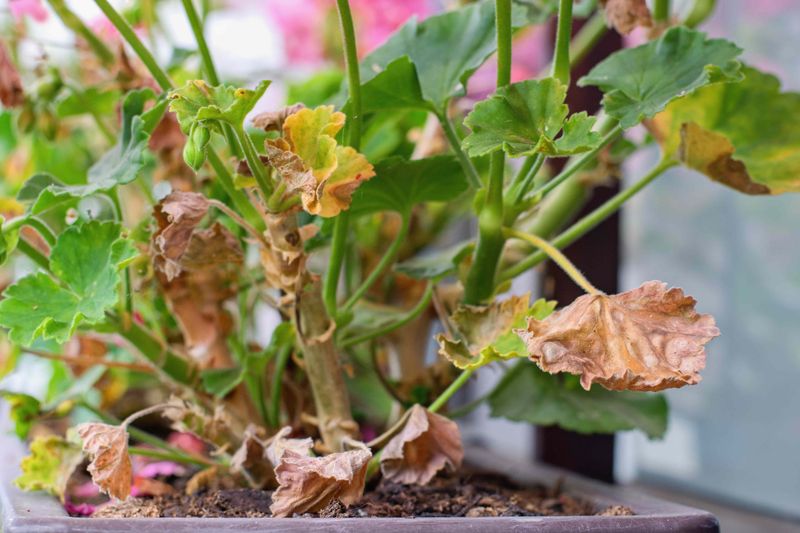
Spotting yellow leaves on your geranium can send any gardener into a quiet panic, but yellowing alone rarely tells the whole story. Most common bedding and container geraniums are actually Pelargonium, a sun-loving plant that can yellow for several different reasons, from soggy roots to dry soil to nutrient gaps.
Before you reach for fertilizer or start pulling plants, a quick inspection of the root zone and leaf pattern can point you toward the right fix. Many cases are manageable once you know what to look for.
Identify the plant and read the yellowing pattern
Most plants sold at Southern garden centers as “geraniums” are actually PelargoniumGeranium, a warm-season annual that thrives in containers and bedding areas. True hardy geraniums belong to the genus and behave quite differently in the landscape, tolerating more cold and shade.
Mixing up the two can lead to the wrong care advice, so confirm your plant before acting on any recommendation. RHS Pelargonium guidance makes this distinction clearly, separating the two genera by growth habit and hardiness.
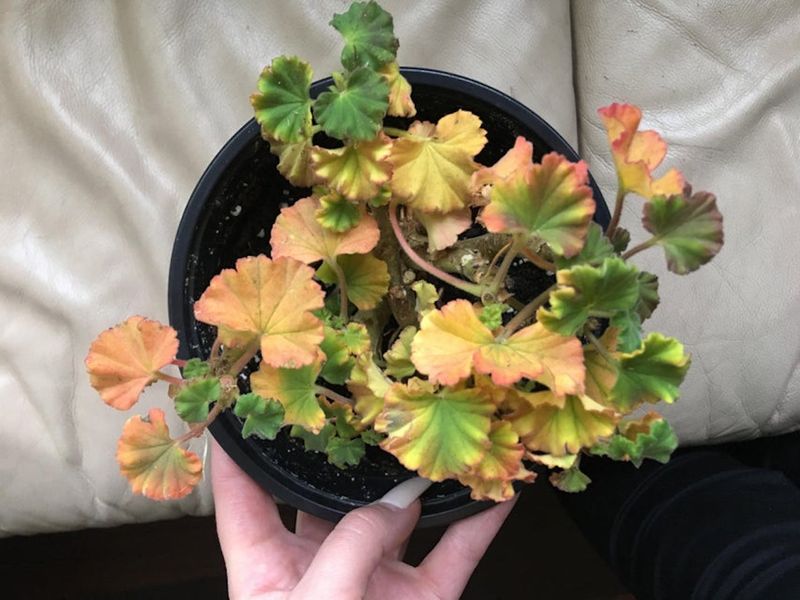
Once you know you have a Pelargonium, take a close look at which leaves are yellowing and whether anything else is happening. Older, lower leaves turning yellow while the rest of the plant looks reasonably healthy suggest a different problem than a plant where every leaf is going pale at once.
NC State Extension’s Pelargonium profile notes that lower leaves can yellow and drop when plants become too dry, which is easy to misread as overwatering.
Look for additional clues alongside the color change: blisters or watery spots on leaf undersides, brown or black lesions, wilting that does not recover after watering, or widespread leaf drop all shift the picture. Cornell Greenhouse Horticulture’s disease guide for Pelargonium lists multiple conditions that can produce yellowing, from bacterial blight to fungal root rot, each with its own set of accompanying symptoms.
These observations narrow the possibilities but cannot establish a diagnosis by themselves.
Check the root zone before blaming the leaves
Yellow leaves on a Pelargonium are a signal from the root zone at least as often as they are a leaf problem. Water and drainage deserve the first look because roots that stay oxygen-starved in soggy soil cannot function properly, and stressed roots quickly show up as yellowing foliage above ground.
At the same time, roots that have been allowed to dry too far send the same distress signal, so the goal is not simply to water less.
“Overwatering” is often misunderstood as watering too many times per week, but the real issue is a root-zone condition. Poor drainage, compacted potting mix, blocked container holes, and saucers left full of water can all keep roots sitting in moisture even when the gardener is watering on a reasonable schedule.
Clemson Extension’s indoor geranium guide recommends checking soil dryness several inches down rather than following a fixed calendar, because environmental factors change how quickly the root zone dries out.
NC State’s Pelargonium profile describes established plants as drought-tolerant and suited to containers that dry between waterings, but UF/IFAS guidance on Pelargonium specifically flags excessive drying as a cause of lower-leaf yellowing and drop. In Southern heat, where containers can dry faster than expected, reducing water is not automatically the right move.
Check what the soil is actually doing before changing anything.
Inspect moisture and drainage before changing the routine
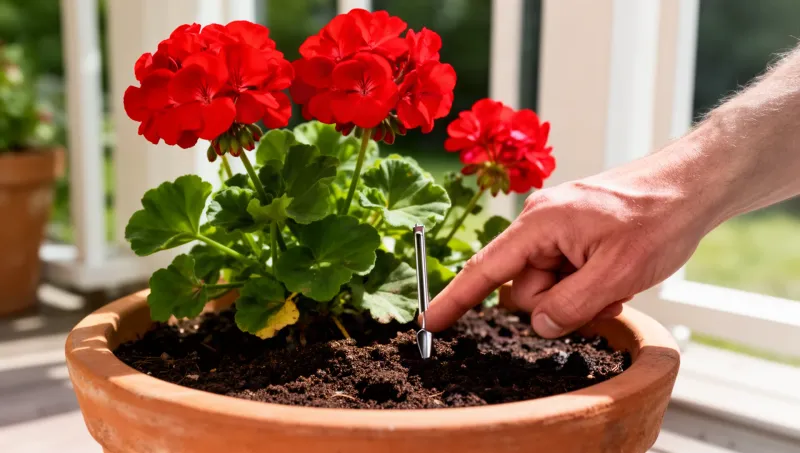
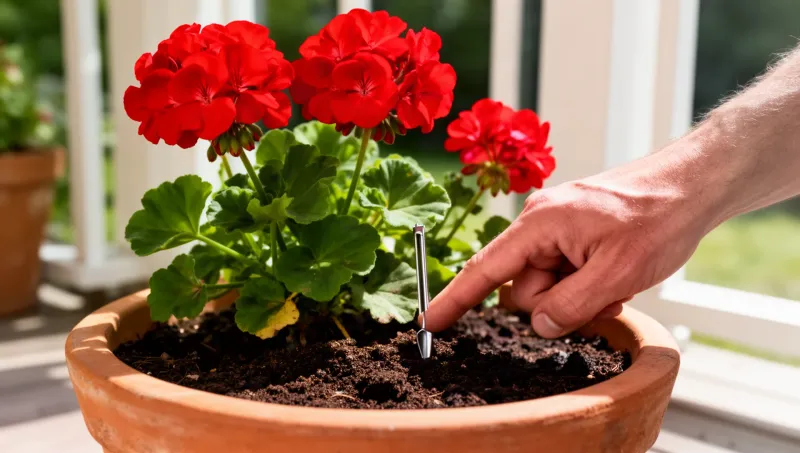
A practical inspection takes only a few minutes and gives you much more reliable information than guessing from the leaf color alone. Push a finger or a wooden skewer several inches into the soil and pull it out: soil that feels wet or leaves moisture clinging to the skewer after sitting for a day or two without rain signals a drainage problem, not a need for more water.
Soil that feels bone dry and pulls away from the pot edges tells a different story entirely.
For container plants, check whether the drainage holes are open and unobstructed. Roots, compacted soil, or a layer of gravel placed directly over a small hole can all slow or block outflow.
Clemson Extension’s annual geranium fact sheet advises watering at the soil surface or plant base, preferably in the morning, and emptying any standing water from saucers after each watering session. A saucer left full of water keeps the root zone wet long after the surface soil appears to have dried.
When a container or bed consistently stays soggy, the fix is structural, not just a matter of timing. Switching to a free-draining potting mix, moving to a container with larger or more drainage holes, or raising a bed slightly can do more than any watering schedule adjustment.
UF/IFAS recommends well-drained soil and slightly raised beds for Pelargonium, and UGA Cooperative Extension’s geranium guide echoes the recommendation to check soil conditions rather than rely on a rigid watering calendar. Heat, wind, sun exposure, pot size, and recent rainfall all affect how quickly the root zone dries, so no single schedule works for every situation.
Recognize edema as a different water-imbalance problem
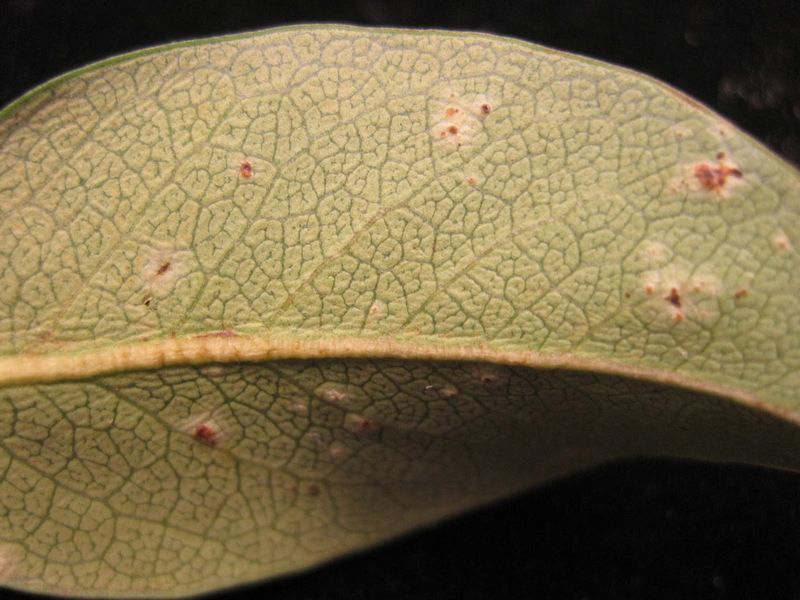
Edema is one of the less obvious reasons a Pelargonium can develop yellow leaves, and it is frequently overlooked because it does not involve a pathogen. Penn State Extension’s edema fact sheet explains that the disorder develops when roots absorb water faster than the leaves can release it through their pores, causing cells to swell, burst, and eventually collapse.
The result is a pattern of watery, translucent spots or small blisters that appear first on the undersides of older leaves before progressing to tan, brown, or corky patches and eventual yellowing and leaf drop.
The conditions that trigger edema are specific: warm, wet soil combined with cool, humid air and limited air circulation around the foliage. This combination is common in Southern gardens during overcast stretches in spring or after heavy rain events when soil stays saturated.
Edema is not contagious and will not spread to other plants the way a bacterial or fungal disease can.
Managing edema means addressing the environment rather than treating a disease. Reduce watering during humid or cloudy periods when the plant cannot transpire efficiently.
Improve spacing between plants to allow better airflow, and avoid wetting foliage when watering. Edema damage already present will not reverse, but slowing the water intake during vulnerable conditions can prevent new blisters from forming.
Seeing corky patches on leaf undersides alongside yellowing is a meaningful clue that separates edema from ordinary overwatering stress.
Use other symptoms to look beyond watering
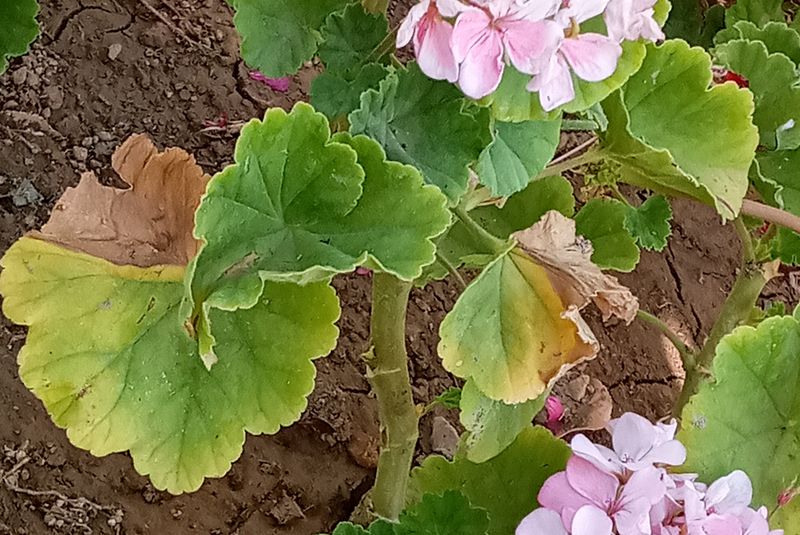
Correcting moisture and drainage is a smart first step, but it should not become the only lens through which you look at a yellowing plant. A Pelargonium where the whole plant appears washed-out or pale green, with older leaves affected before newer ones, may be running low on nitrogen.
UMass Extension’s geranium nitrogen deficiency documentation shows how light-green to yellow coloring on older leaves can reflect nutrient availability rather than a watering problem. Interveinal yellowing, where leaf veins stay green while the tissue between them turns yellow, or yellowing along leaf margins, can point toward a different nutrient gap altogether.
Before adding any fertilizer, rule out root-zone problems first. Roots sitting in waterlogged or compacted soil cannot absorb nutrients efficiently even when those nutrients are present, so fertilizing a plant with a drainage problem may not help and could add salt stress to an already struggling root system.
Diagnose from the full picture, not from leaf color alone.
A separate set of symptoms signals something more serious than a nutrition or watering issue. Brown or black lesions on leaves or stems, dark streaking inside a cut stem, sudden wilting that does not respond to watering, or rapid widespread leaf drop are all flags that Cornell’s Pelargonium disease resource and Penn State’s geranium disease guide associate with bacterial blight, fungal root rot, or vascular wilt.
Pest feeding, including damage from aphids or spider mites, can also cause stippling or distorted yellowing that mimics nutrient stress. When these additional symptoms appear, a basic watering adjustment is unlikely to be enough.
Clean up damaged leaves without mistaking cleanup for treatment
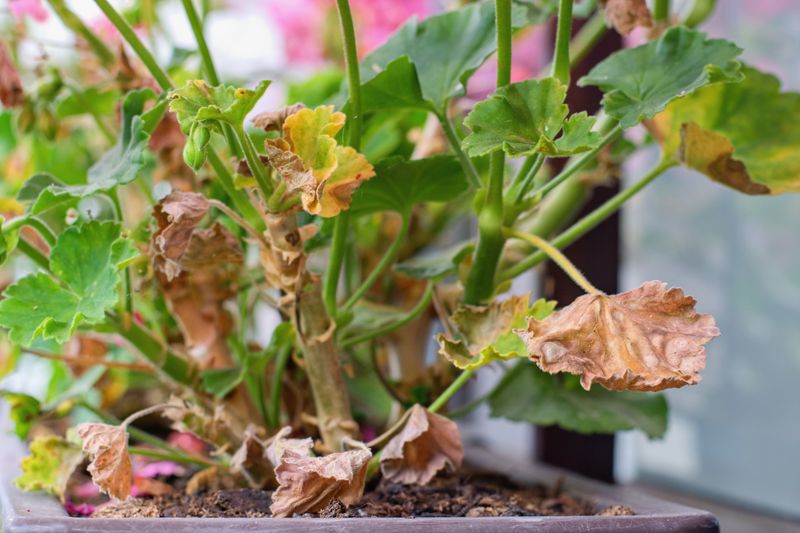
Removing yellow, brown, or badly damaged leaves is a reasonable part of caring for a struggling Pelargonium, but it is a sanitation step, not a cure. Pulling off discolored foliage tidies the plant and eliminates material that can harbor disease spores or pests, but it does nothing to correct waterlogged soil, blocked drainage, a nutrient gap, or an active infection.
The underlying condition still needs to be addressed separately.
When removing leaves, preserve all foliage that still looks healthy and green. Stripping too much live material from an already stressed plant reduces its ability to photosynthesize and recover.
Penn State Extension’s geranium disease guide recommends discarding suspect diseased material rather than adding it to a compost pile, particularly when bacterial leaf spot or blight is possible, since composting may not destroy the pathogen.
Clemson Extension’s annual geranium fact sheet advises watering at the soil surface or plant base, preferably early in the day, and avoiding routine overhead wetting of foliage. Wet leaves and crowded conditions favor the fungal and bacterial diseases that can complicate a simple yellowing case.
For mild yellowing where soil moisture and drainage have been corrected and no lesions or wilting are present, cleanup combined with better water management is a reasonable starting point. When disease, severe root damage, or a persistent nutrient problem is involved, those issues need their own evaluation rather than just a tidier-looking plant.
Know when a watering fix is not enough
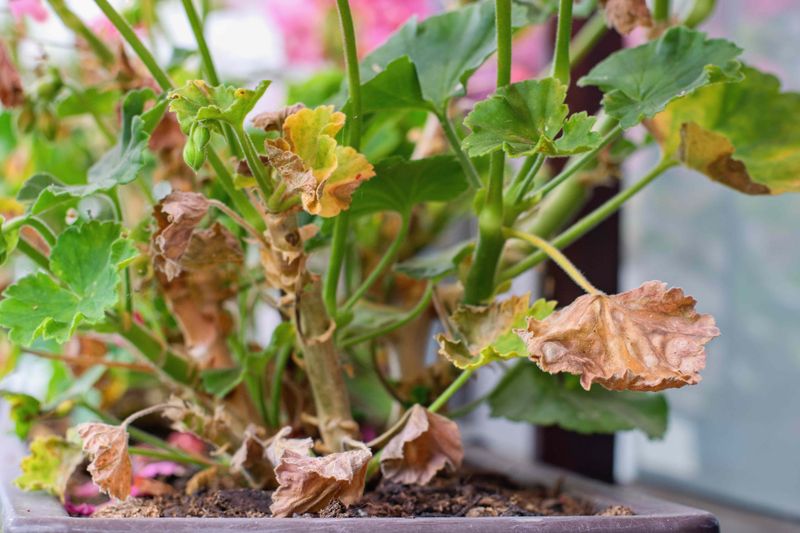
After inspecting the root zone, correcting any documented moisture or drainage problem, and cleaning up damaged leaves, the next step is simply to watch the plant. If new leaves emerge looking healthy and the yellowing slows or stops, that is a cautious encouraging sign that conditions are improving.
Damaged leaves that have already turned yellow are unlikely to regain their green color, so focus on what the new growth is doing rather than expecting the old leaves to recover. This is a practical observation, not a guaranteed diagnostic rule.
UF/IFAS notes that in much of central and southern Florida, Pelargoniums are often treated as cool-season color plants because flowering can fade and plants can decline by mid-to-late summer. Extreme heat, drought stress, and seasonal decline can complicate any yellowing diagnosis in the South, making it harder to separate a watering problem from natural seasonal fatigue.
Adjust expectations based on your local conditions and time of year.
Some situations call for more than a watering adjustment. Progressive wilting that does not respond to corrected moisture, soft or blackened stems, a foul smell from the root zone, suspicious lesions, or vascular discoloration when a stem is cut open are all signs that Cornell’s disease resource and Penn State’s geranium disease guide link to conditions that water management alone cannot fix.
Treat those warning signs as a prompt to consult your local cooperative extension office rather than as ordinary stress to wait out. Yellow leaves are often the beginning of a solvable problem, but reading the full picture is what keeps a manageable situation from becoming an unrecoverable one.