
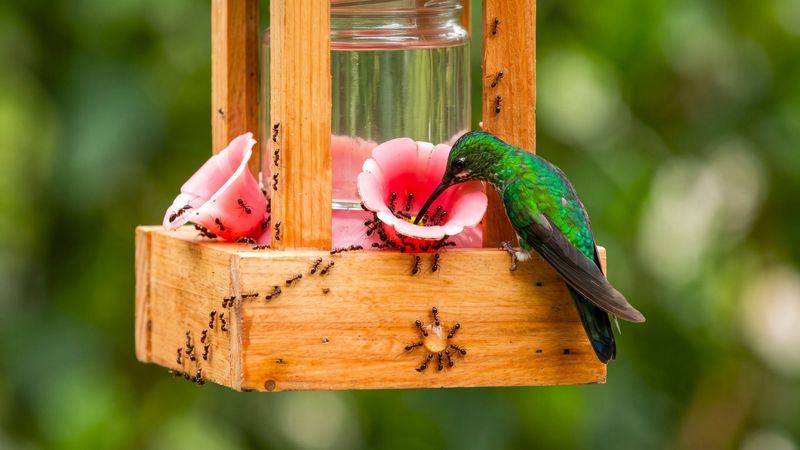
Ants around a hummingbird feeder are one of the most frustrating backyard problems in the South, especially when summer heat is already making feeder maintenance a daily job. If a line of ants has shown up seemingly overnight, a leaking feeder may be giving them exactly what they need: a steady drip of sugar water on the feeder, the hanger, or the porch below.
Fixing that leak, cleaning the residue, and blocking ant routes can make the feeder usable again without harming the birds you are trying to attract.
A nectar leak may be the ants’ easiest food source
Ants are drawn to sugar, and a feeder dripping nectar onto the hanger, railing, or porch gives them a food source that is far easier to reach than flower nectar deep inside a bloom. When an ant line appears suddenly around a hummingbird feeder, a leak is one of the most practical explanations worth checking first, even though it is not the only possible cause.
Audubon’s guidance on feeder pests specifically points to loose components and nectar drips as conditions that can attract ants quickly.
A leak is a strong hypothesis, not a guaranteed diagnosis. Cornell Lab’s advice on keeping ants out notes that ants may find a feeder through the hanging wire, nearby plants, vines, or spilled nectar left during filling, even when the feeder itself is not dripping.
A functioning feeder can still attract ants if a sugar trail exists anywhere along the route.
The most useful first step is to inspect the feeder before doing anything to the yard or the ant colony. Look for wet spots on the feeder body, the base, the hanger, and any surface directly below the feeder.
That inspection will tell you whether a drip is the likely culprit or whether ants are simply finding their way in from another direction.
Several feeder problems can create a drip
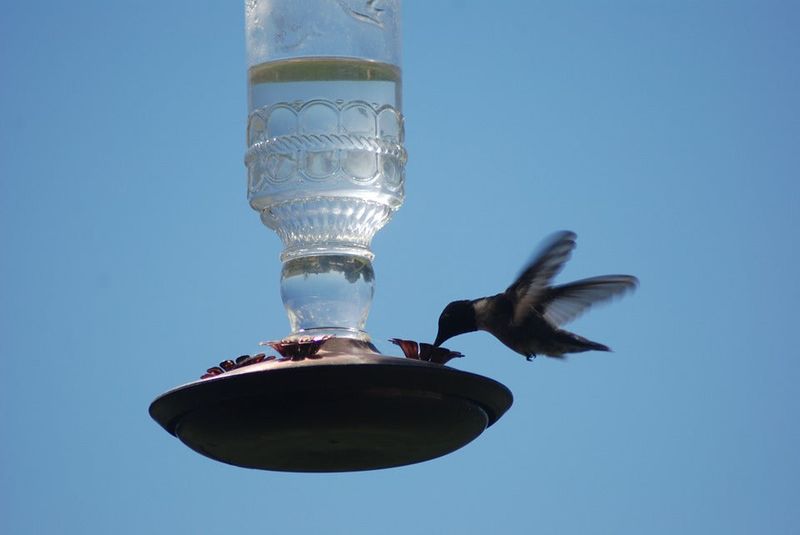
A dripping feeder does not automatically mean the reservoir is cracked. One of the most common causes, particularly with inverted bottle- or tube-style feeders, is direct sunlight warming the air trapped inside the reservoir.
As that air expands, it pushes nectar outward through the feeding ports or around the seal. Cornell Lab’s hummingbird feeding guide identifies this pressure-driven drip as a specific reason to keep bottle-style feeders out of direct sun.
Tray or saucer feeders work differently because they do not rely on the same air-pressure balance, so this particular mechanism applies mainly to the inverted bottle design.
Beyond sun exposure, loose assembly is one of the most overlooked causes. If the base is not threaded on evenly, if the gasket or sealing ring is seated at an angle, or if the feeder was reassembled without checking each part, nectar can find a path out.
Birdfy’s troubleshooting guide for feeder leakage lists an improperly seated seal and a tilted feeder among the leading causes of drips.
Wind, swinging, bumps from larger birds landing on the feeder, and overfilling the reservoir can all cause nectar to splash out as well. Audubon recommends hanging feeders in a less-breezy spot and securing all components before assuming the feeder itself is defective.
Each of these mechanisms points to a specific thing to look for during inspection: the seal, the angle of hang, the fill level, and the location.
Empty the feeder and inspect every seal
Taking the feeder down for a close look is the most direct way to find where nectar is escaping. Start by emptying and discarding any nectar that may be cloudy, contaminated, or of uncertain age.
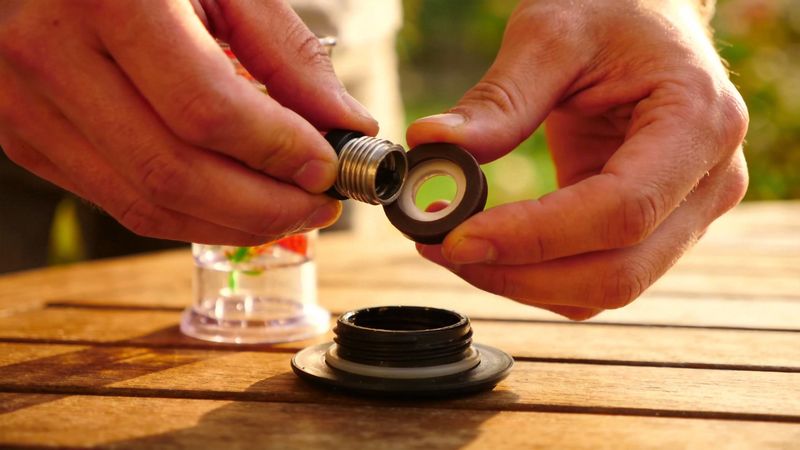
Then separate the feeder into its main components: the reservoir, the base, the threads or locking ring, the gasket or sealing ring, and the individual feeding ports.
Birdfy’s leakage troubleshooting steps highlight two specific things to check: whether the seal is seated flat all the way around, and whether the feeder hangs level once it is rehung. A gasket that is even slightly twisted or pinched on one side can let nectar seep out steadily.
Run a finger around the full circumference of the seal to feel for gaps, folds, or compression marks that suggest it has been seated unevenly.
Reassemble the parts evenly and tightly, following the manufacturer’s directions for your specific feeder model. Do not use glue, tape, petroleum products, or household sealants on any surface that contacts nectar or that a bird might touch.
If a gasket is cracked, brittle, or deformed, replace it with the correct part from the manufacturer rather than improvising a fix. Once the feeder is back together, check that it hangs level.
A tilted feeder puts uneven pressure on one side of the seal and can cause a drip even when every part is otherwise in good shape.
Move the feeder and erase the sugar trail
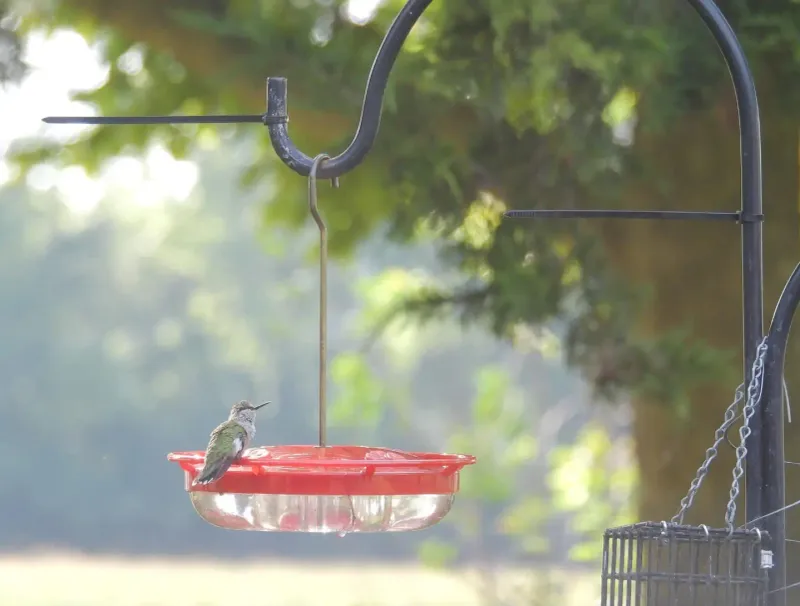
Once the feeder is reassembled and the leak is corrected, where it hangs matters more than most people realize. Bottle-style feeders that dripped because of sun-warmed air pressure will benefit from being moved to bright shade or a spot that gets morning sun with afternoon shade.
Cornell Lab notes that shade also slows nectar spoilage, which is a real concern during Florida and Texas summers when temperatures routinely climb well above 90 degrees Fahrenheit.
Securing the feeder in a less-breezy location reduces the swinging and splashing that can create a sugar trail even from a feeder that is otherwise well-sealed. Audubon specifically recommends taking feeders down during rough weather and checking that all components are tightened before rehinging.
A feeder that swings hard in wind will lose nectar through the ports regardless of how well the seal is seated.
After the feeder is repositioned, rinse nectar from every surface it touched: the feeder body, the hanger, the hook, the porch railing, and any surface directly below where it was hanging. Plain water is enough to remove sugar residue from hard surfaces.
Skipping this step leaves the sugar trail intact, and ants will continue following it to a feeder that is no longer leaking. Residue on the feeder’s exterior can also attract bees, so a thorough wipe-down protects the feeder from multiple insect visitors at once.
Use an ant moat only after blocking bypass routes
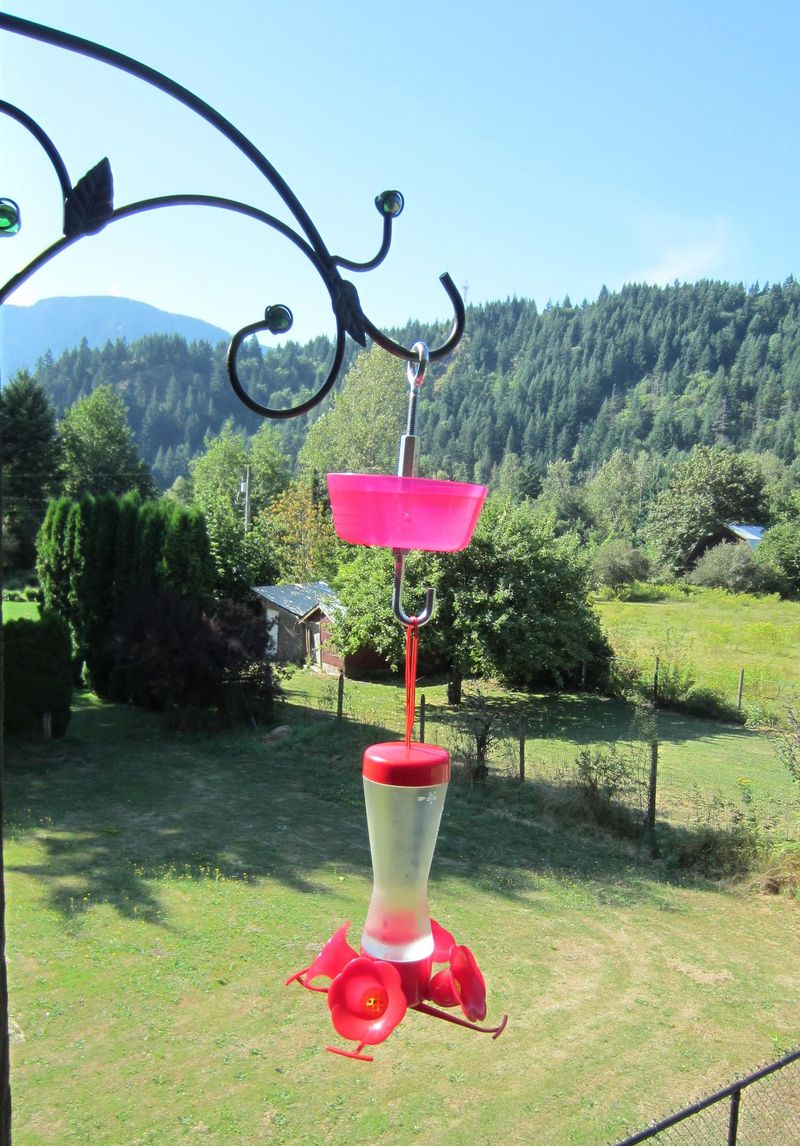
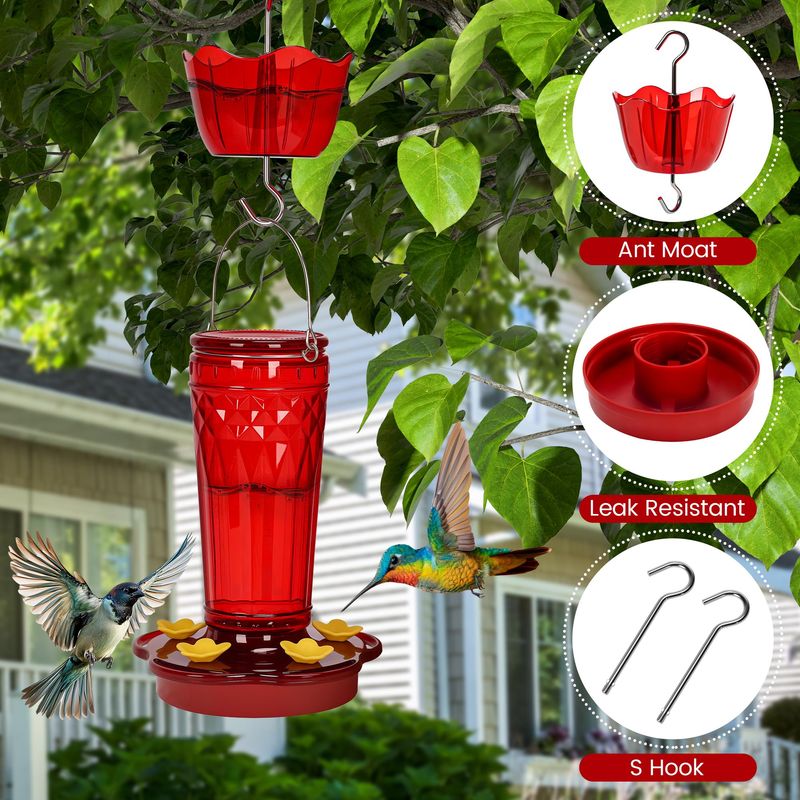
A water-filled ant moat is the most widely recommended physical barrier for keeping ants away from feeder ports. The moat hangs between the hanger and the feeder itself, and ants that walk down the wire or string hit the water and cannot cross.
Cornell Lab identifies moats and ant guards as practical tools for blocking ant access, and Texas Parks and Wildlife recommends placing a moat on the hanging wire or string above the feeder.
The barrier only works if ants cannot go around it. Before relying on the moat, walk around the feeder and check whether any branch, vine, porch post, eave, or string comes close enough to touch the feeder or hanger.
Ants are resourceful, and a single twig brushing the side of a feeder is enough to bypass the moat entirely. Trim or redirect any vegetation that reaches the feeder’s zone, and keep the hanger away from porch structures that ants can climb.
Bee guards, which are small mesh or plastic covers over the feeding ports, are sometimes sold alongside ant moats. They are different tools with different purposes.
Audubon notes that bee guards are not a substitute for cleaning when the feeder is coated in sugar water, and they do nothing to fix a dripping reservoir or remove nectar already on the feeder’s exterior. An ant moat blocks the route; it does not remove the food source.
That is why cleaning and repairing the leak come before adding any barrier.
Fresh nectar and clean parts protect hummingbirds
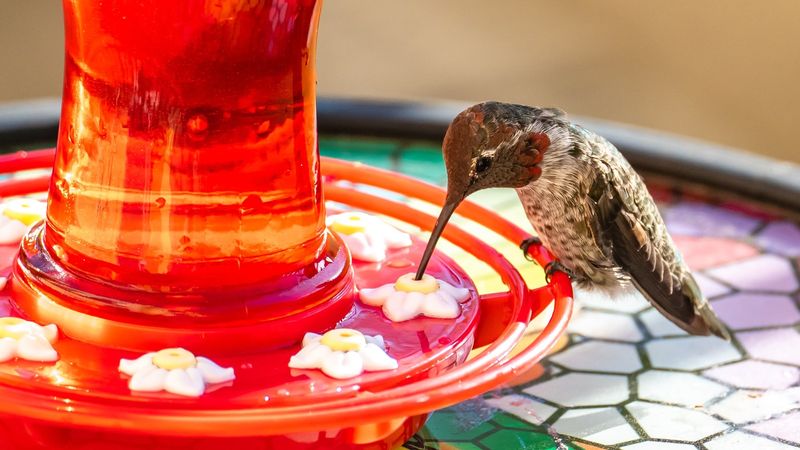
The nectar formula is straightforward: one part refined white sugar dissolved in four parts water. Audubon’s hummingbird feeding FAQ is clear that honey, artificial sweeteners, extra sugar, and red dye have no place in the mixture.
Honey can ferment quickly and promote fungal growth, while dye adds nothing that benefits the birds. Natural flower nectar is clear, and a simple sugar-water mixture at the correct ratio matches it closely enough.
In Florida and Texas, summer heat makes nectar go bad faster than most feeder guides suggest. Cornell Lab recommends changing nectar every day in very hot weather and never leaving it out more than two or three days under any conditions.
UF/IFAS guidance on Florida hummingbirds warns that direct sunlight and high temperatures accelerate bacterial growth inside the feeder. Inspect the nectar daily during heat waves or heavy use, and discard it immediately if it looks cloudy, smells fermented, or contains mold or drowned insects.
Cleaning the feeder thoroughly before every refill removes the biofilm and residue that build up quickly in warm weather. Hot water and a bottle brush are the most broadly supported cleaning tools across reputable sources.
Audubon’s hummingbird yard guide and Cornell both advise against soap or detergent, while some UF/IFAS resources allow a small amount of soap or recommend vinegar. Because guidance differs, the safest approach is to follow the feeder manufacturer’s cleaning instructions, use hot water and a brush as the primary tools, and rinse every part extremely well before refilling.
Fix the feeder before treating the insects
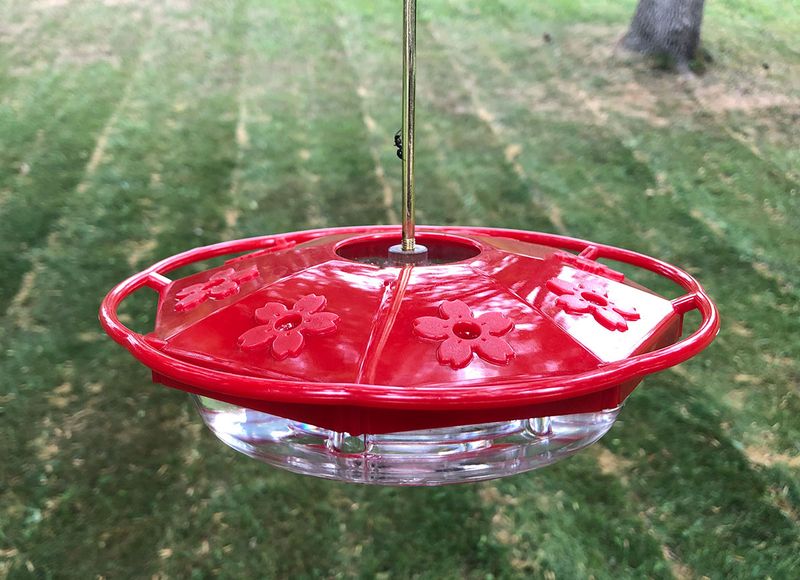
When ants show up around a hummingbird feeder, the most productive first move is to look for leakage or sugar residue before reaching for any yard treatment. Check the feeder, correct any loose parts or placement problems, clean the surrounding surfaces, and add a water-filled moat if ants are still finding a route.
That sequence addresses the actual food source rather than treating the symptom.
Spraying insecticide on the feeder, the hanger, or the ant trail nearby is not a safe option. Audubon’s guidance on hummingbird-friendly yards recommends keeping yards pesticide-free, in part because hummingbirds eat insects and spiders for protein.
Killing the insects around a feeder removes part of the birds’ diet and can expose them to chemicals they encounter while feeding or preening.
Feeder nectar gives hummingbirds a reliable energy source, but UF/IFAS notes that feeder nectar supplements, not replaces, the nutrients birds get from flowers and insects. A yard with native flowering plants and no broad insecticide use supports hummingbirds far more completely than a feeder alone.
Fix the leak, clean the residue, and protect the broader habitat, and the feeder becomes one useful part of a yard that works for the birds year-round.