
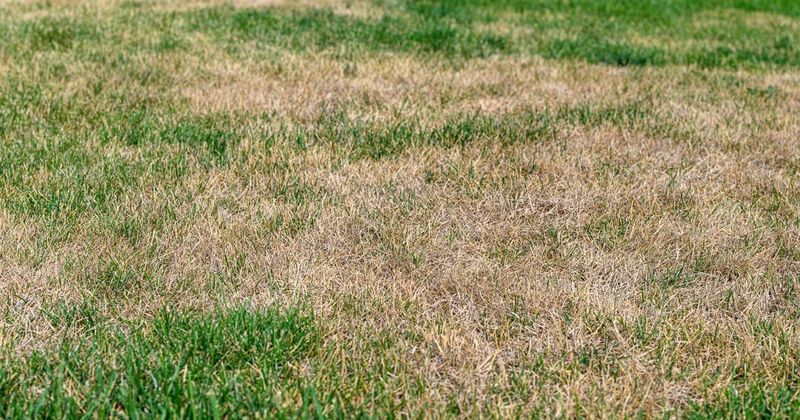
Watching your lawn go from green to tan right after mowing is one of the more frustrating yard problems in the South, especially when you have no idea why it keeps happening. The mower setting you choose matters more than most homeowners realize, and cutting warm-season grass too short can weaken the turf and open the door for weeds to move in.
That said, low mowing is not the only explanation for brown or weedy grass, and blaming the mower before checking other causes can send you chasing the wrong fix. This article walks through how to read the clues, match your height to your grass, and figure out whether something else is driving the problem.
Treat the post-mowing color change as a clue
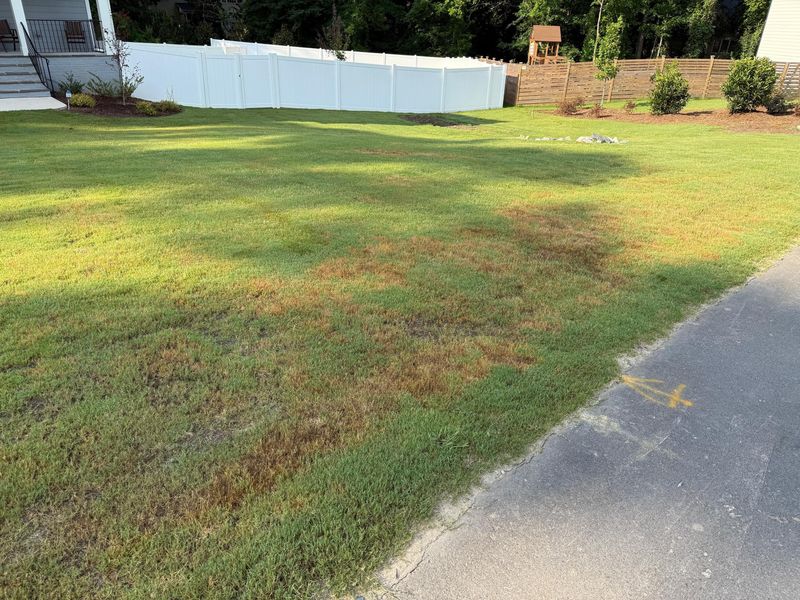
A lawn that shifts from green to tan right after the mower passes is worth paying attention to, but that color change is a clue rather than a verdict. Texas A&M AgriLife guidance on bermudagrass home lawns specifically notes that a green-to-brown change after mowing suggests too much green tissue has been removed, which can happen when the mower is set too low or when the lawn has been allowed to grow too tall between cuts.
That observation is most directly tied to bermudagrass, so keep the species in mind before applying it to every warm-season turf.
For other grasses like St. Augustinegrass, centipedegrass, or bahiagrass, post-mowing discoloration can still point to excessive leaf removal, but cultivar differences, existing stress, and blade sharpness all affect how obvious that color shift looks. A freshly scalped lawn tends to look uniformly tan across a mowed area, which is different from older, irregular brown patches that show up in scattered or circular patterns.
Uniform tan that appears right after cutting and then gradually greens back up over several days is more consistent with a mowing issue.
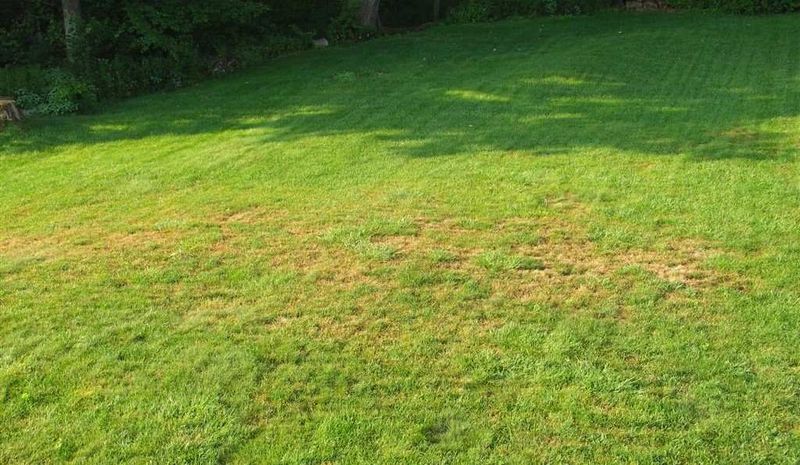
Irregular patches that stay brown regardless of mowing, spread over time, or follow the edges of a shaded area or sprinkler gap are more likely tied to disease, irrigation failure, or another cause. UF/IFAS guidance on turfgrass disease management cautions that short mowing, drought, and nutritional deficiencies can all injure turf in ways that look similar, so the timing and pattern of discoloration matter when you are trying to sort out what is actually going on.
Excessive leaf removal weakens the turf canopy
Every time you run the mower, you are reducing the green leaf area the grass uses to capture sunlight and produce energy. When you remove too much of that leaf area in a single pass, the plant has less capacity to recover, which can weaken the stand over time and reduce root development.
The concern is not simply that a lawn is maintained at a short height, but that repeated cutting removes more leaf tissue than the grass can quickly replace.
Thin turf and exposed soil are where the weed connection comes in. UF/IFAS weed management guidance for Florida lawns explains that weeds generally take advantage of weakened turf and open soil rather than being the original cause of decline.
A dense, vigorous canopy shades the soil surface and competes with weed seedlings for light and space, while bare or thin areas give those seedlings a much easier start.
Research on mowing effects and turf performance supports the idea that excessive leaf removal is the more important concern, not simply the fact that a lawn is kept at a shorter height. A recent review in Crop, Forage and Turfgrass Management and related work published in Crop Science note that routine mowing within a grass’s recommended range does not automatically reduce stress tolerance.
The problem is when cuts consistently strip away too much green tissue at once, leaving the plant scrambling to rebuild rather than maintaining a stable, competitive canopy.
Match the cutting height to the grass
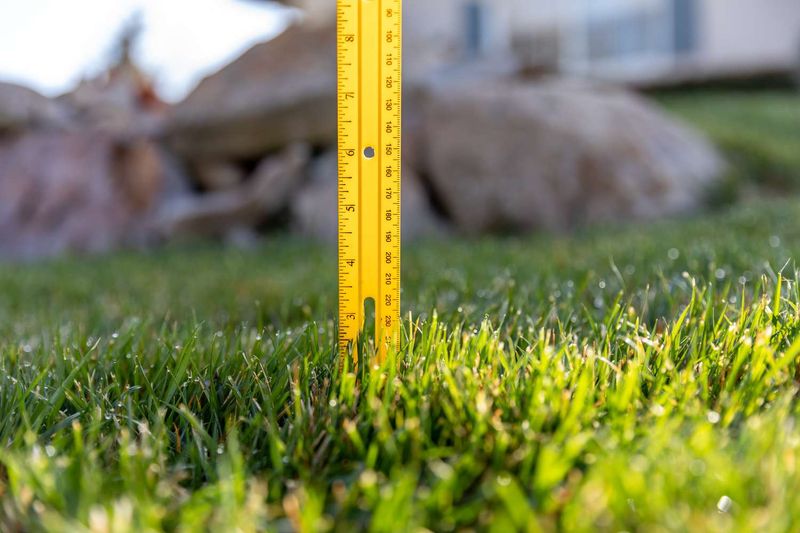
Before touching the mower deck, identify the grass in your yard. The right cutting height varies considerably by species, and using the wrong target can damage turf even if your technique is otherwise solid.
UF/IFAS mowing recommendations for Florida lawns and Texas A&M AgriLife mowing guidance for warm-season turfgrasses both publish species-specific ranges that reflect how each grass grows and recovers.
Approximate targets for common Southern grasses run roughly like this: bahiagrass performs well at about 3 to 4 inches; St. Augustinegrass is generally recommended at about 2.5 to 4 inches; centipedegrass fits best around 1.5 to 2 inches; bermudagrass on home lawns commonly falls in the 1 to 2 inch range with a rotary mower; and zoysiagrass height depends on cultivar, with coarser types in Florida often cited around 2 to 2.5 inches. UF/IFAS turfgrass selection guidance notes that these ranges span a wide enough spread that species and cultivar matter before any other adjustment.
A 1-inch cut that works reasonably well for certain bermudagrass cultivars maintained with frequent mowing and adequate fertility would be damaging on St. Augustinegrass or bahiagrass, where cutting that low exposes the stolons and removes most of the photosynthetic leaf area. Texas A&M AgriLife St. Augustinegrass management guidance specifically links frequent scalping to exposed soil and greater weed emergence.
The opposite extreme also causes problems: letting any warm-season grass grow well above its recommended range and then cutting it back down in one pass forces the same kind of excessive tissue removal that a too-low setting causes every time.
Shade, season, mower type, local fertility, and irrigation capacity can all shift the practical target within a species range. When in doubt, stay toward the upper end of the recommended range for your grass during heat stress, drought, or any period when the turf is already under pressure.
Reset the mower with the one-third rule
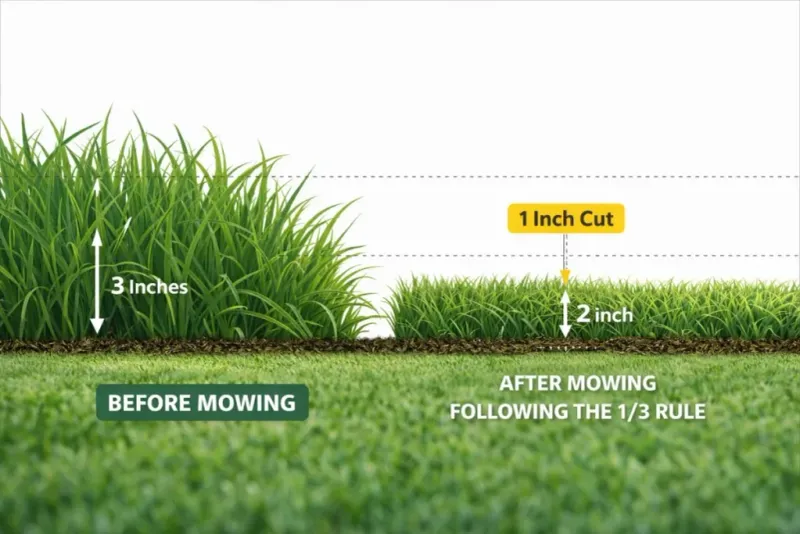
Adjusting the mower is straightforward once you know what height to target, but the cutting height stamped on the deck does not always match what the blade is actually doing. Use a hard, flat surface and measure from the ground to the blade before committing to a new setting.
Many homeowners discover the mower has been running a half-inch or more lower than they assumed.
Texas A&M AgriLife guidance on St. Augustinegrass describes the one-third rule clearly: remove no more than one-third of the green leaf blade at any single mowing. If you maintain your lawn at 2 inches, mow before it grows past about 3 inches.
Cutting a 4-inch lawn back to 2 inches in one pass removes half the blade, which is the kind of excessive removal that triggers browning and weakens the stand. The fix is not always raising the height, it is also mowing more frequently so the grass never gets tall enough to require a severe cut.
Sharp blades matter more than most homeowners give them credit for. Dull blades shred the leaf tip rather than cutting cleanly, leaving a frayed edge that turns brown and creates a ragged appearance across the whole lawn.
UF/IFAS St. Augustinegrass guidance and broader UF/IFAS turfgrass disease management recommendations both flag dull blades as a source of injury and increased disease risk. Sharpen or replace blades at least once per season, or more often if you mow frequently or hit debris.
Skip mowing when the grass is wet if you can. Wet clippings clump, the cut comes out uneven, wet soil compacts more easily under mower wheels, and mowing wet turf can spread some pathogens from one area of the lawn to another.
None of those outcomes help a lawn that is already struggling.
Give stressed turf enough leaf to recover
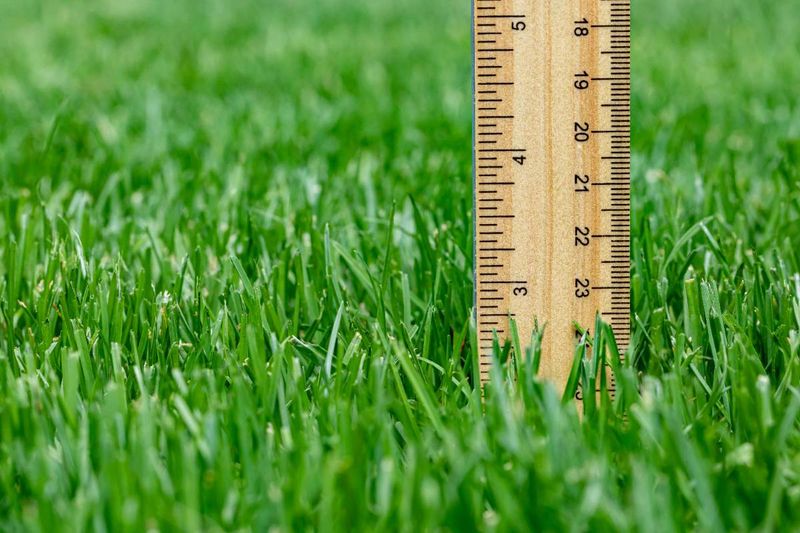
Shade changes the mowing equation in a meaningful way. Grass growing under trees or along the north side of a fence or structure gets less sunlight and needs more leaf area to capture what it can.
Oklahoma State University turfgrass shade management guidance and Penn State Extension shade turf recommendations both call for raising the mowing height modestly in shaded areas. Cutting shaded grass as short as sunny sections removes the leaf area the plant is depending on to function, which speeds decline in spots that are already marginal.
Brown color does not automatically mean the grass is thirsty. Warm-season grasses including bermudagrass can enter drought dormancy, turning brown and stopping active growth, then recover once adequate moisture returns.
UF/IFAS bermudagrass guidance describes this dormancy pattern and distinguishes it from injury-related browning. Before watering, look for the actual stress indicators: blades that fold or roll inward, a blue-gray tint to the canopy, and footprints that stay visible for longer than usual after you walk across the lawn.
When those signs are present, check soil moisture and sprinkler coverage before running the system. Texas A&M AgriLife bermudagrass management guidance recommends applying enough water to wet the root zone, then allowing the lawn to dry appropriately before irrigating again.
Uneven sprinkler coverage is a common hidden cause of patchy brown areas that looks almost identical to a mowing problem, so running through each zone and checking for dry spots or blocked heads is a useful step before assuming the mower is to blame.
Build dense turf before treating weeds
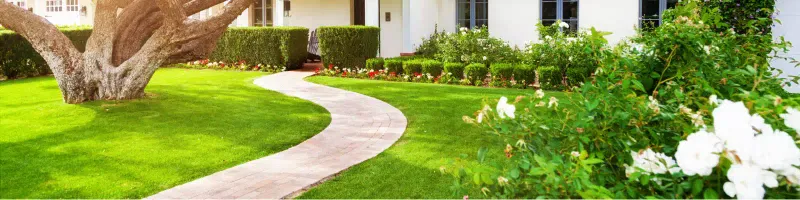
Weeds showing up in thin areas after repeated low mowing is a pattern that many Southern homeowners recognize, even if they have not connected it to the mower. UF/IFAS weed management guidance for Florida lawns frames the relationship clearly: weeds exploit weakened turf and open soil rather than invading a healthy, dense stand on their own.
A vigorous canopy shades the soil surface and competes with weed seedlings for light, space, and nutrients, while thin turf and bare patches give those seedlings exactly the conditions they need to get established.
Raising the mower and following the one-third rule are foundational steps, but mowing height alone is not a complete weed control strategy. Penn State Extension research on mowing and weed pressure notes that some weeds, particularly low-growing crabgrass types, are well adapted to short mowing and can persist even when height is corrected.
Penn State’s crabgrass identification and management resource confirms that these species tolerate a range of mowing heights, so height adjustment is one part of integrated prevention rather than the whole answer.
Rebuild turf density through appropriate mowing combined with matched irrigation, timely fertilization for the specific grass species, and selecting the right turf for the site conditions. When weeds are already established and cultural practices alone are not enough, targeted control becomes part of the conversation.
Any product you consider must be confirmed as labeled for your specific turfgrass and the weed you are targeting, applied according to the label, with appropriate precautions for children, pets, drift, and runoff before and after application.
Investigate brown patches that do not fit the mowing pattern
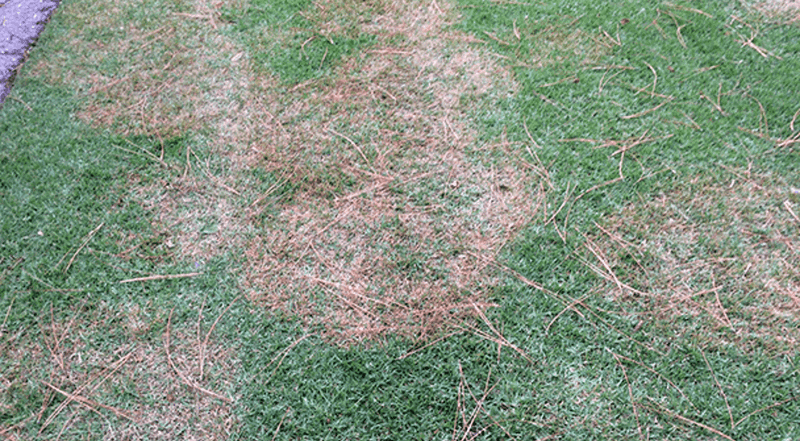
Not every brown patch traces back to the mower. Warm-season lawns in Florida and Texas can develop discoloration from drought dormancy, failed or uneven irrigation, fungal disease, insect feeding, shade stress, compacted soil, poor drainage, excess thatch, salt accumulation, or dog urine damage.
Sorting these causes out requires looking at the pattern, timing, and surrounding conditions rather than assuming the most recent mowing is responsible.
Drought dormancy and scalping-related browning look different when you examine them closely. Dormant bermudagrass typically browns relatively uniformly across exposed areas and recovers after sufficient rainfall or irrigation returns, as described in UF/IFAS bermudagrass guidance.
Scalping tends to produce a more uniform tan immediately after mowing that greens back up within days under good growing conditions. Circular or ring-shaped patches that expand over time, patches with a water-soaked or smoke-ring edge, or areas that stay brown regardless of mowing schedule are more consistent with disease.
Brown patch and large patch diseases involve more than just mowing height. Oklahoma State University brown patch disease guidance and OSU large patch management information both identify prolonged leaf wetness, overwatering, excess nitrogen, poor drainage, thatch buildup, and mowing wet grass as contributing factors.
Raising the mower alone will not cure an established disease.
UF/IFAS homeowner fungicide guidance cautions that short mowing, drought, and nutritional problems can injure turf in ways that mimic disease, making careful diagnosis important before any treatment. Check the patch edges, pull a few plugs to examine roots, probe the soil for moisture and compaction, and look for insect activity before deciding on a course of action.
Monitor recovery before escalating treatment
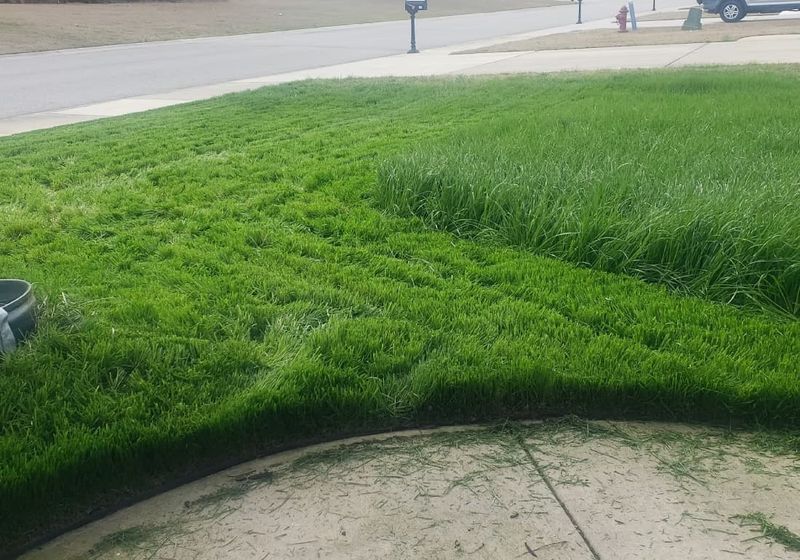
After correcting the mowing height and following the one-third rule, give the lawn a few mowing cycles before drawing conclusions. New growth from a properly set mower should look greener and more uniform than what you saw before the adjustment.
Track whether the thin or tan areas are filling back in, and note whether weed seedlings are appearing in the same spots or starting to lose ground to recovering turf.
If browning continues or follows a distinct pattern that does not match what a mowing correction would explain, shift your attention to water distribution, shade, drainage, disease, or insect pressure. UF/IFAS Florida mowing recommendations and Texas A&M AgriLife St. Augustinegrass management guidance both frame mowing as one component of a broader maintenance system, not a standalone cure.
When symptoms persist despite good mowing practice, UF/IFAS disease management resources can help you identify whether a pathogen or other stressor needs separate attention.
The goal is not the tallest cut you can get away with, but the height your specific grass can sustain without being repeatedly scalped or left so tall that the next mowing removes too much at once. A lawn managed at the right height for its species tends to stay denser, compete better, and need less intervention over time.