
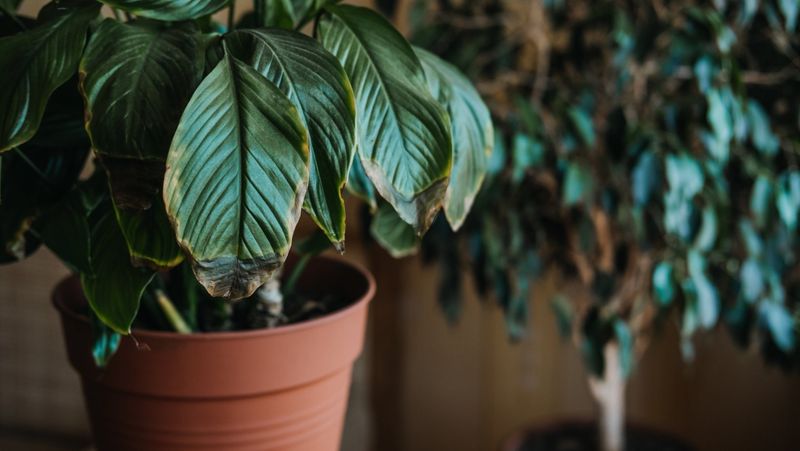
Brown tips and edges on a peace lily are frustrating enough the first time, but watching the damage spread after you’ve already trimmed the leaves can feel like a losing battle. The truth is that old brown tissue never turns green again, and cutting it off only improves how the plant looks – it does nothing to stop whatever is still stressing the roots, leaves, or environment.
Several different problems can produce the same browning symptom, sometimes at the same time, so pinning everything on one cause too quickly can make things worse. Working through a short checklist of the most likely stresses gives you a much better shot at stopping new damage before it takes over more leaves.
Continuing new browning can signal an unresolved problem
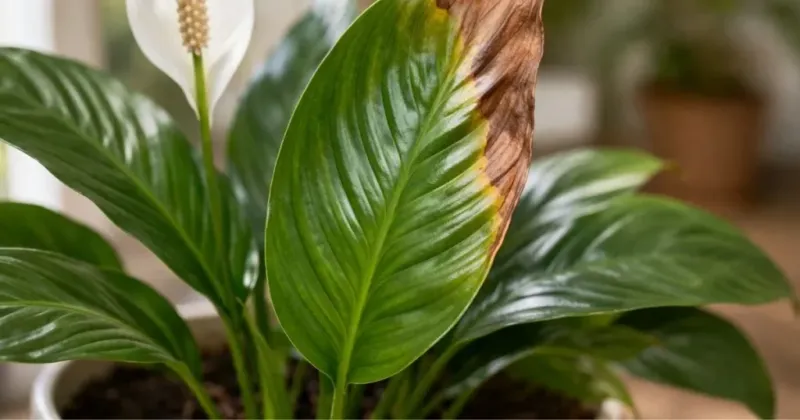
Brown tissue on a peace lily is permanent. Once a leaf tip or margin turns tan or brown and dries out, that cell damage cannot be reversed, and no amount of improved care will restore the color to that section of leaf.
Iowa State University Extension confirms that pruning brown tips only improves the plant’s appearance and does not address the underlying cause of the damage.
When new brown areas keep forming after you’ve trimmed the old ones, that pattern is worth taking seriously. It suggests that whatever triggered the original damage may still be present, or that a second stress has developed alongside it.
Clemson Cooperative Extension notes that several environmental and root-zone problems can produce similar browning symptoms, and more than one can occur at the same time.
Brown tips and edges are symptoms, not a diagnosis on their own. Before changing how you water, fertilize, or position the plant, it helps to work through the most likely checks in order: root-zone moisture and drainage, recent wilting history, light and heat exposure, humidity, fertilizer and mineral buildup, water quality, and any signs of pests or disease.
Adding more water right away, for example, can worsen root damage if the soil is already staying too wet.
Read the damage pattern before changing care
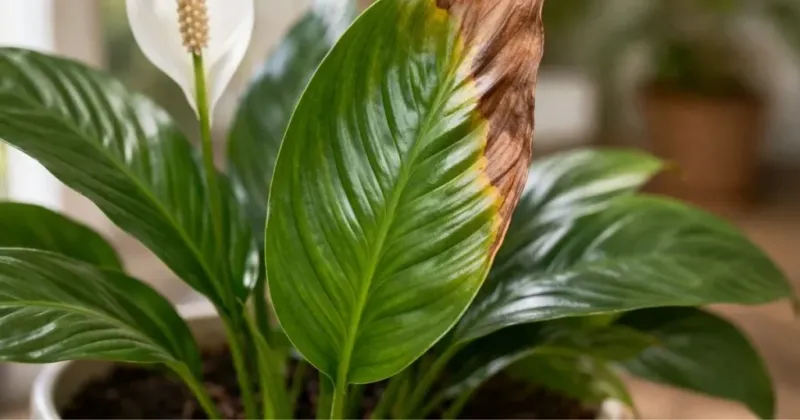
Before touching the watering can or moving the pot, spend a few minutes looking closely at where and how the browning appears. The shape, texture, and location of the damage can point toward different causes, even if it cannot identify one with certainty.
Dry, crispy tips and margins that feel papery are often associated with moisture stress, low indoor humidity, salt or fluoride buildup in the soil, or leaf scorch from too much direct sun. UC Statewide IPM guidance on houseplant problems distinguishes this kind of dry tip burn from discrete spots, lesions with halos, wet-looking patches, or rapidly expanding blotches that can suggest disease, chilling injury, pesticide damage, or other issues requiring different management.
Also consider the plant’s recent history alongside what you see. A peace lily that drooped and then recovered after watering has a different story than one that has been sitting in a wet pot for weeks.
Drooping alone does not confirm underwatering – Clemson Extension explains that root rot and drought stress can both cause wilting, so a plant that stays limp in wet soil needs a root inspection, not more water. Matching the damage pattern to recent conditions gives you a more useful starting point than jumping to a single explanation.
Use the root zone as a key watering checkpoint

Checking the root zone is one of the most informative things you can do when browning persists, especially if watering habits are hard to pin down. Push a finger about an inch into the potting mix.
If the upper layer feels bone dry and the plant has been drooping, repeated drought stress may be contributing to tip burn. If the mix feels soggy several days after watering, the roots may be sitting in poorly drained, oxygen-poor conditions for too long – which is what overwatering actually means, not simply giving the plant a thorough drink.
North Carolina Extension’s Spathiphyllum profile describes peace lilies as preferring evenly moist soil, watered thoroughly when the top layer begins to dry, with excess water allowed to drain freely afterward. The plant should never stand in a saucer full of runoff for extended periods.
Check the container itself. A pot without a drainage hole makes it nearly impossible to manage moisture properly.
An oversized pot can hold far more water than the roots use between waterings, keeping the mix wet longer than the plant tolerates. Penn State Extension and UF/IFAS cultural guidelines for Spathiphyllum both flag poor drainage and oversized containers as contributors to root problems.
If you tip the plant out gently and find roots that are dark, limp, or mushy rather than firm and pale, root damage is a more likely explanation for continued browning than simple low humidity.
Check light, heat, and drafts for continuing injury
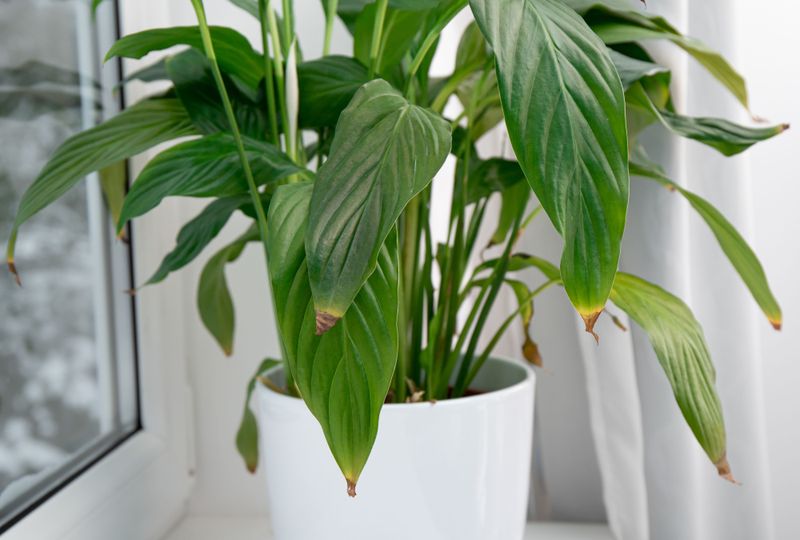
Placement problems can keep a peace lily browning even when watering looks fine. A spot that seems acceptable in winter can become damaging in summer when the sun angle shifts and window glass intensifies heat.
North Carolina Extension recommends bright, filtered or indirect light for peace lilies – not a sunny south- or west-facing windowsill, but also not a dim interior corner with almost no natural light. Very low light reduces vigor and flowering without eliminating browning caused by other stresses.
Heat sources and cold drafts are worth checking room by room. A peace lily sitting within a few feet of a heating vent, a window air conditioner, or a drafty sliding door can experience repeated temperature stress even when the thermostat reads comfortable.
Florida and Texas homes in particular can expose plants to intense window heat in summer and sudden cold from air conditioning set very low.
Peace lilies are tropical plants with no tolerance for frost or freezing. UF/IFAS production guidelines flag temperatures below roughly 45 degrees Fahrenheit as a chilling-injury risk under production conditions, and UF/IFAS Florida foliage care guidance classifies Spathiphyllum as not freeze-tolerant.
Those figures are useful warning points, not fixed thresholds for every cultivar in every home. Moving a plant abruptly from indoors to a shaded porch or back can also cause temporary stress, so any location changes should be gradual.
Treat humidity as one possibility, not the default answer
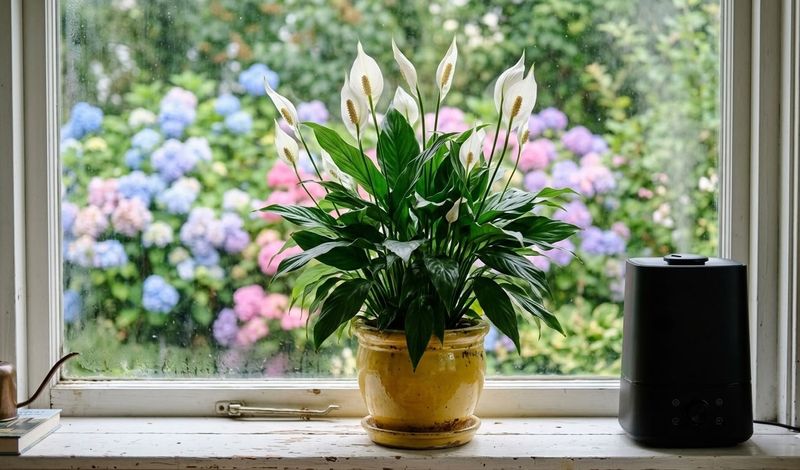
Low indoor humidity can contribute to dry, crispy leaf tips and margins on a peace lily, particularly in air-conditioned Florida and Texas homes where indoor air can become surprisingly dry. Humidity is worth investigating, but it should be evaluated alongside root condition and placement rather than assumed to be the main answer whenever brown tips appear.
Practical options for raising local humidity include grouping the peace lily with other plants, which allows shared transpiration to raise moisture in the immediate area, or running a room humidifier nearby. Iowa State Extension explains that a pebble tray filled with water can provide some local humidity benefit, but only if the pot sits above the waterline – never directly in the water, which would create the same drainage problems as a standing saucer.
The tray effect is limited and works best as a supplement to other methods rather than a standalone fix.
Frequent misting is not a reliable substitute. Iowa State Extension notes that foliage dries quickly after misting, making the humidity benefit too short-lived to matter, and that repeatedly wetting leaves may increase the risk of some fungal issues.
North Carolina Extension’s care profile supports grouping and humidifiers over misting as the preferred approach. Correcting humidity alone will not stop browning caused by root damage, salt buildup, or placement problems.
Investigate fertilizer, salts, and water quality
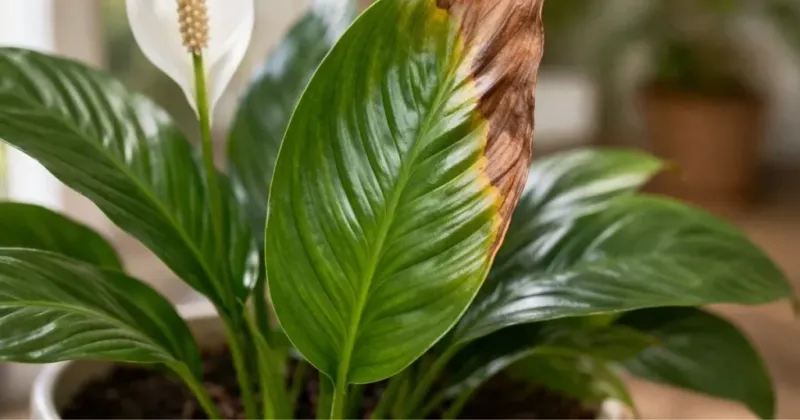
Chemical stress from fertilizer or mineral accumulation is easy to overlook because the symptoms look a lot like moisture stress: brown tips and margins that progress inward over time. Missouri Extension specifically identifies peace lilies as sensitive to fluoride, with brown leaf tips listed as a characteristic symptom.
Chlorine, fertilizer salts, and the minerals in softened water can also play a role depending on your local water source.
While diagnosing browning, pause routine fertilizing. Peace lilies have relatively modest fertility needs indoors, and adding more fertilizer to a stressed plant can burn root tips and worsen leaf damage.
Look at the soil surface and the outside of the pot for white or crusty deposits – those are a reliable visual cue that soluble salts have been accumulating. UF/IFAS houseplant care guidance recommends periodically drenching the pot with clean water and letting it drain freely to flush salts out, and repotting into fresh mix when buildup is severe.
Do not attempt a flush if the pot lacks a drainage hole or the plant is already sitting in saturated soil – doing so would make root conditions worse.
On the water-quality side, a common misconception is that letting tap water sit overnight removes fluoride. EPA documentation on fluoride states that boiling does not remove fluoride, and ordinary activated-carbon filters are generally not effective for fluoride removal.
If water quality is a genuine concern, use a water source or filtration system specifically certified for the contaminant in question rather than relying on standing tap water as a fix.
Irregular marks deserve a pest or disease check
Not every brown mark on a peace lily fits the dry-tip-burn pattern. When damage looks uneven, scattered, or concentrated in odd places – especially on new growth or along leaf veins – a pest or disease inspection should move up the priority list before any other care changes are made.
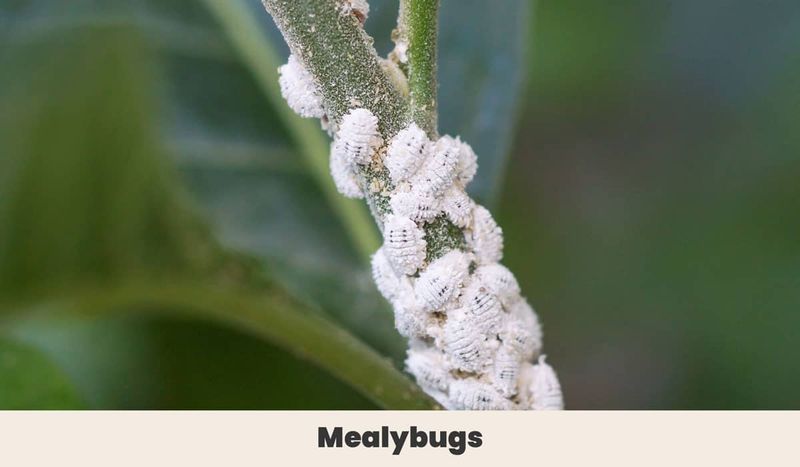
Turn leaves over and check the undersides carefully, because that is where most soft-bodied pests hide. Mealybugs appear as white cottony clusters near leaf joints and stem bases.
Scale insects look like small brown bumps that do not move. Spider mites are tiny and may be hard to see without magnification, but fine webbing on leaf undersides and between stems is a strong indicator.
Sticky residue on leaves or surrounding surfaces often points to sap-feeding insects. North Carolina Extension’s Spathiphyllum entry lists mealybugs, scale, and spider mites among the pests to watch for, and UC IPM’s houseplant problem guide reinforces that irregular damage patterns warrant a pest inspection rather than a default watering adjustment.
Lesions that look wet, have distinct halos, or expand rapidly across leaf tissue suggest a disease issue rather than dry tip burn. Penn State Extension’s indoor plant disease guide notes that fungal or bacterial leaf spots require different management from environmental stress – improving drainage or raising humidity will not resolve an active infection and may worsen it.
If you find evidence of pests or suspect disease, address those specifically before returning to environmental adjustments.
Trim for appearance, correct the likely stress, and observe cautiously
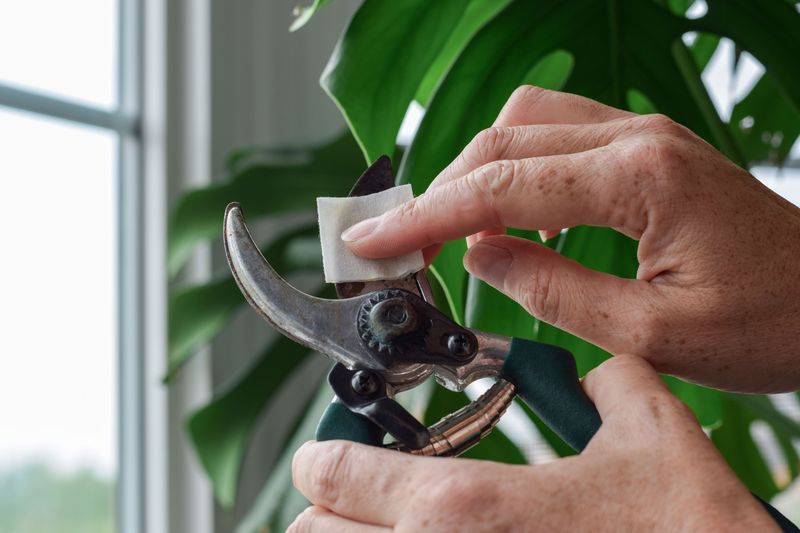
Once you have gathered enough information to make a reasonable guess about the main stress, trimming the existing brown tissue is a reasonable next step for appearance. Sterilize your scissors with rubbing alcohol before starting.
Follow the leaf’s natural tapered shape when cutting so the trimmed edge blends in, and remove only the brown or damaged portion rather than cutting deeply into healthy green tissue. Iowa State Extension is clear that trimming is cosmetic – it does not stop new browning unless the underlying stress is corrected.
After trimming, correct the single care factor that your investigation most strongly supports. If drainage is poor, address the container.
If the plant has been in direct sun, move it to filtered light. If salt deposits are visible, flush the pot with clean water.
Changing one major variable at a time and then watching how new leaves develop over the following weeks is a practical observation strategy. It is not a guaranteed diagnostic test, and new growth alone cannot definitively confirm which change made the difference, but it gives you a clearer picture than adjusting everything at once.
A brief safety note for households with pets: peace lilies contain insoluble calcium oxalates throughout the plant. If a dog, cat, or other animal chews the leaves or stems, the result can include oral irritation, drooling, vomiting, or difficulty swallowing.
The ASPCA lists peace lily as toxic to dogs and cats and recommends veterinary attention for severe symptoms. Keep the plant out of reach of animals, and consider wearing gloves when handling it if you have sensitive skin.
The most reliable recovery sign is not a fixed timeline – it is a plant that stops producing new brown tissue on leaves that developed after your care change.