
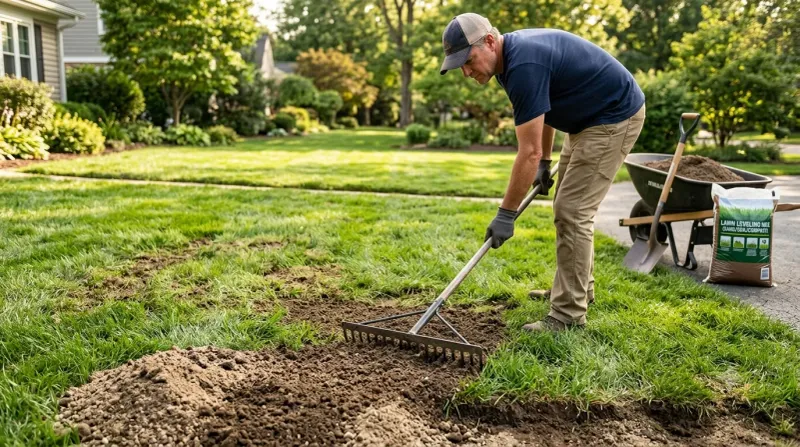
A rough, uneven lawn is more than an eyesore – it can make mowing miserable and hide real problems beneath the surface. The good news is that many shallow bumps and minor dips in Southern yards can often be improved with basic hand tools and a little patience.
But the fix only works when you know what caused the problem in the first place, and when you understand that some conditions need more than a rake and a bag of soil.
Diagnose the bump before you reach for a rake
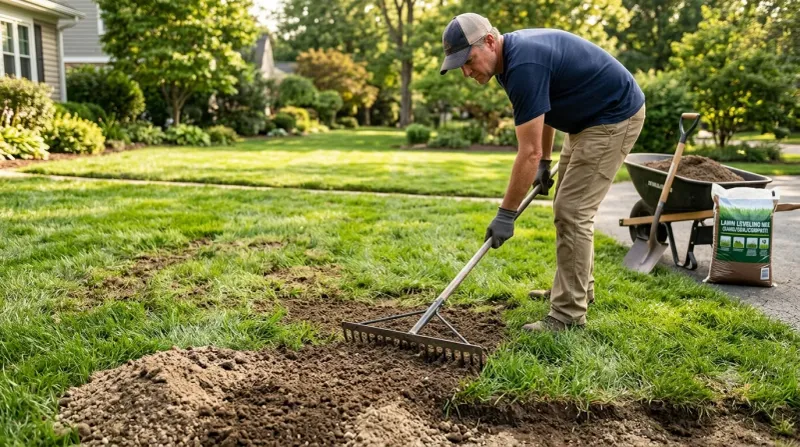
Picking up a rake before you understand what made the lawn lumpy is the fastest way to waste a weekend. Different bump patterns point to very different causes, and treating the surface without addressing the root problem often means the unevenness comes right back.
Shallow, dish-shaped depressions and gentle rolling variation are usually the candidates for a simple hand-tool repair. Raised ridges, conical soil mounds, connected tunnels, and irregular trails are a different story entirely.
University of Minnesota Extension’s turf bump diagnostic guide explains that moles, voles, ants, earthworms, and other animals can all create distinctive surface patterns, and flattening the surface without addressing the animal or other active cause will likely give you only a short-lived improvement.
Walk the yard slowly and look for clues. Soft, spongy spots under your feet may signal compaction or thatch rather than a grading problem.
Firm raised ridges or holes with loose soil at the edges suggest animal activity. Areas that stay wet long after rain, or depressions near downspouts and foundations, may reflect a drainage or settlement issue rather than ordinary surface variation.
This guide focuses on minor, repairable irregularities: shallow low spots, slight surface unevenness, and moderate compaction in an otherwise healthy lawn. If the pattern you find points to major grade changes, buried debris, deep settlement, exposed tree roots, active tunnels, or significant drainage failure, Penn State Extension’s lawn establishment guidance makes clear that those conditions call for a different approach than simple surface passes.
Preserve the lawn’s useful slope before changing the surface
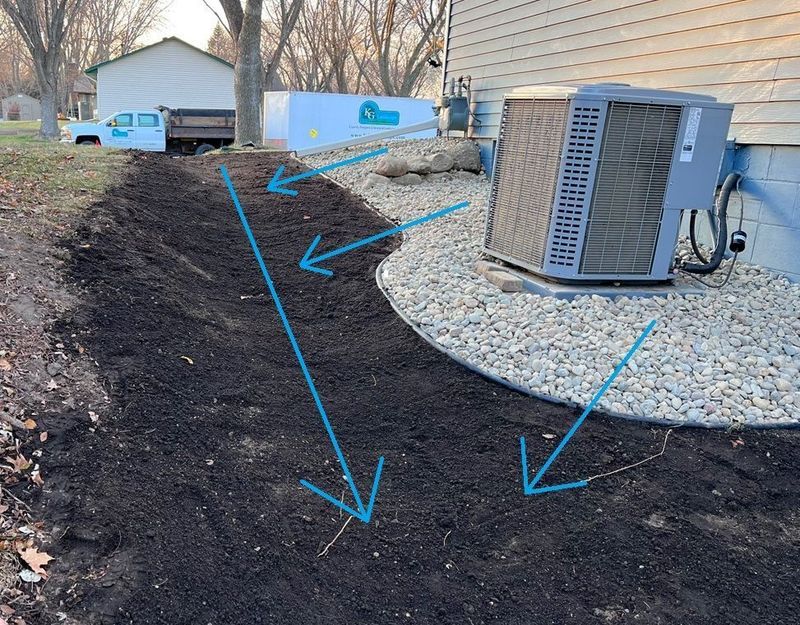
Smooth does not mean perfectly flat. Every yard needs enough slope to move rainwater away from the house and prevent it from pooling in low areas, and that functional grade is worth protecting even if it makes the lawn look slightly uneven from certain angles.
Before filling any depression, ask where the water is supposed to go. A low spot sitting near a foundation, crawlspace, downspout, or drainage swale is not necessarily a cosmetic problem you can simply fill.
Adding soil there can redirect water toward the structure or toward a neighbor’s property. Persistent wetness near a building is a signal to investigate the grading and drainage source, not to pile in topsoil and move on.
Penn State Extension notes that proper drainage and grade preservation are foundational to any lawn improvement, and changes that disrupt functional water movement can create bigger problems than the original bump.
One more step belongs at the top of any repair plan that involves breaking ground: call 811 before you dig. The national 811 safe-digging service exists to locate buried utility lines before a shovel hits something dangerous.
There is no shallow-digging exemption – state requirements vary, so check the rules in your state and allow the required time for lines to be marked before you start any soil work.
Prepare the lawn and tools for controlled repair passes
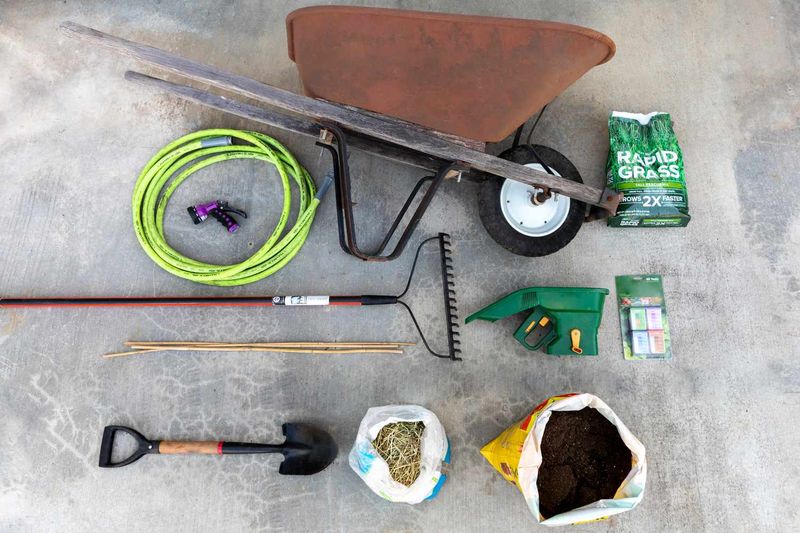
Good preparation makes the actual repair work go faster and protects the grass you are trying to improve. Start with a normal mowing pass at your grass’s recommended height so the canopy is short enough for added material to reach the soil surface without smothering the blades.
The hand-tool kit for most minor repairs is simple: a flat spade or shovel, a wheelbarrow or garden cart to move material, and a grading rake or stiff leaf rake to spread and work it in. Reserve a hollow-tine aerator for areas where compaction is suspected or confirmed – it is a targeted tool, not a routine first step for every uneven lawn.
Penn State Extension’s turf compost guidance specifically describes hand-spreading material with a shovel and working it into turf with a leaf rake as the practical method for small repair areas.
Timing matters more than most homeowners expect, and Florida and Texas lawns do not share one universal repair window. UF/IFAS guidance on St. Augustinegrass points to active warm-season growth as the right window for repair work in Florida, while Texas A&M AgriLife Extension’s warm-season FAQ ties repair timing to when grass has greened up and is actively growing in your area.
Work when soil is moist but not saturated – wet soil compacts easily under foot traffic, and hot, dry conditions stress the turf during the repair process.
Use core aeration only when compaction is causing the uneven growth
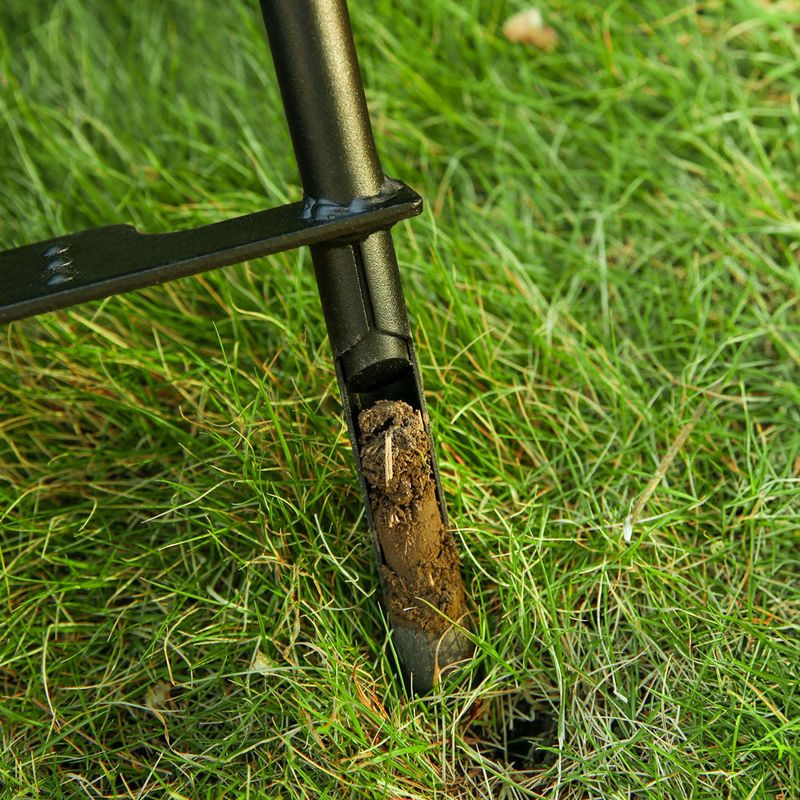
Compacted soil loses the pore space that roots, water, and air need to move freely through the ground. When that pore space collapses under foot traffic, equipment, or heavy clay, the result can be thin turf, water that puddles instead of soaking in, and an uneven mowing surface because the grass simply cannot grow consistently across the yard.
Hollow-tine core aeration fits this problem because it physically removes small cylinders of soil, opening channels for air, water, and root growth rather than just punching closed holes. University of Georgia Extension’s master gardener guidance identifies compaction as a genuine barrier to lawn recovery and aeration as a practical remedy.
The key is keeping the treatment targeted: aerate the areas where compaction is confirmed or strongly suspected, not the entire lawn as a default response to any uneven surface. UF/IFAS research on soil compaction in the urban landscape reinforces that compaction restricts infiltration and root development in ways that surface leveling alone cannot correct.
Compaction and thatch are two separate problems that call for different tools. Thatch is a layer of organic matter between the soil and the grass blades; when it becomes excessive, it can create a spongy, uneven surface.
Oklahoma State University Extension’s thatch management fact sheet cautions against routine annual dethatching – the thatch layer should be measured and diagnosed as excessive before any removal is done, because unnecessary dethatching can injure turf.
Rolling is a separate matter entirely. Penn State Extension supports lightweight rolling mainly for firming a prepared seedbed or newly laid sod.
Repeatedly rolling an established, uneven lawn does not correct compaction and can worsen it – core aeration and incremental topdressing are the appropriate tools for an existing yard.
Build shallow dips with thin, soil-matched topdressing
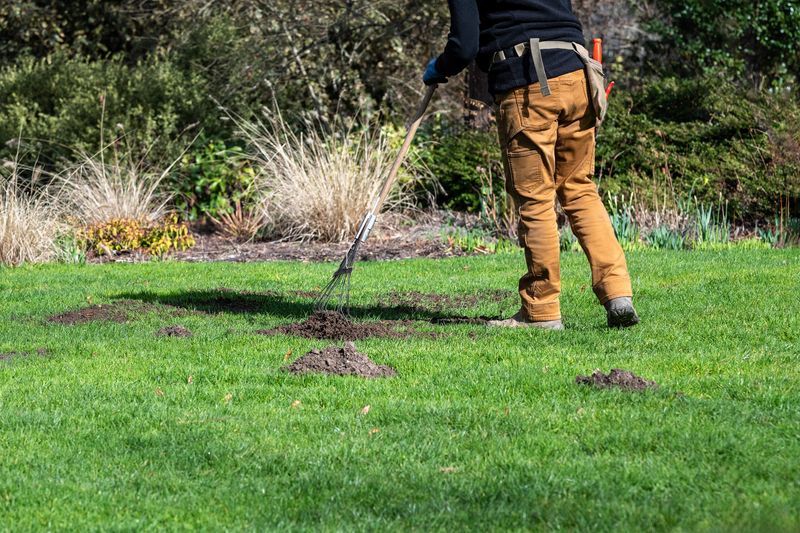
For minor low spots in an established lawn, the most reliable hand-tool method is thin, repeated topdressing with clean soil that matches what is already under your grass. The goal is gradual improvement over multiple passes, not a one-session transformation.
UF/IFAS guidance on St. Augustinegrass in Florida identifies approximately 1/4 inch as a suitable routine topdressing rate for established warm-season turf, and Penn State Extension’s compost-topdressing guidance recommends a similar thin application for established turf. That 1/4-inch figure is not a minimum – it is the practical routine rate that lets grass continue to grow through the added material rather than being covered and weakened by it.
Spread the material with a shovel in small amounts, then use a grading rake or stiff leaf rake to work it down into the canopy so it contacts the soil surface between the grass blades. Do not leave piles sitting on top of the turf.
After each pass, water lightly and allow the grass to grow and push through before applying the next thin layer.
Soil texture is not optional when selecting fill material. The topdressing should be as close as possible to the existing soil beneath the lawn.
Using an incompatible material – even a high-quality one – can create a layering effect that interferes with water movement and root growth over time. Ask your supplier about the texture of the soil you are buying, and avoid material from unknown sources that may carry weed seeds, plant-parasitic nematodes, or soil-borne diseases.
This method improves shallow irregularities reliably over time; it does not correct major grade changes or depressions deeper than about an inch without additional steps.
Correct deeper depressions without burying living grass
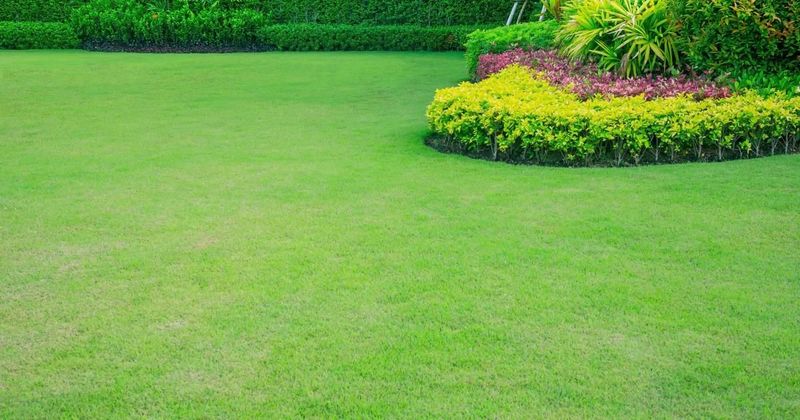
A staged fill approach does exist for deeper low spots, but it does not mean spreading 1 to 2 inches of soil directly over intact, growing turf in one application. That thickness can smother grass before it has any chance to grow through the added material.
The correct interpretation of UF/IFAS guidance on lawn topdressing is that deeper corrections should happen in controlled lifts, with recovery time between each one. For depressions that require more than about an inch of correction, the practical method is to cut back or lift the sod, add soil to bring the grade up, firm it lightly, replace the sod, and allow the grass to recover fully before deciding whether another lift is needed.
Trying to bury established turf under a thick layer in a single pass is not a shortcut – it is a reliable way to kill the grass you were trying to preserve.
Soil texture remains critical at this stage. UF/IFAS St. Augustinegrass guidance warns against using incompatible fill materials that create a distinct layer in the soil profile.
Sand deserves a specific caution here: routine sand applications are not a universal remedy for clay-heavy lawns. Penn State Extension explains that meaningful improvement of clay soil with sand requires incorporating roughly 3 to 4 inches of sand into 6 inches of clay – a quantity that is generally impractical for home lawn repair.
Using smaller amounts of sand in clay can actually worsen drainage by creating a concrete-like layer.
Compost is not a substitute for leveling soil either. UF/IFAS soil compaction research and Penn State Extension’s compost topdressing guidance both caution that heavy or repeated compost applications can smother turf or create a surface organic layer that restricts rooting.
Use compost as a soil conditioner in thin applications, not as fill for grade correction.
Treat bare ground and grass type as separate repair decisions
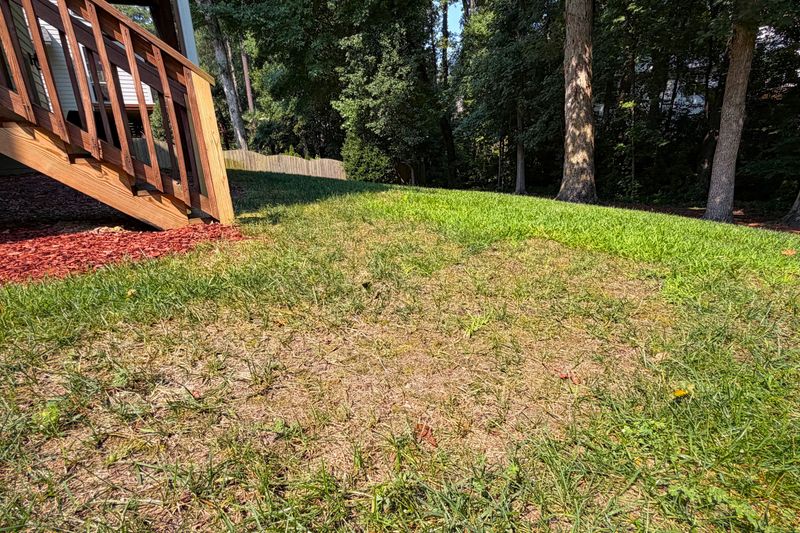
Leveling the soil and restoring turf coverage are two different jobs, and confusing them leads to disappointing results. Topdressing a thin or bare patch does not plant new grass – it just covers bare dirt with a thin layer of soil that will wash or blow away without roots to hold it.
When a lawn has extensive bare or sparse areas, the repair path runs through reestablishment, not leveling. UF/IFAS guidance on establishing a Florida lawn identifies sod, sprigs, and plugs as the practical options for restoring warm-season turf coverage, and renovation guidance from multiple sources treats substantial bare or dead areas as a reestablishment problem rather than a surface correction problem.
Topdressing can follow reestablishment once new growth is established, but it cannot replace it.
Grass type also shapes every repair decision. Recovery rate, mowing height, thatch tendency, and tolerance for practices like vertical mowing all vary by species.
UF/IFAS cautions specifically that vertical mowing can injure St. Augustinegrass and should only be done while the grass is actively growing – a reminder that techniques appropriate for bermudagrass or zoysiagrass may not transfer safely to a St. Augustine lawn.
Texas homeowners working with bermudagrass or other warm-season species should consult Texas A&M AgriLife Extension’s turfgrass establishment guidance for species-specific timing and method recommendations. Matching the repair technique to the grass you actually have is as important as matching the soil texture.
Know when hand-tool passes are not enough
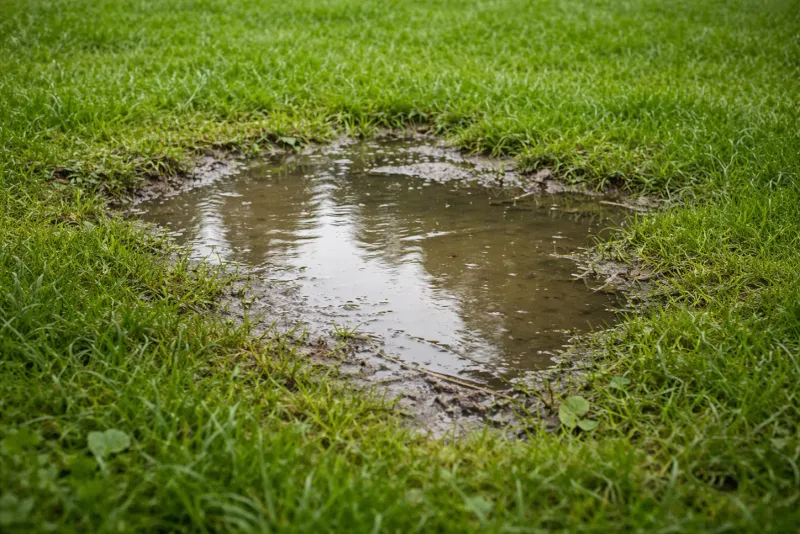
Recognizing the limits of simple passes is part of getting the job done right. Several conditions consistently fall outside what a shovel, rake, and bag of topsoil can reliably fix, and pushing ahead anyway can make things worse or create new problems.
Stop the simple-pass approach and reassess when you find any of these: major grade changes that require moving significant soil volume; persistent wetness near a foundation, downspout, or crawlspace that signals a drainage or grading failure; deep settlement over buried construction debris or organic material; exposed tree roots that are pushing the surface up; active animal tunnels that will reform after flattening; or extensive dead and bare turf that needs reestablishment rather than leveling. University of Minnesota Extension’s lawn bump diagnostic tool is a useful starting point for identifying which of these patterns you are dealing with before committing to a repair method.
These conditions may require lifting sod, excavation, drainage work, regrading, or professional assessment. University of Georgia Extension’s guidance on planting new lawns and UF/IFAS lawn establishment resources both treat significant grade correction and reestablishment as distinct projects from routine surface maintenance, with Penn State Extension drawing a clear line between fine surface grading and larger-scale soil preparation.
The qualified takeaway from this entire process: diagnose the cause first, protect any drainage slope that is already working, prepare during active growth, aerate only where compaction is confirmed, and improve suitable low spots through thin, soil-matched passes over time. A lawn that improves steadily over a season is a better outcome than one that looks fixed for a week and then settles back into the same old ruts.