
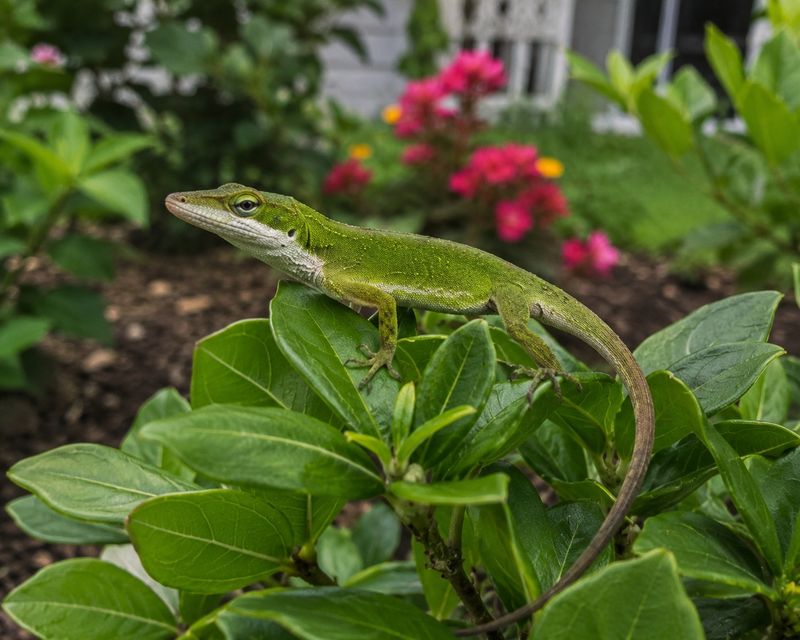
Spotting a bright green anole doing push-ups on a sunny fence rail is one of those small garden moments North Carolina homeowners quietly look forward to. When those lizards stop showing up, it is easy to assume something has gone wrong with the yard.
The truth is more useful: a missing anole is a clue worth following, not a verdict about what happened first. Checking temperature, vegetation, pest-control habits, and a few other yard conditions usually tells you far more than any single explanation can.
A Missing Anole Is a Clue, Not a Diagnosis
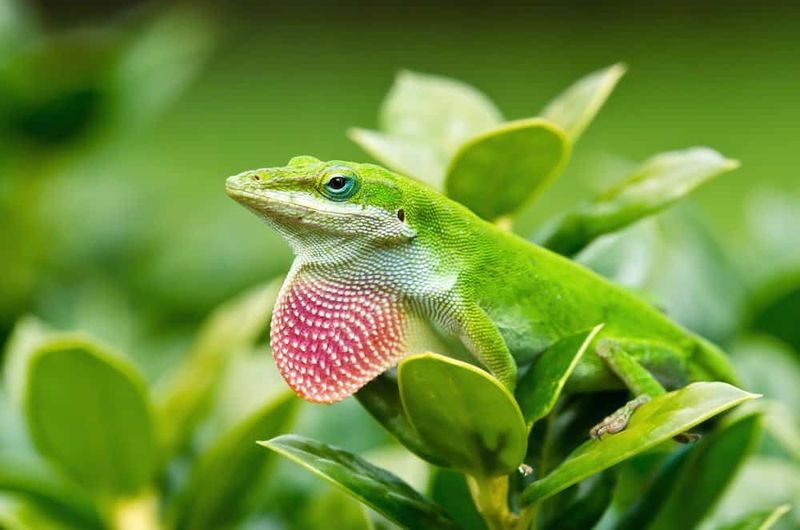
Fewer anole sightings do not automatically mean the lizards left or that some pest event drove them away. According to North Carolina’s herpetology species account, green anoles range across much of the state, from the Coastal Plain through the southern Piedmont and into some lower mountain areas, and they are genuinely common in urban and suburban settings.
One missed sighting on a cool morning or a cloudy afternoon is a very thin reason to declare them gone.
Several everyday conditions can make a familiar lizard hard to find. Females and juveniles are smaller and less flashy than the displaying adult males most people recognize.
Anoles higher up in shrubs or on a building’s upper trim boards simply go unnoticed. Cold or overcast weather reduces their activity noticeably.
Any of these factors, alone or together, can leave a homeowner scanning the garden without seeing a single lizard even when the local population is perfectly intact.
The NC Wildlife Resources Commission’s green anole profile describes the species as dependent on trees, shrubs, woody vines, arthropod prey, and warm conditions. That combination of needs points to the practical checklist worth running before reaching any conclusion: temperature at observation time, where in the yard you are looking, what the vegetation structure looks like now compared with before, what arthropods are available as prey, and whether pesticide practices changed recently.
Those are the variables that shape anole visibility and habitat suitability, and they are the ones a homeowner can actually do something about.
Warm Weather and Higher Perches Can Hide Them
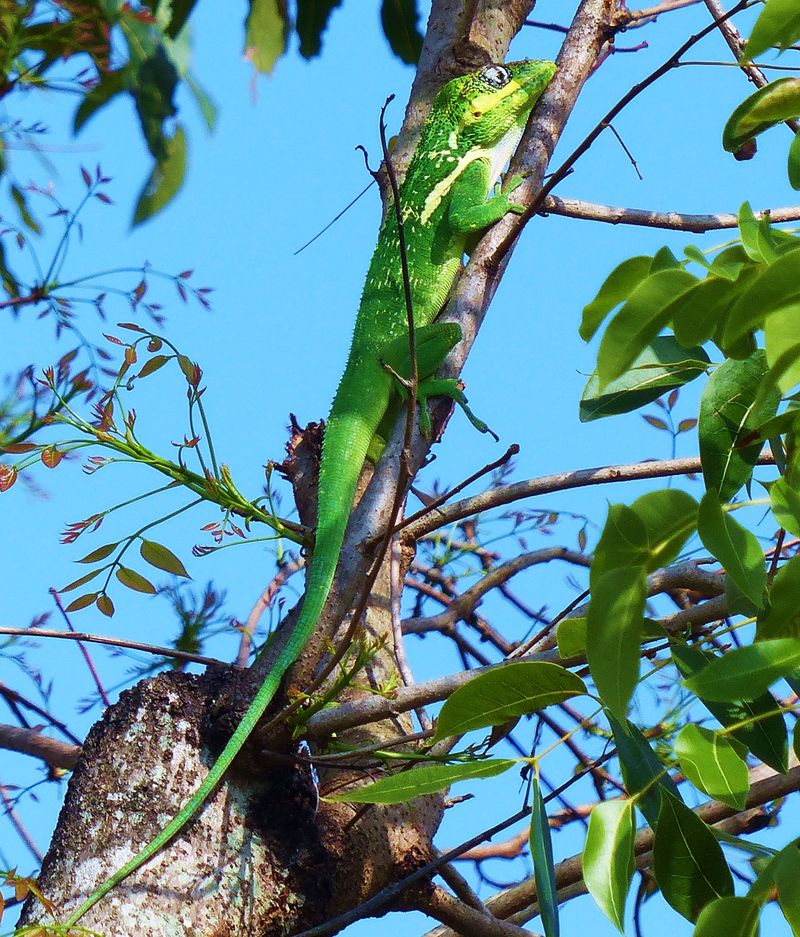
One of the most overlooked explanations for a “missing” anole is timing. Green anoles are cold-sensitive reptiles, and North Carolina winters, along with cool spring mornings and overcast fall days, can push them into torpor or keep them tucked under bark and behind thick stems where no casual walk through the garden will reveal them.
The NC herpetology account is clear that cold is a significant limitation on their activity. Checking the garden once on a chilly or cloudy day and finding nothing is not the same as finding nothing after several warm, sunny afternoon checks.
Try looking at different heights. Most people scan at eye level or below, but anoles regularly perch on fence tops, window trim, lattice, the upper stems of taller shrubs, and even tree trunks well above the ground.
Adult males are the most conspicuous because they display their pink dewlap and do visible push-up behaviors. Females and juveniles stay quieter and lower, which is exactly why a yard can have active lizards that a homeowner never notices from a standing position on the path.
There is one additional scenario worth knowing about, mainly because it circulates widely online. In Florida, research has documented that green anoles sometimes shift higher into the tree canopy when brown anoles move into an area, making them harder to spot from the ground.
University of Florida IFAS information on brown anoles explains the competition dynamic well for that state. For a North Carolina yard, however, this behavior should be treated as a remote possibility rather than the first explanation.
The state’s wildlife records do not describe brown anoles as widespread established breeders in North Carolina, so a higher-perching green anole in your yard is far more likely reflecting ordinary behavior than displacement by a competing species.
Anoles Need Prey, Perches, and Cover
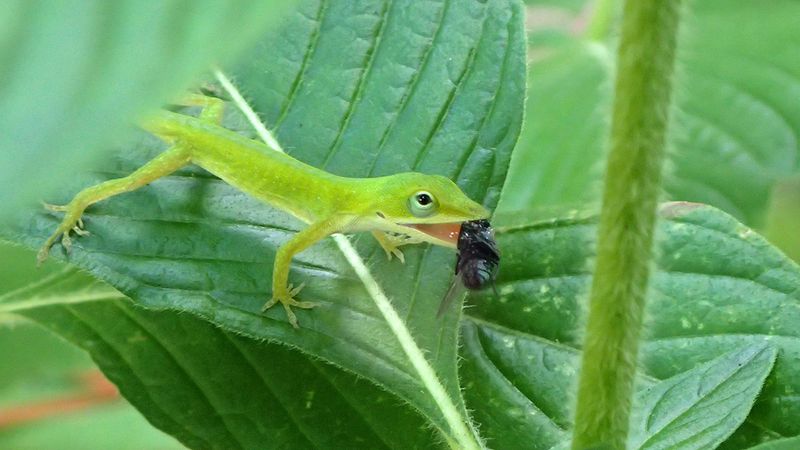
Green anoles are semi-arboreal hunters. The North Carolina reptile database describes them using trees, shrubs, woody vines, forest edges, and shrubby residential areas as core habitat, while also taking advantage of buildings, fences, and other structures for perching.
Their diet covers a wide range of small arthropods, including flies, crickets, moths, beetles, termites, ants, and even occasional snails and slugs.
That broad prey list means anoles can contribute to keeping arthropod populations in check around the garden. Research on anoles as biocontrol agents in southeastern agroecosystems supports the idea that these lizards can play a useful role in managing small invertebrate populations.
What the evidence does not support is a promise that keeping anoles in your yard will reliably eliminate mosquitoes, ticks, caterpillars, or any other specific pest. They eat broadly, not selectively, and the connection between their presence and measurable pest reduction in an individual home garden has not been established with precision.
The relationship between pest pressure and anole abundance is also not a simple one-way street. Heavy insecticide use could reduce the arthropods anoles rely on for food while simultaneously exposing the lizards themselves to chemical risk.
Habitat simplification, such as removing layers of shrubs and groundcover, could cut both prey populations and usable perch space at the same time. Both problems, the pest spike and the lizard disappearance, may share a common cause rather than one triggering the other in a predictable sequence.
The NC State Extension IPM handbook frames this kind of ecosystem thinking as the foundation for smarter pest decisions, and it applies directly here.
Inspect What Changed in the Garden
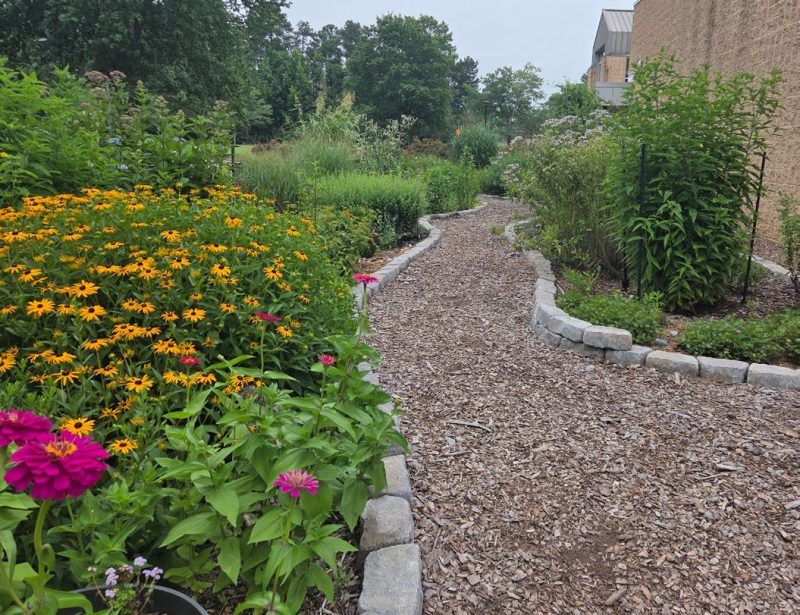
Before assuming the worst, walk the yard with a specific question in mind: what looks different now compared with when anoles were regularly visible? The comparison does not require perfect memory.
Obvious changes, such as a large shrub removed, a hedge trimmed back hard, a section of fence cleared, or a new patio installed over a previously planted bed, can all reduce the structural features anoles use daily.
A USDA Forest Service study on green anole habitat selection in eastern Texas pine forests found that population estimates were considerably higher in plots with greater shrub density, and that lizards most often used relatively large live shrubs. That is geographically adjacent evidence rather than a direct North Carolina study, but it reinforces what the habitat description suggests: dense, layered woody vegetation matters more than any single plant choice.
A yard that went from shrubby and layered to open and mowed is a yard that became less useful to a climbing, cover-dependent lizard.
NC State Extension’s guide to reptiles and amphibians in home landscapes and Durham County Cooperative Extension’s habitat guidance both identify habitat loss, fragmentation, and development-related disturbance as meaningful pressures on reptile populations. Look at whether sunny basking spots still exist near dense cover, whether leaf litter and low groundcover remain near the base of shrubs and fences, and whether any recent clearing or construction changed the yard’s structure.
The NC State Extension wildlife gardening chapter provides a useful framework for thinking about what residential yards can offer native species when they are designed with vertical structure and layered cover in mind.
Restore Habitat Structure Before Adding Products
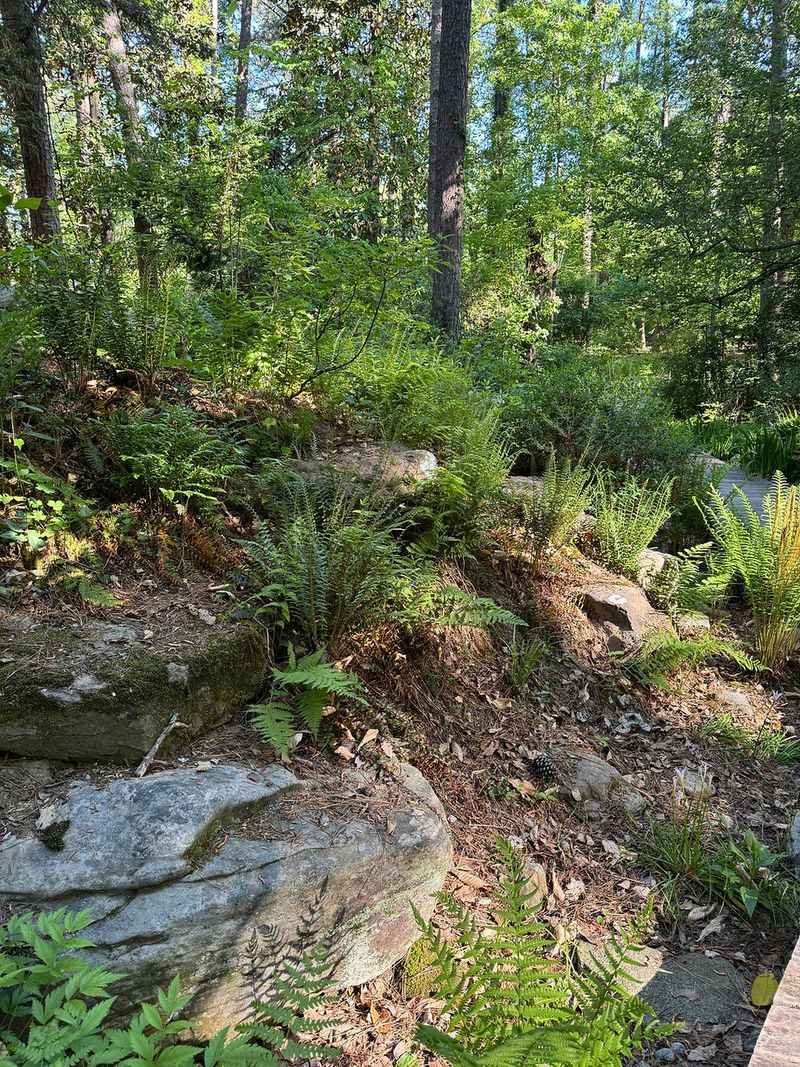
When the inspection reveals a yard that has become more open, simplified, or disturbed than it used to be, the most useful first step is structural rather than chemical. Retaining existing shrubs and small trees, adding woody vines along fences and trellises, and allowing some leaf litter to remain near the base of perch structures gives reptiles and their arthropod prey places to live, hunt, and take cover.
Wholesale clearing of low vegetation right up to fence lines and building foundations removes exactly the habitat layers anoles use most.
NC State Extension’s reptile and amphibian habitat page and the Extension Gardener Handbook’s wildlife chapter both recommend preserving or adding native shrubs, trees, and vines as the foundation of backyard reptile habitat. The emphasis is on structure, not a specific plant list.
A yard with multiple canopy layers, shrubby mid-story growth, and low groundcover near perch points is more useful to a green anole than a yard with a single named native plant surrounded by bare mulch and lawn.
The eastern Texas research referenced earlier also supports this general direction. Anoles concentrated in areas with denser shrub cover, which suggests that adding structural complexity to a simplified yard is a reasonable response even if it cannot guarantee a specific outcome on a fixed timeline.
Habitat improvement works on the scale of seasons and years, not days. Expecting lizards to reappear immediately after planting a new shrub is unrealistic, but building toward a layered, cover-rich yard reduces the barriers that may have made the space less hospitable in the first place.
Starting with what is already there and protecting it from unnecessary removal costs nothing and avoids the risk of making conditions worse.
Manage Garden Pests Without Broad Spraying
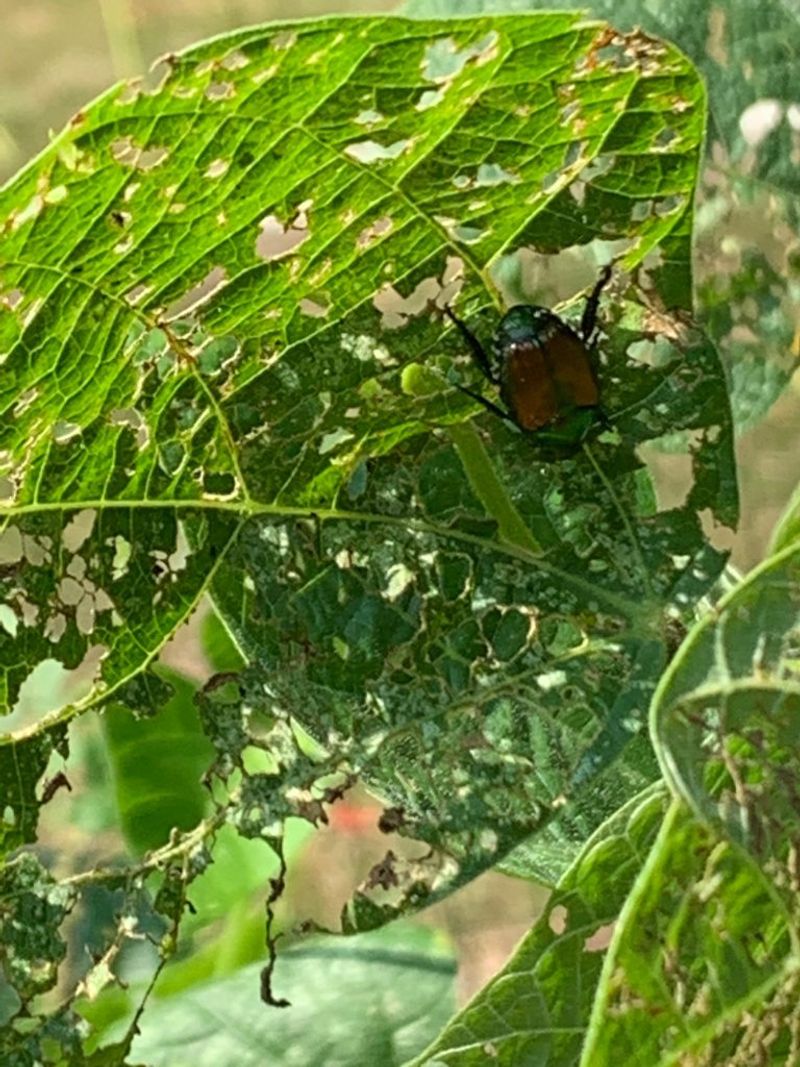
Noticing more insects or plant damage at the same time anoles seem scarce is worth taking seriously, but the right response is identification before action. The NC State Extension integrated pest management handbook lays out the recommended sequence plainly: accurately identify what is causing the damage, monitor to see whether it is spreading or getting worse, decide whether the level of damage actually exceeds a threshold worth treating, try cultural and mechanical controls first, and use a pesticide only when the evidence justifies it.
That sequence protects both the garden and the broader yard community, including the lizards.
The EPA’s guidance on reducing pesticide impacts on wildlife is direct: improper use, overapplication, runoff, and spray drift can harm non-target animals. Treating a whole yard because a few plants show leaf damage is not a proportionate response and creates real risk for foraging lizards and the arthropods they depend on.
The EPA’s common causes of pesticide incidents page reinforces that unintended wildlife exposure is a documented problem, not a theoretical one.
Laboratory evidence adds a specific reason for caution with at least one common product type. A published study on pyrethrin toxicity in green anoles found that toxicity varied with temperature and exposure concentration.
That finding does not mean routine, label-compliant garden use will harm anoles, but it does support avoiding direct spraying near areas where lizards forage and perch, and it reinforces the case against blanket treatments when a targeted approach or a non-chemical method would address the actual problem. If a pesticide is genuinely needed, treat only the affected area, follow the label precisely, and time applications to minimize exposure to lizards and their prey.
Do Not Assume a Brown Anole Took Over
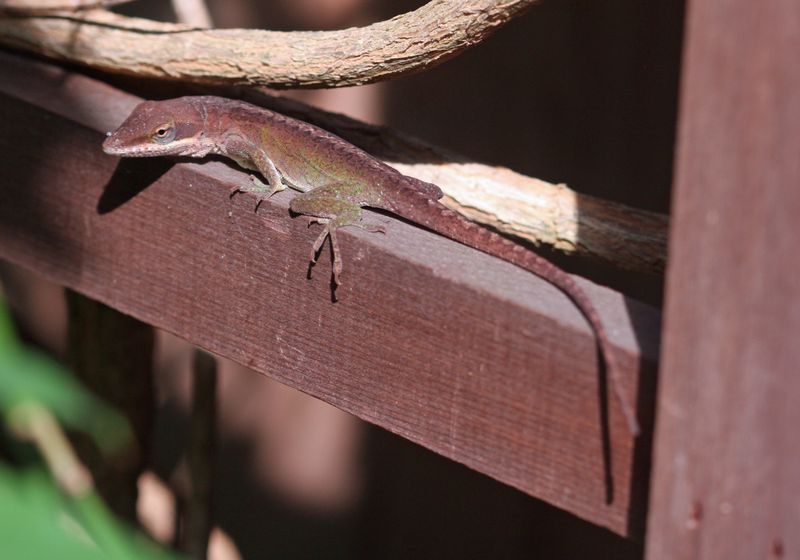
A brown lizard in a North Carolina yard is not automatically a brown anole. Green anoles change color regularly, shifting from bright green to various shades of brown or gray depending on temperature, stress, background, and social context.
A stressed or cold green anole sitting on a brown fence board can look convincingly like a different species to someone expecting a bright green lizard. Identification should consider the animal’s body shape, the length and taper of the snout, whether a dewlap is visible and what color it is, any patterning on the back, where the lizard is perching, and how it is behaving.
The University of Florida IFAS anole identification guide describes these distinguishing features clearly.
The brown anole competition story is well documented, but it belongs primarily to Florida. Florida IFAS research on the introduced brown anole describes how Cuban brown anoles, now widespread in Florida, compete with native green anoles, sometimes push them into higher canopy positions, and can prey on juveniles.
That research is valuable and worth understanding, but it describes Florida conditions. The North Carolina Wildlife Action Plan does not describe brown anoles as widespread established breeders in the state, and North Carolina’s reptile records treat the green anole as a secure native species.
Buying lizards at a pet store and releasing them in the yard is not a solution this article recommends, and no agency guidance supports it. Releasing non-local animals creates disease, genetic, and ecological risks that outweigh any imagined benefit.
If you want more anoles, the path is better habitat and smarter pest management, not stocking the yard like a pond.
Use the Yard’s Evidence to Choose the Fix
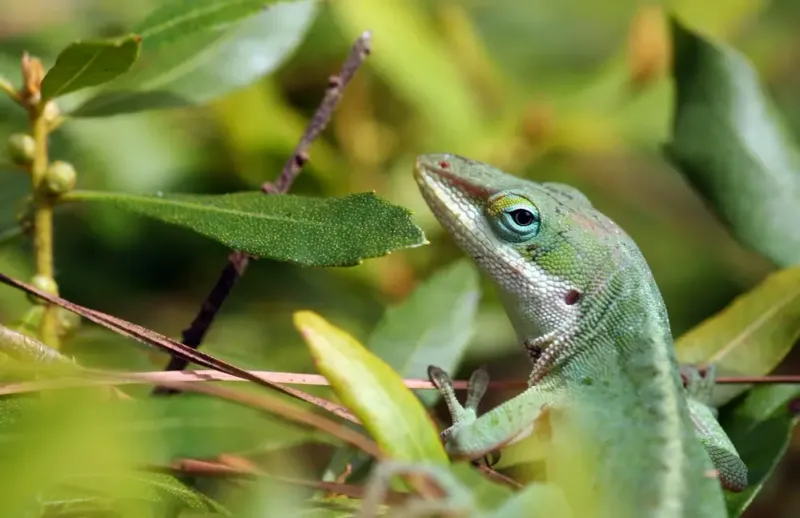
Running a quick checklist puts the missing-anole question in practical terms. Check the yard again on a warm, sunny afternoon before drawing any conclusions.
Look at multiple heights, including shrubs, fence tops, and building trim. Then ask whether the vegetation structure changed, whether broad pesticide applications happened recently, and whether prey habitat was reduced by clearing or heavy mulching.
Those four questions cover the most likely explanations. North Carolina’s official green anole account identifies exactly these conditions as ecologically meaningful for the species.
If the inspection points to a simplified yard, start adding structural layers: native shrubs, small trees, woody vines, and preserved leaf litter near perch areas. If pest pressure is the concern, follow the NC State IPM sequence rather than reaching for a broad spray.
Both fixes work in the same direction: a yard with layered cover, active arthropod communities, and minimal unnecessary chemical use is a better place for green anoles and a better-managed garden overall. The NC State wildlife gardening guidance frames this as habitat stewardship, not restoration heroics.
Green anoles are useful native predators, and their absence is worth investigating. A yard that supports them is also a yard that tends to have healthier soil life, more beneficial insects, and fewer conditions that let pest outbreaks build unchecked.
The best reason to look after the conditions that keep anoles around is not to guarantee they come back, but because those same conditions make the whole garden work better.