
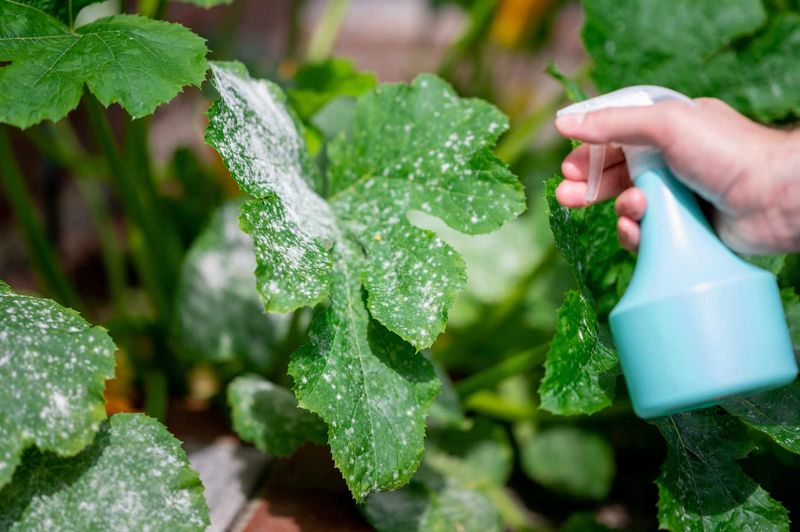
You walk out to the garden and find flour-like white patches spreading across your squash leaves. It looks alarming, and it can travel from plant to plant faster than you might expect.
The good news is that a closer look at the pattern can tell you a lot about what you are dealing with. A few calm, practical steps may help you protect your vines and keep the harvest going longer.
Expanding powdery patches can signal a squash disease
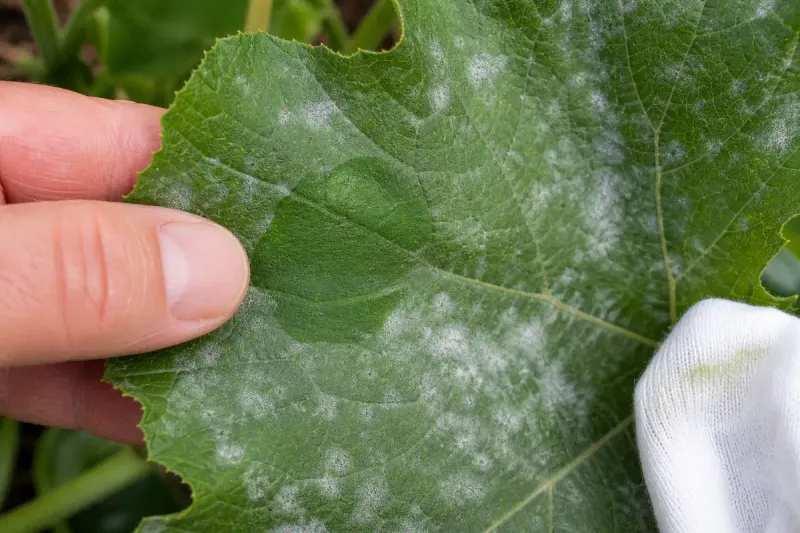
Picture someone dusting a leaf with flour, then leaving it out to spread. That is close to how powdery mildew on cucurbits often looks.
You see distinct white patches that grow larger over time, and they can show up on the top or the underside of a leaf.
Patterns like this are consistent with powdery mildew, a fungal disease carried by wind. White color alone does not prove it, so it helps to watch how the patches behave before you decide on anything.
Timing also varies by place. Northern guidance often says older leaves show symptoms first, but UF/IFAS Extension reports that powdery mildew occurs every year in south Florida and can appear on young squash leaves in Miami-Dade.
In Florida and Texas, do not assume a set calendar or a set leaf age.
Take a few minutes to check several plants, both sides of the leaves, and the shaded spots near the center. Note whether the patches are enlarging over a few days.
That simple habit gives you better information than any quick guess.
Check white markings before treating
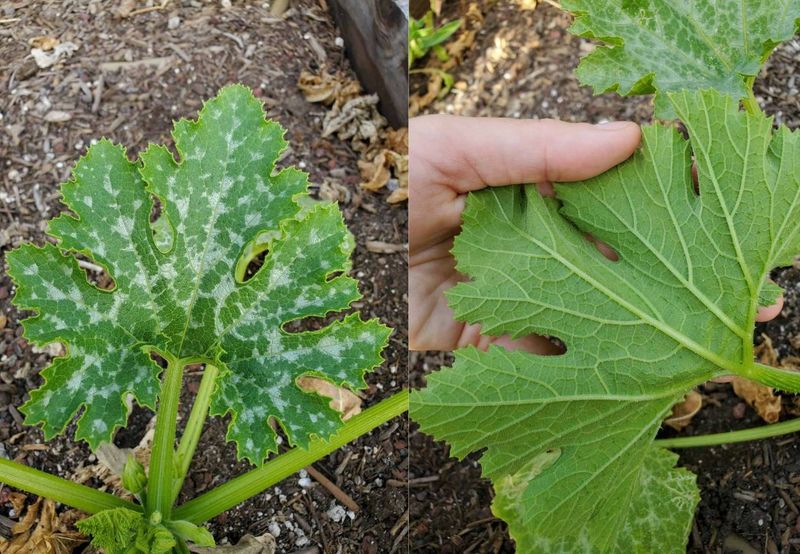
Not every white leaf is a sick leaf. Some squash varieties naturally have symmetrical, angular white or silvery markings, often right over the veins.
As University of Minnesota Extension notes, those markings alone are not a sign of disease.
Powdery mildew looks different. Its colonies are irregular, powdery, and they grow larger from one day to the next.
If the marks stay the same shape and match the vein pattern, you are probably looking at the variety itself.
Downy mildew is another look-alike, and it is a different disease. It more often causes angular yellow-to-brown lesions bounded by the veins, and in humid weather you may see gray, purplish, or bluish growth on the underside of the leaf.
The University of Georgia troubleshooting guide is a helpful reference for Southeastern gardeners.
Getting the diagnosis right matters because a generic mildew spray may miss the real target. Flip a leaf over, look closely, and confirm what you have before you spend money or spray anything.
Powdery mildew mainly damages foliage
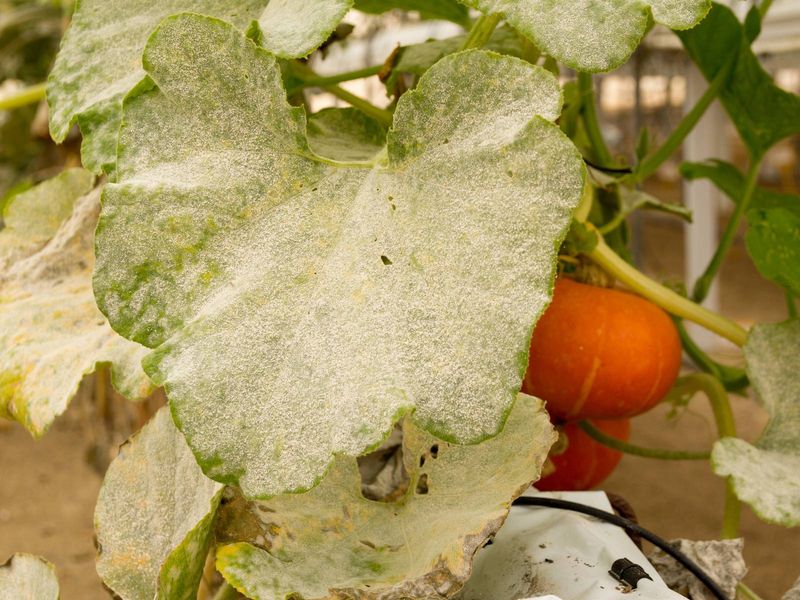
Here is some reassurance: powdery mildew does not directly infect the squash fruit. The damage happens mostly on the leaves, which is where the plant makes its food.
When mildew builds up, leaves can yellow and die back. UF/IFAS Extension describes how this can weaken vines and reduce or shorten the harvest.
Severe leaf loss can also leave fruit exposed to sunburn, which matters in strong Southern sun.
Risk varies, though. A plant with a few mildewed leaves late in the season may keep producing well, while heavy early infection can cut yields more.
Not every affected plant will lose its crop.
The University of Minnesota guidance on cucurbit powdery mildew points to protecting healthy leaf area as the goal. Keep an eye on how quickly patches expand and how much green leaf remains, then act in proportion.
Prune affected foliage without stripping the vine
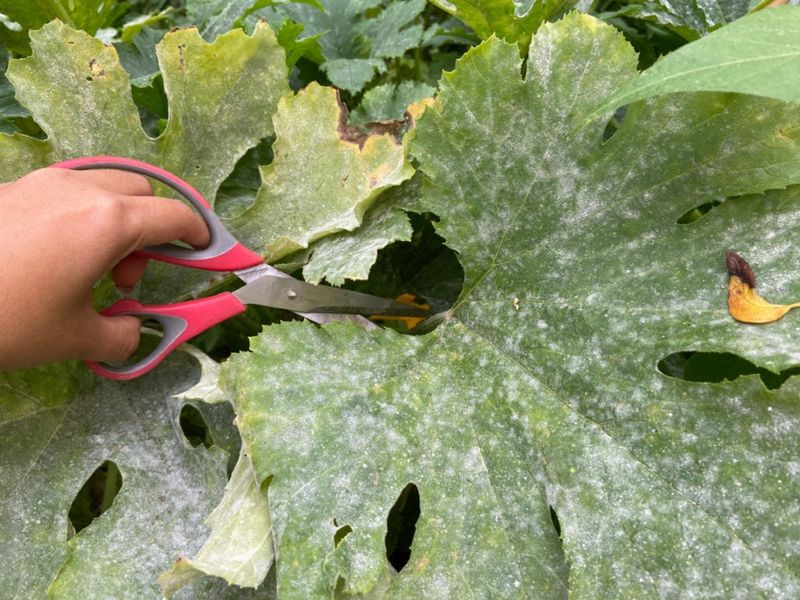
Light, careful cleanup is the best approach. Snip off leaves that are clearly diseased or dead when it seems useful, but leave the healthy foliage in place.
Your plant still needs those leaves to feed developing fruit and to shade it.
Skip the urge to strip the vine. Removing large amounts of healthy leaf area can stress the plant more than the mildew does.
Leaves with harmless natural white markings should stay too.
At the end of the season, clear away plant debris. Oregon State University Extension suggests disposing of diseased material off-site rather than adding it to a home compost pile.
Follow your local waste guidance for how to bag or haul it.
Keep expectations realistic. Wind can carry spores to nearby plants, so pruning cannot ensure the disease stops spreading.
Think of it as one tool that may lower disease pressure alongside the other steps in this article.
Improve airflow and avoid excessive nitrogen
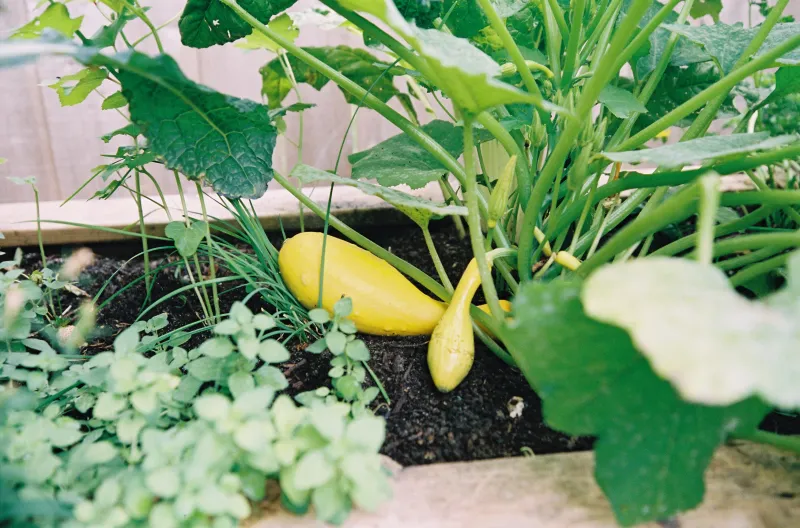
Growing conditions give you plenty of room to work. Space plants so air can move through the leaves, and pull weeds that crowd around them.
The University of Minnesota guidance on cucurbits supports this kind of airflow management. It may reduce disease pressure, though it will not guarantee anything.
Go easy on nitrogen too. Heavy feeding pushes lots of soft, leafy growth, and excessive nitrogen is best avoided.
A balanced fertilizer at label rates is a safer choice.
For future plantings, look for resistant or tolerant varieties. UF/IFAS notes that fewer squash varieties are tolerant than cucumber and melon varieties, so the choices may be limited.
Watering has tradeoffs. Watering at the soil can help reduce some other foliage diseases, but it does not by itself prevent powdery mildew.
Oregon State and its eradication Q&A note that overhead water may reduce powdery mildew but also raises humidity and the risk of other fungal diseases. Powdery mildew can also reproduce in dry conditions, so dry leaves are no guarantee.
Choose treatments carefully and follow the label
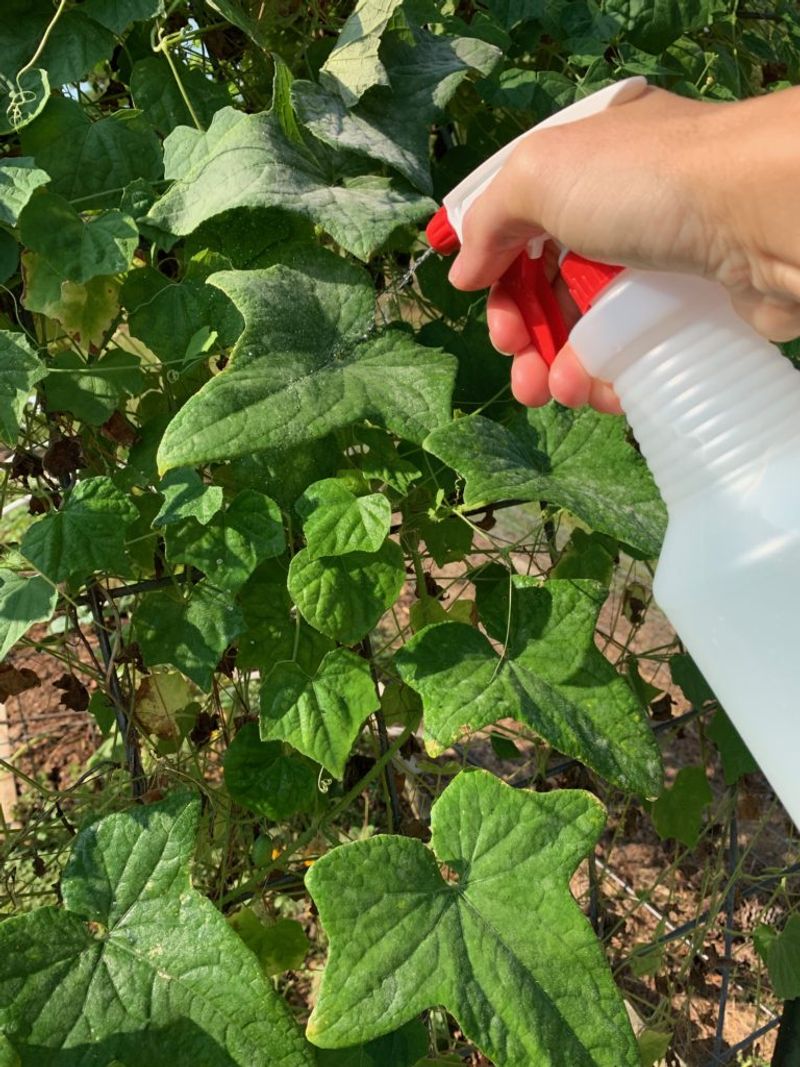
If you decide to use a fungicide, start with the label. Choose only a product whose current label allows use on squash and on the specific disease you have confirmed.
Then follow every direction, including harvest intervals and weather precautions. The EPA explains that pesticide labels are legally enforceable, so they are more than suggestions.
Milk sprays get a lot of attention online, and the research is mixed. A field study on pumpkins found variable results, with milk less effective on average than the chemical control.
A separate greenhouse zucchini study reported that milk worked.
Those different results do not add up to a dependable home-garden cure or a universal recipe. Results seem to vary by crop and growing conditions.
For the same reason, it is wise to skip unverified household mixtures. Baking soda, dish soap, neem oil, and sulfur are not proven, universally safe fixes.
Squash grown in Southern heat can be sensitive, so stick with what a label supports.
Healthy squash is mostly about steady habits, and the best result is usually a plant that keeps its leaves a little longer.