
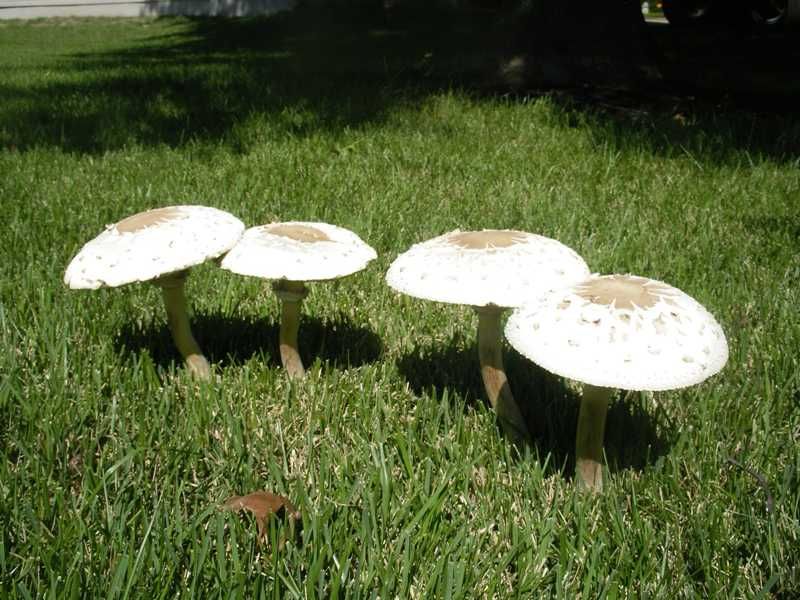
You walk out after a soggy October weekend and find a scatter of pale mushrooms standing in the grass. They seem to come out of nowhere, and many Southern homeowners wonder if the lawn is in trouble.
The truth is more interesting, and a lot less scary, than it looks. Here is what those mushrooms can tell you, what they cannot, and what to do next.
Rain-triggered mushrooms show fungal activity, not soil quality
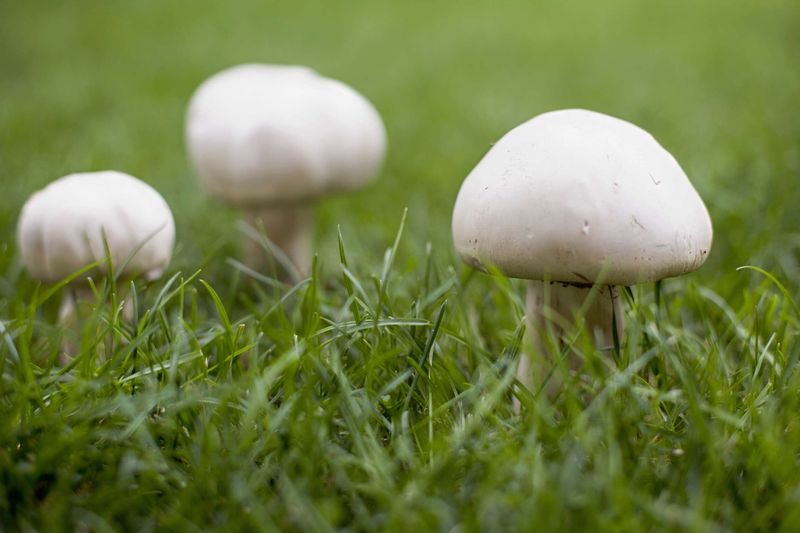
A flush of white mushrooms tells you one thing for sure: a fungus is active in your lawn. It does not hand you a report card on the soil.
Extension specialists explain in University of Maryland Extension guidance that lawn mushrooms often do not harm turf and usually do not need control.
That means a few popular conclusions do not hold up. Mushrooms do not prove your soil is rich or fertile.
They also do not prove it is acidic, poor, or badly drained, and they are not a sign of lawn disease on their own.
If you want to know about drainage, disease, or nutrients, you need other evidence. Look at how the grass itself is behaving, notice where water stands after storms, and use a soil test for the chemistry.
The mushrooms are simply a visible clue that something is living and working below the surface.
Rain reveals a fungus that was already there
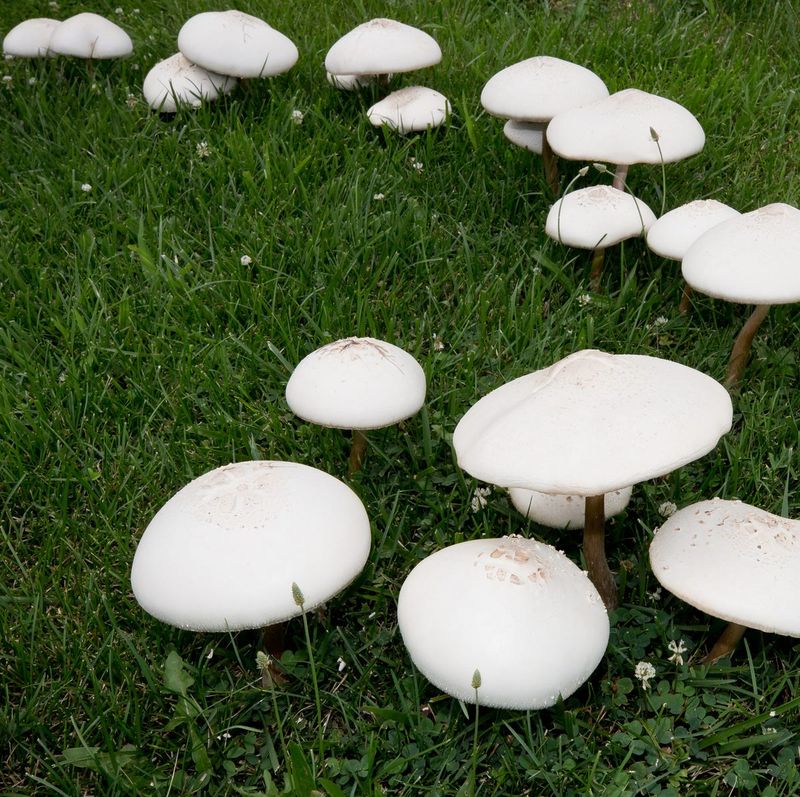
Think of a mushroom as the fruit of a much bigger organism. The part you see is a short-lived reproductive structure, while most of the fungus stays hidden in the soil or inside its food source.
As University of Minnesota Extension describes, mushrooms in lawns tend to show up when conditions turn damp.
So the fungus did not arrive with the storm. It was already there, and the moisture was a possible trigger for it to send up caps.
That is why they can seem to appear overnight after a fall rain in Florida or Texas.
A wet spell should not be read as proof of a drainage problem or overwatering. Plenty of well-managed lawns put up mushrooms after a good soaking.
Most caps wither within a few days once the weather dries out.
The fungus may be using a localized food source
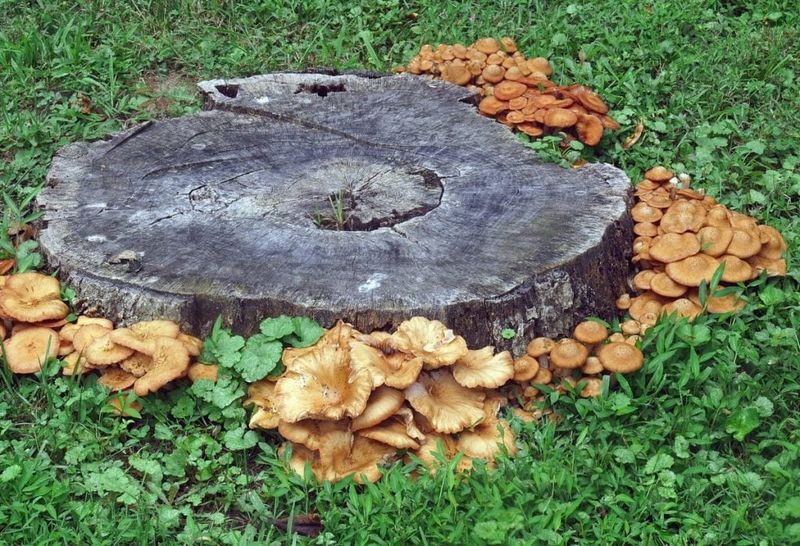
Many lawn fungi make a living by breaking down dead plant material. Their menu can include buried roots, old stumps, fallen leaves, and thatch.
Maryland Extension notes that this recycling is part of normal nature.
Other fungi work differently and form partnerships with living roots, as Minnesota Extension also explains. Either way, the mushrooms point to biological activity.
Here is the catch. A fungus feeding on one buried stump, say where a tree came down years ago, can produce mushrooms in a lawn that has little organic matter elsewhere.
So a patch of caps cannot tell you how much organic matter the whole yard holds, or whether the soil is healthy overall.
A useful habit is to check the spot. Was there a tree, a construction pile, or buried wood nearby?
That may explain the location far better than any soil theory.
A ring of mushrooms matters more when the grass changes too
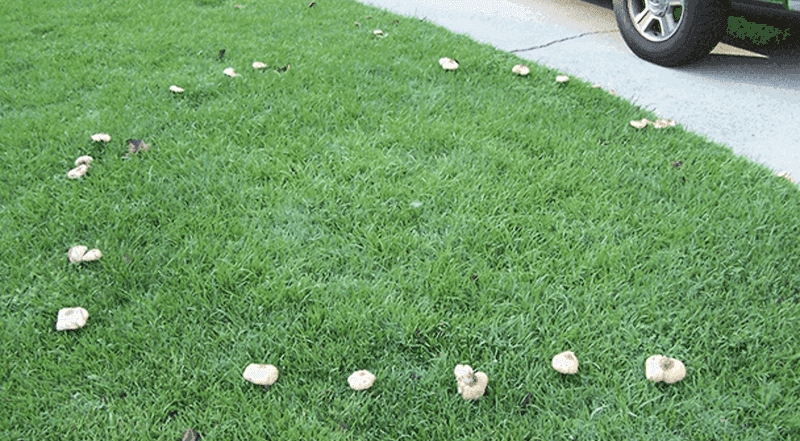
Sometimes mushrooms line up in a cluster or circle, and the grass beneath seems different. If you see a matching arc or ring of unusually green, brown, or dead turf, fairy ring becomes one possible explanation.
A mushroom circle alone does not settle it.
According to Illinois Extension, some fairy-ring fungi release nutrients that green up the turf. Dense fungal growth can also block water from moving into the soil, which may stress or kill grass.
Texas A&M AgriLife documents fairy rings in Texas turf as well.
Turf effects vary, so one lawn may show a bright green ring while another shows a dry, dead band. A random scatter of white mushrooms with healthy grass around them is far more common and usually does not point to fairy ring.
If you do see the ring pattern, take photos and contact your county extension office. Management for fairy ring is a separate job from ordinary mushroom cleanup.
Removing the caps will not remove the fungus
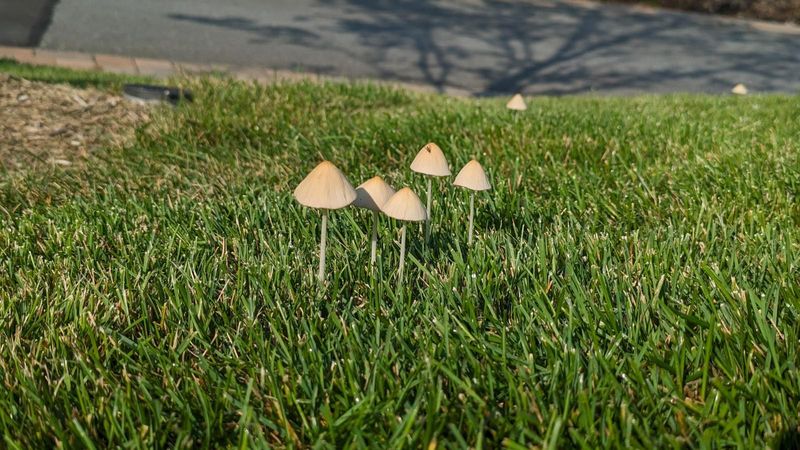
You have two reasonable choices. If the mushrooms are not a hazard or an eyesore, you can simply leave them, since they fade on their own.
If kids or pets play in the yard, rake or pick them up and discard them in the trash.
Wear gloves and wash your hands afterward. Keep in mind that taking off the caps only removes the visible part, and Maryland Extension notes the fungus underground carries on.
More mushrooms may appear after the next good rain.
Skip the fungicide for ordinary mushrooms. It generally will not eliminate the fungus in the soil, and common lawn mushrooms often need no control at all.
Fairy ring is the exception, since it is a specific diagnosis with its own management steps. Without matching turf damage, cleanup and patience are usually all you need.
White is not a safe identification
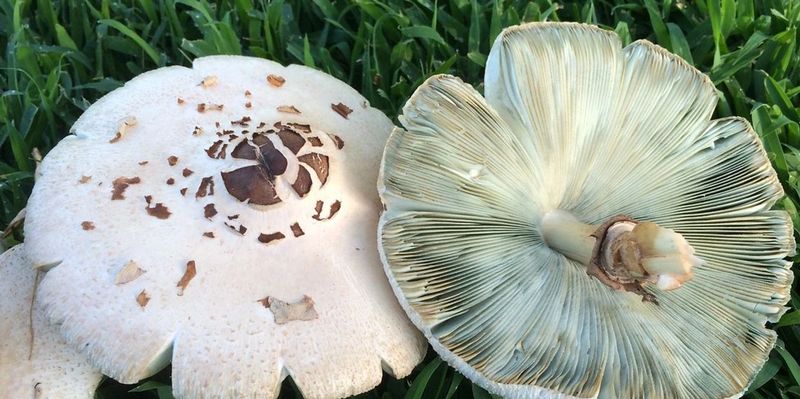
Color cannot tell you what a mushroom is or whether it is safe. Never eat a lawn mushroom, and never rely on white caps as a sign of anything good.
In Florida, the green-spored parasol is a common lawn mushroom that can cause severe stomach illness. UF/IFAS Extension points out that it often starts out with a white cap, which is one reason white is such a poor test.
If someone may have eaten a wild mushroom, call Poison Control at 1-800-222-1222 right away, as Poison Control advises. Do not wait for symptoms to appear.
If a dog or cat may have nibbled one, contact your veterinarian or the ASPCA Animal Poison Control Center. The ASPCA’s pet safety tips are worth a read.
Saving a sample or taking a photo can help.
Test soil before you change it
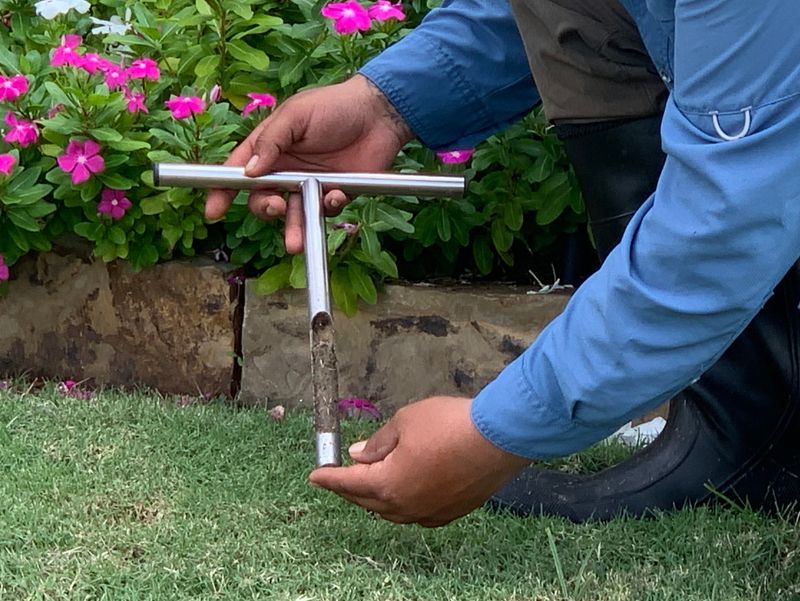
If you really want to know what your soil needs, a soil test is the tool. Follow your lab’s sampling instructions exactly.
The Texas A&M homeowner soil form advises sampling areas that are managed differently, such as a front lawn and a garden bed, separately.
Interpretation depends on where you live and what grass you grow. UF/IFAS notes that pH and salinity are useful results for Florida turf, while some nutrient readings have limits.
Your county extension office can help you read the report.
Hold off on fertilizer, lime, sulfur, or other amendments just because mushrooms showed up. Without test results, you may spend money and still miss the real issue.
The caps are a sign of fungal life, and the lab report is where the real answers live.