
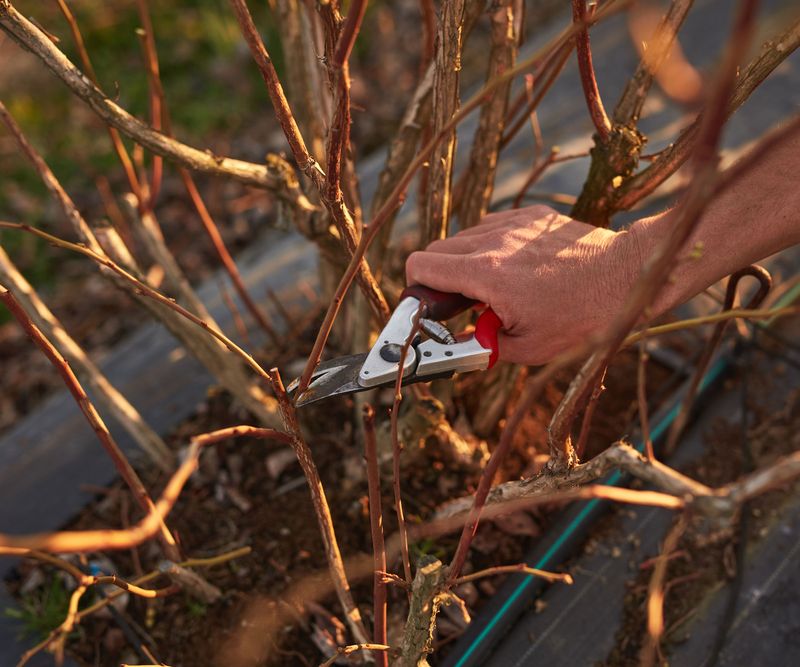
Blueberry bushes that go unpruned for years can fill up with thin, crowded shoots and small berries. A few well-placed cuts at the right time can renew an established bush and balance how much fruit it tries to carry.
In North Carolina, that time is late winter, before spring growth starts. Here is how to prune with purpose, what to expect, and why flavor depends on something other than your loppers.
Late winter is the practical pruning window
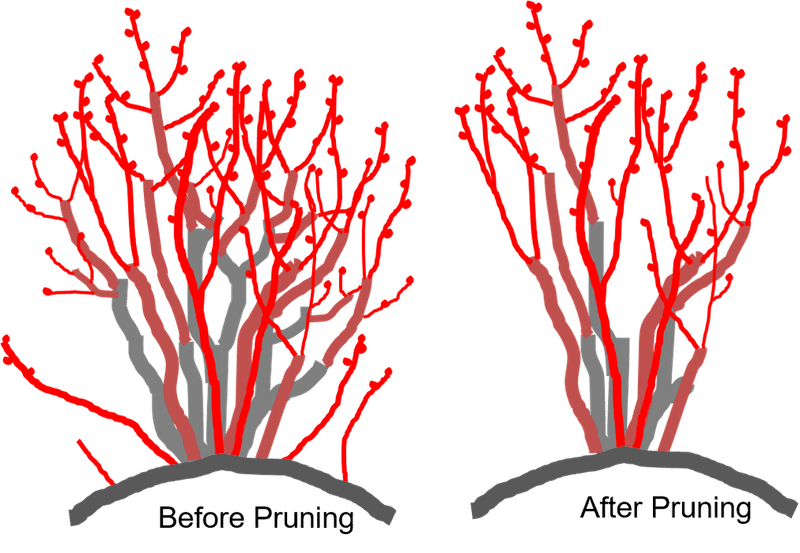
Plan to prune established bushes while they are dormant, after the leaves have dropped and before spring growth begins. For most North Carolina yards, that points to late winter.
Waiting until then lets you see the plump flower buds clearly and judge what the bush is actually carrying.
NC State’s gardener handbook describes a broader winter pruning window of November through March, and it calls late winter especially desirable in the mountains. Penn State Extension goes a step further, recommending pruning toward the end of dormancy, usually March, and advising against fall pruning.
Putting those together, late winter before budbreak is the simplest and most conservative choice, and fall pruning should not be your default.
Think of this as a general window, not a statewide calendar date. Budbreak comes earlier on the coastal plain and in the southern Piedmont than it does in the high mountains, so a bush near Wilmington may be waking up while one near Boone is still fast asleep.
Cultivars also differ in how early they push growth.
Watch the buds rather than the calendar. If they are swollen but not yet opening, you are in good shape.
Experience with your own cultivars, which NC State’s home garden guide says should guide pruning decisions, will help you fine-tune the timing from year to year.
What pruning can—and cannot—improve
Selective pruning does two jobs. It renews the bush by clearing out worn-out or crowded growth, and it manages crop load so the plant is not asked to ripen more fruit than it can handle.
NC State says pruning can increase berry size and help prevent overcropping, which can leave you with small, poor-quality fruit.
That makes larger berries a possible benefit, not a promise. Your results depend on the cultivar, the bush’s health, and the weather that season.
There is a tradeoff to keep in mind. In a study of two cultivars, Duke and Legacy, reducing the fruit-bud load improved berry size, weight, and firmness, but production per plant went down.
The results were specific to those cultivars, that site, and that season, so treat it as an illustration of the tradeoff rather than a forecast for your backyard.
Pruning also does not make berries sweeter, and it does not guarantee a bigger total harvest. A neglected bush full of weak, twiggy shoots may improve with careful renewal.
A bush that is already balanced can lose some of its crop if you cut too much. The goal is a healthier framework and a sensible fruit load, not the heaviest possible haircut.
Assess the bush before choosing canes to remove
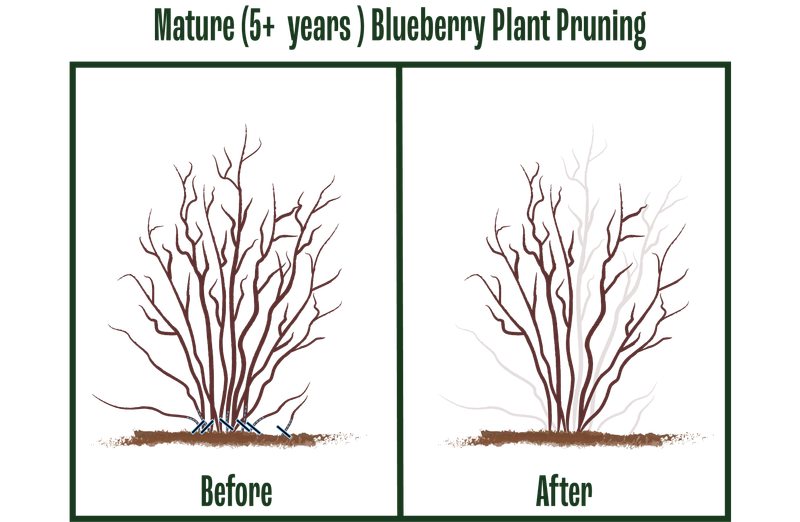
Before you make a single cut, walk around the bush and look at it from several sides. You are sorting the growth into what should stay and what should go.
NC State’s guidance points to removing dead, diseased, or insect-infested wood, along with low-hanging or crossing canes and weak, twiggy growth.
Next, look for vigorous upright canes and try to keep a mix of ages so younger shoots are ready to replace older ones over time. Older canes tend to be thicker and grayer, but gray bark alone is not a reason to cut.
Judge each cane by its condition, how much it crowds its neighbors, and whether healthy replacement growth is coming up.
A useful clue is the tip of the cane. A cane with strong shoots and plump buds is still earning its place, while one covered in short, spindly twigs is likely not.
Your location and cultivar matter too. According to NC State’s home garden guide, rabbiteye generally suits most sites below 2,500 feet, while highbush is better suited to higher mountain elevations.
Rabbiteyes tend to grow tall and upright, while highbush types can look different, so learn what your plant normally does before deciding it is overgrown.
Open the center without stripping the framework
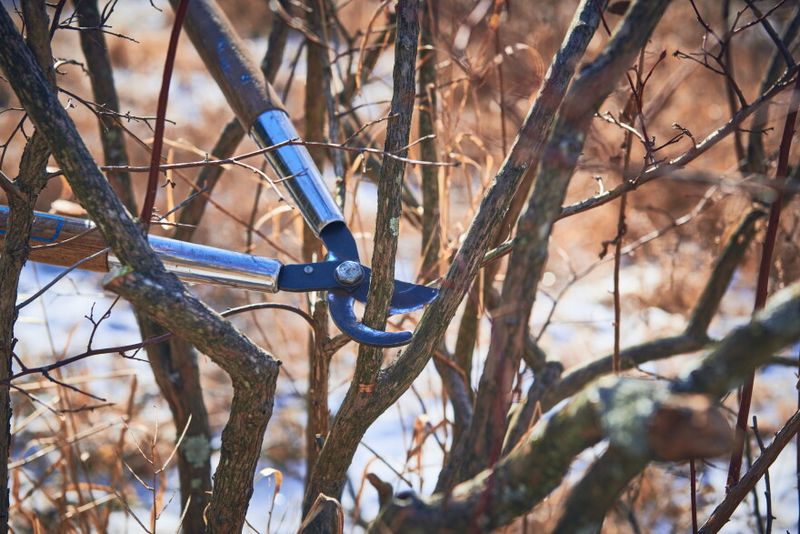
Once you know what you are looking at, start with the obvious problems and then open up the crowded center if the bush needs it. A congested middle blocks light and air, and fruiting wood there tends to stay weak.
NC State mentions removing one to three large central canes where appropriate, which is a conditional suggestion, not a quota for every bush.
If a plant has only a couple of thick canes and plenty of healthy shoots around them, taking out three could leave a big hole. If it is a dense thicket, one or two removals might be enough.
Let crowding, cane condition, and available replacement growth make the call.
Choose your tools to match the cut. Loppers handle the large canes, and hand pruners are better for small cuts.
Cut close to the base or to a side branch so you do not leave stubs behind, and leave the cuts untreated, since NC State says wound dressings are not needed.
Stop often and step back. Purposeful renewal means removing a few of the worst offenders each year while keeping the bush’s structure.
A hard annual haircut can cost you the very buds that would have become next summer’s berries.
Flower-bud thinning trades fruit numbers for crop-load management
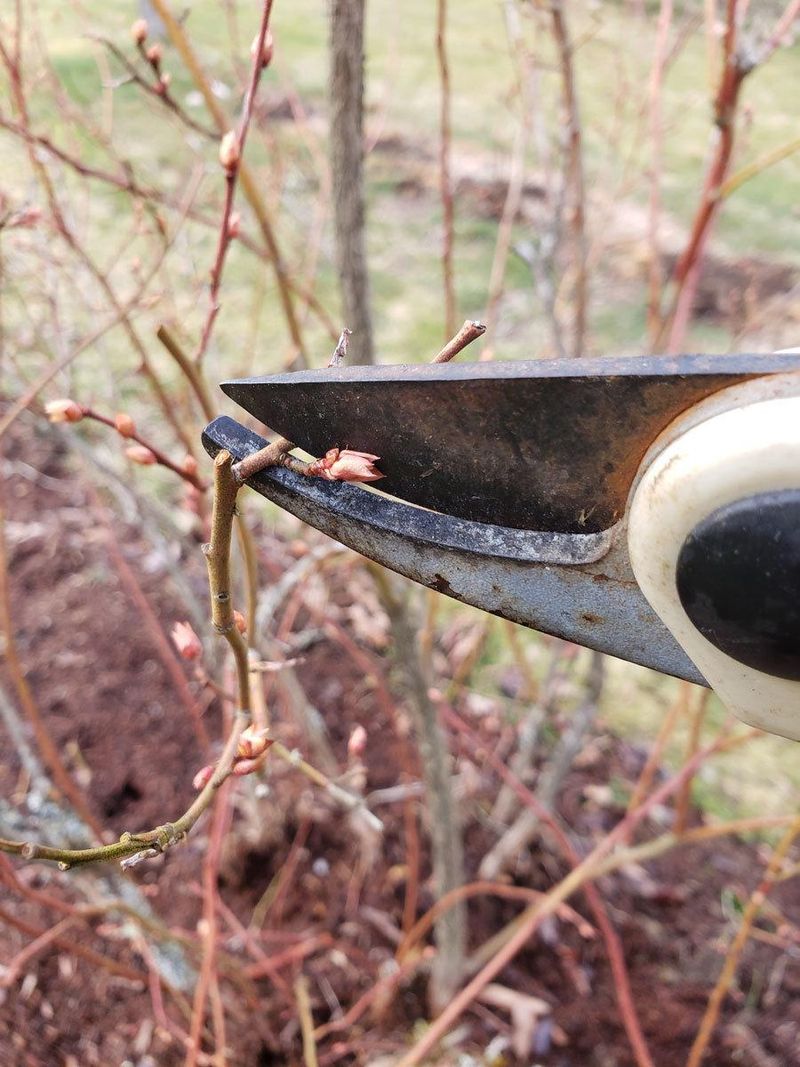
Here is something many gardeners overlook: winter pruning removes more than wood. Every twig you cut off may carry flower buds, and each bud is a possible cluster of berries.
Cutting them lowers the number of berries the bush can set, which is exactly how crop load gets managed.
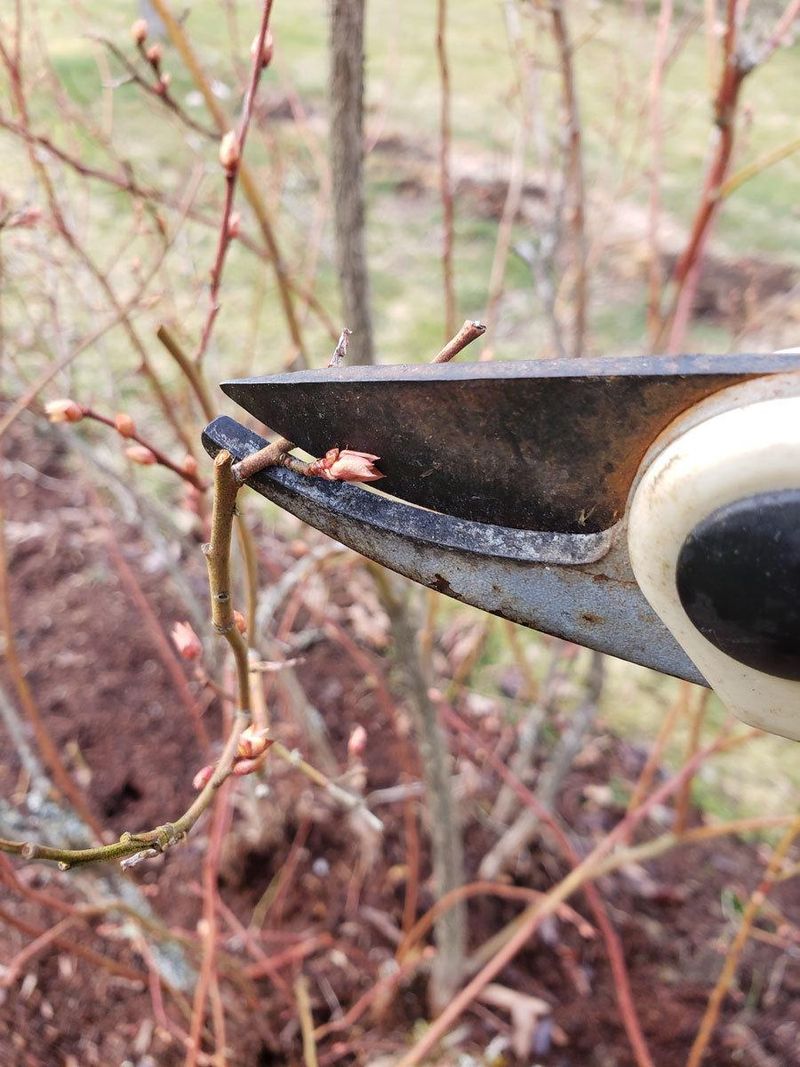
The plump, rounded buds are usually flower buds, and the smaller, pointed ones are leaf buds. Spotting the difference helps you see how much fruit potential you are removing with each cut.
NC State says winter pruning should remove at least a third of the flower buds to limit overcropping. That is the source’s recommendation, not a universal percentage for every bush, cultivar, or gardener.
A heavily loaded bush with many weak twigs is a better candidate for thinning than a sparse one.
Go carefully. Removing too many buds can sacrifice the coming crop, and thinning does not promise a bigger total harvest.
What it can do is spread the plant’s energy across fewer berries, which may help them size up. When in doubt, prune lightly this year and adjust next winter after you see how the bush responded.
Give young bushes a different plan
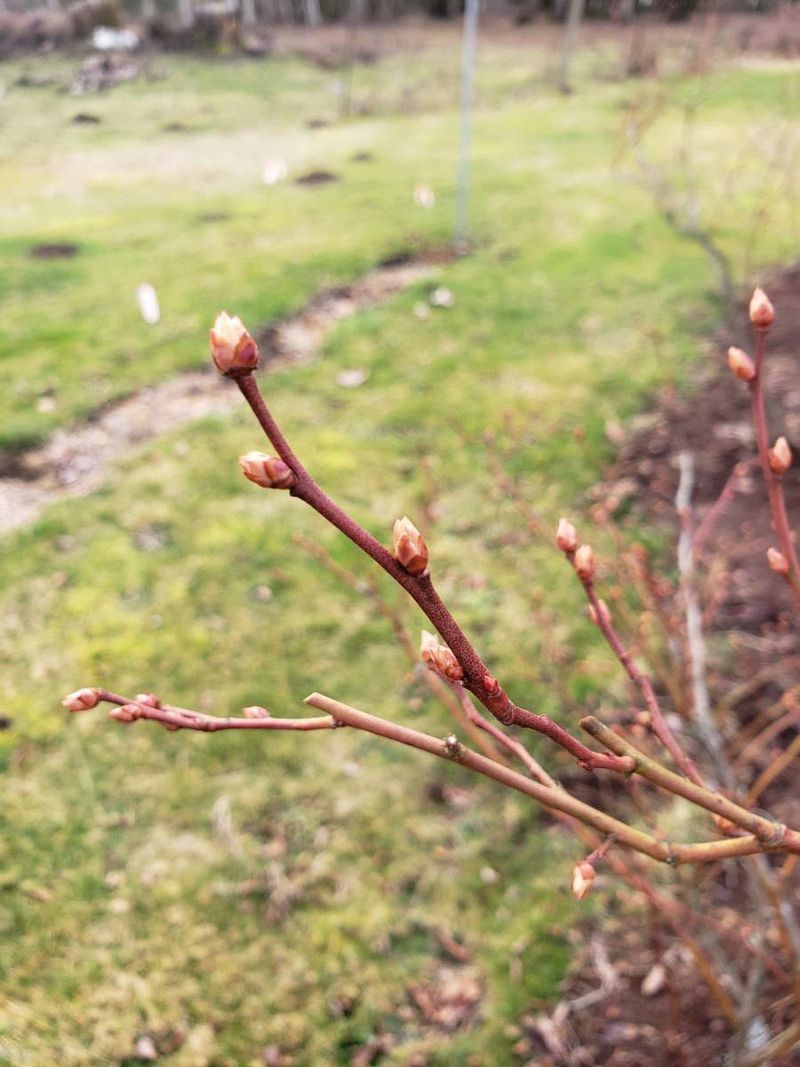
Newly planted blueberries should not get the mature-bush routine. Their job in the first few years is to build roots and strong canes, and fruiting early works against that.
Treating a two-foot shrub like a ten-year-old plant can slow it down.
NC State recommends removing all the flower buds in the first year. In the second year, you can allow a few berries if growth was vigorous.
By year three, keep thinning flower buds so the bush does not overload while it is still filling out.
That means a little patience. You may be giving up an early handful of berries, but you are putting the plant’s energy into roots and framework that will carry heavier crops later.
Judge each plant by how it grew rather than by the calendar alone. A young bush that struggled through a dry summer may need another year of bud removal, while a vigorous one may be ready for a few berries.
Rabbiteye and highbush plants can differ here too, so watch your own bushes and keep the cuts light.
Let berries finish ripening for the best flavor
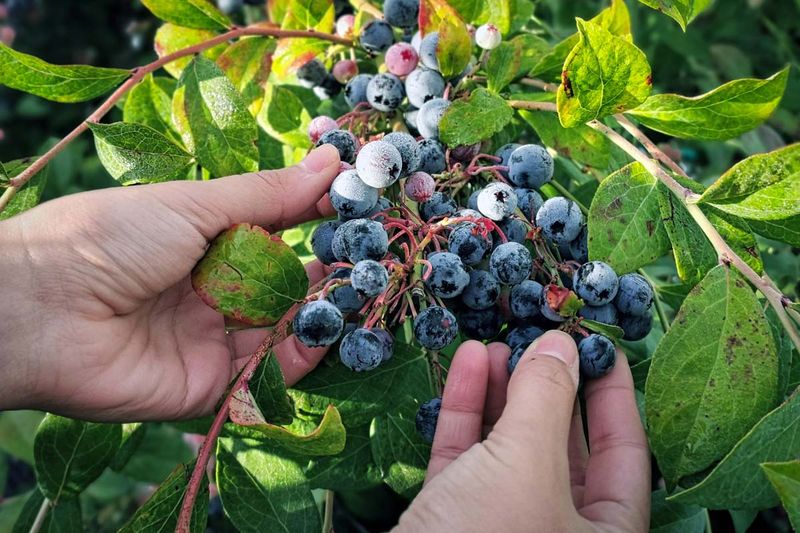
If sweetness is what you are after, the bush gives you a better lever than the pruners. Penn State Extension notes that blueberries can turn blue several days before they reach their sweetest, best-flavored stage.
Pruning does not substitute for that waiting time.
Leave the berries on the bush until they are fully ripe. A good test is to taste one a few days after the color change and compare it with an earlier pick.
Most gardeners are surprised by the difference.
Picking habits matter by type as well. NC State notes that rabbiteye flavor improves when berries are picked less frequently than highbush berries, so there is no need to rush through the rows.
Late-dormant pruning balances the crop, and patient picking finishes the flavor.