
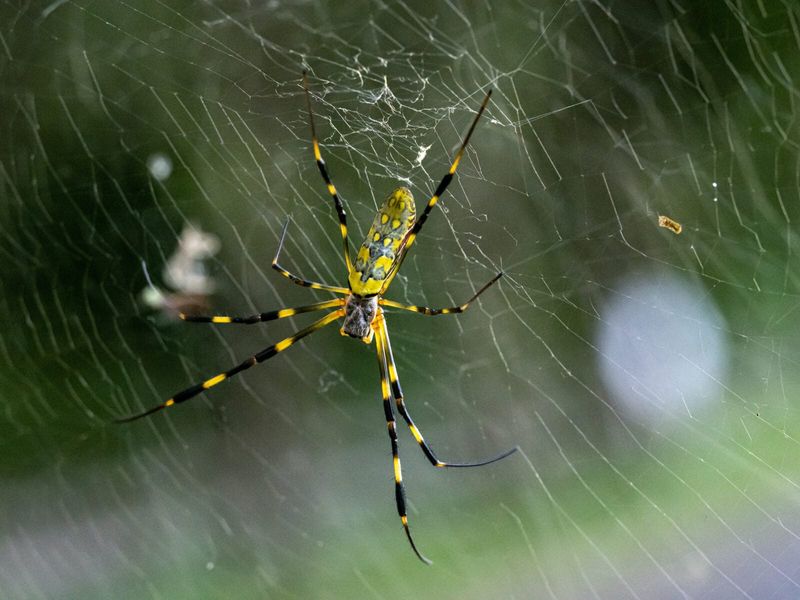
Big golden webs strung between porch posts and shrubs can stop a homeowner in their tracks. The spiders spinning them are Jorō spiders, and people want to know what those sticky sheets are actually catching.
Some of the answers are surprising, and a few might make you rethink your first move with the broom. Here is what researchers have found and what it means for the walkways, decks, and garden corners you use every day.
Jorō Spiders Have Established a Presence in North Carolina
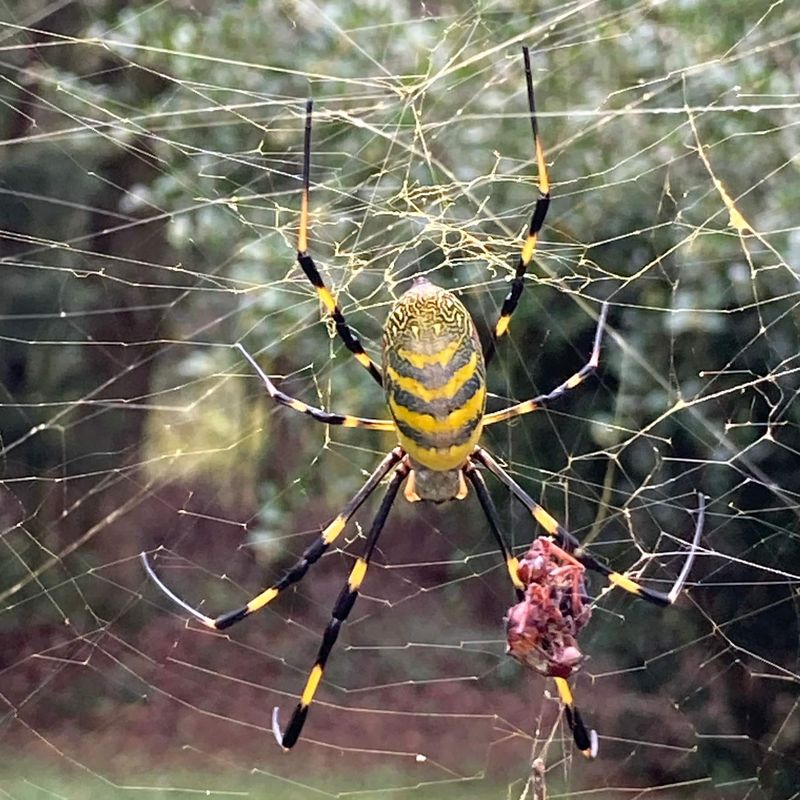
Jorō spiders are not from around here. They are native to East Asia and were introduced to the United States, where they have drawn attention for their size and their bright yellow, blue-gray, and red markings.
In North Carolina, NC State Extension reported the first detections in western North Carolina in fall 2021. That location matters, because it does not mean every yard in the state has one.
If you live in the mountains or foothills, you may be more likely to spot one than a homeowner on the coast.
Still, a web the size of a doorway tends to raise questions wherever it appears. Is it dangerous?
Is it helping with the mosquitoes? Should it come down before the next cookout?
Those are fair questions, and the answers are more nuanced than the scary headlines or the cheerful social media posts suggest. Before deciding what to do about a web in your own yard, it helps to know what these spiders actually eat, what else ends up stuck in their silk, and where the research stops.
The sections below walk through each of those pieces so you can make a calm, practical choice.
What Turns Up in a Jorō Spider’s Web?
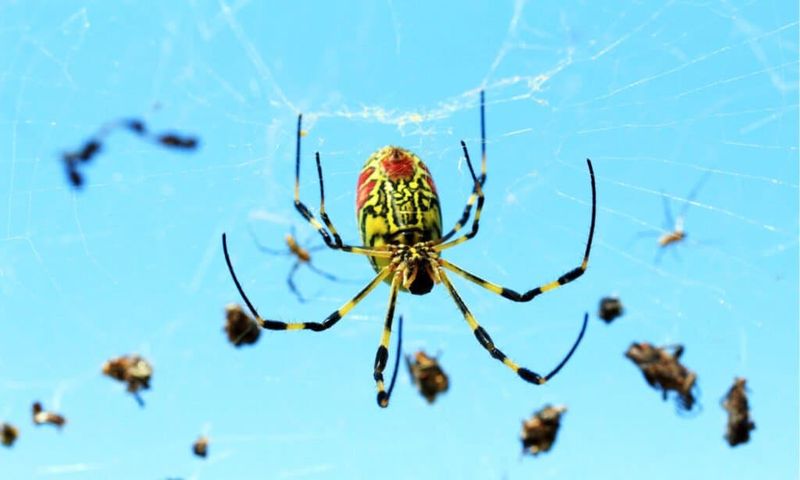
Scientists have a clever way to learn what a spider eats: they look at DNA. In a 2023 study, researchers tested spider feces and leftover prey in webs.
They found mosquito and stink bug DNA in both.
There is a catch in how to read that. DNA in feces is consistent with the spider having eaten the insect.
Prey remains in a web, on the other hand, can include insects that got stuck but were never eaten.
Mosquitoes and stink bugs are not the only items on the list. A 2026 diet study found Jorō spiders eat a wide range of prey, including 26 prey groups that were not detected in the native orb-weavers it studied.
Aphids and leafhoppers were among the examples the researchers highlighted.
So the web is a mixed bag. Some of what lands there is the sort of insect gardeners grumble about, and some is not.
Notice what this does not tell us. These studies identify what turned up, not how many pests a single spider removes from a yard.
A list of prey is a snapshot of a menu, not a measurement of results.
The Web Does Not Sort Insects Into Pests and Allies
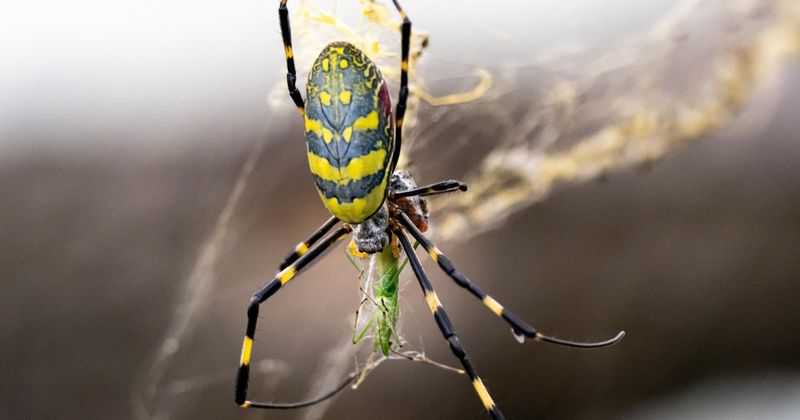
A web is just silk stretched across a flight path. It has no way of telling a stink bug from a bumblebee, so whatever flies in gets stuck.
Researchers saw this in the field. In a 2024 study, observers found that bees, wasps, and ants were the most commonly observed prey group.
Flies came next.
That mix matters if you garden for pollinators. Bees and wasps do real work in a yard, and they showed up in those webs.
Calling Jorō webs harmless to pollinators would be wrong.
Of course, one web is not every web. What a spider catches depends on where it built, the time of year, and which insects are flying nearby.
A web beside a flowering shrub may collect different insects than one over a gravel path.
The takeaway is simple. Jorō webs catch a varied crowd, and it is a mistake to think of them as traps that only grab nuisance bugs.
Catching a Pest Is Not the Same as Controlling It
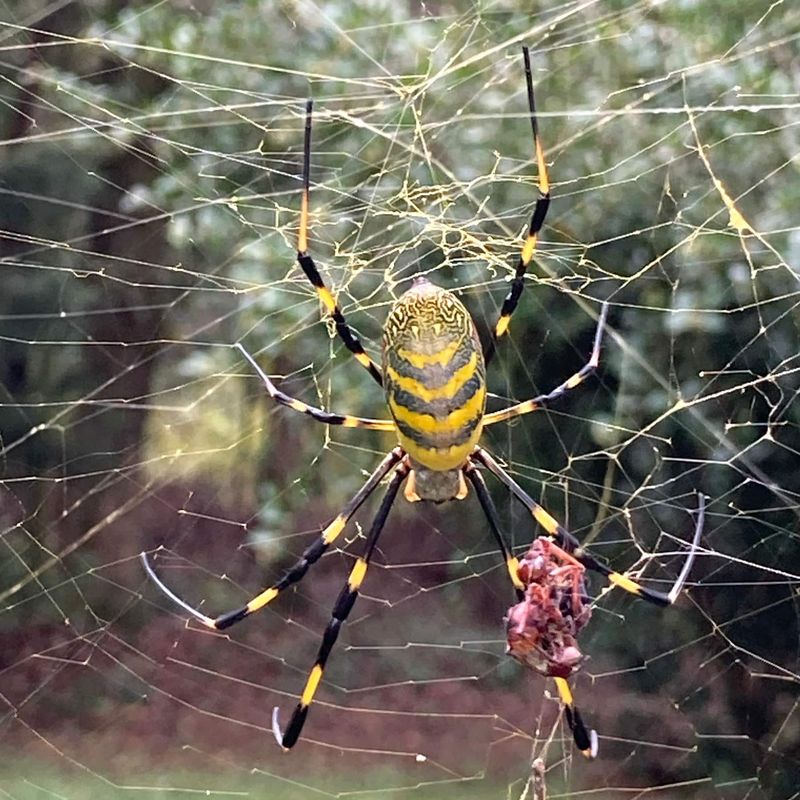
Picture a fishing net that sometimes snags a prized trout. That does not make it a tool for managing the lake.
The same logic applies here.
Diet research shows that mosquitoes and stink bugs can end up as Jorō spider prey. It does not show that the spiders meaningfully lower mosquito or stink bug numbers around homes.
The work in the 2023 DNA study and the 2026 diet study documents what the spiders catch, not how yard populations change.
No study cited here has measured pest-control benefits in North Carolina yards. Claims that a Jorō spider will protect your family from mosquitoes or save your tomatoes from stink bugs go further than the evidence does.
For real protection, stick with the basics. Dump standing water weekly, wear repellent in tick and mosquito season, and keep grass and brush trimmed along paths.
Treat any spider as an occasional bonus at best, not a plan.
What the Research Says About Native Orb-Weavers
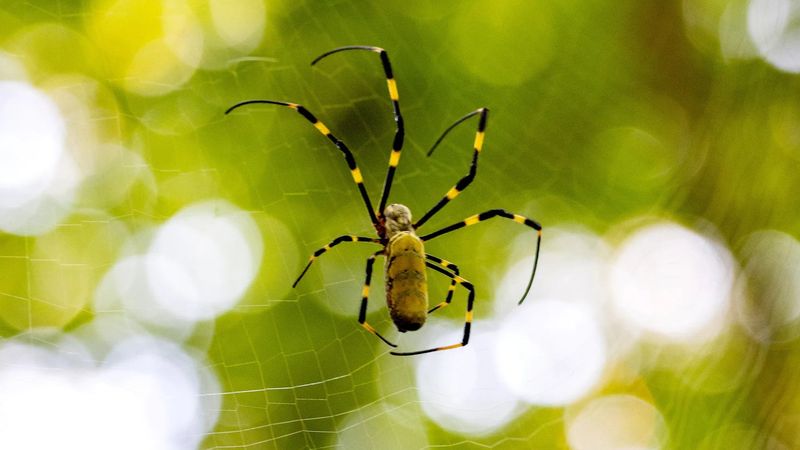
Whether Jorō spiders crowd out native spiders is still an open question, and the studies so far point in different directions.
The 2026 diet study used spiders collected in Georgia and South Carolina in 2021. It found that the diets differed, and it detected no change in the diet makeup of sampled native spiders where Jorō spiders were present.
The authors say the early results do not suggest likely outcompetition based on diet overlap alone.
Diet overlap is only one piece, though. Two spiders eating similar insects does not automatically mean they are competing, and spiders can also compete for web sites.
Then there is a 2025 study of 25 Atlanta-area forest sites. Over three years, Jorō numbers rose while native orb-weaver counts fell.
The authors describe a possible relationship, not proof that Jorō spiders caused the drop.
That study looked at Atlanta forests, not North Carolina yards. Neither result settles the bigger picture, so it makes sense to hold both loosely and watch for new research.
Choose Web Management by Where the Spider Built
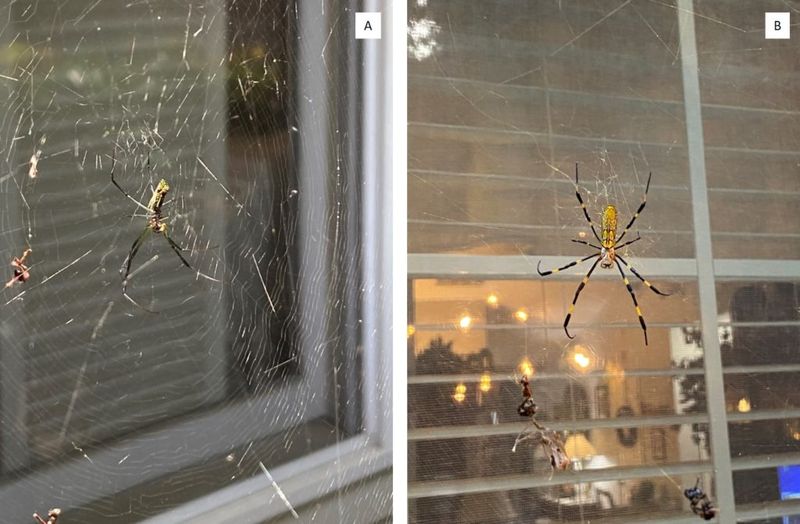
Location is the best guide. UGA Extension guidance suggests dealing with a specific web or spider in a high-contact spot, such as a doorway, walkway, deck, or porch.
Webs in peripheral or low-traffic parts of the yard can be left alone.
Keep in mind that knocking a web down may not end the problem. The spider can rebuild quickly, sometimes within a day, so you may be repeating the chore.
Skip broad insecticide spraying across the yard. UGA warns that wide treatments can also kill pollinators and beneficial insects.
If you do use a pesticide on a particular spot, follow the product label.
Many people worry about bites. According to University of Maryland Extension, Jorō spiders are timid, a bite is unlikely, and the venom is weak and not medically important.
None of that means you should pick one up to check. Keep your hands off, and steer kids and pets around webs where contact is likely.
Keep the Useful Possibility in Perspective
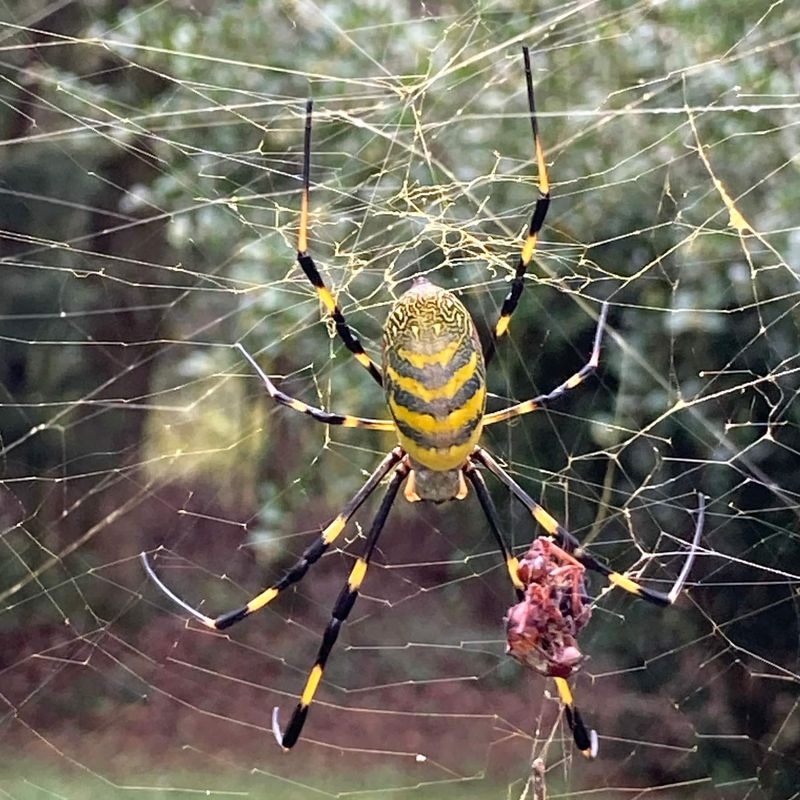
Jorō spiders do eat some insects people regard as pests, but the DNA evidence only shows what is on the menu. Their webs catch many other insects too, and nobody has shown reliable pest relief in yards.
So let daily life make the call. If a web blocks the steps, handle that one, following UGA’s advice.
If it hangs quietly by the fence, you can leave it.
Either way, the web is a puzzle with pieces still missing.