
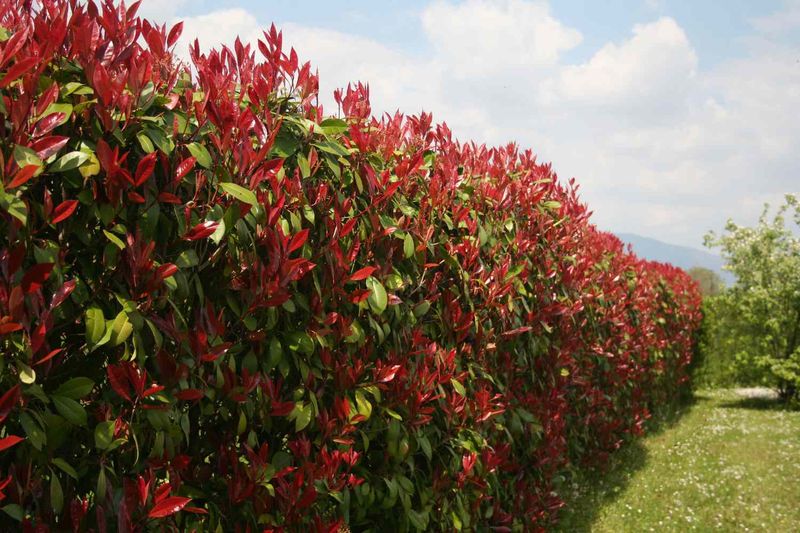
A fence line needs a screen that looks good in July and still does its job in January. Red tip photinia has long been the go-to shrub in North Carolina, but leaf spot has made many homeowners look for another choice.
Southern wax myrtle is a native evergreen in much of eastern North Carolina, and it can grow into a full, dense hedge. Here is how to tell whether it fits your fence, your soil, and your house.
Photinia leaf spot is a risk, but a bare base is not inevitable
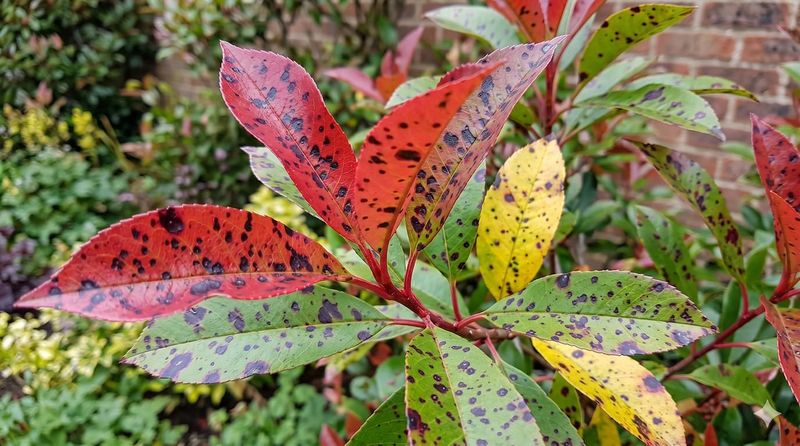
Red tip photinia earned its spot along countless Southern fences for good reason: fast growth and bright red new leaves. The trouble is Entomosporium leaf spot.
University of Maryland Extension describes this disease as a serious problem for red tip photinia, causing heavy spotting and leaf drop that can be hard to manage once it is established.
Look closely at your own hedge before blaming the plant for everything. Small reddish-purple spots on leaves, followed by yellowing and falling leaves, point to disease.
Leaves dropping from the whole shrub, top and bottom, fits that pattern.
A thin base can have a different cause entirely. University of Georgia Extension explains that a hedge that is wider at the top than the bottom shades its own lower branches, and shaded branches lose leaves.
That can happen to almost any shrub that is sheared into a top-heavy shape, not only photinia.
So a bare base is not a guaranteed fate for photinia, and it is not a problem a new plant will solve by itself. Whatever you plant along the fence needs the right spot and the right pruning.
If your photinia is healthy and well shaped, you may have no reason to replace it.
Southern wax myrtle is native in much of eastern North Carolina
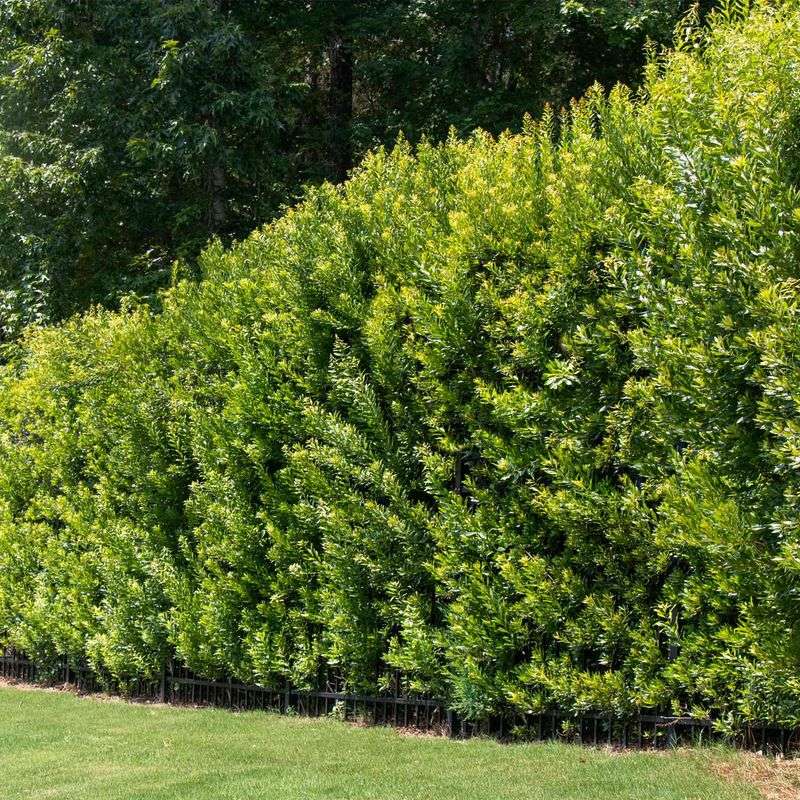
Southern wax myrtle goes by Morella cerifera, and many nurseries and older books still list it as Myrica cerifera. NC State Extension describes it as an evergreen shrub that works as a privacy hedge.
Its narrow leaves are aromatic when crushed, which gives the plant its distinct smell.
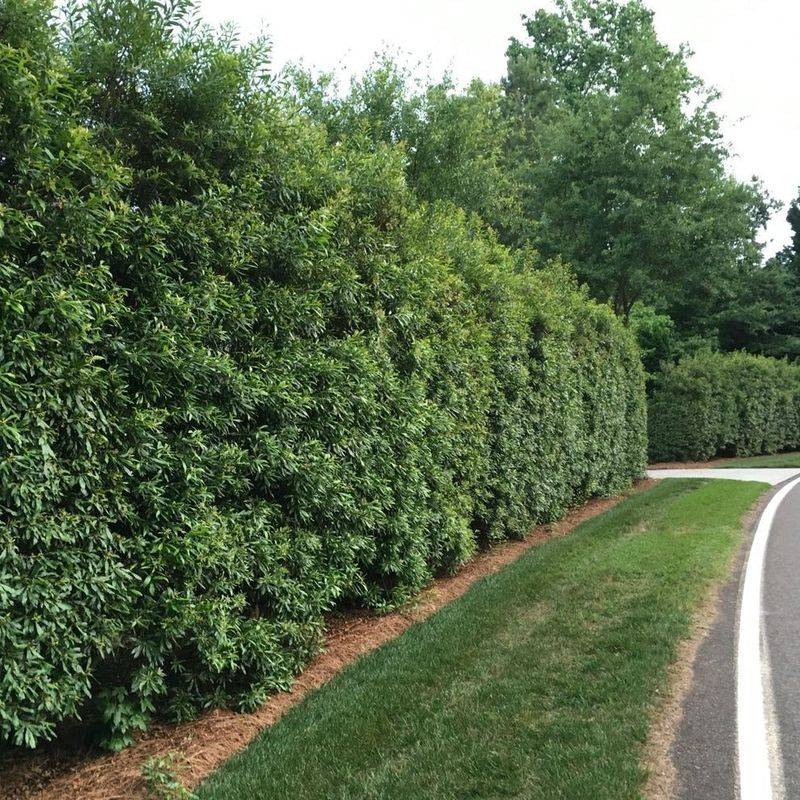
The N.C. Forest Service says its foliage is dense year-round and calls it a natural privacy barrier.
That makes it a reasonable candidate where a thick screen is the goal.
Where it is native matters. According to the Vascular Plants of North Carolina, it is native throughout the Coastal Plain and in parts of the eastern and southeastern Piedmont.
Farther west, its status is uncertain, and plants there may have spread from plantings. So if you live in the mountains or the western Piedmont, do not assume it is a local native.
In the east, it fits naturally with the plants and wildlife already around you.
Give the shrub room before planting the fence line
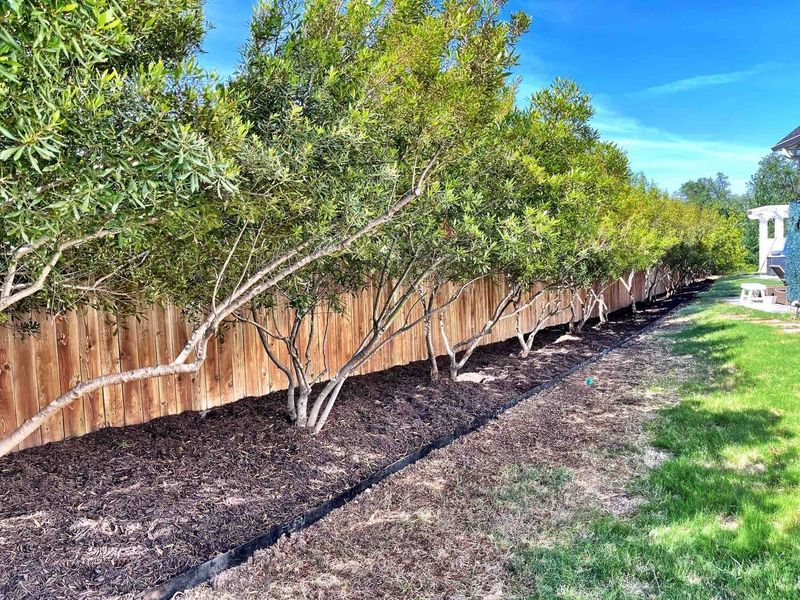
Plenty of people buy a one-gallon wax myrtle and picture a tidy little hedge. The plant has other plans.
NC State Extension gives a potential mature size of about 20 to 25 feet tall and 8 to 10 feet wide, though plants are often shorter.
The N.C. Forest Service lists a similar range, 10 to 25 feet tall with a crown spread of 8 to 10 feet.
That is a lot of shrub for a narrow strip beside a fence.
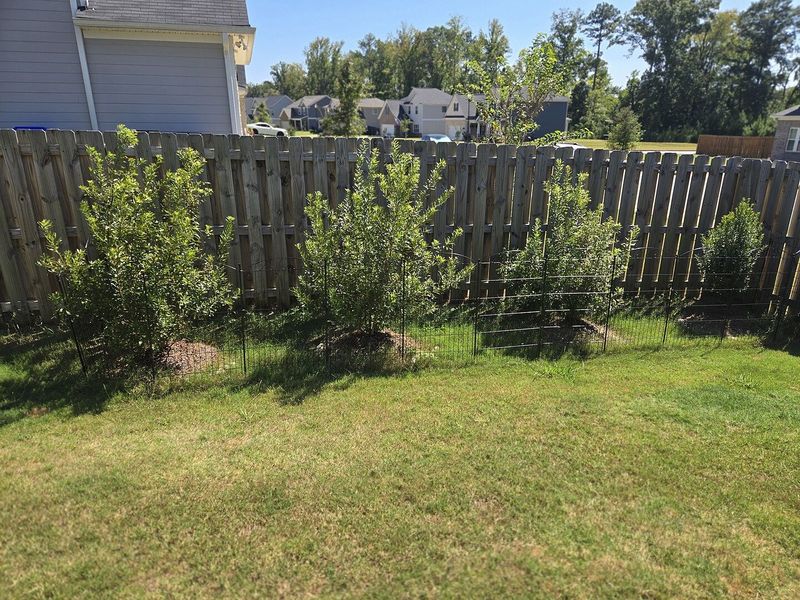
Before you buy, measure the space between the fence and anything you want to keep clear, such as a walkway, a neighbor’s yard, or a utility line. Check the expected size of the exact plant on the tag, and set plants back from the fence enough to handle that width.
The good news is that wax myrtle is flexible about conditions. It grows in full sun to partial shade, and once established it tolerates a wide range of soil moisture.
That helps in spots where drainage is uneven, but it does not change how big the plant wants to become.
Shape the hedge to let light reach its base

Lower leaves need light, and shape decides whether they get it. University of Georgia Extension says a hedge that narrows toward the top lets sunlight reach the lower canopy, while one that is wider at the top can thin near the base.
In practice, trim the sides at a slight slope, with the bottom a little broader than the top. Avoid flat-topped, boxy shearing that creates a shade roof over the lower branches.
Light trimming through the growing season is easier on the plant than one hard cut.
Species alone will not guarantee a leafy base. NC State Extension notes that wax myrtle can be pruned as a hedge but can also be trained into a small tree by removing the lower limbs.
A plant left to grow tall and thin may look more like a tree than a wall of green.
If you want a screen close to the ground, keep lower branches and keep the shape tapered. Shade from nearby trees or buildings can also thin lower growth, so a sunnier spot helps.
Treat dense lower growth as something you maintain, not something you are promised.
Wildlife value comes with a spreading habit
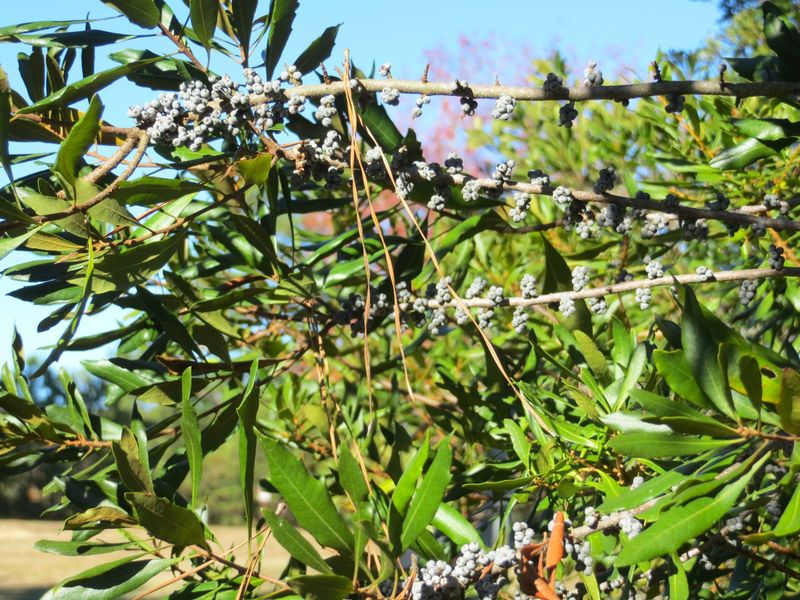
A wax myrtle hedge does more than block the view. Its branches give birds shelter, and the berries are food.
NC Sea Grant identifies wax myrtle seeds as food for several songbirds, and the N.C. Forest Service also points to its value for wildlife.
Think of it as food and cover, nothing more specific than that.
Berries are not automatic. Female plants produce fruit after pollination, and berry production generally requires both male and female plants nearby.
A single plant, or plants of one sex, may give you leaves but no berries.
The other side of the deal is spread. NC State Extension notes that wax myrtle can sucker and form colonies in favorable conditions.
In moist, open soil, new shoots may pop up beyond the row.
Plan on watching the edges. Pull or cut suckers early, and keep a mowing strip or bed edge around the planting.
If you want a strictly confined line of shrubs, this plant will take regular attention.
Cold sites and defensible space can rule it out
Two checks can decide whether wax myrtle belongs on your fence line. The first is cold.
Sources list it as hardy in USDA Zones 7 to 10, and NC State Extension notes that it is only semi-evergreen in northern zones. NC Sea Grant also calls it semi-evergreen.
In practice, a colder or windy, exposed site may see leaf drop in winter. Do not count on the same full screen in January that you have in July.
A sheltered spot in the Coastal Plain is more likely to hold its leaves than an open hilltop yard.
The second check is fire. NC Extension classifies wax myrtle as a potential fire hazard because the aromatic foliage and woody parts contain flammable compounds.
It advises against planting it within a home’s defensible space.
That means you should not tuck it against the house or right beside a wooden deck. A fence line far from the structure is a different story.
Measure the distance, and if the fence runs close to your home, pick a different plant for that stretch. These are siting checks, not reasons to dismiss the shrub everywhere.
Choose wax myrtle only when the site fits
Wax myrtle can be a useful alternative to photinia when the fence line has room for a large shrub, you will trim it wider at the base, and you can handle some suckering. Check the state flora range for your county, expect some winter leaf loss in colder spots, and keep it out of defensible space.
Review the NC State plant profile and the UGA pruning guide before you buy. A healthy photinia can stay.
The right shrub is the one that matches the yard, not the one with the best reputation.