
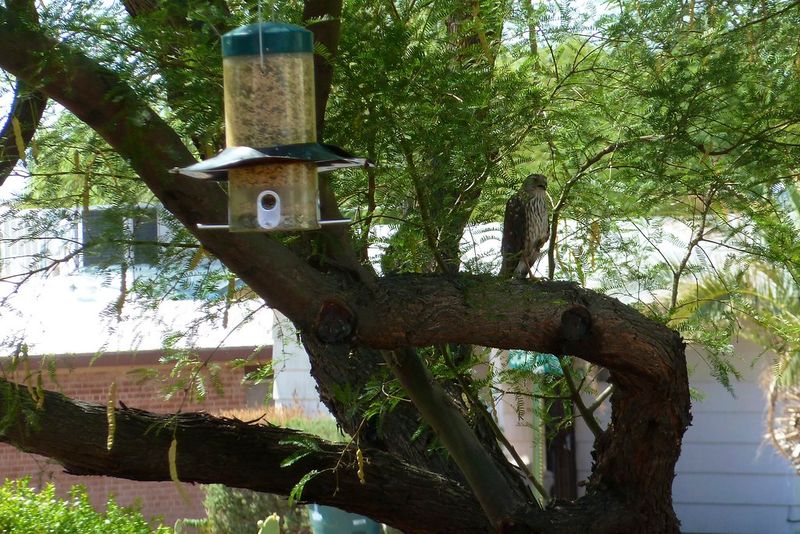
One minute your feeder is busy with chickadees and titmice, and the next the yard goes silent. A hawk has dropped in, and you may wonder if you should step in.
In North Carolina, the best move is often a calm one, and a few simple steps protect the birds you already feed. Here is how to read what you are seeing and what to do next.
A hawk nearby does not prove the feeder is under attack
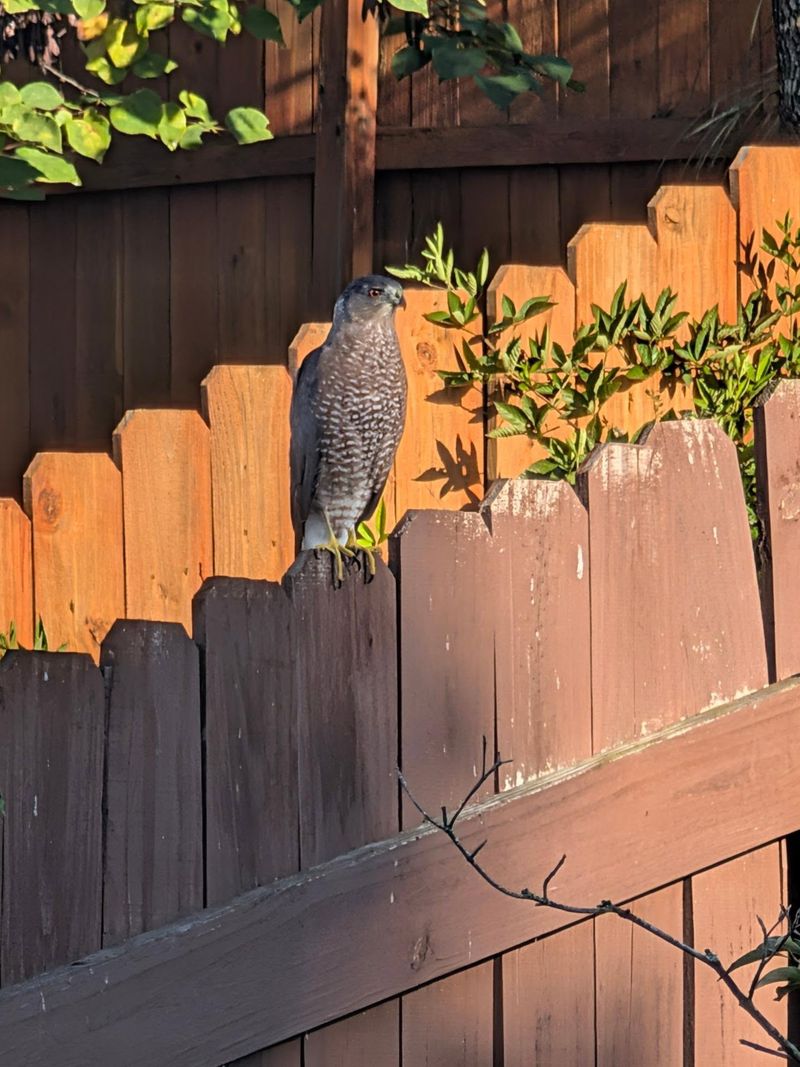
Seeing a hawk in the yard feels alarming, but a sighting is only a sighting. Birds that gather at feeders do create a handy hunting opportunity, and Cornell’s Cooper’s Hawk profile notes that Cooper’s Hawks and Sharp-shinned Hawks are known to hunt birds at feeders.
That is why those two species get most of the blame.
Still, not every hawk overhead is one of them, and not every hawk is after your feeder crowd. Red-tailed Hawks, for example, often go after other prey.
Cooper’s Hawk life history details show that even Cooper’s Hawks take mammals as well as birds, so a hawk on a nearby limb may be resting, watching, or passing through.
Think of it as a clue to weigh, not a verdict. Cornell’s FeederWatch look at backyard hawks shows how often predators and feeder birds cross paths, yet one sighting does not tell you the hawk caught or will catch a particular bird.
Ask what you have actually seen. Did the hawk make a dash at the feeder?
Did you find a pile of feathers? Does it return day after day at the same hour?
Jot down dates and times for a week. Repeated attacks tell a very different story than one quiet fly-by.
When should you pause feeding?
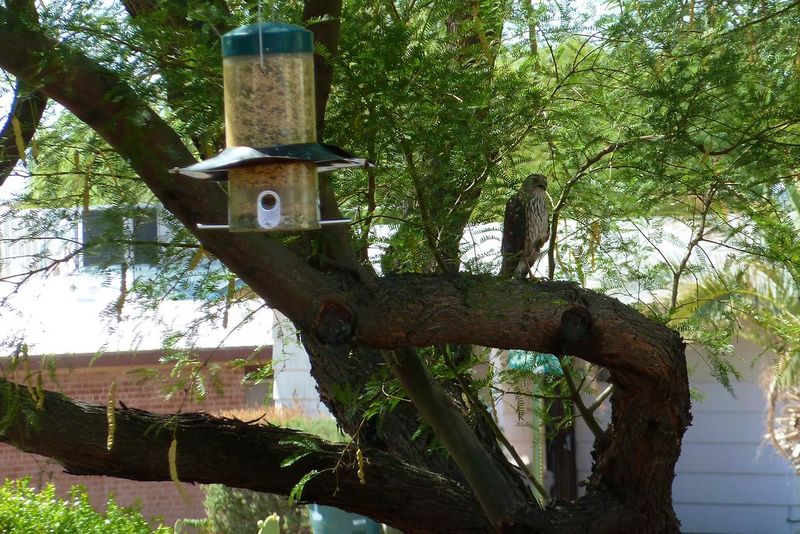
Most hawk visits are brief, and the right response to those is nothing at all. A hawk that swoops through once or twice a season is just part of a healthy yard.
Hunting songbirds is natural behavior, and the hawk is not a villain.
Things change when the pattern becomes hard to ignore. If a hawk shows up again and again, or lingers so long that other birds stay away from the feeder, that is a sustained disruption.
Audubon’s bird FAQ suggests pausing feeding when a hawk hangs around and keeps other birds away.
North Carolina’s wildlife agency points the same way. Its Feeding Birds Responsibly guidance says to close feeders if predation spikes.
Let the effect on your birds be the deciding factor, not the sheer fact that a hawk appeared. Warning signs include repeated strikes, feather piles under the feeder, or a yard that stays empty for hours.
Closing feeders in that case is a practical way to reduce a concentrated feeding opportunity. It is not a punishment for the hawk, and it is not a confrontation.
Cornell also lists a temporary feeder break as the step to try when a hawk is hunting your feeder birds.
Taking feeders down is a trial, not a hawk-removal plan
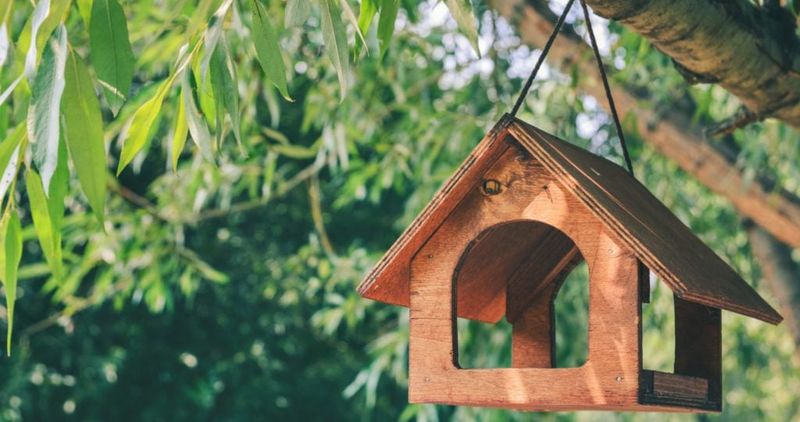
Pausing is simple. Bring in every feeder, not just the one the hawk seems to favor, and sweep up spilled seed and hulls below so the spot stops acting like a dinner table.
Wash the feeders while they are down, so they are ready when you put them back.
How long should you wait? Guidance varies.
The shortest advice is a few days, and Cornell’s suggestion stretches to a week or two. Treat that span as a trial rather than a timer, because no source promises how quickly a hawk will move on.
Cornell’s advice on hunting hawks frames it as a way to change the hawk’s routine, not a sure fix.
When the pause ends, put one feeder back out and watch. If the yard fills up and the hawk stays away, great.
If the hawk returns and hunts again, you can pause once more. Cornell’s guide to unwanted yard visitors notes that a hawk may come back after feeders go up again.
The hawk may also simply stay nearby, since your yard is only one stop on its hunting route. That is fine.
North Carolina’s wildlife agency treats closing feeders as a response to a predation spike, and that is all this step is meant to be.
A short feeding pause is not generally expected to starve seed-eating birds
Many people hesitate to take feeders down because they worry the birds will go hungry. That concern comes from a good place, but feeder food is a supplement for most species.
As Audubon’s FAQ explains, birds rely on many food sources, so a break in feeding is not generally expected to make seed-eaters starve.
Think about what your regular visitors do all day. Cardinals, finches, sparrows, and chickadees already move between your feeder and wild seeds, berries, and insects.
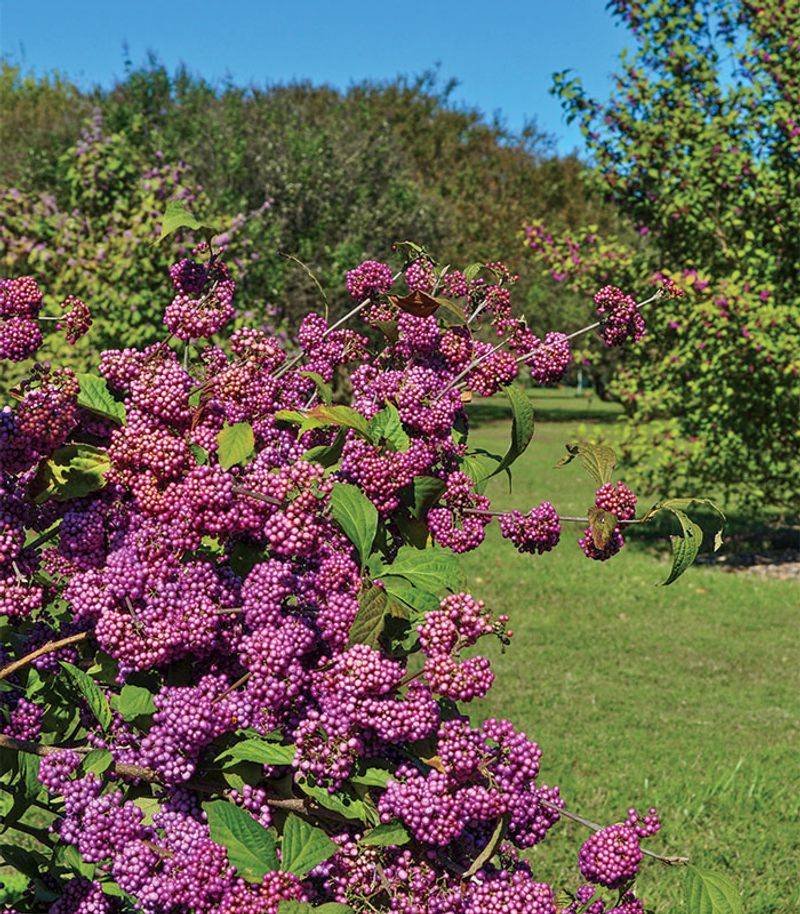
Native plants like coneflower, American beautyberry, and dogwood offer natural food they can turn to while the feeders rest.
Cornell’s winter bird feeding note also describes feeder food as a boost rather than a lifeline for many species.
There are limits to that reassurance. No one can promise that every bird will find food easily in every condition.
During an unusually severe cold snap, an ice storm, or a stretch when natural food is scarce, a pause carries more risk, and you may want to think harder before closing feeders.
In the mountains, a hard freeze can arrive sooner than on the coastal plain, so local weather matters. A short trial in mild fall weather is a very different situation from a long gap in a deep freeze.
Nearby natural cover can offer feeder birds a refuge
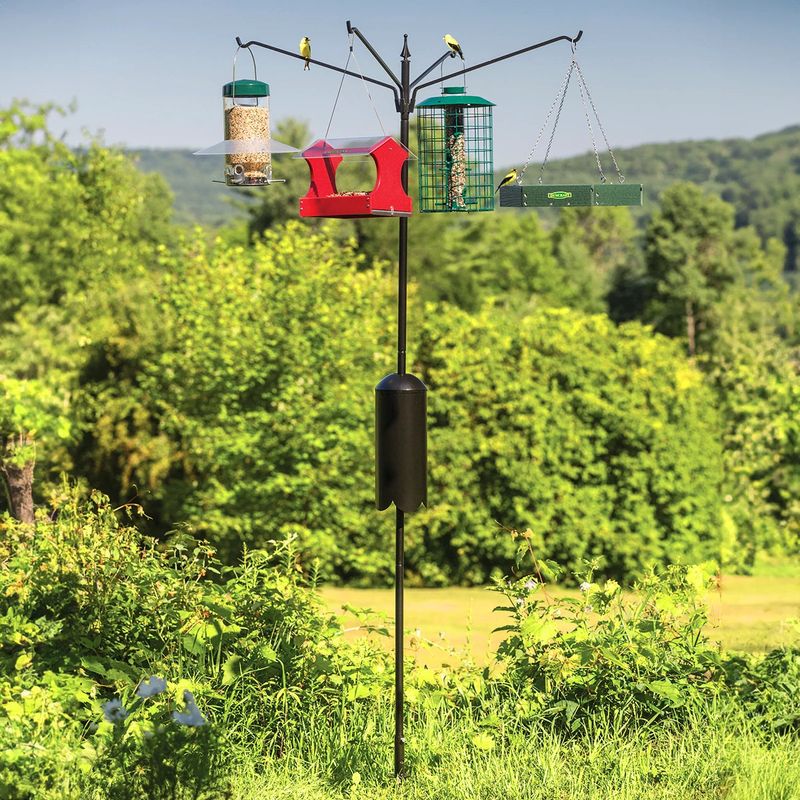
Where you hang a feeder matters as much as whether you hang it. Shrubs and small trees close by give birds a place to dart into when a shadow passes.
Native choices like American holly, yaupon, and serviceberry work well across much of North Carolina.
Project FeederWatch’s feeder placement guidance describes about 10 feet from cover as a reasonable compromise. That is close enough for a quick escape, yet far enough that branches do not hand squirrels or cats an easy launch pad.
Keep the number in perspective. It is general feeder-placement advice, not a proven hawk-proof distance.
A hawk can still attack a bird that is feeding, or chase one into the brush.
Cover offers a possible refuge, and that is all it is. It cannot guarantee safety.
Still, a feeder tucked beside a shrub border gives birds more options than one standing alone in the middle of an open lawn.
This weekend, walk your yard and look at where each feeder sits. If one stands far from any cover, consider moving it closer to a shrub line.
If it sits tight against a thicket, shift it a few steps out. Small changes like these cost nothing and may help your birds feel less exposed.
Leave the hawk and its active nest alone
Whatever frustration a hawk may cause, the line is clear. Do not chase it, trap it, injure it, poison it, or try to kill it.
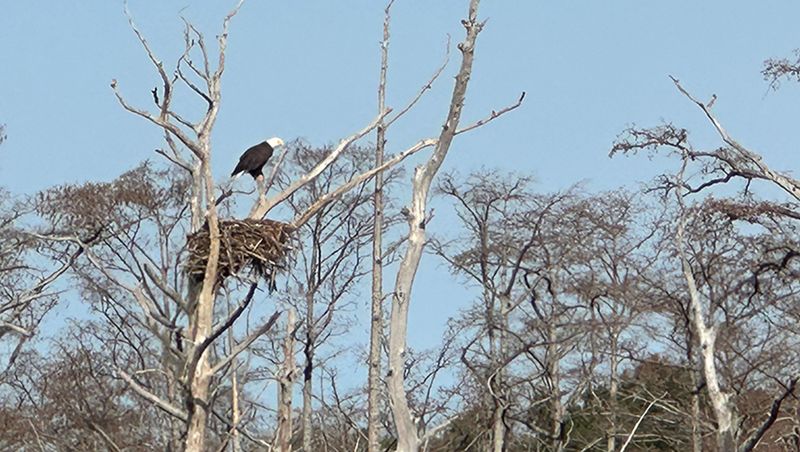
Do not climb, trim, or disturb a tree holding an active nest either.
The North Carolina Wildlife Resources Commission says that all hawk species in the state are protected by federal and state law. According to the agency, it is illegal to kill, injure, or harass native hawks, and to harm or destroy active hawk nests.
For exact legal details, check with the agency directly.
There is a practical side too. Scare tactics, fake predators, and loud noises have not been shown to be a reliable fix for a hawk at a feeder, and they can stress every animal nearby.
The steps that sources do support are a temporary feeder break and good natural cover.
If you notice a nest, enjoy it from a distance. Use binoculars instead of walking up to the tree, and put off any pruning nearby until you are sure the nest is no longer active.
A hawk is part of the wild neighborhood, and it is doing what hawks do. You can protect your feeder birds without ever laying a hand on it.
A hawk on the ground may be eating, not injured
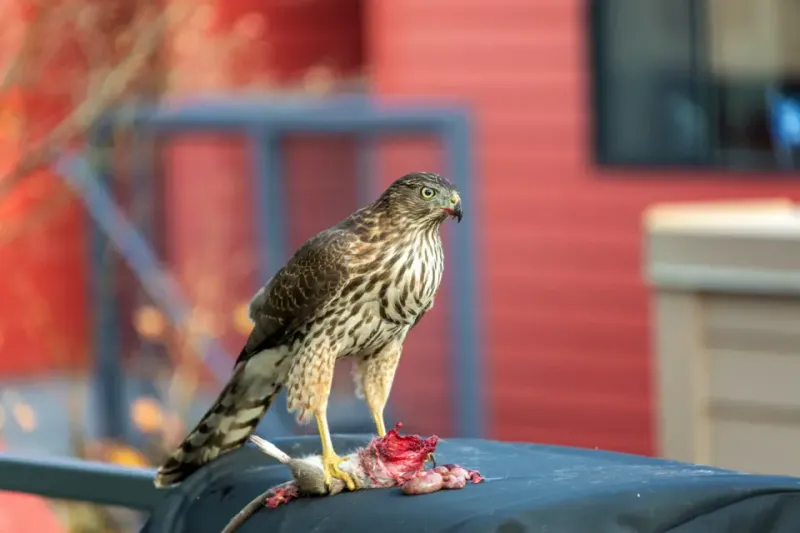
A hawk sitting on the grass can look like a bird in trouble, but that is often not the case. It may be eating its catch, and it may hold its wings out over the meal to hide it.
The North Carolina Wildlife Resources Commission notes in its hawk guidance that a hawk on the ground may simply be eating prey.
Give it time and space. Watch from a window, keep pets indoors, and check again in an hour or so.
Most hawks finish the meal and fly off on their own.
The picture is different if the bird is clearly sick, injured, or in immediate danger. Signs might include a drooping wing, an inability to fly after a long wait, or a bird in the road or near a hazard.
In those cases, do not pick it up or try to treat it yourself, because hawks have strong talons and handling can hurt both of you.
Instead, contact a licensed raptor rehabilitator. The agency can point you toward one in your area.
Keep this separate from your feeder decisions. A hawk eating on the lawn says nothing about whether to pause your feeders.
Choose the least disruptive next step
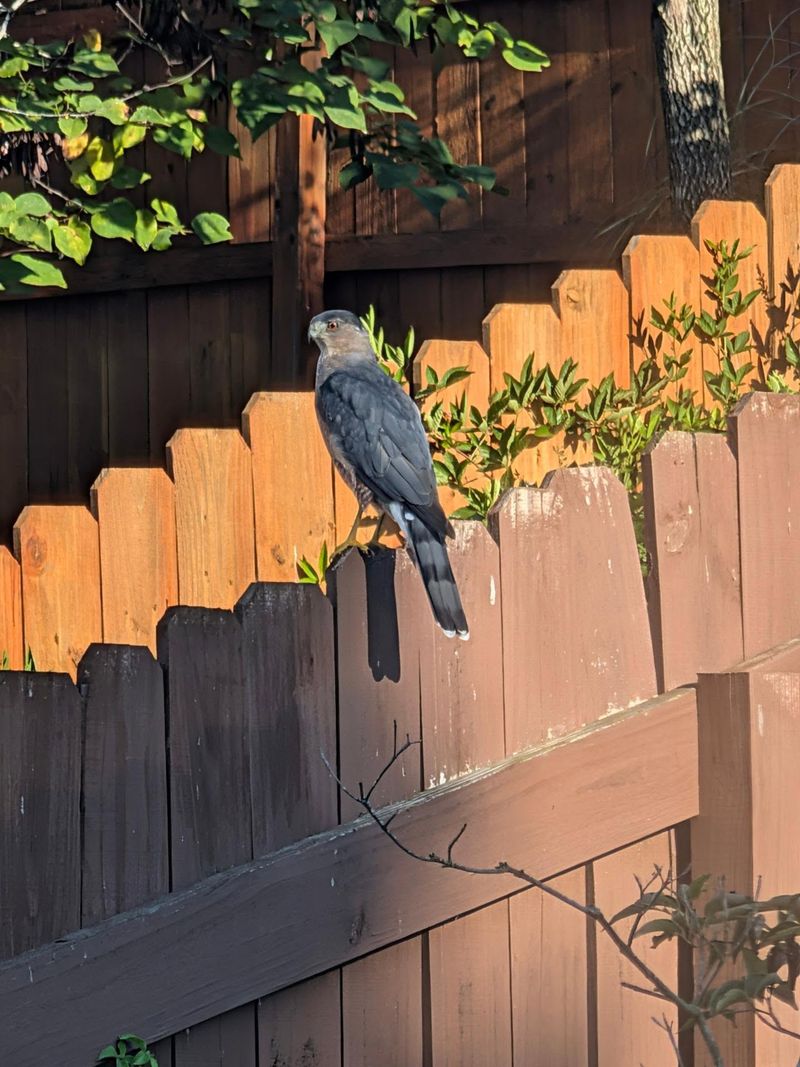
Start small. An occasional hawk deserves nothing more than a good look.
If hunting turns frequent or your yard stays empty, take the feeders in for a trial, as the state’s feeding guidance advises when predation spikes. Then put one back and watch what happens.
A pause may change the feeding opportunity, but Cornell’s yard visitor advice makes clear the hawk may still return. Leave it, and any nest, unharmed, since North Carolina protects native hawks.
A yard busy enough to attract a hawk is a yard doing its job.