
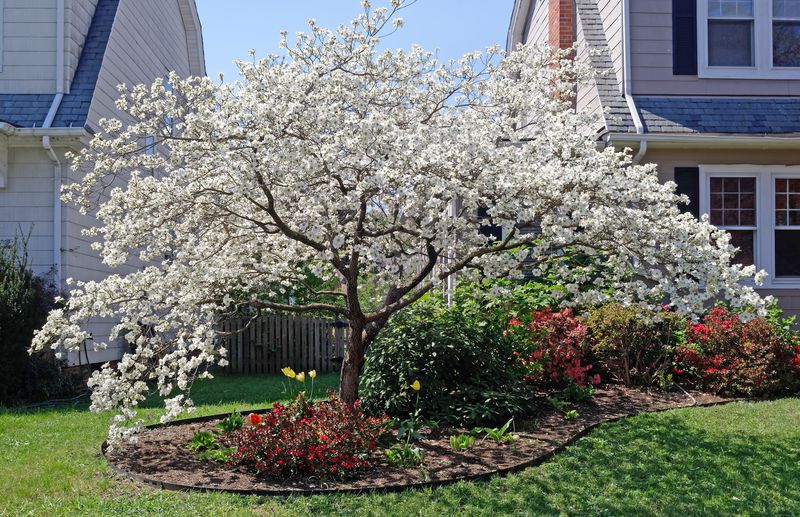
Your dogwood put on a show last April, and now you want to help it do it again. Late fall is a good time to look at the tree, but a hose is not a magic wand for next year’s blooms.
Whether water helps depends on one simple thing: how dry the soil is around the roots. Here is how to check, what to do, and what watering cannot fix.
Flower buds form before fall, but watering does not shield them
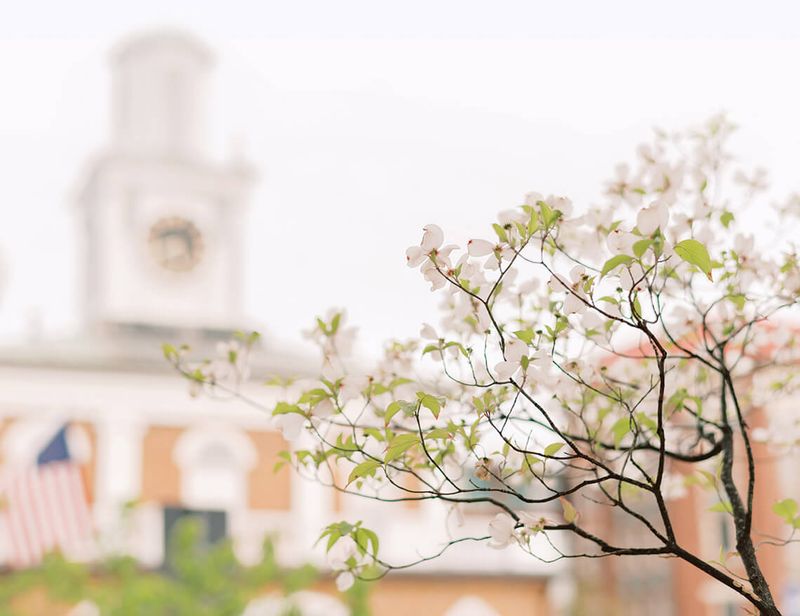
By the time November arrives, next spring’s flowers are already waiting on the branches. The U.S.
Forest Service reports that flower and leaf buds on flowering dogwood become evident in August, stay dormant through winter, and expand in spring. For North Carolina and South Carolina, it lists March through April as the typical flowering time.
So the buds are not starting from scratch in late fall.
That timing changes what a late-fall watering can do. Water can help a tree get through dry weather without stress.
It does not wrap the buds in a protective layer, and it cannot prevent winter bud injury or damage from a late frost. Those are separate risks, and a hose has little say in them.
It also means there is no magic deadline. Nothing special happens on November 1 that makes a soak work or fail.
What matters is whether the ground is actually dry. The USDA plant guide notes that dogwoods do not tolerate severe drought, but they also do not do well in heavy, saturated soil.
Both extremes can hurt.
Think of watering as general tree care, not a bloom guarantee. A tree that stays out of drought stress is simply in better shape, whatever spring brings.
Whether it flowers heavily is a bigger question with several possible answers, which we will come back to at the end.
Check whether the root-zone soil is dry
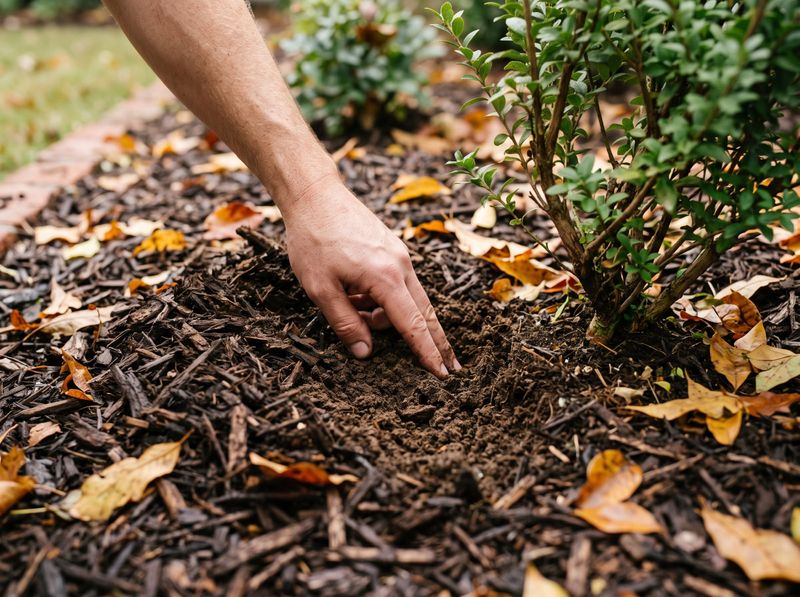
Before you drag out the hose, spend two minutes with a trowel or a finger. Dig a few inches down in the soil beneath the canopy, where the tree’s roots are working.
Look at the soil and feel it. If it is damp or clumps in your hand, the tree has what it needs for now, and watering would only add risk.
Calendars make poor guides. A wet October on the coastal plain looks nothing like a dry one in the Piedmont foothills, and sandy soil dries out faster than heavy clay.
Checking the ground beats following a date or a neighbor’s habit. There is no magic moisture number to chase here, just a plain sense of whether the soil is dry or wet.
NC State Extension advises checking soil moisture before watering and warns against overwatering. That fits what the dogwood needs, since the USDA plant guide says the species dislikes both severe drought and heavy, saturated soil.
Try checking in a couple of spots, since one side of a tree may be drier than the other. If the root zone is dry after a stretch without rain, watering makes sense.
If it is wet, put the hose away and check again after the next dry spell.
Give a dry root zone a slow, thorough soak
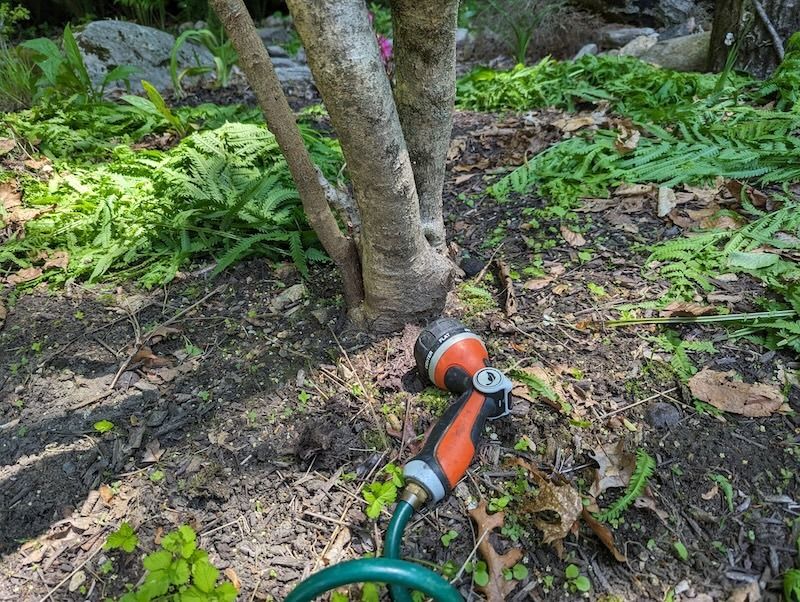
When the soil really is dry, how you water matters more than how often. A quick sprinkle wets the surface and little else.
A slow trickle over the root zone gives water time to soak down to where roots can use it, with less runoff down the slope.
Lay a hose at low flow on the ground under the canopy and move it around the tree. Soaker hoses work well too.
Apply water to the soil rather than the leaves, as NC State Extension recommends. Afterward, dig down again to see how deep the moisture went.
You may come across a specific watering schedule for dogwoods. N.C.
Cooperative Extension in Lee County recommends deep root-zone watering during extended drought. Its example schedule was written for a tree recovering from chronic stress after about a month without rain in very warm weather.
It is not an automatic plan for late October, so treat it as an example of drought care, not a rule for every yard.
What this soak does is ease water stress and support the tree’s overall health. It does not protect buds from a hard freeze, and it does not guarantee flowers.
After a good soak, let the soil dry out again before you consider watering a second time.
Newly planted dogwoods need closer attention

A dogwood planted this year or last is still building the root system it will rely on later. Until those roots spread out, the tree cannot reach much water on its own.
That is why a new planting deserves more frequent checks than a mature tree that has been in the ground for years.
The NC State Extension Gardener Handbook gives an establishment watering example for small nursery plants when it does not rain. It also notes that plantings made in cooler seasons may need less.
Fall installs often get help from cooler air and more reliable rain, so the example is a starting point and not a fixed routine.
In practice, look at a new tree every week or so during dry stretches. Push a trowel into the soil beside the root ball and see how it feels.
If rain has been steady, skip the hose. If a week or two has gone by with no rain and the soil is dry, give it a slow soak.
Established trees are not off the hook completely. A long dry spell can stress an older dogwood too, and it may need a soak then.
The difference is that a mature tree usually needs a good reason to be watered, while a young one needs you to keep watching.
Use mulch to conserve moisture, but avoid saturated soil
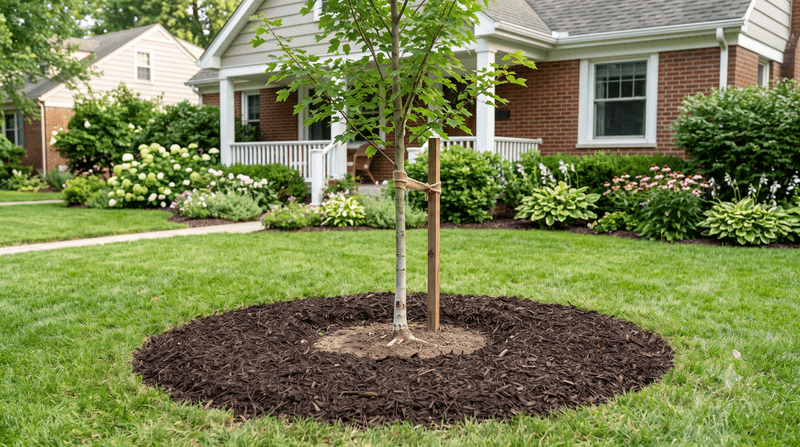
Mulch is one of the easiest ways to help soil hold on to moisture. A ring of shredded bark or pine straw slows evaporation and keeps turf from competing with the tree’s roots.
Shape it like a doughnut, with the hole around the trunk instead of a pile against it.
Keep the mulch at least 6 inches away from the trunk, as the NC State Extension Gardener Handbook recommends. Mulch piled against the bark stays damp and can invite trouble.
A layer a few inches deep across the root zone is plenty, and you can pull it back to check the soil beneath.
Mulch helps with water, but only in a modest way. It does not shield flower buds from cold, so it should not be treated as bloom insurance.
Moisture can also be overdone. NC State Extension cautions against overwatering, and soggy soil is hard on dogwood roots.
If water pools around the tree after rain or the soil stays soupy, hold off on the hose. Poorly draining spots may need a different fix, and a wet root zone is a sign to stop watering, not to water less often by the calendar.
A missed bloom may have causes beyond watering
Checking the soil, soaking a dry root zone slowly, and avoiding soggy ground will all support a healthy dogwood. None of it ensures flowers in April.
Poor bloom can come from drought, low light, excess water, winter bud injury, or a late frost. The USDA plant guide is a good place to read about the tree’s needs.
Other possibilities include a tree that is still too young, too much nitrogen fertilizer, and pruning at the wrong time. University of Maryland Extension lists several of these reasons trees and shrubs fail to flower.
A dogwood that sits out one spring has not necessarily been neglected. Sometimes the weather simply had the final say.