
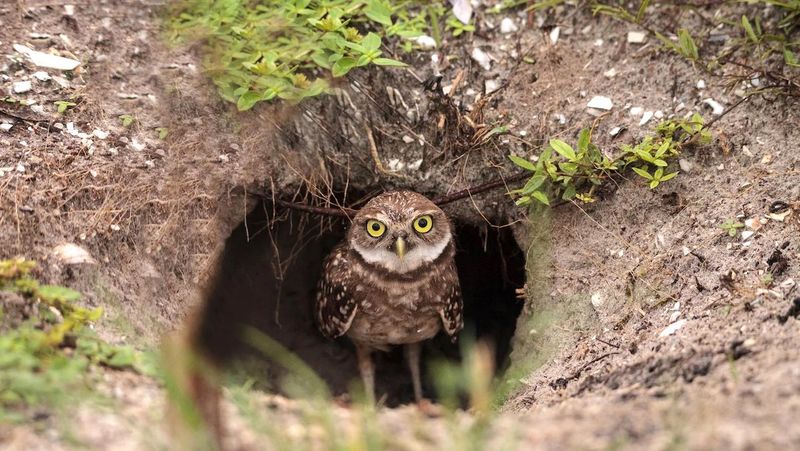
That hole in your yard might look like a plain ground squirrel burrow. In some open California spaces, a small, long-legged owl may use the same kind of hole for shelter and nesting.
Most holes will not have an owl in them, but a quick pause can matter when one might. Here is how to tell when to wait and who to ask.
A ground-squirrel burrow can shelter a different animal
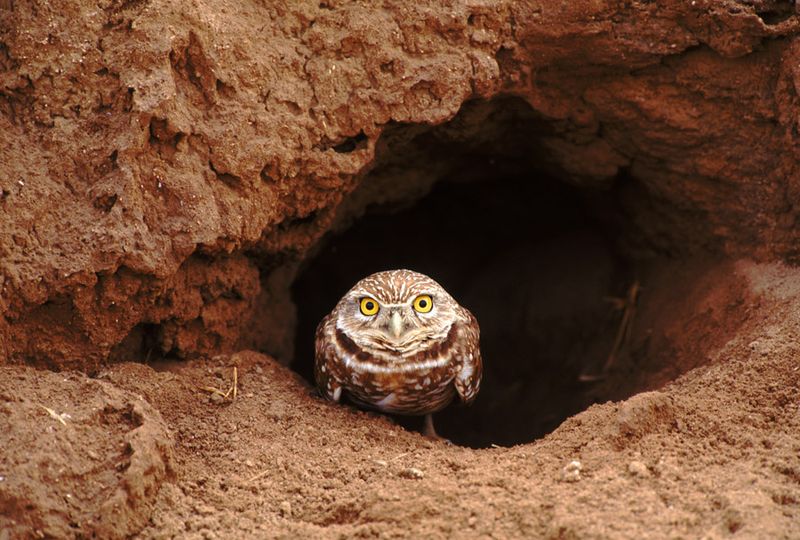
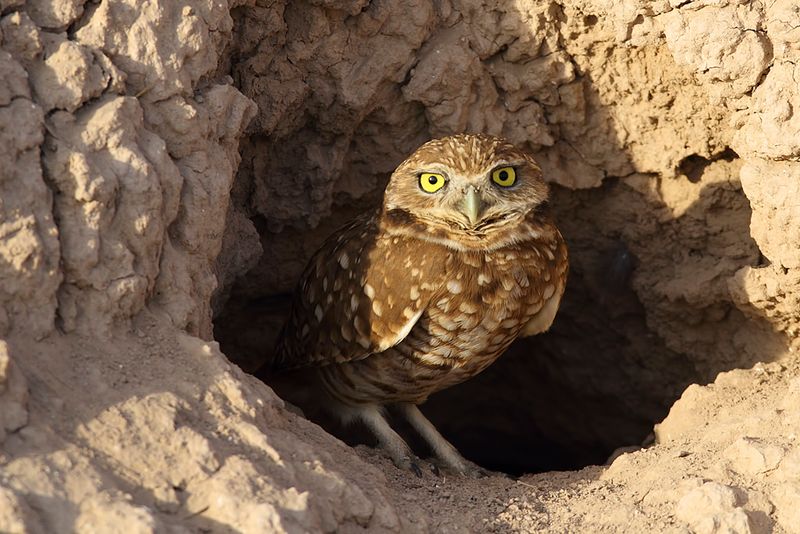
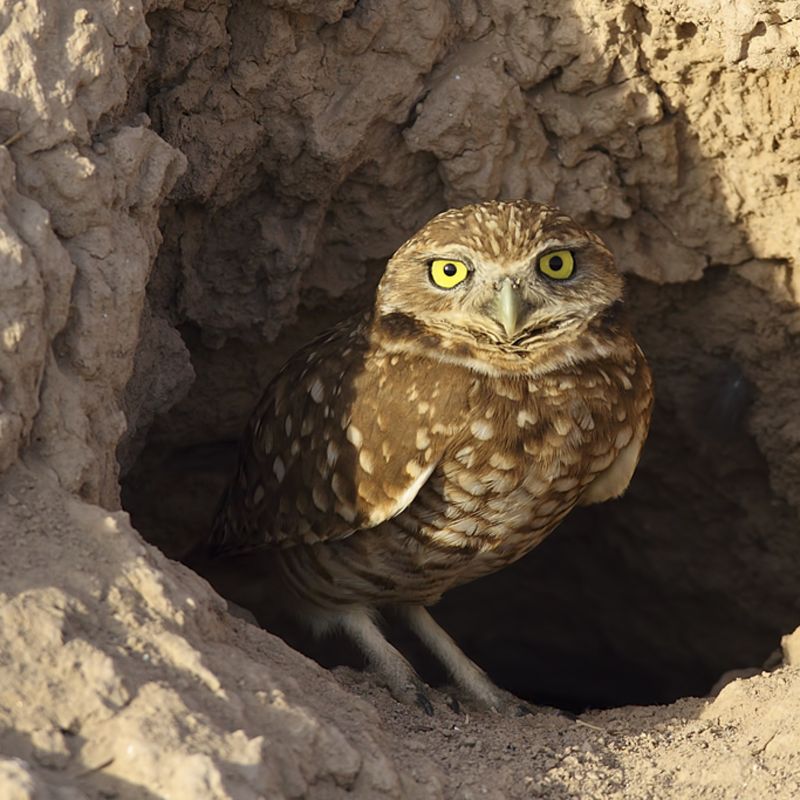
Picture a small owl with long legs and bright yellow eyes standing on the ground instead of perching in a tree. That is the western burrowing owl.
It uses burrows for nesting and for cover, and in California it often takes over holes that ground squirrels dug.
According to CDFW’s staff report on burrowing owl mitigation, the owls rely on existing burrows. They may also dig their own in soft soil, or use other cavities and some human-made structures.
So “ground squirrel hole” is a handy shorthand, but it is not the whole story.
Burrowing owls favor open areas with sparse vegetation. The U.S.
Fish and Wildlife Service notes that developed places such as vacant lots and golf courses can offer habitat too. That means a suburban setting does not automatically rule them out.
Here is the key limit. A hole, even one in a nice open yard, does not show that an owl lives there.
Most burrows hold squirrels, other animals, or nothing at all, and owls are not likely in every California yard. The point is simply that a burrow can have a different tenant than you expect, and that is worth keeping in mind before you reach for a shovel or a bag of fill dirt.
Which clues should make you pause?
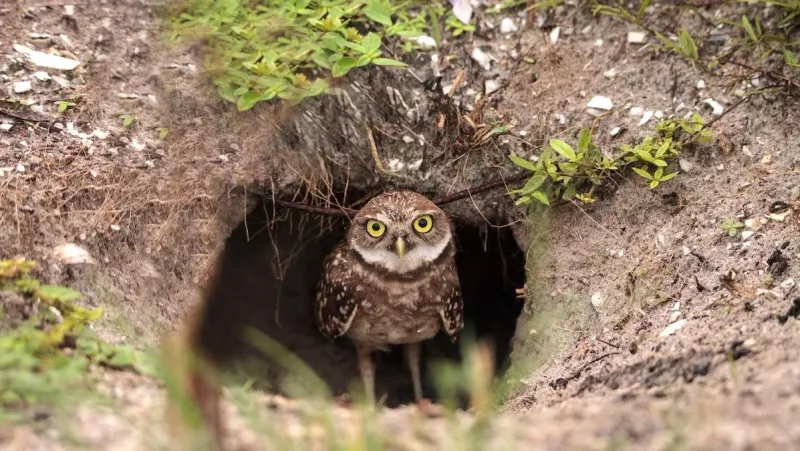
Some small details around a burrow can hint that an owl may be using it. You might spot an owl standing at or near the entrance, especially at dawn or dusk.
You might also notice white streaks of droppings, sometimes called whitewash, near the opening.
Other clues include pellets, which are small coughed-up lumps that contain fur or bones, along with feathers and bits of prey such as insect parts. The California Department of Pesticide Regulation’s burrow identification sheet describes signs like these, and Los Angeles County Planning lists similar ones.
Think of these as reasons to slow down, not as a test you can score at home. One sign alone does not prove an owl is there, and not seeing any signs does not prove the burrow is empty.
Owls can be away, hidden underground, or using the burrow at a different time of year.
So if you notice any of these clues, skip the guesswork. Leave the hole as it is, take a few photos from a distance, and ask an expert to weigh in.
A photo of the entrance and the ground around it can be very helpful when you reach out for advice.
California protects the owl as a CESA candidate
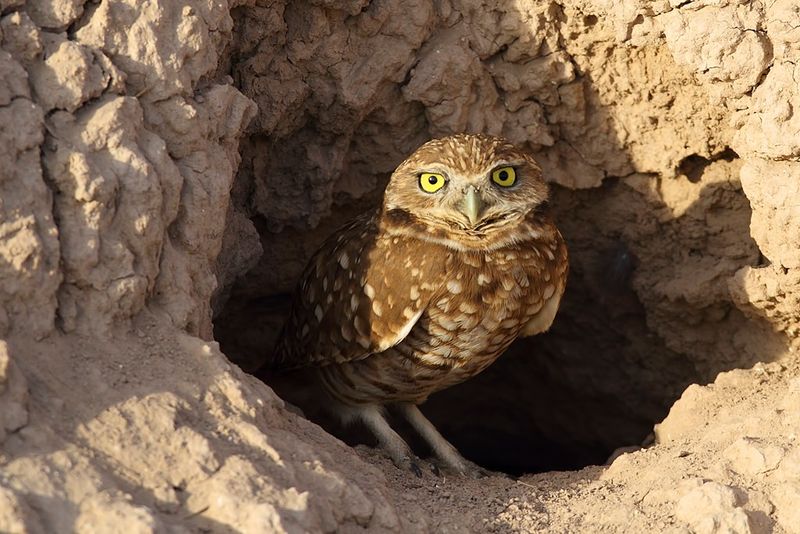
Protection for this owl has recently changed. In October 2024, the California Fish and Game Commission made the western burrowing owl a candidate for listing under the California Endangered Species Act, often shortened to CESA.
CDFW’s announcement explains that candidate species receive the same legal protection as threatened or endangered species.
Candidate status is not the same as a final listing. It means the state is reviewing the owl’s status.
The Commission’s CESA petition page still lists the status review report as due October 25, 2025, and it does not show a final determination. So the owl is a candidate, not simply an endangered species.
What does that mean for your yard? It does not mean that filling any burrow is automatically illegal.
Whether a rule applies depends on the facts, such as whether an owl is actually using the burrow, and on the laws that cover your location.
Because every situation is a little different, the best move is to ask the people who know. CDFW can answer questions about your specific site, and a short call can save you from a costly or harmful mistake.
Do not disturb or treat a burrow that may be occupied
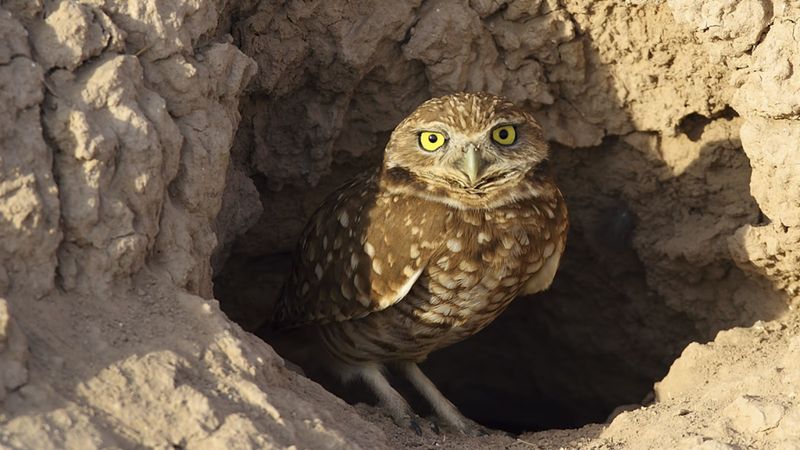
Say you spot an owl or some of those possible signs. The clearest instruction is to hold off.
Do not fill, seal, dig out, fumigate, or poison the burrow while you wait for advice.
The UC Statewide IPM Program’s ground squirrel guide warns against treating a burrow when a nontarget animal may be present. It also names burrowing owls as possible occupants of abandoned ground squirrel burrows.
In other words, even a hole that looks like squirrel work could have a different resident.
It may be tempting to use a treatment to find out whether something lives inside. Please don’t.
Fumigation, poison, and blocking the entrance can harm any animal in the burrow, and they cannot be undone.
You can still protect your yard while you wait. Keep pets and kids away from the hole, hold off on mowing or digging right around it, and watch from a distance.
Nothing about a short pause is wasted effort, since a squirrel problem will usually still be there after a day or two of getting good advice.
Breeding-season dates are not a safe-to-fill window
You may come across the dates February 1 through August 31 in your reading. CDFW’s 2012 mitigation report gives that span as the breeding season for survey guidance.
It helps biologists decide when to look for nesting owls.
Those dates are not a promise that other months are fine. Owls may use burrows outside the breeding season, for example for shelter in winter.
Protections are not limited to that period either.
The dates also say nothing about your particular hole. A survey window does not show that an owl is there, and it does not show that the burrow is safe to fill at another time.
It is a tool for trained surveyors, not a homeowner calendar.
If you catch yourself thinking, “It’s September, so I’m in the clear,” treat that as a cue to double-check. The same signs and the same advice to pause apply in every month of the year.
Get site-specific advice before deciding what to do
When you suspect a burrow is occupied, the next step is simple. Leave it undisturbed and contact CDFW or a qualified wildlife professional about your site.
Describe what you saw, share your photos, and ask what they recommend.
CDFW’s survey and monitoring resources show how professionals check for owls. You do not need to run a formal survey yourself.
Those resources are there so you can understand the process and know what to ask.
Remember that a pause is not a claim that every hole in your yard hides an owl. It is a sensible response to not knowing.
Most burrows will turn out to be ordinary.
Still, a day of waiting costs little, and a buried burrow cannot be unburied. A quick question to the right expert keeps you on the safe side.