
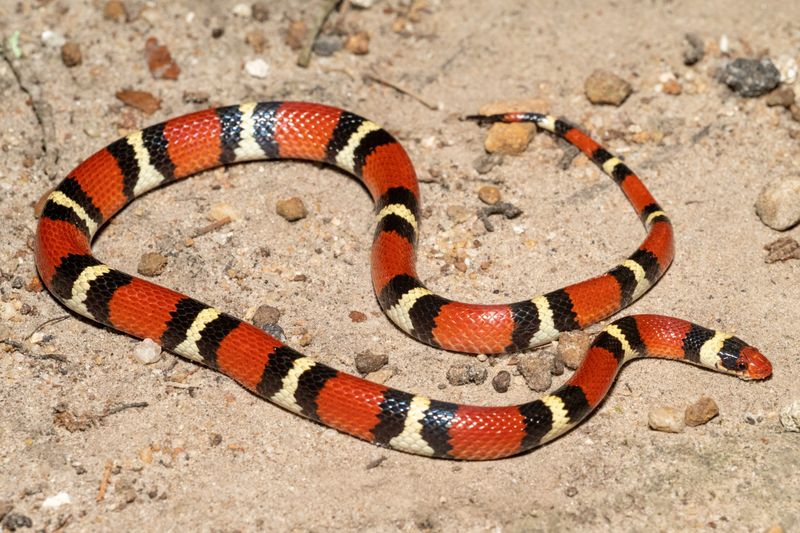
You lift a paver or rake back some mulch and spot a skinny snake striped in red, black, and pale bands. In Florida, that moment can make your heart jump, because one snake with similar colors is venomous.
A nonvenomous look-alike, the scarlet kingsnake, turns up in yards too. Learning a few color clues can help you stay calm, and knowing their limits can keep you safe.
A nonvenomous look-alike may shelter in a Florida garden
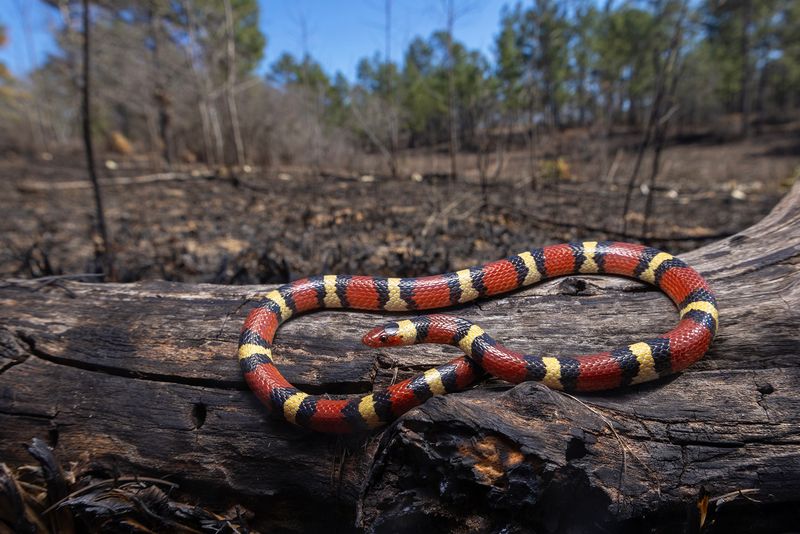
Gardeners often call it the harmless one, but a better word is nonvenomous. The scarlet kingsnake is the Florida snake most often mistaken for the venomous eastern coral snake, and it is a real neighbor to your flower beds.
According to the Florida Museum of Natural History, this species lives statewide, including in every Florida county. Adults are usually about 14 to 20 inches long, so you are looking at something about as long as a school ruler or a bit more.
Its bands wrap all the way around the body.
Scarlet kingsnakes are secretive. They commonly shelter under rocks, logs, and debris, which means a mulch pile, a stack of pavers, or a pot left on the ground can make a fine hiding spot.
Finding one there is plausible, and it is also a good reason to learn what you are seeing.
Here is the catch. A snake hiding in your garden bed tells you where it wants to rest, not what species it is.
Location is never an identification clue, so the rest of this article focuses on features you can see from a safe distance.
Nonvenomous also does not mean friendly. A kingsnake that gets grabbed or pinned may bite in self-defense, so the plan for any banded snake is the same: watch it, do not touch it, and let it move along.
Compare the band patterns, but do not rely on a rhyme
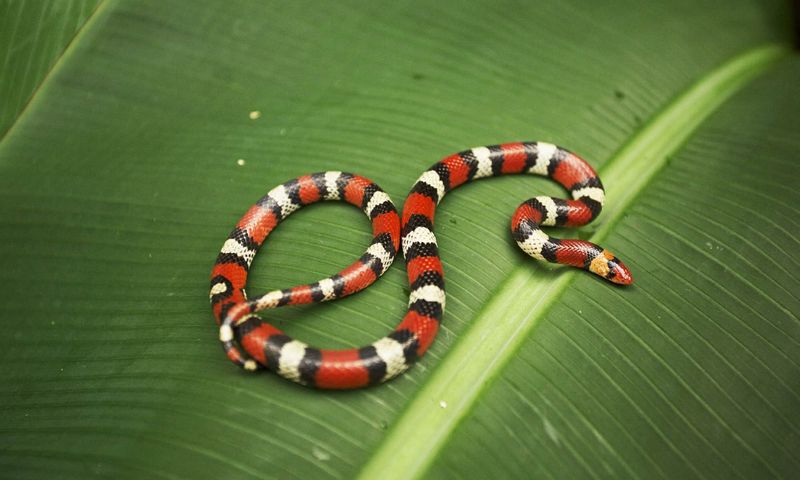
The band order is the most useful clue you can check from a few steps away. On a scarlet kingsnake, black separates the red bands from the yellow or pale bands.
On an eastern coral snake, the red bands touch the yellow ones.
That difference is described in UF/IFAS Extension guidance on Florida’s venomous snakes, which limits its stoplight-style advice to North American coral snakes. Please do not carry this rule over to coral snakes in other parts of the world, because patterns differ elsewhere.
Another detail: the kingsnake’s bands encircle its body. The Florida Museum notes this in its scarlet kingsnake profile, and it also says the familiar color rhymes work most of the time in Florida.
Most of the time is not every time.
Unusual color variations do occur. Dim light, dirt, a half-hidden body, or a snake that is moving quickly can also make bands hard to read.
A rhyme can slip your mind or get twisted in a stressful moment.
So treat band order as a helpful clue, not a pass or fail test. If you cannot clearly see the whole pattern from where you stand, count the snake as unidentified and keep your distance.
Treat the snout as a supporting clue
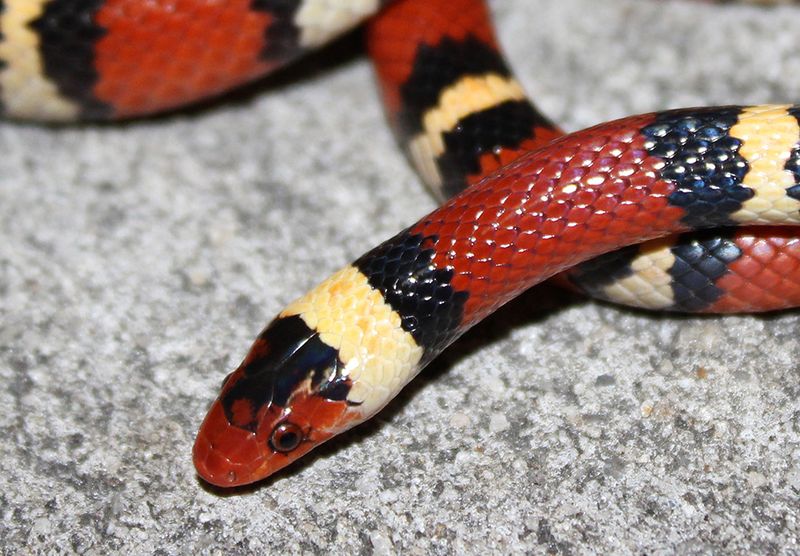
Snouts offer one more hint. A scarlet kingsnake has a red snout, while an eastern coral snake has a blunt black one, as UF/IFAS describes it.
Notice the word supporting. A snout is small, and checking it would mean getting far too close.
Never lean in, poke at the snake, or move debris to get a better look.
Florida sources do not fully agree on rhymes. The Florida Museum says they work most of the time, but a UF/IFAS Central Florida post advises against using them and suggests looking at the snout instead.
The Museum also reports unusual color variations.
The practical takeaway is simple. No saying should be used to declare a snake safe, and no single clue settles the question.
If you cannot tell from a comfortable distance, accept that. Leaving the question unanswered costs you nothing, and it keeps your hands and feet well away from the snake.
The scarlet snake is another Florida look-alike
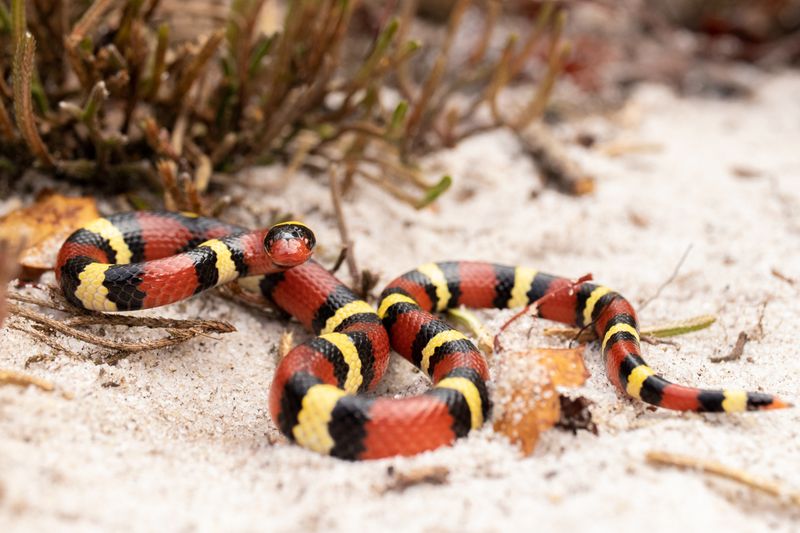
Kingsnake versus coral snake is not the whole story. Florida also has the scarlet snake, a different nonvenomous snake with red, black, and pale markings.
The Florida Museum explains that the scarlet snake’s bands do not fully encircle its body, and its belly is plain and pale. A scarlet kingsnake’s bands wrap all the way around.
Those details are hard to see on a snake sliding under a paver. You might catch only the back half, or a flash of color through the mulch.
A belly view is not something to wait around for.
This matters because it is tempting to sort every banded snake into two boxes, kingsnake or coral. That shortcut can lead to a wrong guess in either direction.
When your view is partial, treat the snake as unknown. Step back, give it room, and let it leave on its own.
Garden-bed cover cannot tell you which snake you found
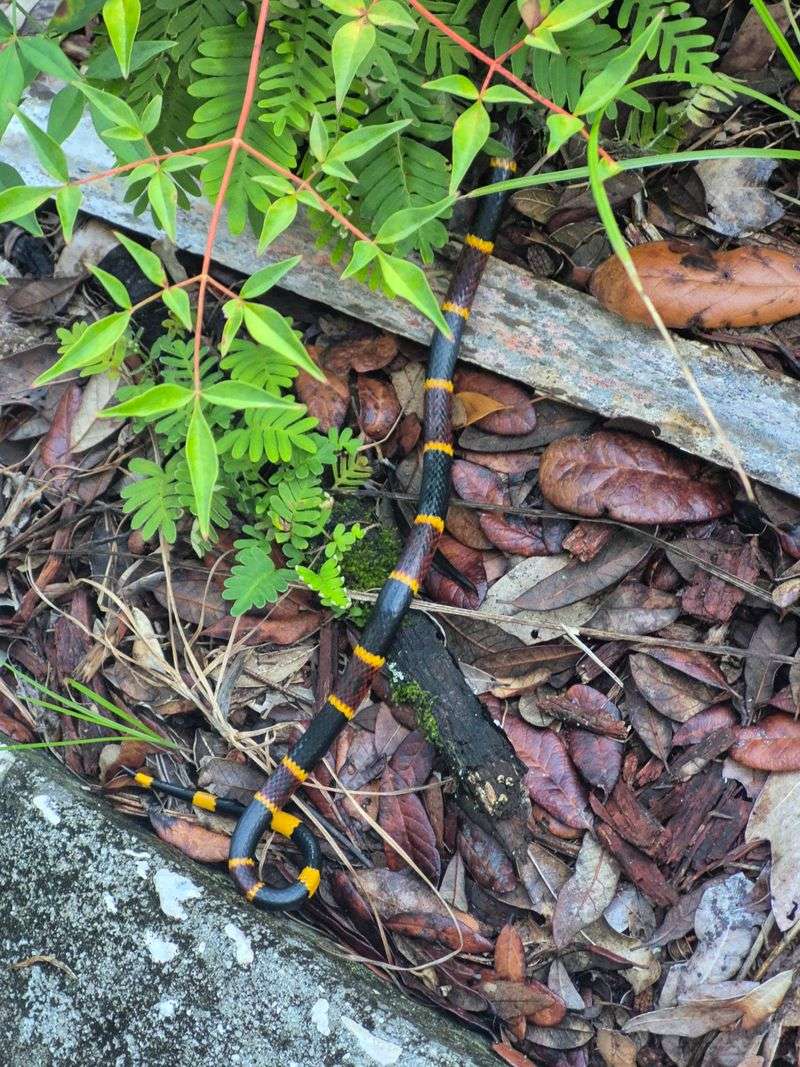
Picture a paver in the corner of your bed, with a banded snake underneath. It is natural to think that a snake in such a spot must be the harmless kind.
That guess does not hold up.
Scarlet kingsnakes do shelter under rocks, logs, and debris, as the Florida Museum reports. But Florida’s Poison Control Centers note that coral snakes also stay beneath objects, spend much of their lives underground, and occur statewide apart from the southern Keys.
Both snakes like the same cool, tucked-away spaces. Mulch, pavers, boards, and flowerpots offer exactly that, so the hiding place gives you no clue about the species.
Coral snakes are secretive, but that is not a reason to assume they are absent from your yard. Secretive simply means you may not see them often.
Skip the guessing game about location. Rely on what you can see from a safe distance, and when that is not enough, leave the snake alone.
Observe from a distance and work cautiously around debris
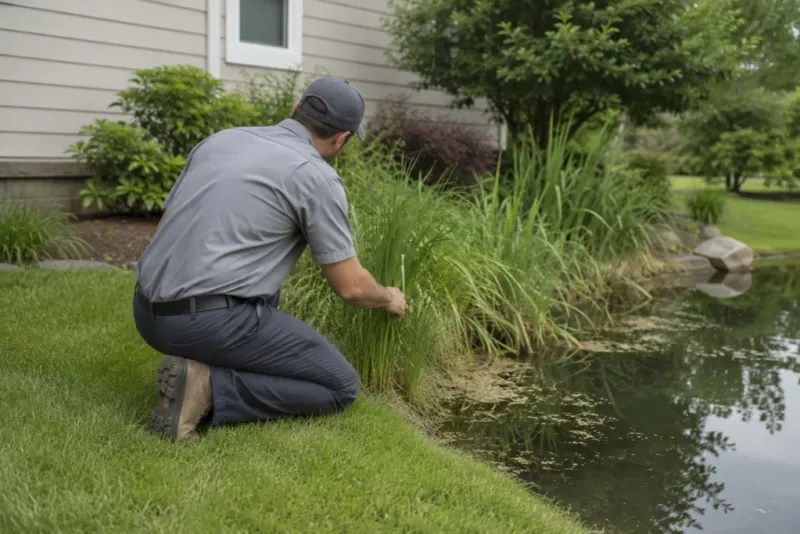
Once you spot a banded snake, the safest move is to freeze, step back, and watch. Do not pick it up, trap it, or handle it.
Trying to move it with a shovel or a stick is also a bad idea.
If you can do it safely, a photo from a distance may help with identification later. Florida Fish and Wildlife encourages people to observe snakes from afar and give them space.
Skip the photo if getting it would mean moving closer.
Keep kids and pets away from the spot while the snake is there. Most snakes will slip off on their own once things are quiet.
For future yard work, plan ahead. CDC guidance recommends wearing boots and long pants, and using leather gloves when handling brush and debris.
That gear will not make a snake safe to touch. It simply adds a layer of protection while you clear leaves, boards, or old pots.
Move items slowly, look before you reach, and avoid sticking bare hands into dark gaps.
Seek emergency care after a possible venomous bite
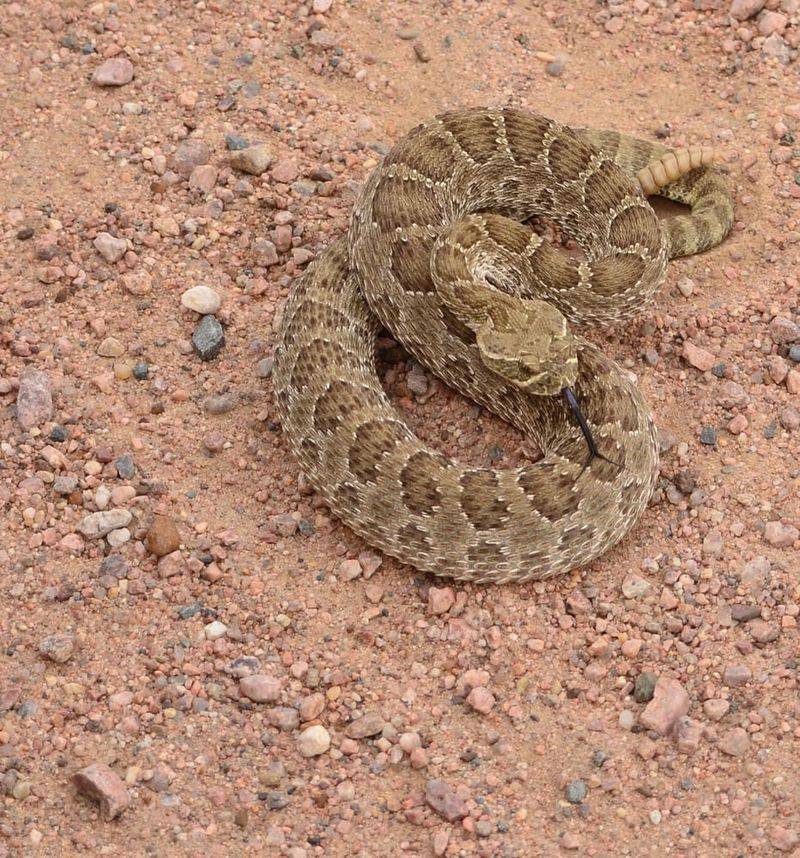
If a snake that might be venomous bites someone, get emergency medical care promptly. Call for help right away, and do not wait to see whether symptoms show up.
Do not try to catch or kill the snake. CDC guidance advises against capturing it, and a second bite helps no one.
Skip the old folk remedies as well. According to the American Heart Association’s 2024 first aid guidelines and CDC advice, do not cut or suck the wound, apply ice, or use a tourniquet.
This is also why a close-up identification is never worth it. Staying back costs nothing, while a bite from a misjudged snake can cost a great deal.
A banded snake under your mulch is a puzzle you can leave unsolved.