
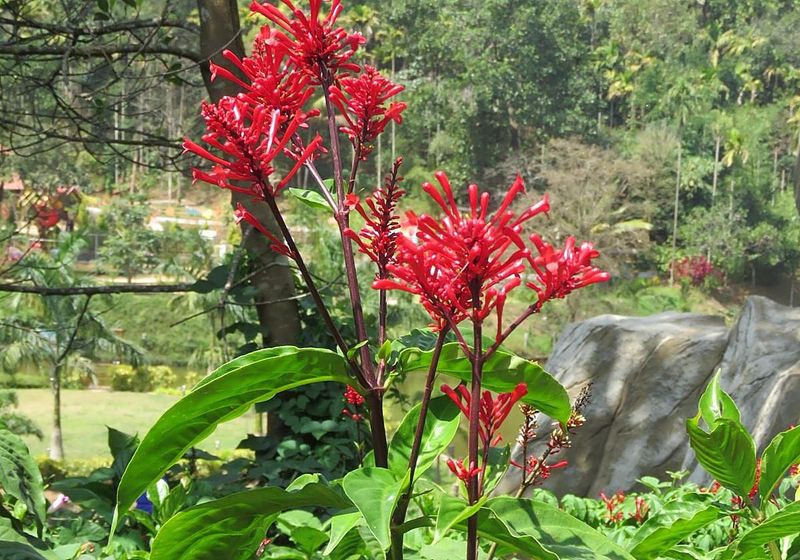
A bed that gets only part of the day’s sun can be hard to fill with bright color. Firespike, a Florida-friendly perennial with tall red flower spikes, is one plant that may do the job.
Its nectar can draw hummingbirds when they are in the area, which makes it a fun pick near a window. Here is how to judge your site, plan for its size, and set fair expectations for fall and winter.
Firespike brings red color to partial shade
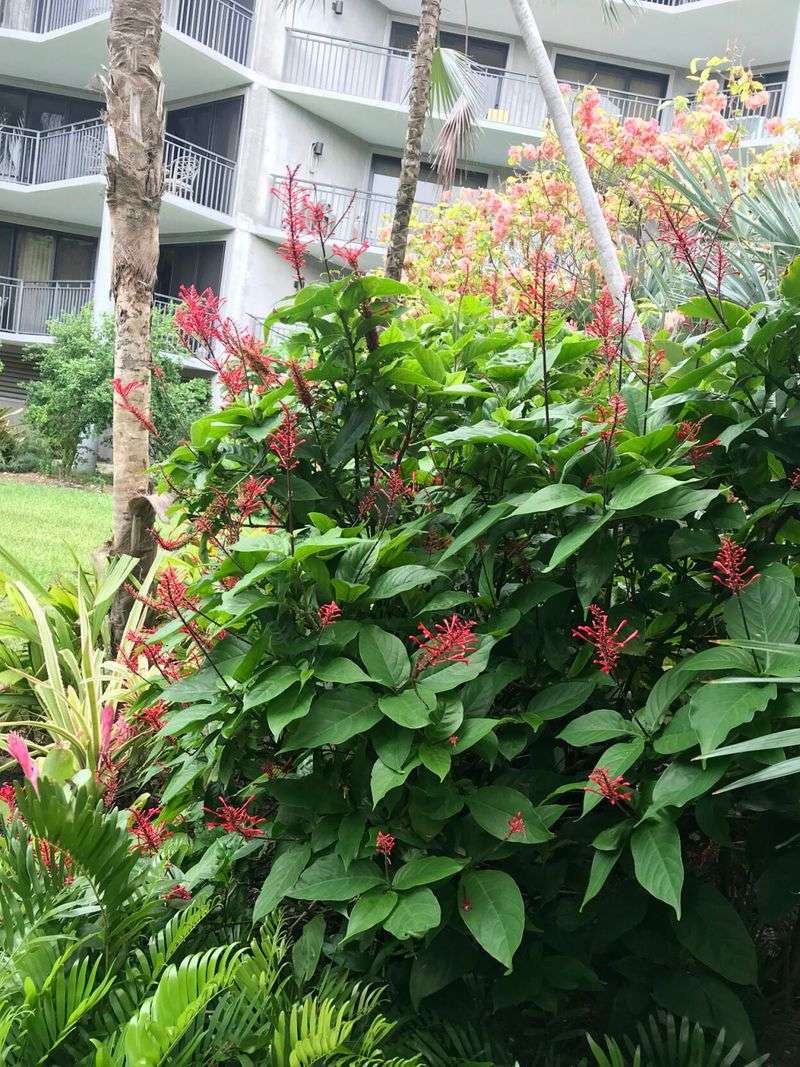
Picture a bed on the east side of a house, where morning sun gives way to afternoon shade. Firespike (Odontonema strictum) is a red-flowering herbaceous perennial that can work in a spot like that.
UF/IFAS describes it as suited to part shade or part sun, and it is known for upright spikes of tubular red flowers over dark green leaves.
Part shade does not mean deep shade. A spot under a dense oak canopy, where the ground stays dim most of the day, is not what this plant is asking for.
UF/IFAS notes that firespike gives red color in partly shaded sites, but it flowers most heavily and has its best habit in full sun.
So the real question is how much light your bed actually gets. Spend a day checking it.
Note when the sun hits, how many hours it lasts, and whether the light is dappled or fully blocked. A bed with a few hours of direct sun plus bright filtered light is a reasonable candidate.
Expect a trade-off. In more shade you may see fewer flowers and a looser, leggier plant.
In more sun you can expect fuller growth and heavier bloom. If you want a strong red display near a window, lean toward the brighter end of the part-shade range, and treat the flowers as a bonus rather than a sure thing in dimmer corners.
Winter flowers and hummingbird visits are not guaranteed

Plenty of people hope firespike will bloom all winter with hummingbirds at the glass every morning. Sometimes it comes close, but it is not a promise.
Even UF/IFAS sources differ. The firespike plant profile lists fall and winter bloom, while the Florida hummingbird guide lists summer and fall and notes the plant is frost-sensitive.
The practical reading is simple. Firespike can bloom into fall or winter in warm, frost-free conditions.
A cold snap can cut the show short, and a mild year in South Florida will treat it better than a frosty one in the north of the state.
Then there are the birds. Hummingbirds may visit firespike nectar when they are around, but flowers alone do not guarantee a visit.
Audubon says several species regularly overwinter in south Florida and along the Gulf Coast, while most Ruby-throated Hummingbirds migrate. Cornell Lab range information shows some remaining around the Gulf Coast and at Florida’s tip.
If you live in the Panhandle or north Florida, winter visitors may be few. Near the Gulf Coast or in the far south, you have better odds.
Either way, think of firespike as an extra nectar source for birds that happen to be nearby.
Firebush also grows in partial shade
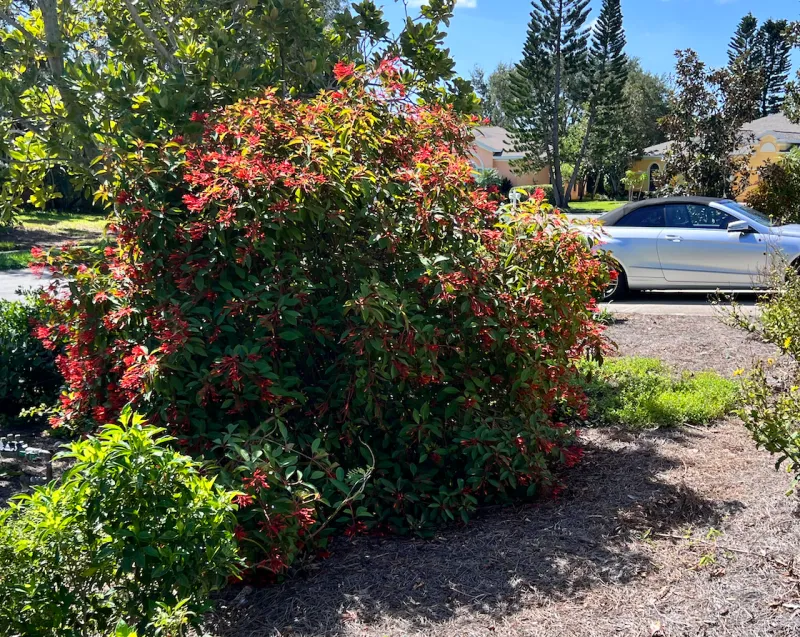
Firebush fans sometimes assume it needs blazing sun all day. That is not quite right.
UF/IFAS says firebush prefers full sun to partial shade, so it can handle a bed with some shade too.
That means firespike is not a rescue plant for a spot firebush cannot manage. It is simply another red-flowering option, and the two look different.
Firebush is a woody shrub with orange-red tubular flowers, while firespike is an herbaceous perennial with upright spikes of crimson blooms.
Use the comparison to decide what you want in the bed. Do you want a woody shrub or a perennial that may die back in a freeze?
Do you want orange-red clusters or tall red spikes? Do you have room for a plant that spreads about 2 to 3 feet, as UF/IFAS lists for firespike?
Neither plant should be picked because someone claims it draws more birds or performs better. Choose by light, space, and the look you want.
In a larger yard, planting both in different light conditions can add variety, and each can be judged on how it actually does in your own soil and sun.
Plan for a 2- to 3-foot footprint

Before you buy, measure the bed. UF/IFAS lists firespike at 2 to 6 feet tall with a spread of 2 to 3 feet, and it suggests spacing plants 24 to 36 inches apart.
That range in height is wide, so a plant in a shadier spot may stay shorter and one in better light may stretch taller.
For a window view, think about sightlines. A plant that reaches 5 or 6 feet can block a low sill, so you may prefer placing it to one side or a few feet back.
Leave enough space for air flow and for the plant to widen without crowding walkways or neighbors.
Soil is the easier part for most Florida yards. UF/IFAS lists sand and loam among the soils firespike tolerates, so ordinary sandy ground is suitable.
Drought tolerance is only moderate, though. That means it is not drought-proof, and a new plant in fast-draining sand may need water during dry spells.
Salt tolerance is poor. If your yard sits right on the coast and gets salt spray or salty wind, firespike may struggle.
A spot sheltered by a building or fence, or farther back from the shore, is a safer bet.
A freeze can change the plant’s shape

Firespike is tender to cold, so a hard freeze can brown the leaves or knock the plant back. Because it is an herbaceous perennial, it may not stay a leafy shrub through winter the way an evergreen would.
Gardeners in colder parts of Florida should expect some years with a messy, damaged look.
UF/IFAS recommends cutting firespike to the ground in winter for cleanup. If frost has already blackened the stems, that cut tidies the bed and gives fresh growth room to come back when the weather warms.
Cold can also keep the plant’s size in check. A freeze that sets it back may leave you with a shorter, tidier plant the next season, while a run of mild winters can let it grow toward the upper end of its height range.
If you want more plants, firespike can be propagated by division or cuttings. Dividing a clump is a simple way to fill another bed or share with a friend.
Just remember that a freeze-prone display needs patience. Plan to enjoy it in the warm months and treat winter flowers as a nice surprise rather than a given.
Consider its nonnative status before planting
Firespike is not native to North America, and it may self-seed. That does not make it a statewide prohibited invasive, but it does call for a little thought about where you plant it.
Seedlings that pop up in nearby beds are easy to pull, yet seedlings that escape into natural areas are harder to manage.
The guidance gets more specific in one part of the state. UF/IFAS’s South Florida low-maintenance plant guide lists firespike as “Cult Only” and cautions against planting it within 500 feet of a native hardwood hammock in Miami-Dade County.
If you live there, check how close your property is to one of these forest patches.
Outside that situation, a practical approach works well. Plant it in a managed bed rather than along the edge of a wild area, watch for seedlings after bloom, and pull any you do not want.
Dispose of pulled plants in the trash rather than tossing them into a natural area.
The UF/IFAS firespike profile notes both its nonnative origin and its self-seeding potential. Keep this planting-site question separate from your cold-care and spacing plans, because it is about where the plant ends up, not how it grows.
Choose the spot, not a winter guarantee
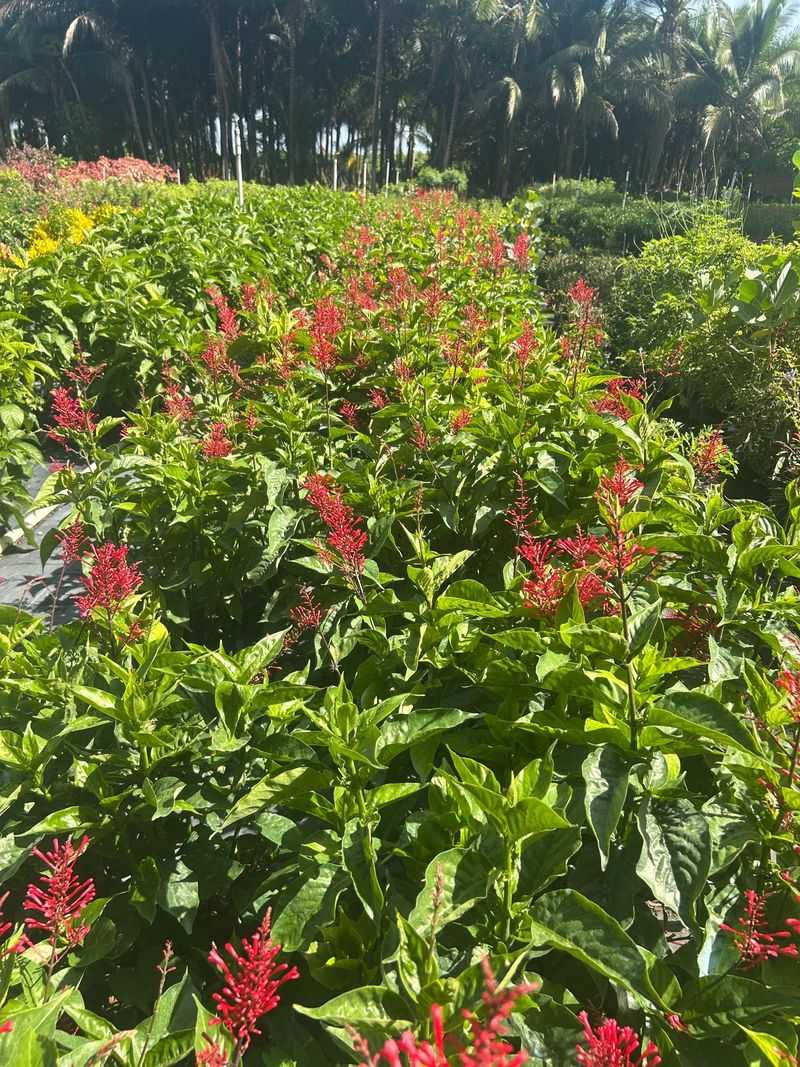
Firespike suits a Florida gardener who wants red color in part shade or part sun, can give it 2 to 3 feet of width, and can live with freeze dieback. Fall or winter flowers and hummingbird visits are possible in favorable conditions, not assured.
Pick the right light, leave it room, and the window view takes care of itself.