

Pine straw piled against your foundation can set up trouble. It keeps soil damp and hides the base of your house, which is exactly where termite activity would show first.
That does not mean the straw pulls termites in from the neighbor’s yard, but it does give them cover. Here is what North Carolina experts say to do about it, and what a bit of raking can and cannot do.
What mulch can—and cannot—do around a foundation

Mulch piled against a house does two things worth knowing about. It can help keep the soil underneath moist, and it can hide the bottom of the foundation from view.
NC State Extension notes that termites may feed on mulch that contains cellulose, that thick mulch can cover termite mud tubes, and that mulch should not touch the foundation or the lowest siding.
Here is the part that often gets blurred. Nothing in the research shows that pine straw pulls termites in from elsewhere or sends them into a house on its own.
Iowa State Extension’s summary of field and laboratory work says mulch can improve conditions for termites that are already foraging nearby, but it found no evidence that the moist conditions attract termites from the surrounding landscape.
So the realistic concern is cover, not a magnet. A deep, damp blanket against the wall gives termites a sheltered path and gives you no way to see them.
If termites are already in the area, that is a poor setup.
Keeping the foundation visible is a sensible inspection and upkeep habit. It is not a reason to panic, and it is not a termite treatment.
Think of it as keeping the one place termites tend to show themselves in plain sight.
How subterranean termites reach foundations
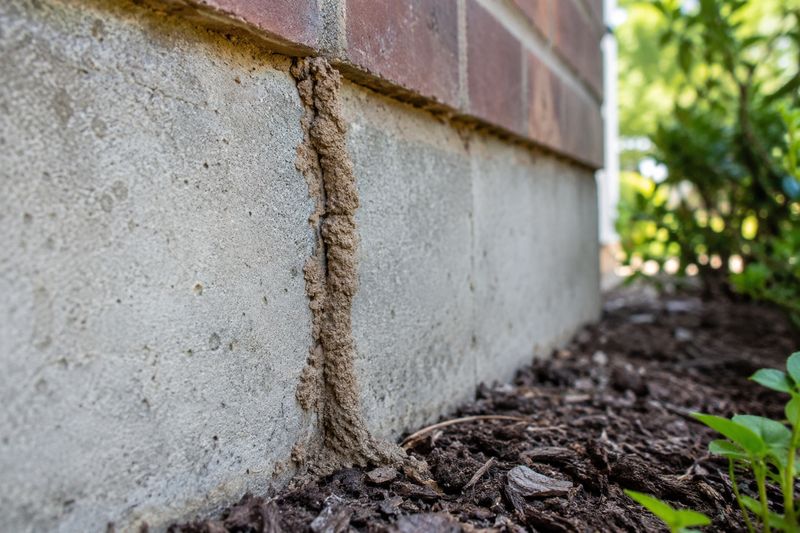
Subterranean termites live in colonies in the soil. From there, workers forage outward, and they travel through the ground or through mud tubes they build to cross exposed surfaces.
NC State Extension’s termite biology guide explains that these tubes can run up foundation walls to reach wood.
A tube is about as wide as a pencil and the color of dirt, so it is easy to miss even on bare concrete. Add a layer of mulch or a screen of shrubs, and a tube can go unnoticed for a long time.
NC State’s guidance on existing homes points out that thick mulch and plantings can cover these signs.
Winter adds another wrinkle. Termite activity and feeding often slow in cold conditions, but they may continue where the insects are protected from the cold.
Soil beside a heated house, under mulch, or near a warm crawl space can stay mild enough for termites to keep working.
A cold snap is therefore not a safe sign. A cleared strip along the wall helps you look for tubes on a sunny January afternoon just as easily as in July.
What research says about pine straw

Pine straw gets blamed a lot, but research has not established it as uniquely risky. The best-known test is a laboratory study of subterranean termites and landscape mulches.
Researchers offered termites several mulch materials, pine straw among them, to see what they would eat.
Termites consumed most of the mulch types that were tested. That result says pine straw is not special in either direction.
It is one of several materials termites will chew on when given the chance.
The authors also said more research is needed to learn whether landscape mulch around foundations actually supports termite colonies. That is an honest limit.
A lab dish with termites placed on purpose is very different from a real yard.
Around your own house, what matters is the setup: how deep the mulch is, how wet the soil stays, whether it touches siding, and whether termites are already nearby. The study cannot tell you what is happening at your home.
It can only tell you not to treat any one mulch as the sole villain.
Keep mulch off the foundation

The simple job is to rake mulch back far enough that it does not touch the foundation or the lowest siding. Leave enough of the foundation exposed that you can look along the base and see what is going on.
NC State Extension gives this advice for existing homes.
There is no official horizontal distance to measure. The goal is visibility and less contact, so use your eyes.
If you cannot see bare foundation along its length, pull the mulch back more.
You may see the number 6 inches in this advice. NC State recommends keeping siding at least 6 inches above the ground.
That is vertical clearance between siding and grade, not a required mulch setback.
Raking is gentle work, and that matters. Do not dig, trench, or turn over soil within 12 inches of the house as part of this job.
EPA guidance on termites stresses that treatment is a specialized task, and digging can break up soil that was treated against termites.
Pulling mulch away helps you see and maintain the area. It does not treat an infestation or prove that termites are absent.
Manage moisture and keep inspection areas accessible
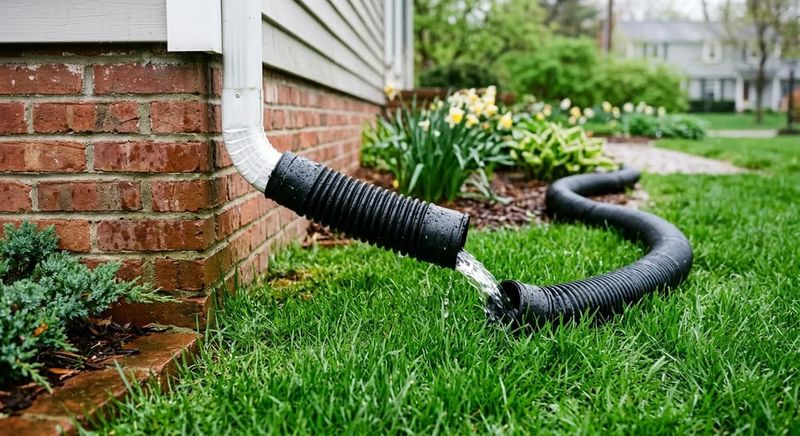
Mulch is only one piece of the moisture picture. Termites do best where the soil stays damp, so it pays to look at where water goes around your house.
NC State Extension advises correcting drainage problems, fixing leaks, and not letting water collect at the foundation.
Walk the house after a good rain. Look for downspouts that dump beside the wall, dripping spigots, puddles along the base, and soil that slopes toward the house instead of away.
Access matters too. If shrubs, stacked lumber, or deep beds block your view of the foundation, no one can check it well, including you.
The North Carolina Department of Agriculture and Consumer Services recommends accessible foundation areas, proper grading to direct water away, and no contact between building woodwork and soil or fill.
The department also recommends annual inspections. That is a recommendation, not a legal requirement, and good housekeeping does not stand in for the termite protection your home already has.
If you have a bond or treatment plan, keep it current and keep the yard tidy as a companion to it.
When to call a termite professional
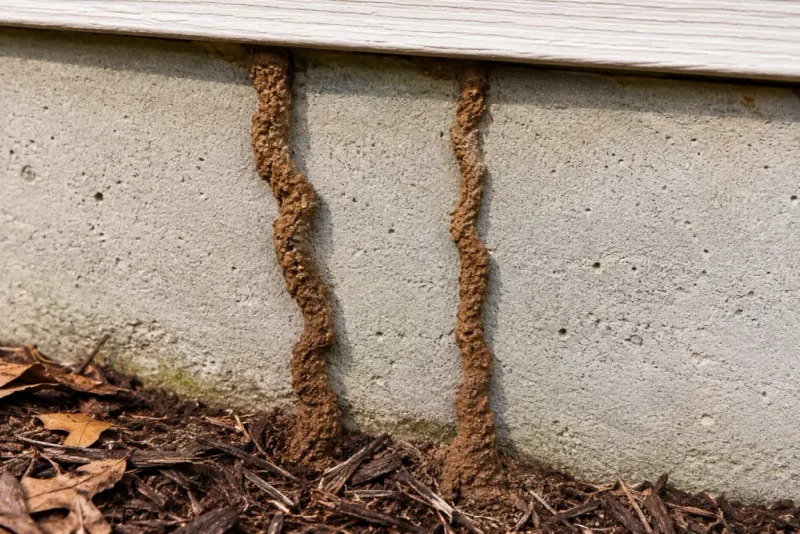
Some finds call for a professional inspection right away. Those include mud tubes on the foundation or in the crawl space, wood that is damaged or sounds hollow, and swarmers, the winged termites, indoors.
NC State Extension recommends an inspection in these cases rather than panic or rushed treatment choices.
Spraying a tube or crushing the termites you can see feels productive, but it tells you nothing about the rest of the colony. Killing visible termites cannot show whether activity exists elsewhere in the house, and it does not resolve a possible infestation.
An inspector can check the places you cannot reach.
Resist the urge to dig out the problem yourself. Do not disturb soil within 12 inches of the house, because digging may break up treated soil.
If you have a termite treatment contract, call your provider before touching that strip.
Professional treatment can be complex, and EPA guidance also points homeowners toward qualified help. A clear foundation makes the inspector’s job easier, but it does not rule out termites or treat them.
A tidy wall shows you the evidence; only a trained eye can read it.