
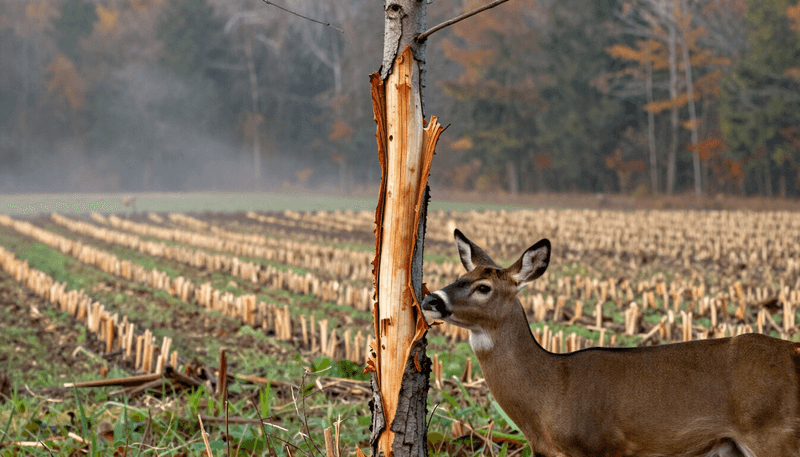
One buck working over a young tree in a single night can strip the bark and leave the tree badly hurt, and if the damage wraps all the way around the trunk, the tree can die. Late fall is when this happens in North Carolina yards, and the tree you planted last spring is exactly the size bucks like.
Not every rub is a death sentence, but a sturdy cage put up this weekend is the surest way to keep the odds in your favor. Here is what to know before winter sets in.
Why fall is a good time to protect young trees
Fall is rubbing season. Bucks scrape their antlers against trunks and branches as the breeding season gets going, and rubbing is linked both to rubbing off velvet and to communication or marking during the rut.
Neither reason tells the whole story, so there is no single trigger to watch for.
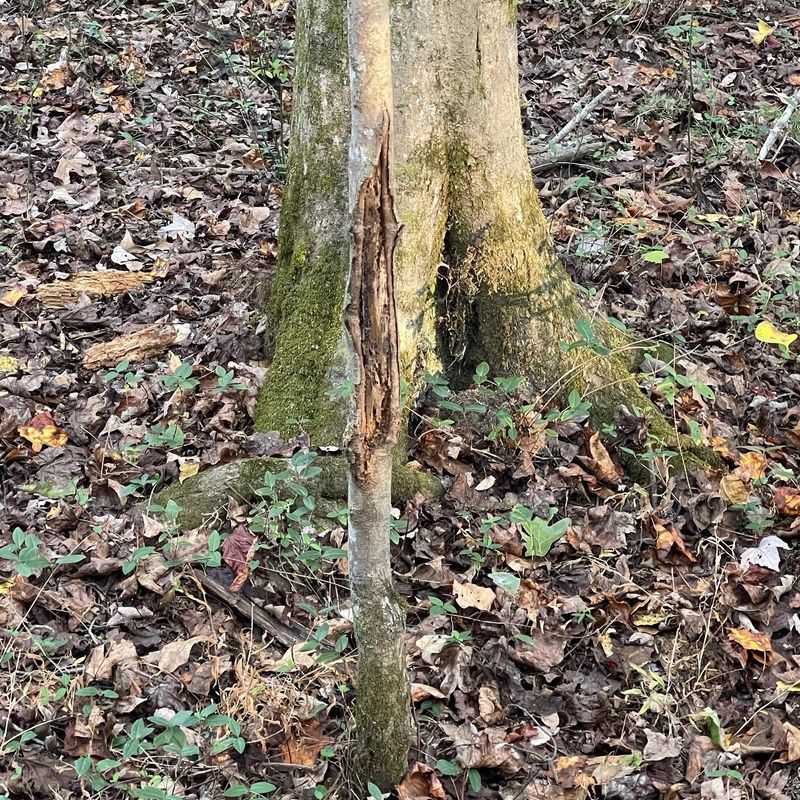
Young trees make easy targets. Thin bark and a flexible trunk mean a few passes of antlers can do real harm, and Iowa State Extension notes that damage is commonly found on the trunk roughly 1½ to 3½ feet above the ground.
Walk your yard and look at that height range on every small tree.
Timing is not the same across the state. NC State Extension describes breeding activity as peaking from late October through December, and the mountains, Piedmont, and coast do not run on one schedule.
The Wildlife Resources Commission publishes estimated peak conception dates by zone, but those numbers describe breeding in general. They cannot tell you when a particular buck will wander through your yard, and some county estimates carry uncertainty.
Risk also differs from yard to yard. A tree near a wood line or a deer path faces more pressure than one beside a busy driveway.
Since you cannot predict the night, the smart move is to protect the trees most likely to be visited now, before the rut is in full swing.
How much trunk damage matters
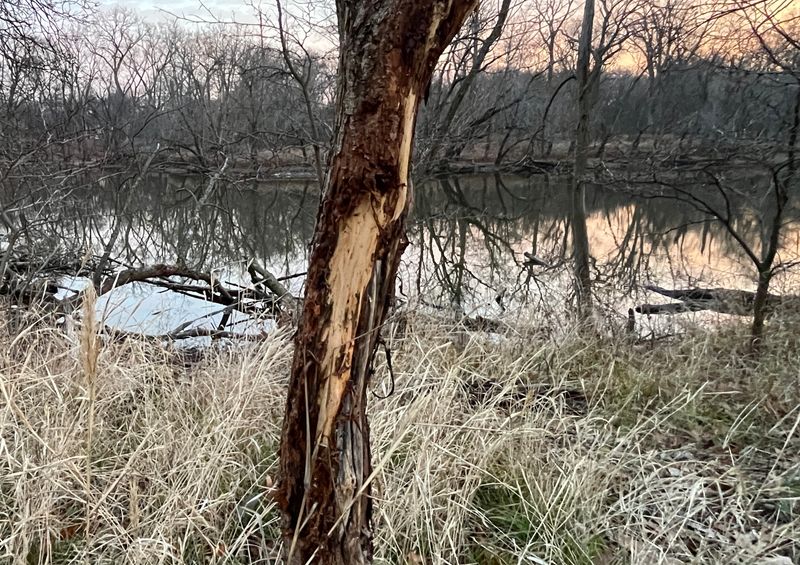
Antlers act like a rough rasp. When a buck pushes and drags them along a slim trunk, the bark can be scraped, shredded, and peeled off, sometimes down to bare wood.
One encounter can do serious harm, though that does not mean every encounter does.
What counts most is how much of the trunk is hurt. Just under the bark sits a thin layer of living tissue that carries water and sugars between roots and leaves.
A wound on one side may leave enough of that layer intact for the tree to stay alive, even if it ends up scarred or weakened, as University of Idaho Extension explains.
Damage that goes all the way around the trunk is called girdling, and it is far more dangerous. With the living layer cut off in a full ring, the flow between roots and crown is broken, and the tree can die.
A tricky point: bark loss alone does not tell you a tree’s fate. A wide strip on one side can look scary and still leave a path for the tree to live, while a narrower wound that circles the trunk is a bigger problem.
Look at how far around the trunk the injury reaches, and not only at how much bark is gone. For a tree you care about, Iowa State Extension makes clear that severe injury is not something home treatments fix, which is why preventing it matters so much.
Put a sturdy cage around vulnerable trees
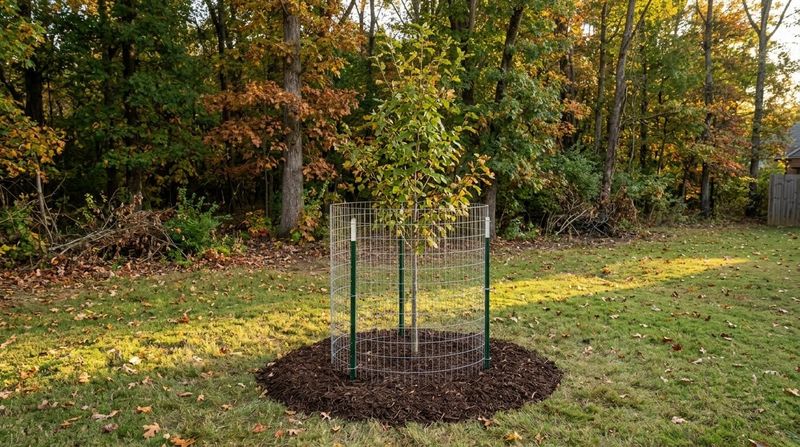
Here is the weekend job: put a physical barrier between the antlers and the trunk. If a buck cannot reach the bark, it cannot strip it.
That simple idea is why a cage beats nearly every other option.
For rubbing, Texas A&M Forest Service guidance calls for a welded-wire cage at least 48 inches tall, secured with posts. Make the cage wide enough to stand well away from the trunk, and drive the posts firmly so a pushing buck cannot knock it over or flatten it against the tree.
Closer to home, NC State Extension recommends plastic or woven-wire cylinders to protect young trees. Whichever style you pick, the point is a stable structure that holds its shape under pressure.
A few practical tips. Start with the trees closest to wood lines, fields, or trails.
Set the posts before you fit the wire so you are not wrestling a wobbly frame. Tug on the finished cage and shove it with your hand; if it leans or rattles, tighten it.
Do not treat other products as stand-ins. Repellents are only a supplement to a barrier, and a thin wrap hugging the trunk does not give the stand-off distance a sturdy cage does.
A loose or flimsy barrier can also be knocked aside in seconds.
Check the cage as the tree grows
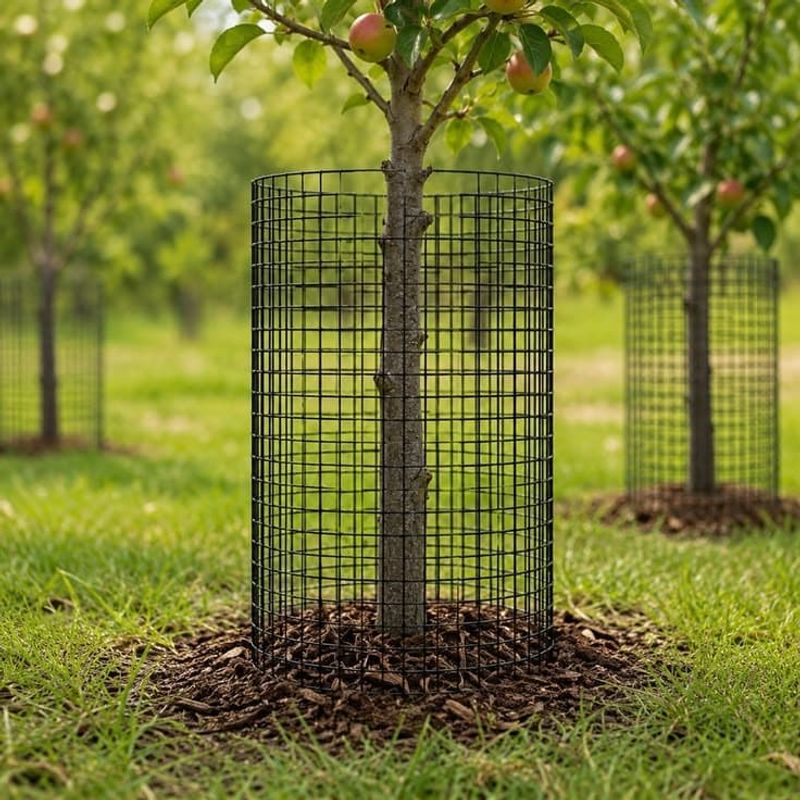
Putting up a cage is not a set-it-and-forget-it job. Trees thicken, soil shifts, and posts loosen, so a barrier that was perfect in November can be a problem by spring.
Every few weeks during the season, give the cage a quick once-over. Does it still stand straight and firm?
Is there open space between the wire and the trunk, with no bark rubbing against it? Nothing should press, squeeze, or cut into the tree, and branches should have room to grow.
Texas A&M Forest Service guidance points to checking for stability and clearance, and that is a good routine to follow.
Timing matters too. Iowa State Extension advises installing barriers by mid-August and taking them off in spring so they do not interfere with growth.
If you are reading this in the thick of fall, you are past that ideal date, but do not wait. Put the cage up promptly and keep a closer eye on it.
A late cage is no guarantee. A buck may already have visited, or it may find a gap, so walk the yard after windy or stormy nights and look for fresh scrapes or shredded bark.
Then plan to remove or adjust the barrier in spring before it crowds the trunk.
What to do after a buck rubs the trunk
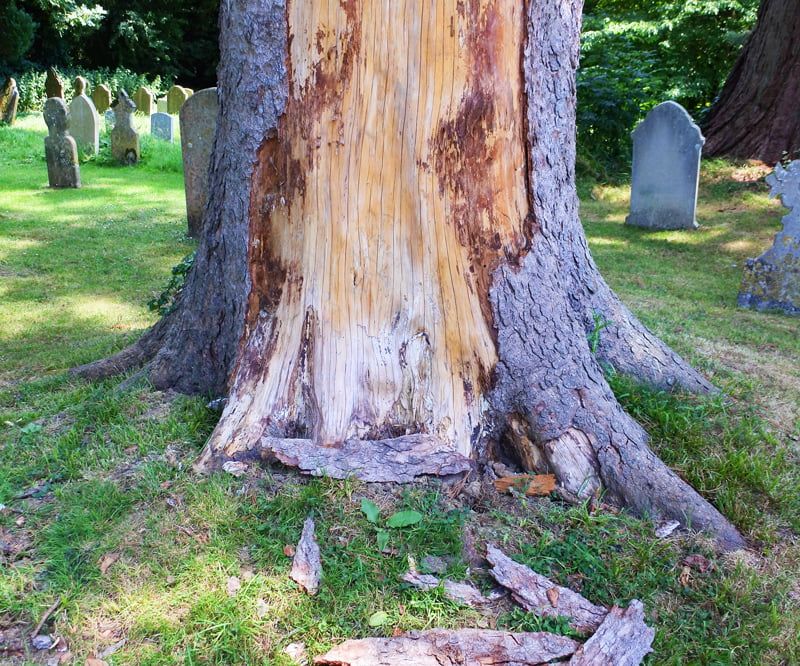
Found fresh shredded bark? Stay calm and look closely.
Walk all the way around the trunk and note how much of it is injured. Is the wound a strip on one side, or does it reach around the whole circumference?
Take a few photos so you can compare over time.
Limited damage can leave a tree standing, though it may be scarred. Wounds that run all the way around are the serious ones.
Even so, it is wise not to predict the outcome from the look of the bark alone, since how deep and how far the injury goes both matter, as University of Idaho Extension describes.
Skip the quick fixes. Iowa State Extension says wound dressings, pruning paint, latex paint, and wraps do not repair severe deer damage.
Girdled trees are often best replaced.
Do protect the tree from a second hit, because a buck may return to the same spot. Put a sturdy cage around it right away.
If the damage is extensive, or the tree is valuable to you, call a local arborist for an assessment. They can look at the wound in person and tell you whether the tree has a fair chance or whether it is time to replant.
Protect the trunk before the next encounter
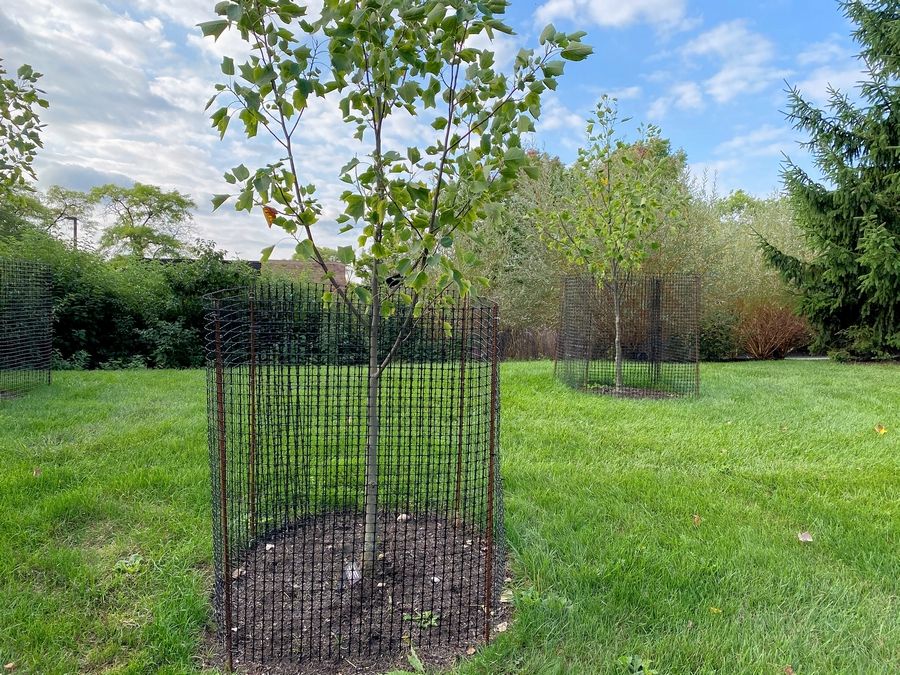
You do not need an exact rut date to act. Cage the trees most at risk, as NC State Extension and Texas A&M Forest Service both suggest, then make sure each cage stays firm and clear of the bark.
If a tree is already badly hurt, get a local arborist’s opinion.
Bucks need only one night to cause the trouble, and a cage needs only one afternoon to stop it.