
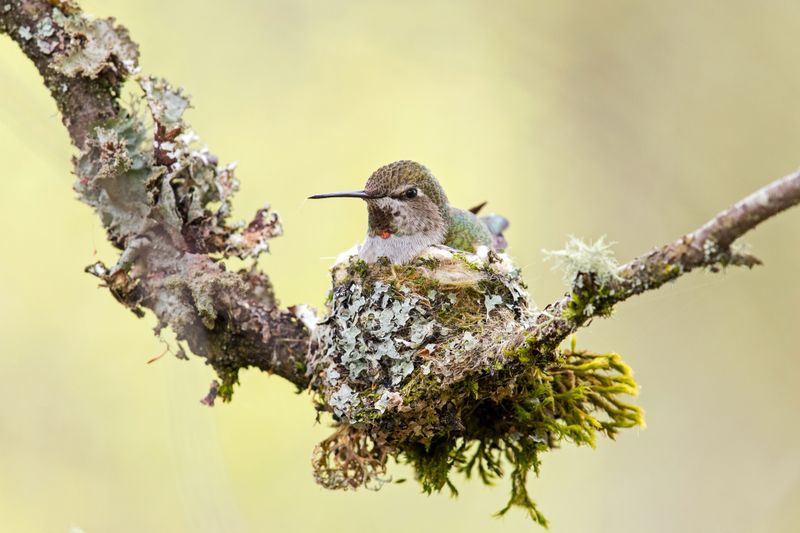
A hummingbird nest is about the size of a walnut half, and it can sit in a tree or shrub while you trim, rake, and tidy. Anna’s hummingbirds often nest in the cooler months, long before most gardeners think about baby birds.
That timing overlaps with routine yard cleanup in many parts of California. A few simple habits can help you keep your garden tidy and still give a hidden nest a chance.
Winter nesting is normal for Anna’s hummingbirds

Most birds wait for spring, but Anna’s hummingbirds are early starters. A peer-reviewed study describes a typical nesting season from December through May, and the National Park Service gives the same window.
So a nest in January, when many gardens look bare and quiet, is part of a normal pattern in much of their range.
California records can stretch wider than that. A California Department of Fish and Wildlife life-history account lists nesting from mid-December through mid-August, with the busiest activity from February through May.
That means a nest could still be in use well after the cooler months have passed.
Timing is not the same everywhere. It shifts with location, local weather, and the habits of individual birds.
Not every Anna’s hummingbird nests in winter, and not every yard will have a nest at all.
What this means for you is simple. If you prune, thin, or clear brush between December and August, it is reasonable to think of your trees and shrubs as possible nesting spots.
You do not need to cancel your garden plans. You just need to look first, and the next sections show you how.
Think of it as a seasonal heads-up, similar to knowing when the rainy season usually arrives. It helps you plan, but it is not a promise about any one yard.
Rainy-season conditions align with nesting in the Bay Area
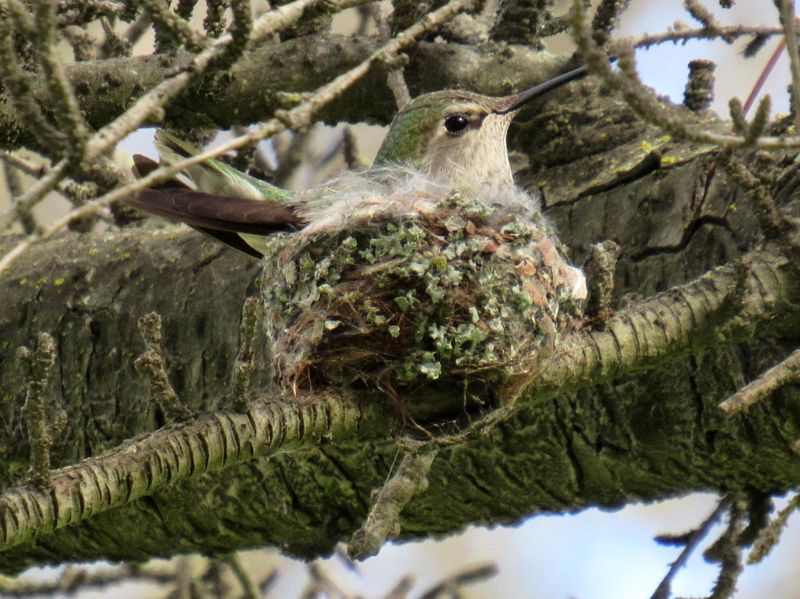
Around San Francisco Bay, the wet months bring something hummingbirds need: food. A Bay Area open-space agency says breeding tracks the rainy season, when plants bloom and insects become more common.
Nectar feeds the adults, and tiny insects give growing chicks protein.
That is a seasonal link, and it is specific to the Bay Area. It does not mean the first rain sets off nest-building, and a single storm will not send a bird to start a nest the next morning.
Other parts of California have different climates, so this explanation should not be stretched to cover every region.
Researchers offer a slightly different idea. The peer-reviewed study suggests the timing of winter blooms may help explain why these birds nest so early.
In other words, flowers could matter as much as the weather itself.
For a homeowner, the takeaway is practical. Winter-blooming plants in your yard may draw hummingbirds close, and birds that are nearby may nest nearby.
Treat a flowering shrub as a clue to check carefully, not as proof a nest is there.
Rain or no rain, the safest habit is the same. Look over your plants before you cut, no matter what the sky is doing.
Look for a small cup on a horizontal branch
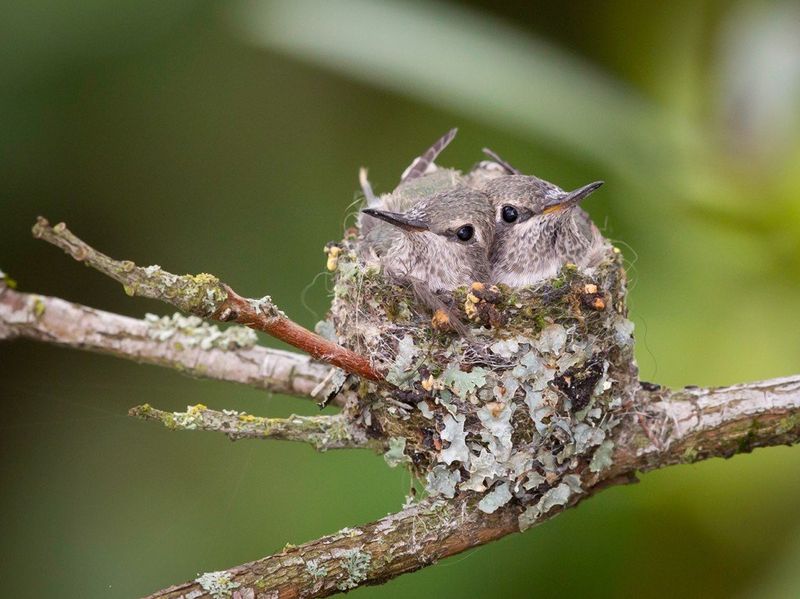
Picture a small cup about 1 inch tall and 1.5 inches across. That is roughly the size of a large thimble or a walnut half.
Cornell Lab’s life-history notes say the nest is built with plant down and held together with spider webs.
Many nests are dressed up on the outside with bits of lichen or moss. That camouflage makes the cup look like a small knot or bump on the branch.
Even a careful gardener can look right at one and miss it.
Placement offers a useful clue. Nests are often set on a horizontal branch, commonly 6 to 20 feet above the ground, though a bird may choose something lower or higher.
Reported sites include oaks, sycamores, eucalyptus, vines, and shrubs, and nests are often near nectar sources. Treat that list as examples, not a complete rule.
Try scanning from a few angles. Look along side branches, forks, and the tips of drooping limbs.
Check the tangle of a climbing vine as well, since a small nest can hide there.
You may also notice a female making short trips to a particular spot. Hummingbirds build and tend nests alone, so a quiet visitor returning again and again can be a hint.
Binoculars help if the spot is high.
Check plants before pruning or removing branches
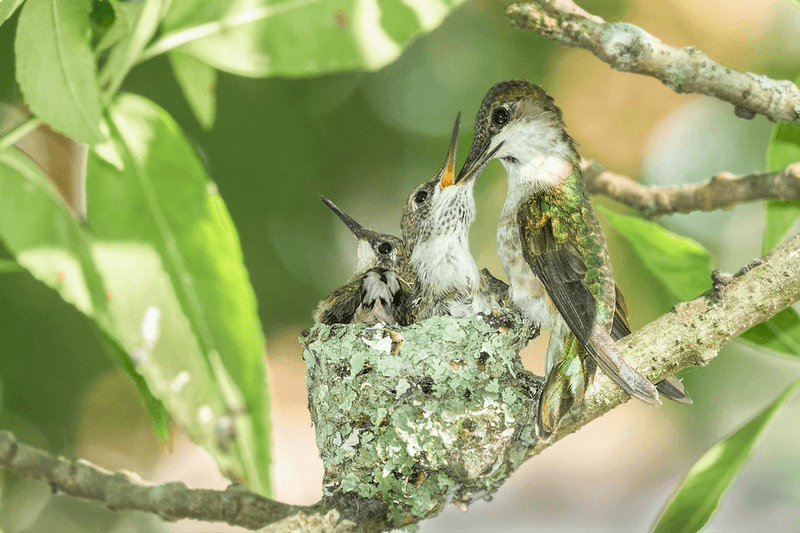
Before the loppers come out, take five minutes for a slow walk around the plant. Because these nests are so small and so well camouflaged, Cornell Lab’s description of the nest is a good reminder of what you are hunting for: a tiny cup on a horizontal branch.
Start with the branches you plan to cut. Look at the forks and side limbs, then step back and view the plant from another side.
Light from behind can help a small shape stand out.
A few habits make the check easier. Use binoculars on tall trees, and watch for a small hummingbird that keeps returning to the same place.
Check vines and dense shrubs gently without pushing deep into them.
No method will find every nest. Some will stay hidden even after a careful look, so treat the check as a way to lower the odds of trouble, not a guarantee.
If you spot a nest, stop work in that area right away. You can often keep going on other parts of the yard while you sort out next steps.
Leave the nearby branches uncut for now, and move on to a different task.
Many people find it easier to prune in stages. Do the plants you have checked first, and come back to the others later.
If you find a nest, leave it in place and seek guidance
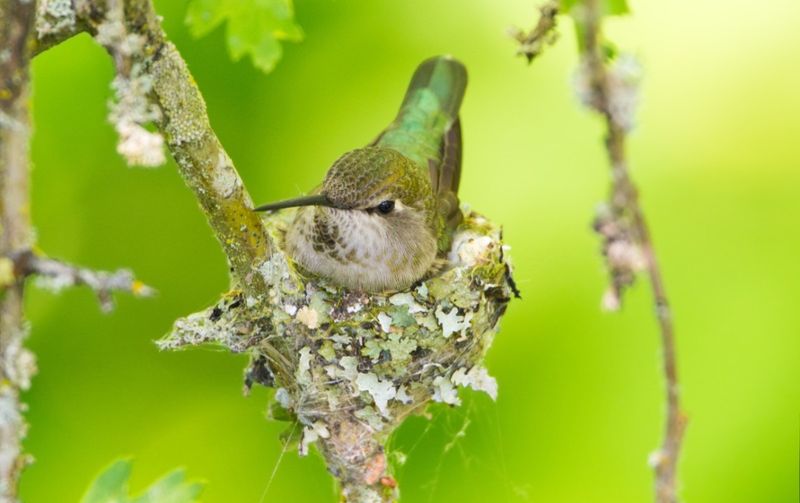
Finding a nest can feel like a surprise gift, and the best response is a quiet one. Pause your work nearby, keep pets and tools away, and avoid touching or moving the branch.
You do not have to stand guard, but a little distance goes a long way.
An empty-looking nest is not proof of abandonment. The mother spends a lot of time away feeding, so you may not see her for long stretches.
Federal guidance in a 2025 USFWS memorandum notes that moving a migratory-bird nest requires authorization, and that telling whether a nest is in use can be hard.
If the nest or a bird looks injured or at risk, reach out for help. CDFW’s wildlife rehabilitation guidance points people to the department or a permitted wildlife rehabilitator, and advises against stepping in without trained guidance.
That means no relocating the nest, no picking up chicks, and no do-it-yourself rescue. Those well-meant actions can do more harm than good.
A short call can clear up a lot. Describe what you see, where the nest is, and what work you had planned, and ask what steps make sense for your yard.
The MBTA memorandum distinguishes in-use from inactive nests
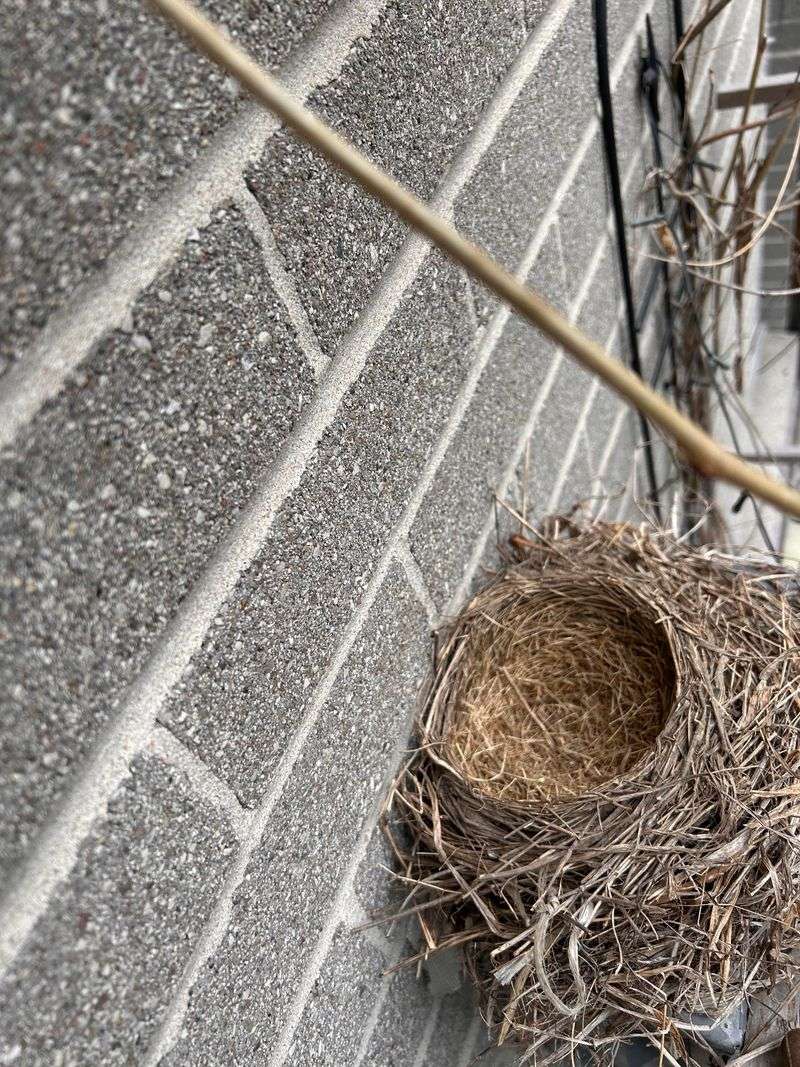
Hummingbirds are covered by the Migratory Bird Treaty Act, or MBTA. In a January 15, 2025 memorandum, the U.S.
Fish and Wildlife Service explains how it treats nests for MBTA authorization. The rule hinges on whether a nest is in use.
A nest is in use once it holds viable eggs or nestlings. It stays in use until the young fledge and are no longer dependent on it.
A nest that is still under construction, before any eggs are laid, is classified as inactive.
Under the memo, destroying an in-use nest requires authorization. Destroying an inactive nest alone does not require MBTA authorization.
That is a narrow statement about one federal rule, not a ruling on what is allowed in your yard.
Other protections may still apply. Federal, state, tribal, or local rules can add requirements, and this article is not legal advice.
An inactive nest under one rule is not automatically free of all protections.
Since you often cannot tell from the ground whether a nest holds eggs, the practical choice is the careful one. Pause the work, leave the branch alone, and ask CDFW or a qualified wildlife professional what applies to your situation.
A tidy yard can wait a few weeks, and a tiny family only gets one shot at the season.