
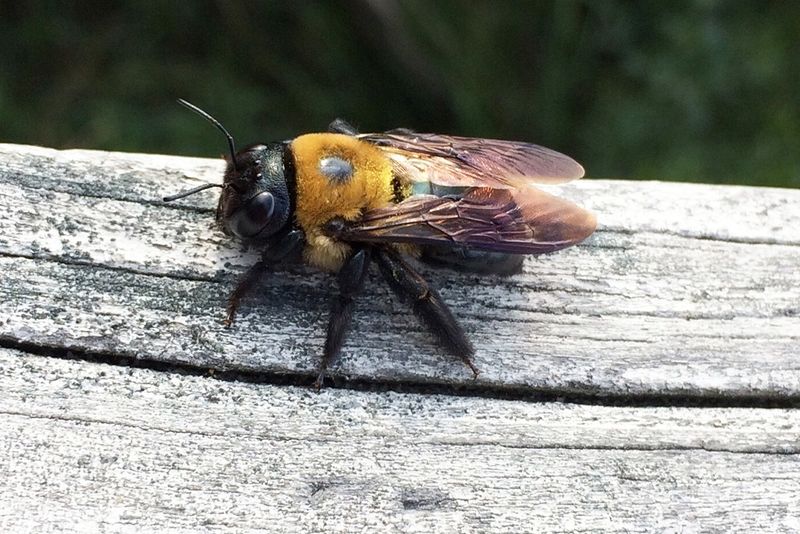
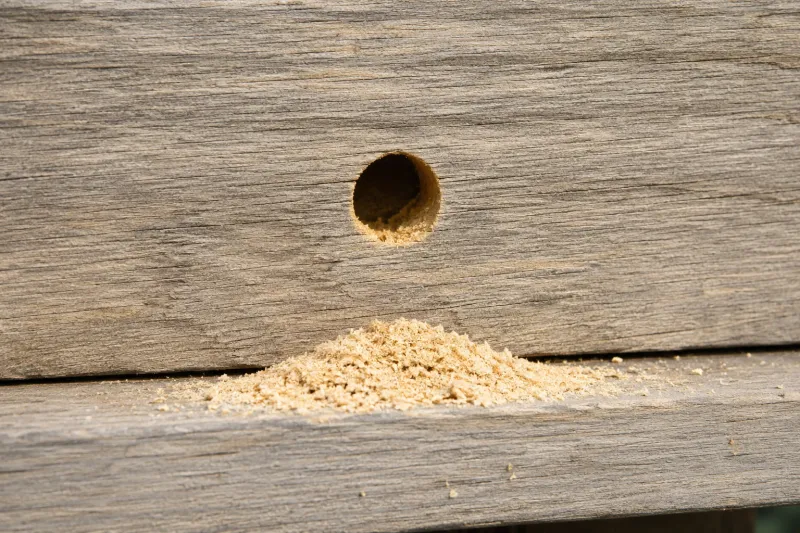
Walk out to your porch on a warm North Carolina morning and you might spot a fat, shiny bee hovering close to the railing, with a small pile of sawdust on the boards below a perfectly round hole. Before you reach for a spray can, it helps to understand what that hole is actually telling you.
Carpenter bees are native pollinators with a very specific relationship to bare, exposed wood, and reading the signs correctly can save you time, money, and unnecessary chemical use.
A round hole can be a strong clue—but confirm the bee
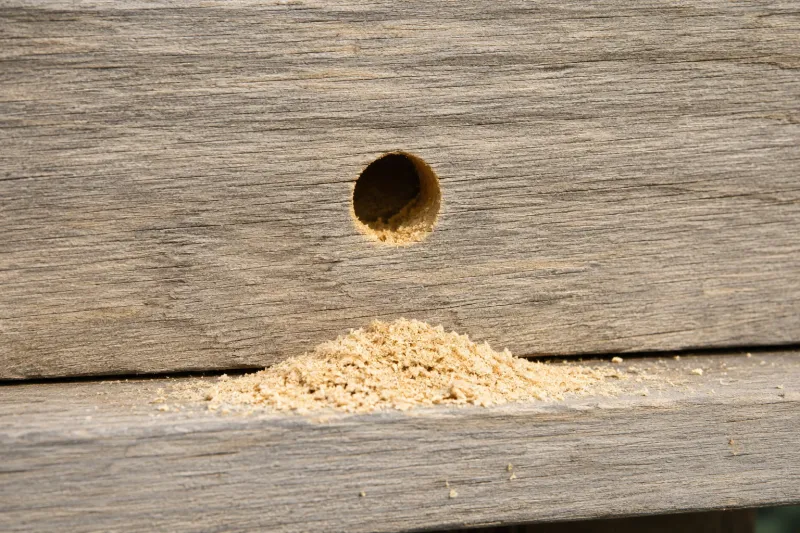
A nearly round entrance hole, roughly one-half inch wide, with fresh sawdust or loose wood debris scattered beneath it is a strong clue that a large carpenter bee has been at work. That clue becomes much more reliable when you pair it with a good look at the bee itself.
NC State Extension guidance on non-honey bee stinging insects describes the large carpenter bee, Xylocopa virginica, as similar in size to a bumblebee but with a shiny, mostly hairless black abdomen. A bumblebee’s abdomen is visibly fuzzy and yellow-banded, and bumblebees do not drill porch wood.
The hole shape alone cannot close the case. Woodpecker damage, for example, can produce ragged openings in similar wood, and the size of the entrance does not always match the extent of the gallery inside.
Confirming that you are seeing a large, glossy-bodied bee entering or exiting the hole, alongside fresh sawdust below it, gives you a much stronger basis for action than hole shape alone.
Small carpenter bees in the genus Ceratina are a separate group entirely. NC State’s profile of small carpenter bees explains that they nest in pithy plant stems, not structural wood, so finding one near your porch does not mean your railing is under attack.
Once you have confirmed the large species, keep in mind what the tunnel is actually for: the female excavates wood to create shelter and brood chambers, not to eat it. Penn State Extension’s carpenter bee resource notes that these bees are solitary rather than colony-forming, so several bees using nearby tunnels does not mean a single large hive has taken over your porch.
Summer sightings do not prove new drilling
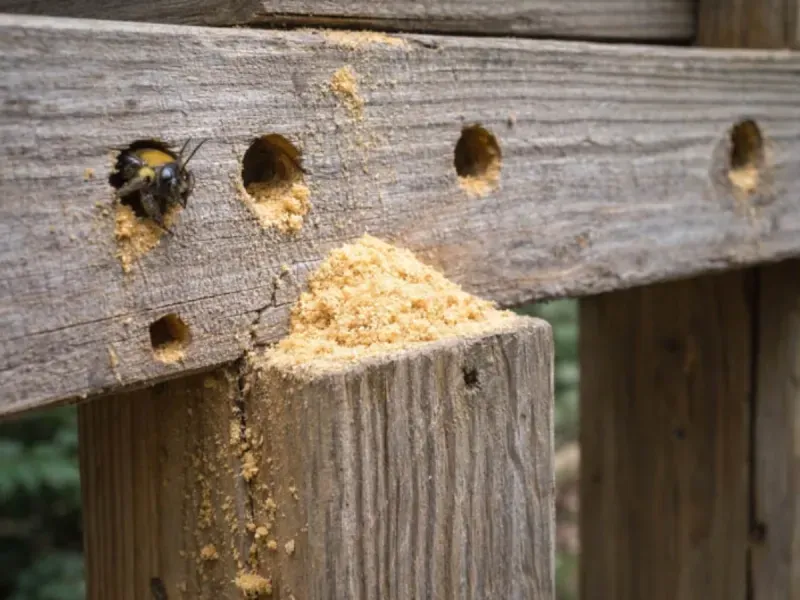
Seeing carpenter bees around your porch in June, July, or August does not automatically mean they have just started boring fresh tunnels. Timing matters here.
NC State Extension reports that North Carolina adults typically emerge from overwintering tunnels in April and May. The bees you spot later in summer are often new adults that have recently developed and are now feeding, cleaning out existing galleries, or simply resting near the wood they were born in.
Flight activity around a hole is interesting evidence, but it is weaker than physical evidence at the entrance. A bee hovering near a railing or landing briefly on a board could be investigating, feeding on nearby flowers, or re-entering an old tunnel.
Fresh sawdust or loose wood debris piled beneath an entrance is a much more specific sign that recent excavation has taken place. If the hole looks weathered and the wood below it is clean, the gallery may have been there for a season or more.
Woodpeckers add another layer of complexity. Purdue Extension’s carpenter bee fact sheet notes that woodpeckers will hammer into galleries to reach larvae, sometimes creating damage that looks far more dramatic than what the bees drilled themselves.
A large, ragged opening in a board is more likely a bird’s work than a bee’s. When you are trying to figure out whether bees are actively excavating this season, the combination of a fresh hole, fresh sawdust, and a bee with a shiny black abdomen entering or exiting that specific hole is the clearest evidence available.
The bees are responding to suitable wood—not declaring it rotten
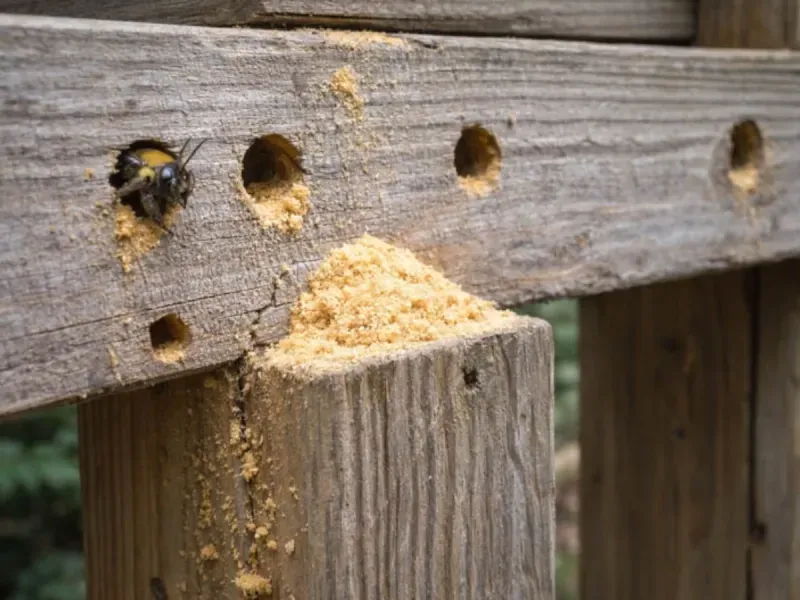
When a female carpenter bee chooses your porch railing, she is not signaling that the wood is rotten. She is responding to wood that suits her needs.
The female begins by drilling across the grain of the wood to create a short entry channel, then turns and excavates along the grain to build the brood chambers where she will lay her eggs. NC State Extension lists porch rails, decks, eaves, and other exposed wooden surfaces as common targets, and Purdue Extension describes the initial tunnel as roughly one to two inches deep before the gallery turns and runs along the grain.
Bare, unpainted, and weathered softwood is often the most attractive option, but the bees are not exclusively targeting decayed material. Painted, stained, pressure-treated, and harder wood can still be attacked, though those surfaces are generally less appealing.
The practical takeaway is that finding a hole in a board does not prove that board is structurally compromised or rotting through.
A few isolated holes in sound, nonstructural wood are a maintenance signal worth investigating, not an emergency. Penn State Extension notes that serious structural weakening is more commonly associated with large numbers of bees tunneling repeatedly over successive years, branching galleries, thin boards, or damage compounded by woodpecker activity and moisture.
One or two holes in a solid railing post calls for a different level of concern than a decade of reuse in a load-bearing beam. Treat the activity as a prompt to look more carefully at the wood’s condition rather than as proof that the porch is failing.
Inspect the porch before choosing a response
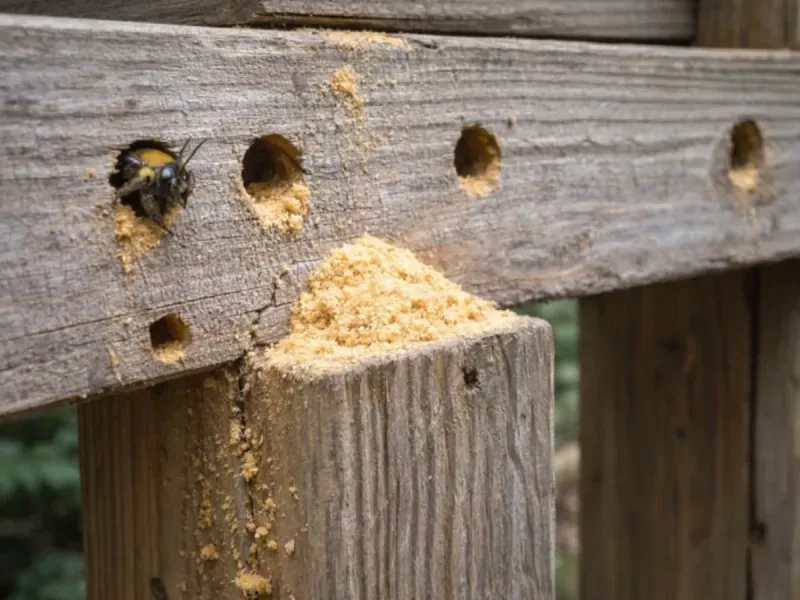
Before deciding on any response, spend twenty minutes doing a systematic walk of the porch. Start at one end and work your way around, checking every exposed wood surface at eye level and below.
You are looking for entrance holes, fresh sawdust or staining beneath them, soft or spongy boards, long cracks running with the grain, and any spots where water collects or where a board stays wet after rain. NC State Extension specifically flags eaves, porch rails, and decking as common target areas, so pay extra attention to horizontal surfaces and end grain.
Press a screwdriver into any board that looks questionable. Sound wood resists the tip; soft, punky wood gives way easily.
A board that passes the screwdriver test but shows a single entrance hole is in a very different category from one that is soft, discolored, and riddled with multiple openings. Count the holes you find and note whether the sawdust below them looks fresh and pale or old and dark.
Fresh pale sawdust suggests recent activity; dark or compacted debris may indicate an older gallery.
Also look up. Woodpecker damage on eaves or soffits often appears as a cluster of ragged holes or a torn-out section of wood, which is quite different from the clean round entrance a bee drills.
Penn State Extension points out that woodpecker excavation can cause more visible destruction than the bees themselves and may indicate that galleries are well established. If you find numerous entrances, soft boards, persistent moisture, thin or weight-bearing members showing damage, or obvious woodpecker activity, that is the point to call a licensed pest-control professional rather than attempting repairs and treatment on your own.
High eaves, difficult ladder access, and suspected structural damage are all situations where professional evaluation is the safer and more reliable choice.
Repair and refinish the wood first
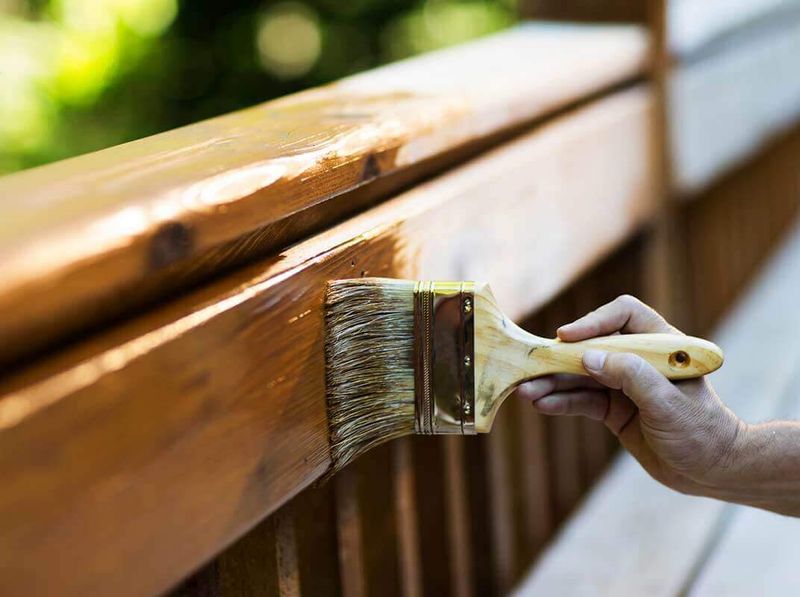
Once you know which boards are affected and whether moisture is a factor, maintenance becomes your first line of action. Replace any board that is soft, deeply cracked, or badly compromised.
A board with significant structural deterioration will not hold paint well and will remain attractive to bees regardless of what else you do. NC State Extension recommends correcting leaks and persistent wetting before refinishing, because sealing moisture into wood creates a different set of problems.
After repairs, apply a quality exterior paint, stain, or wood finish to all bare or exposed surfaces. University of Georgia Extension guidance on carpenter bees supports finishing exposed wood as a way to make surfaces less appealing, and Penn State Extension echoes this approach.
The honest caveat is that finishing is a deterrent, not a guarantee. Carpenter bees have been documented attacking painted, stained, and even pressure-treated wood, so a fresh coat of paint reduces risk without eliminating it entirely.
Pay particular attention to end grain, which absorbs finish poorly and tends to weather faster than face grain. End grain on railing caps and post tops is often the first place a bee will probe.
One more caution: do not seal an active tunnel before the bees have stopped using it. Plugging a live entrance can trap bees inside or prompt them to chew a new exit through undamaged wood.
Wait until you are confident the tunnel is inactive before filling any entrance with caulk, wood filler, or a wooden plug.
A few low-risk holes may call for watchful repair
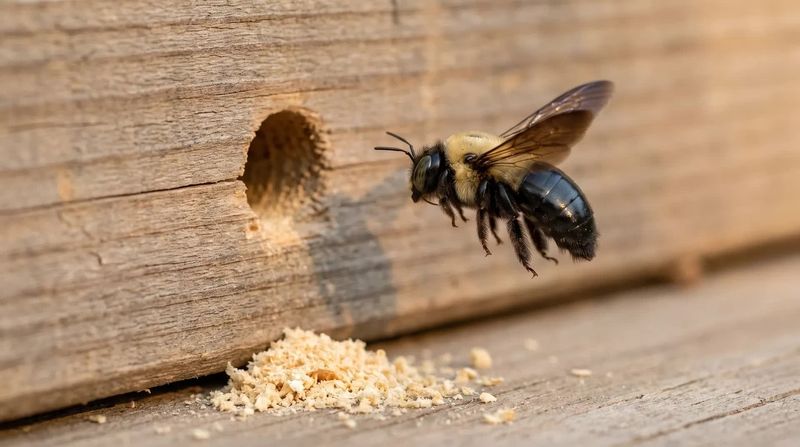
Not every carpenter bee hole demands an immediate chemical response. When you find one or two entrances in a sound, nonstructural board with no soft spots, no moisture damage, and no sign of woodpecker activity, the most proportionate response may be to plan your repairs while leaving the bees alone for now.
University of Georgia Extension’s recent carpenter bee overview notes that these bees are native pollinators with real ecological value, and that low-damage situations do not automatically call for pesticide use.
The calculus shifts when you find numerous holes, evidence that the same tunnels have been reused over multiple seasons, thin or weight-bearing wood showing progressive damage, or woodpecker excavation opening up galleries. Those conditions, taken together, can justify more active control.
NC State Extension ties serious structural risk to large numbers of bees tunneling repeatedly over successive years rather than to a single hole in a single season.
Keep the sting risk in clear perspective. Male carpenter bees are the bold hoverers that get in your face near the porch, but they have no stinger.
Females can sting, though they typically do so only when handled directly or seriously provoked, not simply because you walked past. Penn State Extension makes this distinction clearly.
On the question of commercial carpenter bee traps, results vary enough that extension sources from Clarke County and Henry County UGA Extension describe them as available but not consistently effective. Traps are not a substitute for repairing and finishing the wood that attracted the bees in the first place.
Use targeted treatment only when it adds value
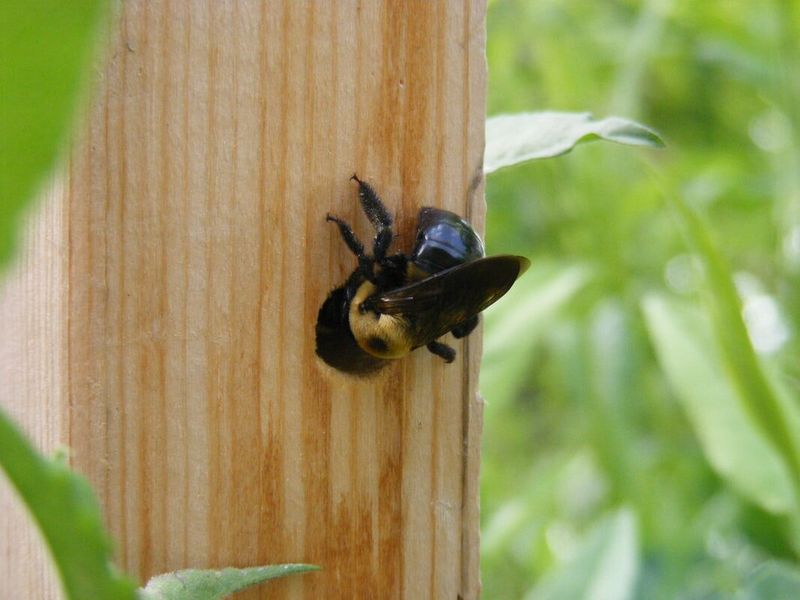
Chemical control is a later, targeted option, not a starting point. Spraying every bee you see hovering around the porch is not an effective approach, and NC State Extension specifically advises against it, noting that applying pesticide to hovering adults is neither sensible nor particularly safe.
The goal of any treatment is to reach the gallery itself, where the bees are sheltering or raising young, not to coat the general porch surface.
Before using any product, verify that its current label lists the intended pest and the specific site you plan to treat. Labels change, and a product marketed for “wood-boring insects” or “wasps” may not be registered for use on a residential porch or in the manner you intend.
The NC State Agricultural Chemicals Manual and the EPA Pesticide Product Label System are two resources that can help you confirm whether a product is registered for your situation. The label is a legal document, and following it is both a legal requirement and a safety measure.
Timing and technique matter. Treatment is generally most effective when bees are inside and inactive, which usually means working at night or in early morning.
Wear protective clothing and eye protection. Apply the product to the tunnel entrance as directed by the label, and do not seal the hole immediately afterward.
NC State’s Chapter V insect control guidance indicates leaving treated tunnels open for approximately 24 to 36 hours before sealing, though other extension sources recommend several days. The specific product label controls that interval.
Once you are confident the tunnel is inactive, seal the entrance with a wood plug, wood filler, or exterior caulk, and refinish the surface. Avoid any application that could allow product to drift onto flowering plants, blooming weeds, or areas where pollinators are foraging.
EPA pollinator-protection guidance identifies drift reduction, application timing, and label compliance as key measures for protecting beneficial insects during any pesticide use. When the holes are high on eaves or soffits, when the wood may be structural, or when safe ladder access is not realistic, a licensed pest-control professional is the right call.
Use a simple decision rule for the next step
The clearest path forward starts with confirmation, not chemicals. Verify that what you are seeing is actually a large carpenter bee entering a hole with fresh sawdust below it.
Then walk the porch systematically to assess how many holes exist, whether the wood is sound or deteriorating, whether moisture is a factor, and whether woodpeckers have been involved. NC State Extension and Penn State Extension both point to repeated tunneling over multiple years, thin or weight-bearing wood, and compounding moisture damage as the conditions that elevate risk beyond a minor nuisance.
For isolated, low-damage situations in sound wood, plan your repairs, refinish exposed surfaces, and monitor through the season. For extensive galleries, recurring reuse, structural members, woodpecker damage, or any situation where safe access is a question, bring in a licensed professional rather than improvising on a ladder with a pesticide.
A carpenter bee hole in your porch is a maintenance prompt. It tells you that some wood is exposed and attractive to a native bee looking for a place to raise her young – and that a coat of paint or a replaced board might be the most useful thing you do all summer.