
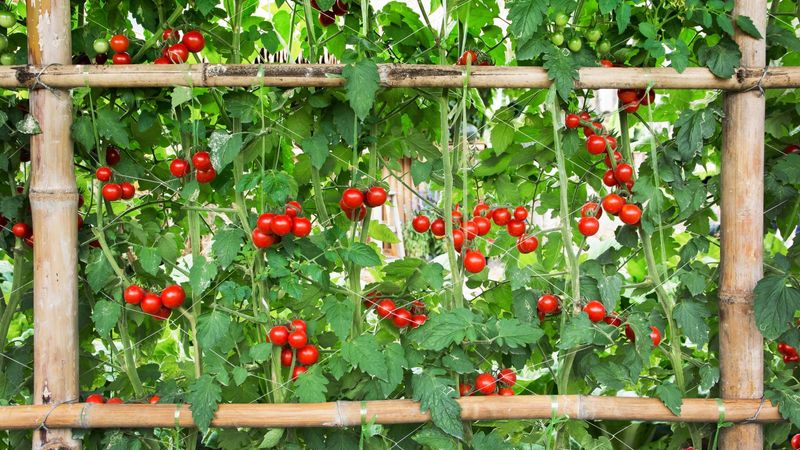
Walk out to your garden mid-July and find your tomato plant sprawled on the ground, its cage tipped sideways under the weight of all those branches, and it is easy to blame the cage itself. But the cage is rarely the villain – the real problem is usually a mismatch between the support you chose and the plant growing inside it. Picking the right structure before your tomato takes off can mean the difference between a tangle you dread harvesting and a plant that stays upright, productive, and easy to manage all season long.
The problem is usually a mismatched cage, not support itself
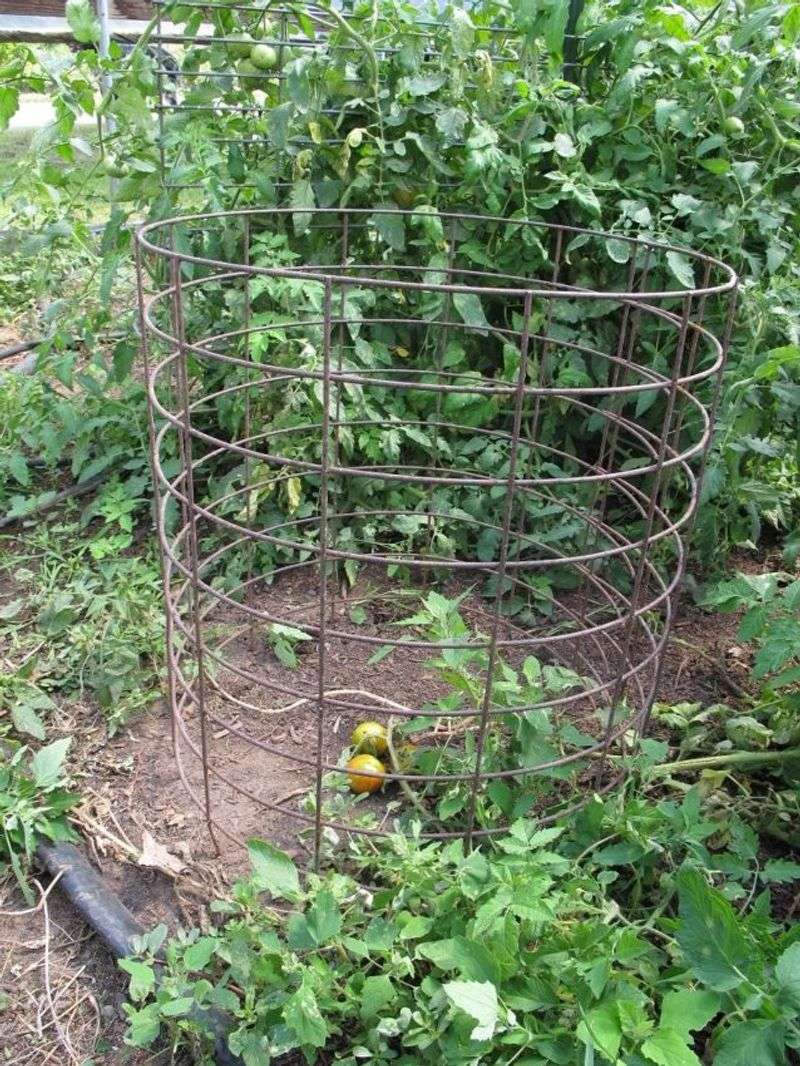
Seeing a tomato cage tip over or watching branches cascade past the rim can feel like a sign that cages are a bad idea. In most cases, though, the cage is not the problem – the match between the cage and the plant is. University of Minnesota Extension guidance on trellises and cages consistently points out that keeping tomatoes supported is beneficial: it lifts fruit and foliage off the soil, improves access for harvesting, and can reduce exposure to soil splash, rot, and some disease pressure.
The warning signs of a mismatched cage are easy to spot. Branches spilling over the top rim, fruit resting on bare soil, a structure that leans or rocks in a light breeze, or a plant so dense and tangled that you cannot reach in to pick a ripe tomato – these are signals that the support has been outgrown, not that support itself is the wrong idea.
The phrase “tomato cage” covers a wide range of products. A flimsy, three-foot conical cone from the garden center is a completely different structure from a wide, heavy-gauge wire cage anchored with posts. Oregon State University Extension notes that the right support depends on the tomato variety and the goals of the gardener. Three support options – a sturdy stake or vertical trellis, a Florida weave system, and a properly sized wire cage – each suit different plants and priorities, and none of them works perfectly for every situation.
Start with the tomato’s growth habit
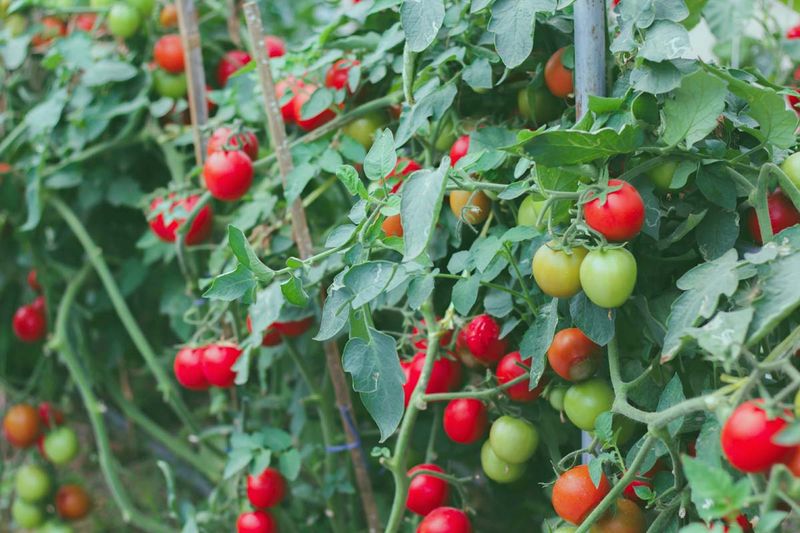
Before buying a single stake or a roll of wire, check the seed packet or plant tag for two words: determinate or indeterminate. That single piece of information will do more to guide your support choice than anything else. University of Minnesota Extension’s tomato growing guide explains that determinate, or bush, varieties reach a set height and stop, making them much easier to manage inside a standard cage.
Indeterminate, or vining, tomatoes keep growing throughout the season. Many popular heirlooms, beefsteaks, and vigorous cherry varieties fall into this category, and they regularly outpace the short conical cages sold at most garden centers. Oregon State Extension notes that indeterminate plants under favorable conditions can reach roughly 6 to 10 feet, though actual height depends heavily on the cultivar, your climate, and how much you prune. Treat any height figure as a rough guide rather than a guarantee.
A standard cage that works reliably for a compact Roma or a patio variety may completely fail a Brandywine or a sungold cherry that keeps pushing new growth into August. Minnesota Extension’s trellis and cage guidance recommends confirming the growth habit before selecting or purchasing any support structure, so you are not retrofitting a solution to a plant that has already outgrown its cage by midsummer.
Match the support to the harvest you want
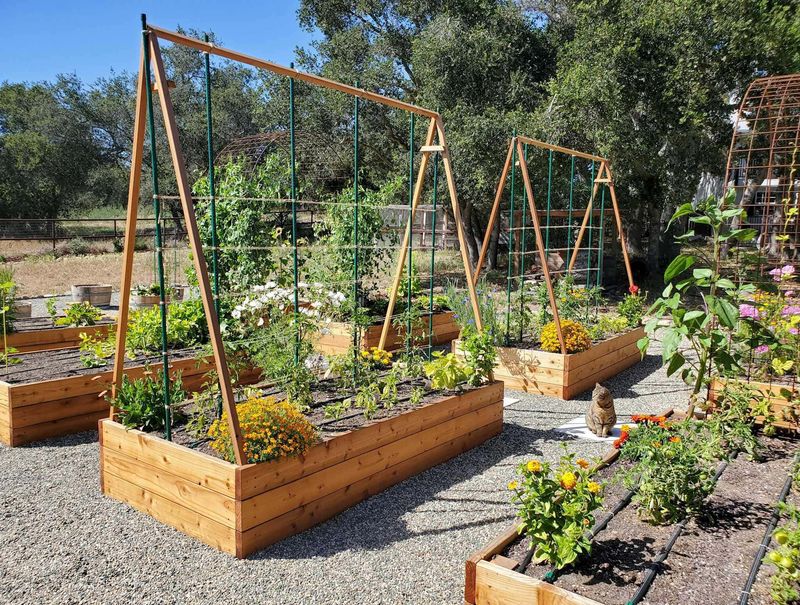
Support choice is not just about keeping the plant upright – it is also a decision about what kind of harvest you want and how much time you are willing to spend managing the plant. Penn State Extension’s tomato growing guide makes clear that different systems produce different results in fruit size, total yield, and labor demands, and that each comes with real tradeoffs.
If you want earlier, larger individual tomatoes and you are comfortable pruning regularly, single staking or a vertical trellis tends to suit that goal. If you want the highest total number of tomatoes per plant with less pruning work, a roomy, well-anchored cage or a less intensively managed system often delivers more fruit overall, even if individual tomatoes may be smaller. Growing several tomatoes in a row with limited space and tools? A Florida weave system can be far more efficient than staking every plant individually.
Other factors matter too. Wind exposure, available space, container size, and whether you are willing to retrain branches throughout the season all affect which system will actually work in your yard. University of Vermont Extension’s overview of cage alternatives and North Dakota State University Extension’s comparison of support options both frame these systems as tools with distinct strengths rather than a ranked list where one is always better. Matching the structure to your specific situation is the step most gardeners skip.
A sturdy stake or vertical trellis gives one plant a clear path upward
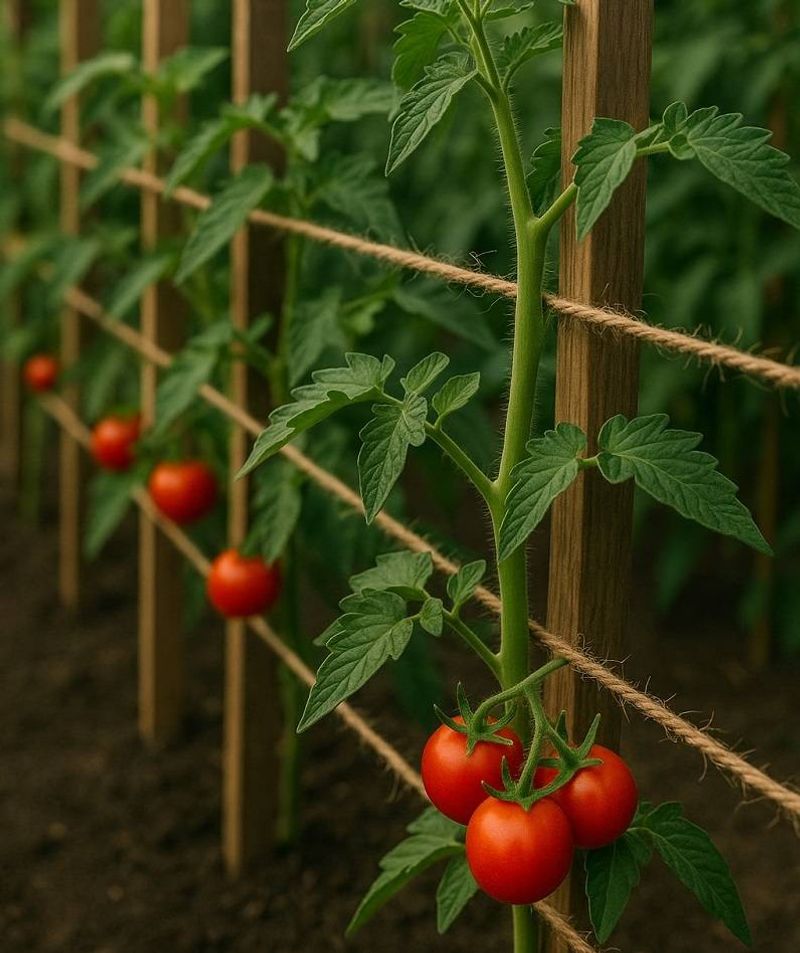
For a gardener with one or two indeterminate plants and a preference for earlier, larger fruit, a sturdy stake or a simple vertical trellis is a reliable option. The key word is sturdy. A thin bamboo rod pushed a few inches into soft soil will not hold a full-grown indeterminate tomato in a summer wind. Penn State Extension’s staking guide recommends using a strong stake and driving it deep enough to stay firm – roughly 8 to 12 inches into the soil as a common starting point, though the right depth varies with soil type, stake material, and wind conditions in your garden.
Timing matters just as much as stake size. Install the stake at planting, not after the plant has established a wide root system. Driving a stake through an established root zone can injure the plant and cause more problems than the support solves. As the plant grows, tie the stem to the stake at regular intervals using soft, flexible material – cloth strips, nylon hose, or soft twine work well.
Cornell’s tomato growing guide recommends a loose figure-eight arrangement, with one loop around the stake and a wider loop cradling the stem, leaving room for the stem to expand without being constricted. Avoid fishing line, zip ties, wire, or any tie pulled tight against the stem.
Staking usually calls for more pruning than other systems. Removing some suckers keeps the plant focused on one or two main stems and makes the vertical structure manageable. Be careful not to strip too much foliage, though. Iowa State University Extension notes that aggressive leaf removal can expose fruit to sunscald and increase water-stress problems – the foliage cover serves a real protective function, especially during peak summer heat.
Florida weave keeps a row of tomatoes moving together
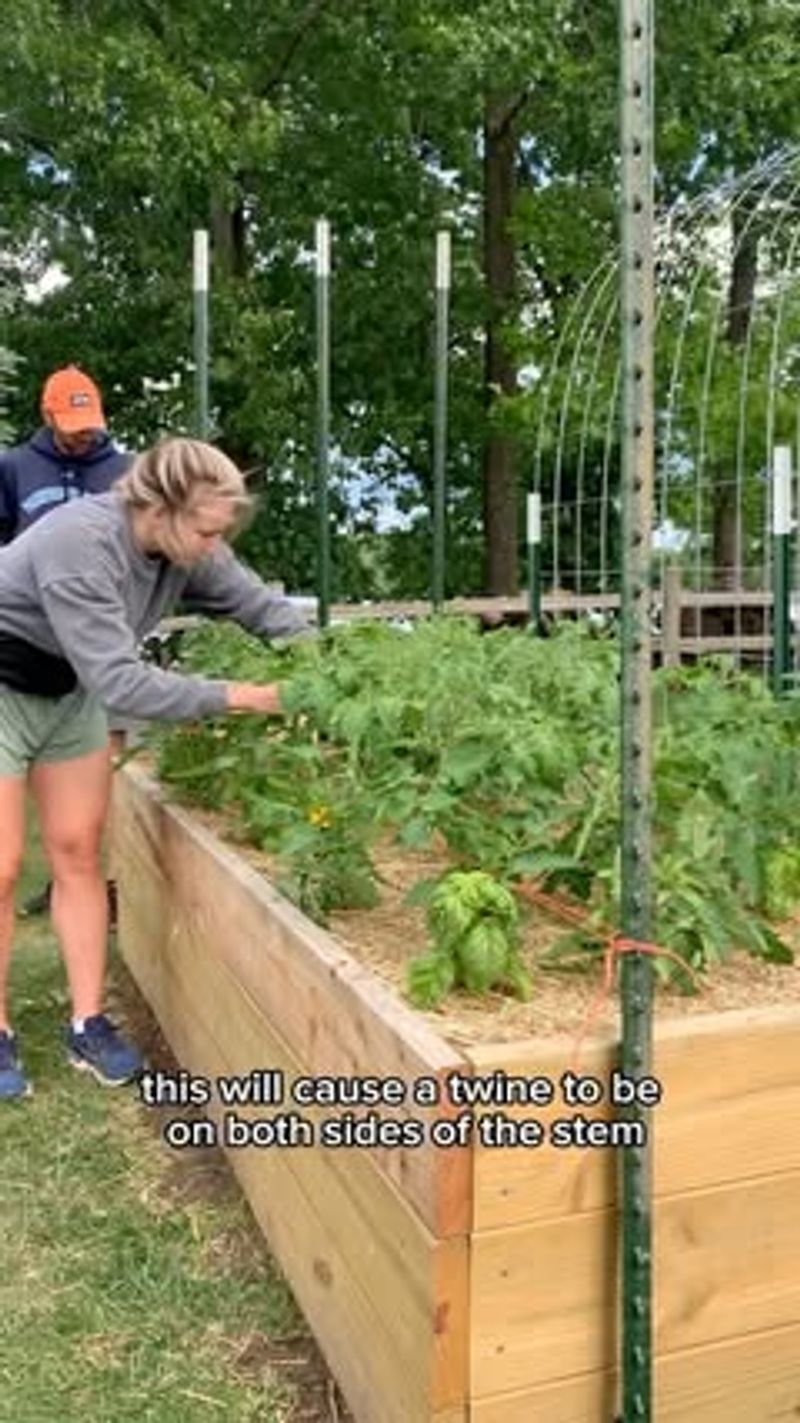
Managing a long row of tomatoes individually – one stake per plant, one set of ties per stem – can eat up a weekend. The Florida weave, sometimes called the basket weave, cuts that labor down significantly by letting a shared system of stakes and twine support multiple plants at once. Penn State Extension’s staking overview describes the basic setup: place stakes in the ground between every two or three plants, then run soft twine along one side of the row, loop it around each stake, and bring it back along the other side, sandwiching the plants between two parallel lines of twine.
As the plants grow taller, you add another layer of twine higher up – typically every 6 to 8 inches or so as stems extend. The weave holds each plant upright without tying individual stems, which saves time compared with staking each plant separately. Illinois Extension’s trellising tips point out that the system works best when gardeners keep up with it – adding new layers promptly as the plants grow rather than waiting until stems are already flopping.
The tradeoff compared with individual staking is less precise control over each plant. Compared with a roomy cage, the Florida weave typically requires more pruning to keep the canopy from becoming a tangled wall. University of New Hampshire Extension’s pruning fact sheet notes that the system suits indeterminate varieties grown in rows and managed with regular attention throughout the season. For a gardener with three or more plants in a line and limited stakes on hand, it is often the most practical option available.
A wide, anchored wire cage gives vigorous plants room to spread
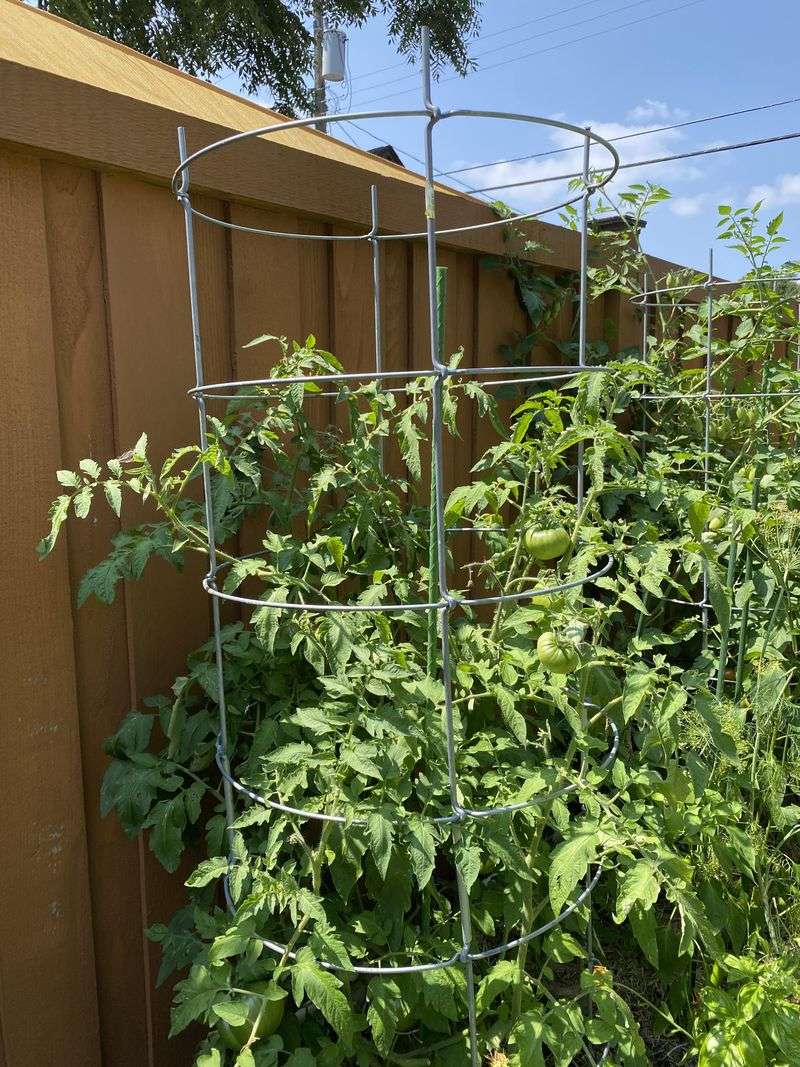
A properly built wire cage is not the flimsy green cone that tips over in July. Heavy-gauge concrete reinforcing mesh, or comparable rigid wire fencing, forms a structure that can hold a large indeterminate tomato upright through a summer storm – provided it is anchored correctly. Oregon State University Extension recommends stiff 9- or 10-gauge reinforcing mesh for large indeterminate cages, with openings wide enough to reach through easily for harvesting – roughly 6 inches square is a commonly cited target.
Width and height matter as much as wire gauge. A cage built for a vigorous indeterminate plant should be wide enough that branches can spread naturally inside rather than pressing against the wire, and tall enough that the plant does not simply grow out the top and flop over. Once built, anchor the cage with stakes or posts driven into the soil alongside it. A tall cage loaded with fruit and foliage acts like a sail in wind, and an unanchored structure can topple and injure the plant or damage roots when it falls.
The practical advantages of a roomy cage are real. Plants retain more foliage, which can protect fruit from sunscald during hot spells and support strong overall production. Minnesota Extension and NC State Extension’s home garden tomato guide both note that caged systems generally require less tying and less aggressive pruning than staking. That said, a bigger cage does not mean a maintenance-free plant.
You will still need to check for leaning, redirect branches that push outside the wire, harvest regularly, and scout for pests throughout the season.
Install early and avoid creating a new tomato problem
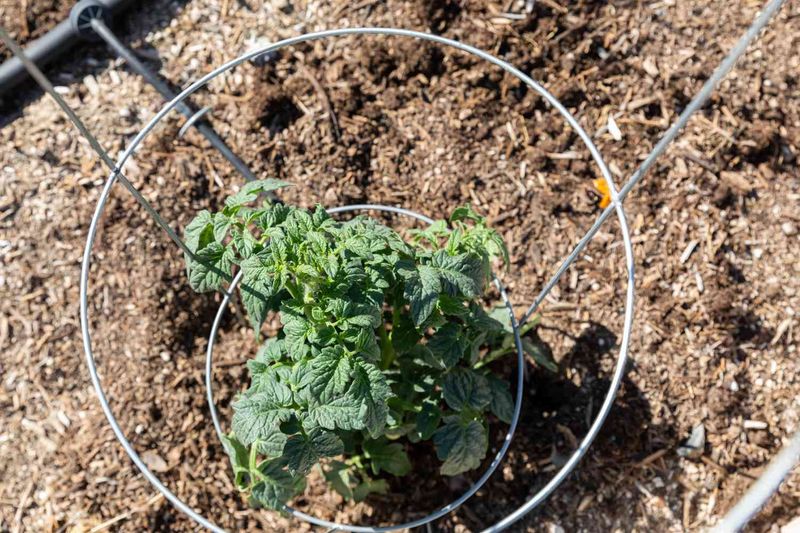
Choosing the right support system only helps if you put it in place at the right time. The safest moment to install any cage, stake, or trellis is at planting or within the first week or two after transplanting, while the root system is still compact and easy to work around. Iowa State University Extension’s tomato training guide is direct on this point: driving a stake or post into the soil later in the season risks cutting through established roots and setting the plant back at a critical growth stage.
If you missed the early window and a plant is already sprawling, resist the urge to force it back through a cage or bend stems sharply into a new position. Add external support instead – a stake placed alongside the main stem and tied loosely, or a cage set around the plant with minimal bending. NC State Extension’s home garden guide recommends working gently and accepting that a late correction may not be as tidy as proper early installation.
Once the structure is in place, a few ongoing habits keep it working well. Use only soft, flexible ties with slack – cloth strips, soft twine, or nylon hose looped loosely around the stem. University of Georgia Extension’s staking and pruning guide emphasizes leaving room for stem expansion so ties never constrict growing tissue. Keep soil moisture consistent, especially in staked systems where aggressive pruning has reduced foliage cover.
Check tall supports after wind events, redirect any branches that have pushed outside the structure, and harvest regularly so fruit weight does not accumulate and tip the cage. Finally, Illinois Extension notes that plant pathogens can persist on reused garden supports, so clean cages and stakes before putting them back in service the following season.
Choose the structure your tomato can actually outgrow
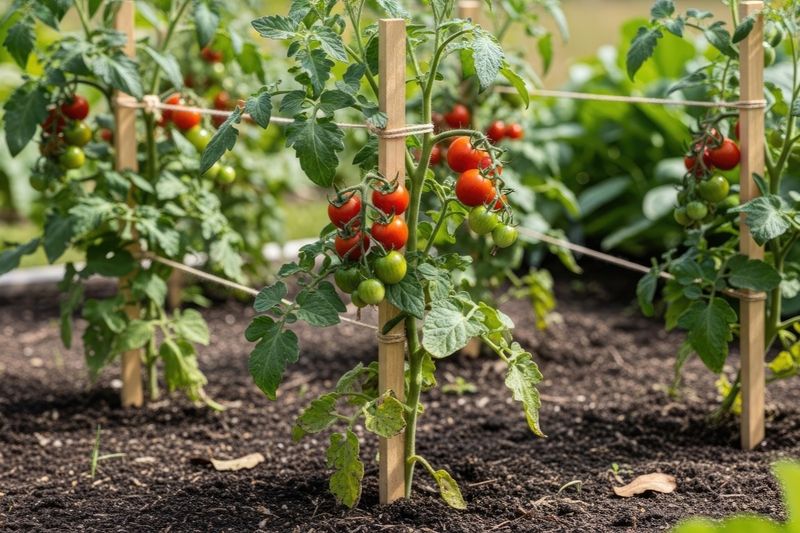
Matching the support to the plant is the whole job. A compact determinate variety – a Roma, a Celebrity, or a patio tomato – often does just fine in a properly sized standard cage, provided the cage is stable and tall enough for that cultivar. Minnesota Extension’s trellis and cage guide confirms that basic cages suit smaller determinate plants well; the problem arises when that same cage is used for a vigorous indeterminate variety that will triple its size by August.
For one carefully managed indeterminate plant, a sturdy stake or vertical trellis with regular tying and selective pruning gives you the most control and tends to produce earlier, larger individual fruit. A row of indeterminate plants attended through the season is often best served by a Florida weave, which uses fewer stakes and keeps the whole row moving upward together. Penn State Extension notes that a wide, anchored wire cage suits a vigorous plant that needs room and benefits from less intensive pruning, supporting strong total production without demanding constant tying.
Replacing a cage that keeps failing is not an admission that cages are wrong – it is a sign you are paying attention to what your tomato actually needs. Illinois Extension’s trellising guidance puts it plainly: the best support is the one matched to the plant, the site, and the gardener’s time. Get that match right, and the structure mostly takes care of itself.