
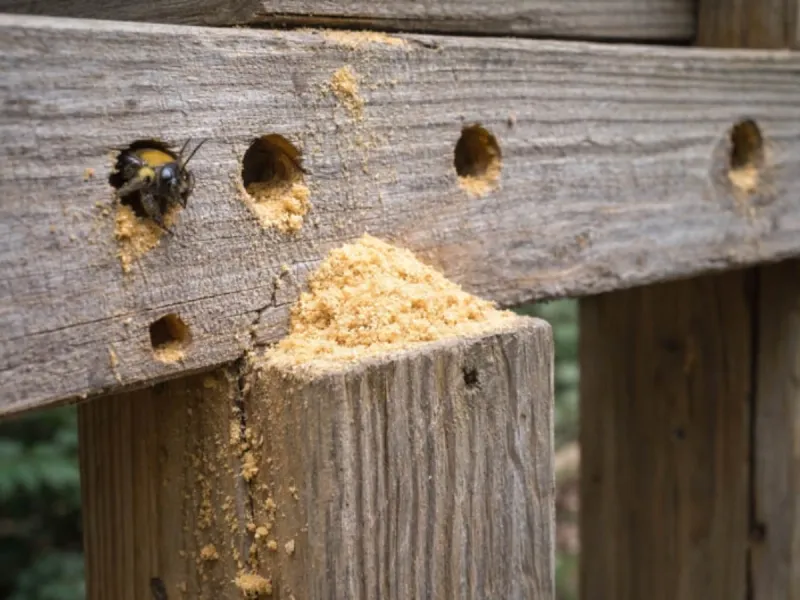
Round holes appearing in your porch wood this summer can feel alarming, but they are telling you something specific about your home rather than signaling a crisis. Large carpenter bees are the most likely explanation when you spot a half-inch opening, a small pile of coarse sawdust, and a big hovering bee nearby on a North Carolina property.
Understanding what those holes actually mean changes every decision you make next, from whether to grab a can of spray to whether the wood even needs urgent attention.
Those round holes may be consistent with carpenter bees—not proof of a wood-eating pest
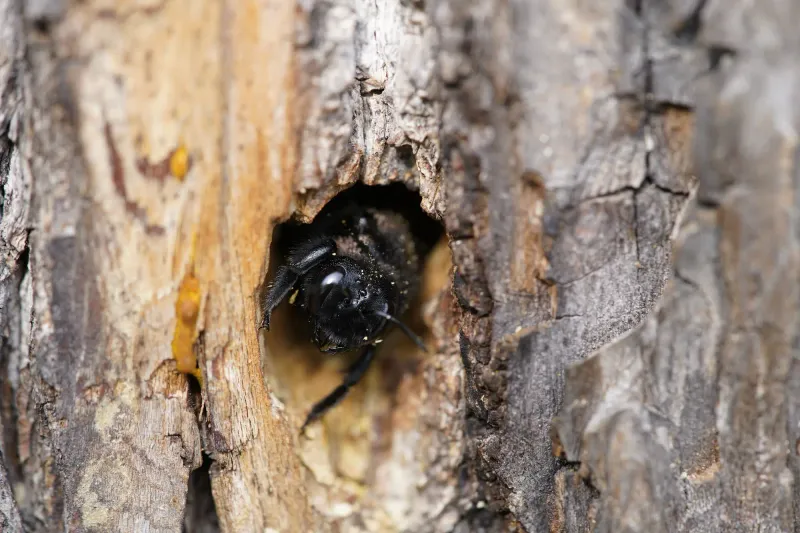
Spotting a perfectly round hole in your porch rail or eave board is unsettling, but a hole alone cannot confirm what made it. The combination of clues that most reliably points toward large carpenter bees includes an entrance roughly half an inch wide, a small mound of coarse sawdust directly below it, yellowish-brown staining on the wood face beneath the opening, and the presence of large, slow-moving bees in the area.
NC State Extension guidance on non-honeybee stinging insects identifies these combined signs as characteristic of large carpenter bees targeting exposed porch wood, eaves, decks, trim, and outdoor furniture.
Large carpenter bees excavate wood to build brood galleries, not to feed on it. A female drills initially straight into the wood, then turns and follows the grain to create a series of chambers where she lays eggs and provisions each cell with a ball of pollen and nectar.
The sawdust you find below the hole is excavated material, not evidence that the wood is being consumed as food.
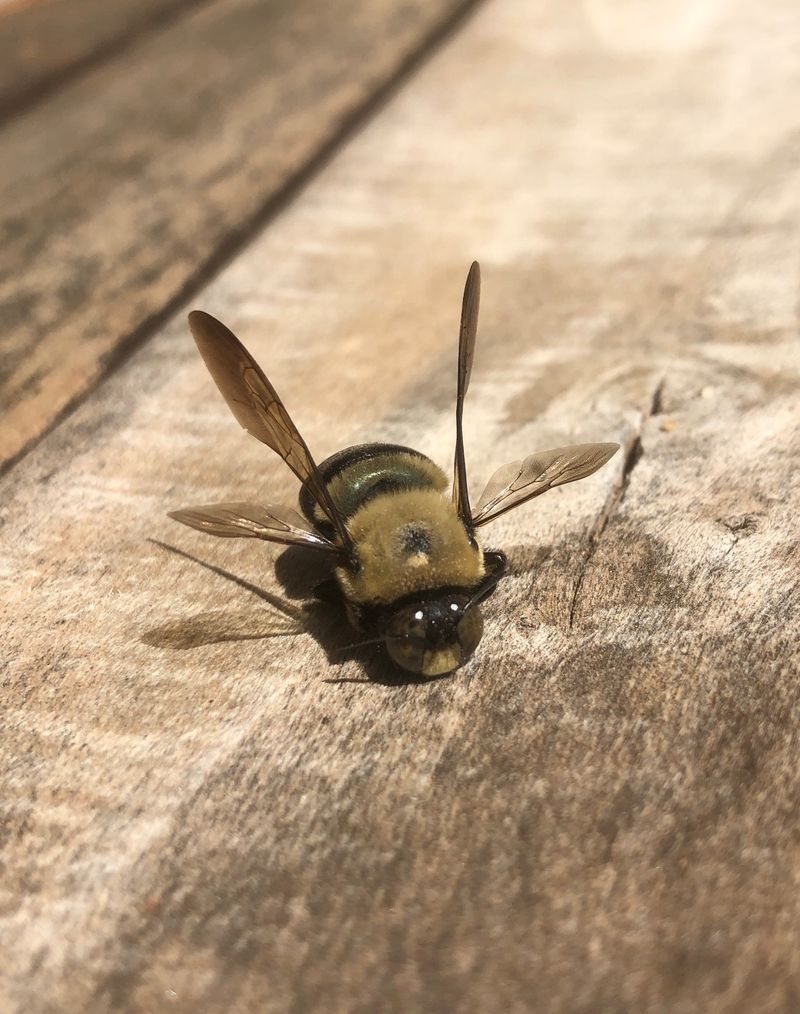
Visually distinguishing carpenter bees from bumblebees matters before you decide what you have. Large carpenter bees are roughly three-quarters to one inch long and have a fuzzy yellowish thorax paired with a shiny, largely hairless black abdomen.
Bumblebees, by contrast, are fuzzy across most of the abdomen. Mistaking one for the other can send you down the wrong response path entirely.
Other wood-boring insects do leave holes, though they are usually much smaller than half an inch. University of Maryland Extension’s household insect identification resource notes that combining hole size, debris type, surface staining, bee appearance, and observed activity gives a far more reliable picture than any single sign.
Take a few minutes to gather that full set of observations before drawing a conclusion.
The porch offers accessible nesting wood; nearby flowers mainly offer food
What those holes most reliably reveal is that your porch surface gave carpenter bees an easy place to nest. University of Maryland Extension’s carpenter bee profile identifies exposed, weathered, bare, stained, cracked, or splintered wood as the primary nesting draw.
The condition and accessibility of the wood surface is the key factor, not the species of plant growing nearby.
Gardens and flower beds in your yard may supply the nectar and pollen carpenter bees need to provision their brood cells, and bees often nest close to reliable food sources. That connection does not mean a pollinator-friendly yard caused the drilling.
Removing flowering plants is not supported as a first-line response and would not address the actual nesting trigger, which is the wood itself.
Carpenter bees are solitary insects, meaning each female selects her own nest site and provisions her own gallery independently. This is a meaningful distinction from social insects like honeybees or yellowjackets, which defend a shared colony.
Several carpenter bees working near the same porch area simply means that section of wood is attractive to multiple individuals, not that a single organized colony has moved in.
The practical takeaway here is straightforward: if you want to reduce nesting activity, focus your attention on the condition of the wood rather than on what is blooming nearby. Accessible, exposed wood is the invitation; finishing, repairing, or replacing that wood is the most direct way to make the porch less appealing as a nesting site.
A few holes suggest maintenance; repeated galleries can become a wood problem
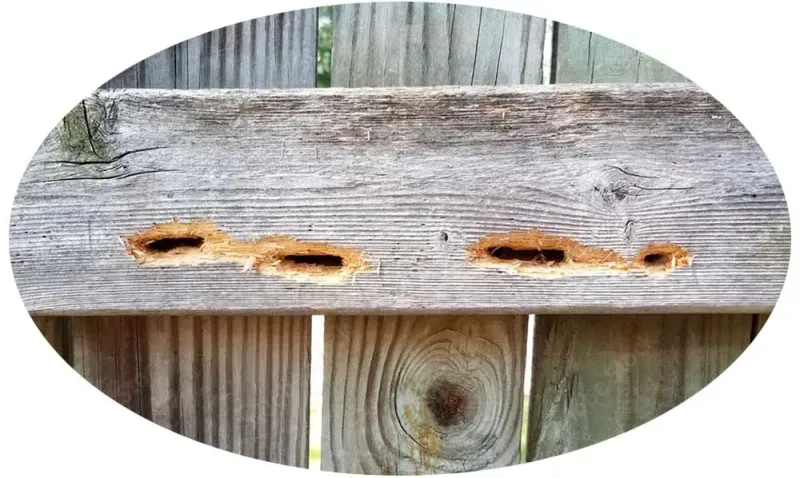
Finding one or two holes in a porch board typically signals a maintenance need rather than a structural emergency. The picture changes when you find numerous openings in the same board, signs that galleries have been enlarged over time, or evidence that bees have returned to the same locations season after season.
Repeated reuse and enlargement of tunnels across multiple years is what extension guidance associates with meaningful wood weakening, particularly in thin or heavily weathered boards.
A thorough inspection covers more ground than the visible face of the porch. Check porch rails, fascia boards, eaves, porch ceilings, trim, siding, and any outdoor furniture made of unfinished wood.
NC State Extension’s stinging insect guidance notes that carpenter bees commonly target these surfaces, many of which are easy to overlook during a quick visual scan from ground level.
During your inspection, note fresh sawdust, active staining, cracks, areas of moisture exposure, soft or spongy wood, and any woodpecker damage. Woodpeckers will tear into boards to reach carpenter bee larvae, and their work can reveal or worsen existing gallery networks.
Soft, punky wood that crumbles under light pressure deserves closer attention than wood that is simply surface-weathered.
Avoid assigning a structural rating based on hole count alone. If a load-bearing post, joist, or beam shows signs of substantial tunneling, visible softness, or physical weakening that you cannot fully assess from the surface, have it evaluated by a licensed pest professional or a contractor rather than guessing.
The extension sources document the potential for long-term weakening but do not offer a homeowner-safe threshold for declaring wood safe or unsafe.
A summer sighting does not prove fresh summer drilling
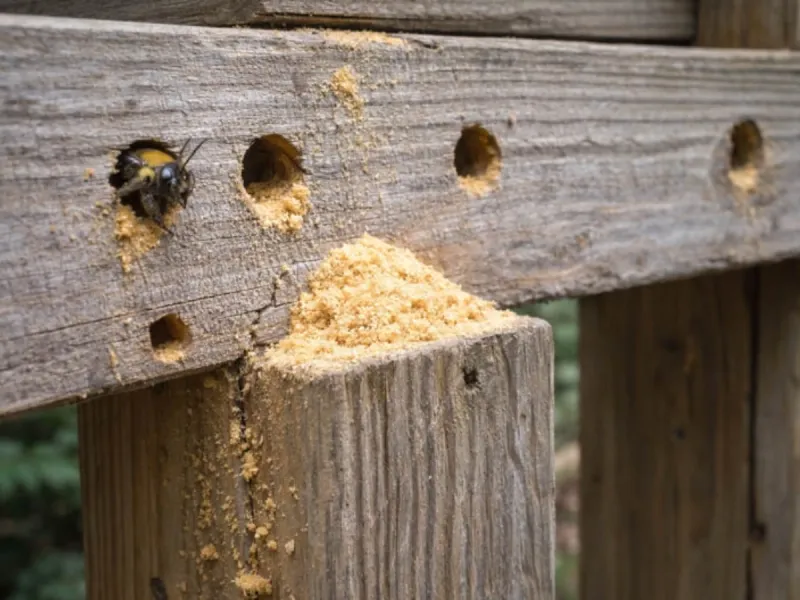
Seeing bees or holes on your porch in July or August does not mean drilling started last week. NC State Extension places typical adult carpenter bee emergence in April and May, which is when most new gallery excavation occurs.
New adults that emerge later in summer often feed on nectar and pollen and then return to existing tunnels to overwinter, so summer activity around a hole may reflect a gallery that was made months or even years earlier.
A hole you notice in summer could represent any of several scenarios: an active nest established in spring, a reused gallery from a prior season, newly emerged adults exploring old tunnels, or adults foraging nearby without actively excavating. The season alone cannot tell you which situation you are looking at, and the response that makes sense differs depending on what is actually happening inside the wood.
The more useful approach is to document what you observe now. Note the location of each hole, whether fresh sawdust is present, and whether you see bees entering or exiting.
That record helps you plan the right next step. Late summer, once activity has slowed, and early spring, before new adults emerge, are both periods that extension guidance identifies as useful windows for repair and prevention work.
Any gallery that still shows signs of active use needs appropriate handling before it is sealed.
Hovering males look threatening, but disturbance and ladder work create the real risks
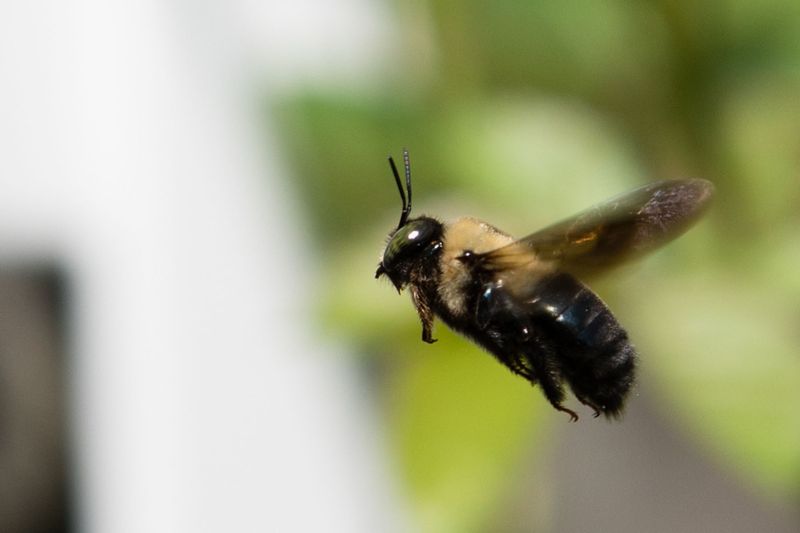
Male carpenter bees are built for display, not defense. They will hover, dart, and occasionally fly directly toward people or pets near a nest site, behavior that looks aggressive but carries no actual threat because male carpenter bees have no stinger.
University of Maryland Extension confirms that females can sting but are generally unlikely to do so unless they are directly handled or feel immediately threatened. Normal yard activity near a porch does not typically provoke a female into stinging.
The practical safety rules are simple: do not grab or swat at bees, do not push fingers or objects into active gallery entrances, and do not position your face close to a hole to peer inside. Those actions bring you into direct contact with a female in a confined space, which is the scenario most likely to produce a sting.
Observing from a comfortable distance is safe and gives you the information you need.
Overhead locations create a separate and more serious risk that has nothing to do with bee behavior. Inspecting or treating eaves, soffits, high fascia boards, or any area that requires a ladder introduces fall hazards and limits your ability to react quickly if a bee does fly out.
Leave overhead, elevated, or otherwise difficult-access work to a licensed pest professional who has the right equipment and training for the job.
Managing carpenter bees makes sense when they are causing meaningful damage to wooden structures, not simply because they have appeared. These are native pollinators, and the decision to treat should be proportionate to the actual condition of the wood rather than a reflexive response to seeing a large bee hovering near the porch.
Repair inactive galleries and deter future nesting without treating every bee
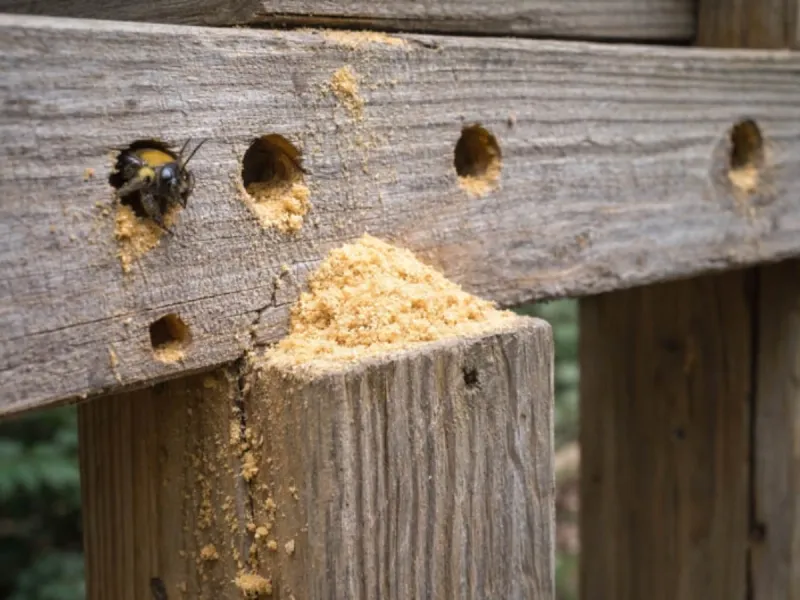
For limited damage with no signs of active use, the most proportionate response is a straightforward repair sequence. Start by replacing boards that are badly deteriorated, then fill old gallery openings, surface cracks, splinters, and nail holes with an appropriate wood filler.
Once those repairs are solid, apply paint or a thorough exterior finish to all exposed wood surfaces. University of Maryland Extension notes that well-maintained painted wood is less attractive to nesting carpenter bees, though paint deters rather than absolutely prevents activity.
Nonwood surfaces such as vinyl or aluminum siding exclude carpenter bees from that material entirely.
The timing of sealing matters. Do not blindly plug a hole that still shows signs of active use.
Extension guidance is consistent on this point: sealing an active gallery can trap bees inside or block emerging adults from exiting, and if treatment has been applied, the gallery may need to remain accessible so bees contact the product. Filling and surface finishing are repair steps that follow the end of active use, not shortcuts that replace it.
Treatment is an option for situations involving real, recurring structural damage, but it is not a universal requirement. Any pesticide you consider must have a current label that specifically permits use against carpenter bees on the intended surface, in the intended location, and by the intended application method.
EPA pollinator-protection guidance makes clear that label instructions are legal requirements, and pollinator-protection restrictions or precautions may apply depending on the product and exposure circumstances. Improvising with a household spray that is not labeled for this use is both potentially ineffective and potentially illegal.
The 2026 North Carolina Agricultural Chemicals Manual lists carpenter bee products and methods with specific restrictions, some of which require professional licensing or training. Carpenter bee traps are sometimes mentioned as a supplemental option, but University of Georgia Extension notes that traps capture varying results and often catch more males than females, so they should not be treated as a reliable stand-alone solution.
Match the response to the actual damage, and leave overhead or technically difficult application work to a licensed professional.
Use the holes as clues, then match the response to the actual damage
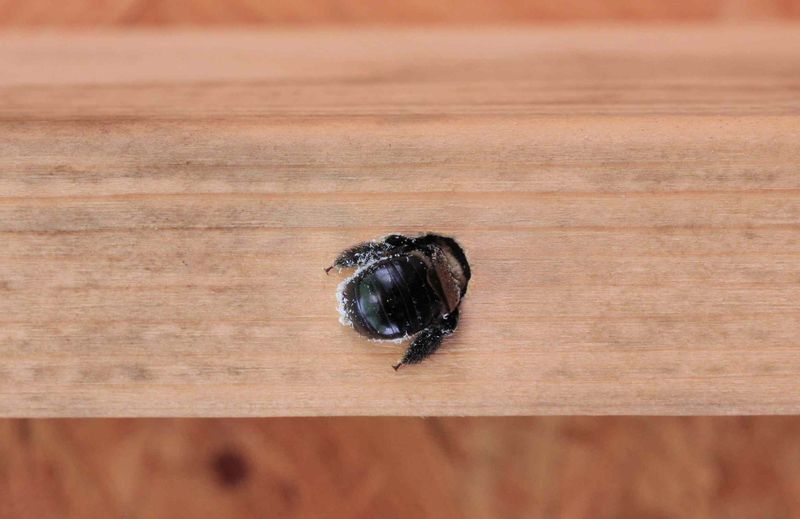
Round holes in porch wood are a starting point for investigation, not a verdict. Gather the full set of clues: hole size, sawdust, staining, bee appearance, and whether you observe bees entering or exiting.
NC State Extension and University of Maryland Extension both point to large carpenter bees as the most likely explanation for the classic combination of a half-inch hole, coarse sawdust, staining, and exposed wood, but identification should rest on the full picture rather than the hole alone.
Inspect the wood carefully, avoid blaming nearby flowering plants, and resist the assumption that one or two holes signals structural failure. Leave any active gallery unsealed until it is no longer in use or until any properly labeled treatment has been applied and activity has stopped.
When numerous reused tunnels have visibly weakened wood or when overhead locations require a ladder, that is the moment to call a licensed pest professional rather than improvise.
A porch with a few carpenter bee holes is almost always a maintenance problem with a clear solution, not a crisis. The homeowners who handle it best are the ones who look carefully first, then act in proportion to what they actually find.