
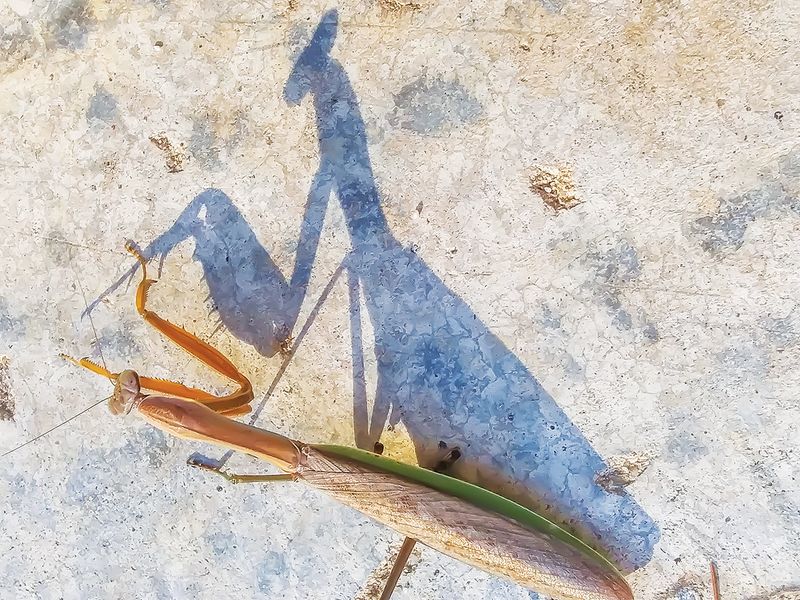
Walking out to your garden and spotting a dozen praying mantises perched on your tomato cages and shrubs can feel like something big is happening in your yard. Many homeowners assume that kind of surge must mean a pest outbreak or some serious shift in the garden’s balance.
The truth is more interesting and a lot less alarming than that. Understanding what actually drives a summer mantis increase can help you make smarter decisions before you reach for a spray bottle or order a bag of egg cases online.
A Mantis Surge Is Not a Yard Diagnosis
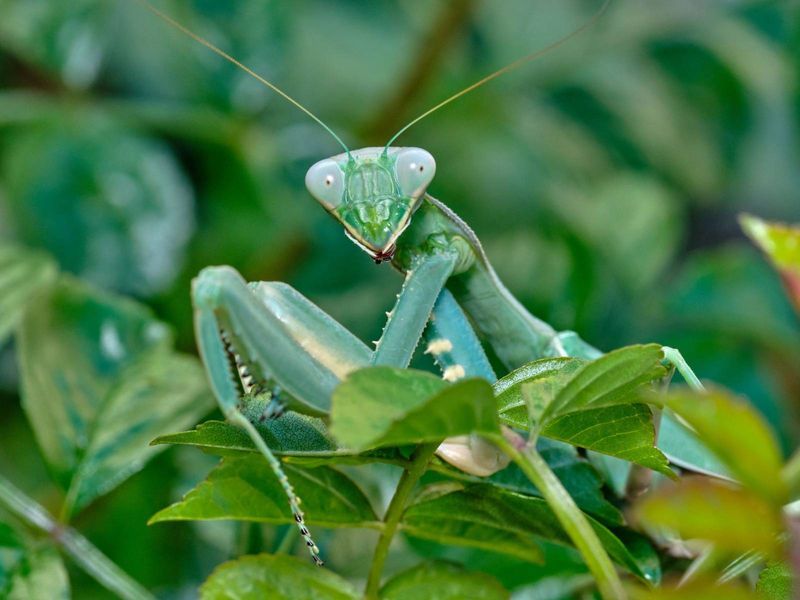
Spotting more praying mantises than usual this summer is striking, but it does not tell you that your yard has developed a specific pest problem or fallen out of ecological balance. Mantises are generalist ambush predators, and their increased presence may simply reflect good vegetation cover, available insect prey in general, the right weather, or nearby egg cases that hatched successfully.
NC State Extension’s review of praying mantid biology notes that mantises hatch in late spring and develop through summer, which means a visible flush of individuals in July or August can be entirely normal seasonal activity rather than evidence of an unusual yard condition.
What the observation cannot do is pinpoint a single cause. Seeing ten mantises on your shrubs does not confirm a caterpillar outbreak, a mosquito spike, or a collapse in natural predator populations.
Those are separate questions that require separate investigation. The mantises may be there because the yard offers suitable habitat, not because something has gone wrong.
The practical rule is to observe before you act. Walk the yard and look at the plants, not just the mantises.
NC State’s Carolina mantid profile is clear that the native Carolina mantid has no demonstrated value in pest management, which means its presence, or the presence of any mantis species, is not a reliable signal that pest pressure is high or low. Treat the mantis count as an interesting observation and check your plants for actual feeding damage, discoloration, or insect colonies before drawing any conclusions about what the yard needs.
Why Mantises Become More Visible in Summer
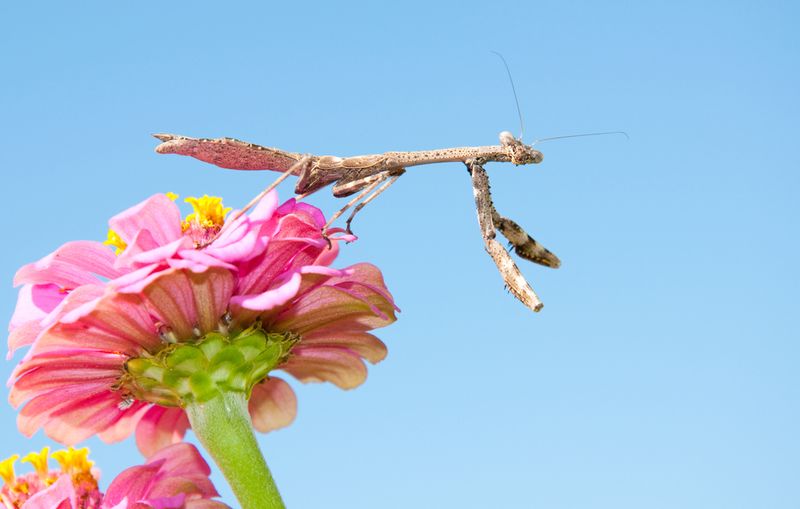
The most straightforward explanation for a summer mantis surge has nothing to do with your yard developing a new problem. Praying mantises follow a predictable annual cycle: egg cases overwinter outdoors, hatch in late spring, and release dozens to hundreds of tiny wingless nymphs that look like miniature adults.
Those nymphs spend the entire summer molting repeatedly, growing larger with each stage, and gradually developing wing pads before maturing into winged adults later in the season.
That progression means mantises that were nearly invisible as small nymphs in May and June become hard to miss by late July and August. NC State Extension’s guide on mantid biology confirms that egg cases are produced in late summer and fall, and that the insects hatch the following spring, completing a cycle that naturally concentrates visible adults during the warmest weeks of the year.
A yard that felt mantis-free in spring may seem overrun in August simply because the insects have grown large enough to see easily.
Vegetation density plays a role too. Mantises prefer to wait on plants where prey is likely to land or crawl past.
A yard with dense shrubs, flowering plants, tall grasses, or garden beds gives mantises more suitable perches, which can make them appear more numerous than they actually are. Nearby egg cases attached to woody stems or fence posts are another factor: a single ootheca can release well over a hundred nymphs, and if several cases hatched near your property line, that population will spread into your yard over the course of the summer.
None of these factors require a specific pest outbreak to be present. Seasonal development, plant structure, and egg-case location are all plausible reasons for increased mantis visibility, and in most cases they are operating together rather than separately.
What Mantises Actually Do in the Garden
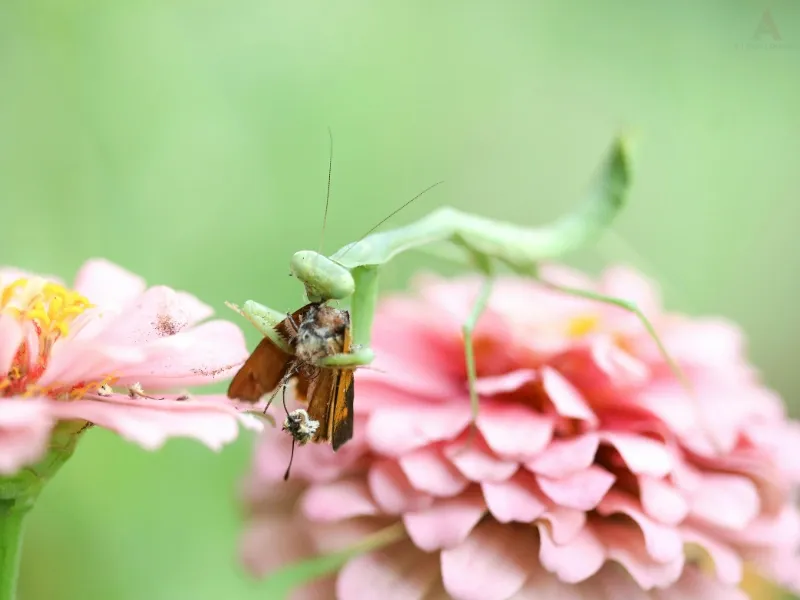
Praying mantises are ambush predators, which means they wait in one spot and seize whatever prey happens to come within reach of their forelegs. They do not patrol the garden in search of aphids or track down a specific pest the way a ladybug might work through a colony.
NC State Extension’s Chinese mantid profile describes them as sit-and-wait hunters that take prey opportunistically, and that prey list covers a wide range: flies, grasshoppers, crickets, moths, butterflies, bees, spiders, and other insects that happen to wander into striking range.
That broad diet is worth understanding before assigning mantises a role as garden helpers. UC Statewide IPM’s assessment of mantids as natural enemies notes that mantises are relatively inactive predators and do not provide meaningful biological control because they eat too many kinds of organisms indiscriminately.
A mantis sitting on a milkweed plant is as likely to grab a monarch butterfly or a bumble bee as it is to catch a cabbage moth. From an ecological standpoint, that is simply how the animal feeds.
From a garden-management standpoint, it means you cannot assign mantises a specific job and expect them to carry it out.
The distinction between ecological interest and measurable pest control matters here. Watching a mantis hunt is genuinely fascinating, and their presence does indicate that the yard supports insect life at multiple levels of the food web.
That is worth something. What it does not mean is that the mantis population is working through a pest problem on your behalf or that you can rely on mantis numbers as a substitute for checking plants directly.
NC State’s Carolina mantid entry states plainly that mantises eat pests and beneficial insects alike, which makes them ecologically interesting neighbors rather than dependable allies in a pest-management plan.
Native and Nonnative Mantises in North Carolina
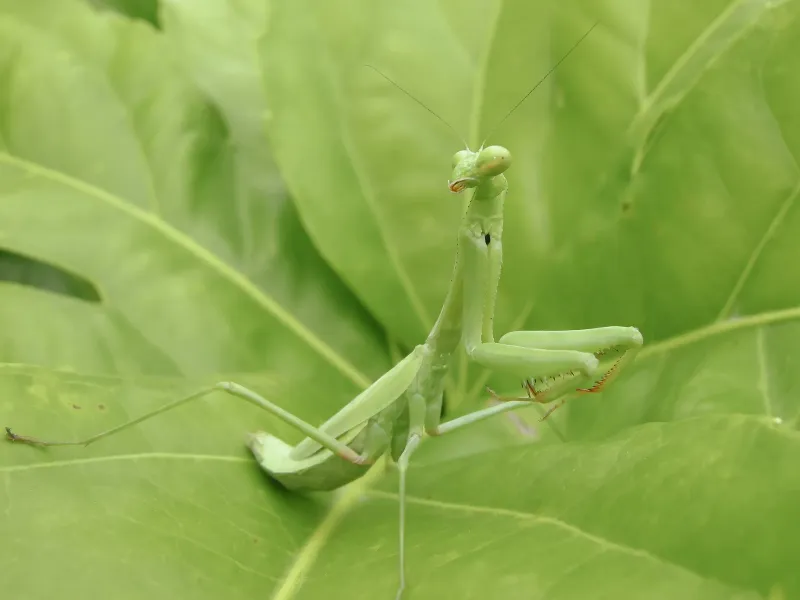
North Carolina yards can host more than one mantis species, and knowing which one you are looking at matters more than most homeowners realize. The native Carolina mantid (Stagmomantis carolina) is a smaller insect, typically around two inches long as an adult, with wings that cover roughly two-thirds of its abdomen.
It has lived in the southeastern United States for a very long time and is a natural part of the region’s insect community.
Three nonnative species have also been reported in North Carolina: the Chinese mantid, the European mantid, and the Japanese narrow-winged mantid. NC State Extension’s review of mantid species in North Carolina notes that the Chinese mantid is frequently encountered in many North Carolina landscapes.
Chinese mantids are considerably larger, sometimes reaching close to five inches as adults, with wings that extend over the full length of the abdomen. That size difference is one of the more reliable field clues for distinguishing the two species.
Color is not a reliable identifier and should not be used alone to make a call. Both the Carolina mantid and the Chinese mantid can appear green, brown, or gray depending on the individual and the vegetation around it.
A large green mantis is not automatically a Chinese mantid, and a small brown one is not automatically native. If accurate identification matters for a decision you are about to make, photograph the insect from multiple angles and submit it to a local NC State Extension office or a citizen-science platform like iNaturalist.
Chinese mantids are best described as nonnative, introduced predators that may prey on pollinators and other wildlife, including bees, butterflies, and occasionally small vertebrates such as hummingbirds. Documented cases of mantises feeding on hummingbirds exist, but those observations do not mean that a yard with Chinese mantids is routinely dangerous for birds.
The concern is real enough to note, particularly in pollinator gardens, without overstating it as a uniform threat to backyard wildlife.
A Mantis Is Not a Substitute for Pest Inspection
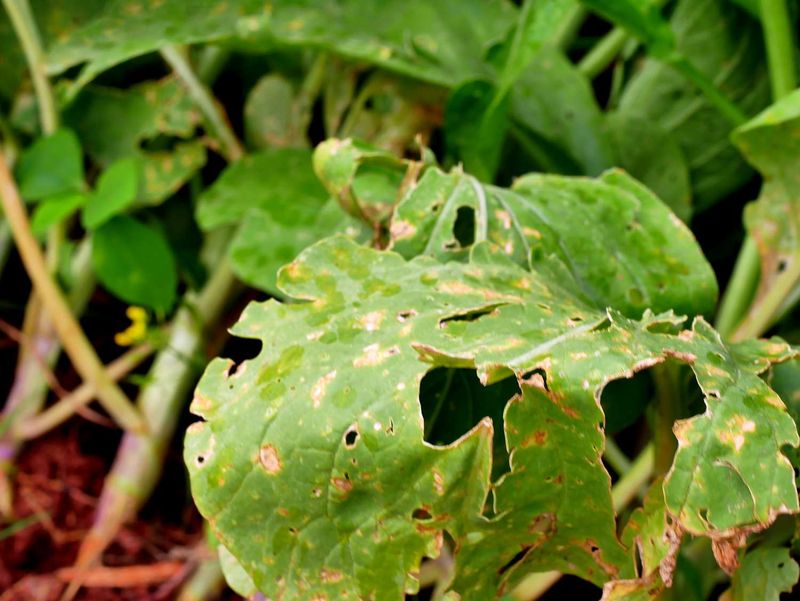
Mantis numbers in the yard tell you that insect prey is available, but they cannot tell you which pest is present, how severe the infestation is, or whether your plants are actually being damaged. Those answers require looking at the plants themselves.
Check leaves for holes, stippling, sticky residue, or discoloration. Look on the undersides of leaves for aphid colonies, scale insects, or caterpillar eggs.
Examine stems for tunneling or girdling. The mantises perched on your fence are not a substitute for that kind of hands-on inspection.
NC State Extension’s guide on biological control for home gardeners is direct on this point: mantises do not seek out common garden pests such as aphids, caterpillars, and thrips, and they cannot be counted on to address a specific pest problem. Releasing purchased mantis egg cases will not reliably control mosquitoes, ticks, aphids, or caterpillars.
The mantises that hatch from those cases will eat whatever prey they encounter, which may include the pest you are worried about or may include pollinators, spiders, and other beneficial insects in equal measure.
Buying egg cases as a guaranteed pest solution is a common mistake, and the Extension sources are consistent in not supporting it. If you have a pest concern, the right first step is identification, not purchasing predators.
Once you know what pest you are dealing with and whether it is actually causing measurable plant damage, you can decide whether any response is needed at all. Many pest populations are self-limiting or held in check by natural enemies already present in the yard, and intervening prematurely can disrupt that balance.
NC State’s Carolina mantid profile reinforces that mantis presence alone should not drive treatment decisions in either direction.
Why Broad Sprays Can Make the Yard Worse
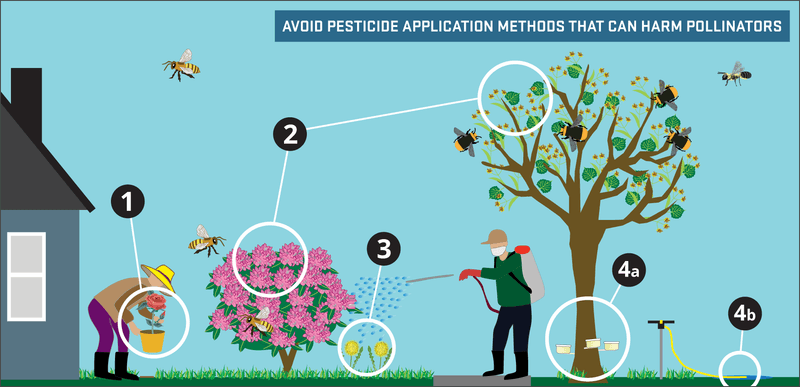
Reaching for a broad-spectrum insecticide spray because you see a lot of mantises, or because you assume mantis activity means pest activity, is one of the more counterproductive responses a homeowner can take. Broad-spectrum products do not distinguish between the insect you are trying to reduce and the ones you want to keep.
Pollinators, predatory insects, spiders, and other natural enemies can all be killed by the same application that targets a pest, and once those beneficial populations are reduced, pest species often rebound faster because their natural controls are gone.
NC State Extension’s biological control Q&A for home gardeners recommends identifying the insect first, assessing whether the damage level actually warrants treatment, and then selecting the least disruptive option suited to that specific pest. That sequence matters.
Skipping identification and going straight to a spray can eliminate beneficial insects while leaving the actual pest problem unresolved, particularly if the pest was never the majority of what was being hit.
When treatment is genuinely necessary after identification and damage assessment, product selection and application timing both affect how much collateral harm occurs. NC State’s integrated pest management and pollination guidance recommends choosing products that are less harmful to beneficial insects, following the label precisely, minimizing spray drift to adjacent plants and areas, and avoiding applications during periods when pollinators are actively foraging, typically during daylight hours when flowers are open.
Evening applications to targeted plants, when pollinators have moved off, reduce but do not eliminate the risk to beneficial insects.
The mantises themselves should never be the target of a spray. If you are seeing more mantises than expected, that is a reason to observe more carefully, not a trigger for treatment.
Any chemical response should be tied to a confirmed pest identification and visible, measurable plant damage, not to the presence of a predator that happens to be visible in the yard.
Photograph Egg Cases Before Moving Them
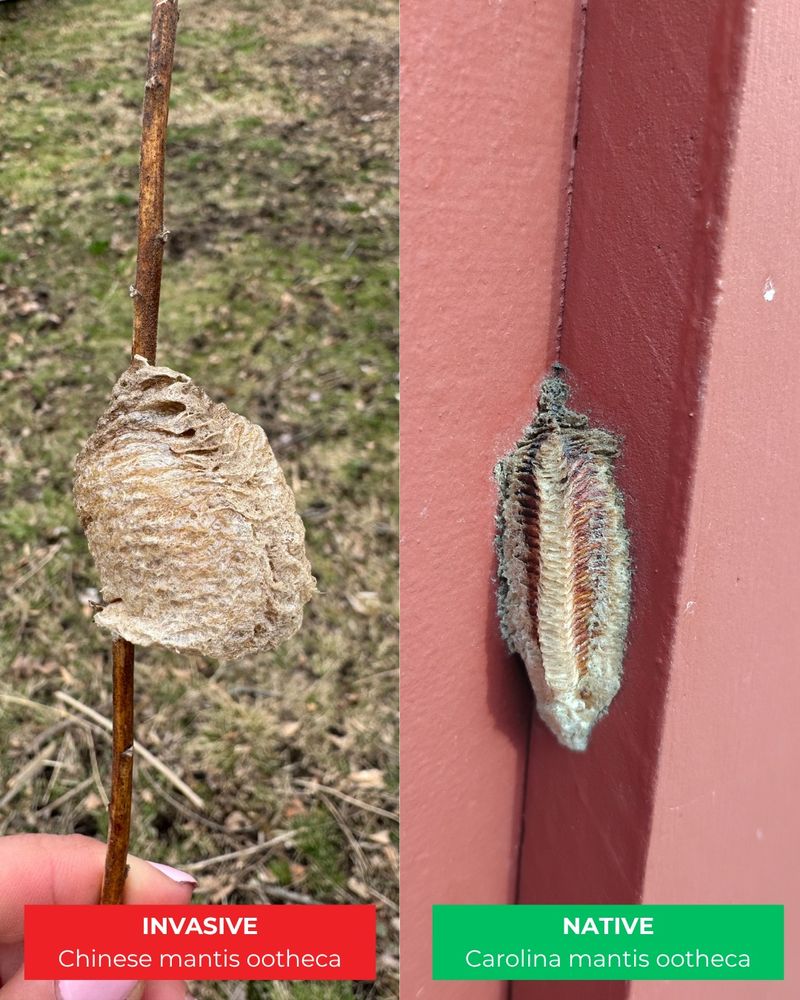
Finding a mantis egg case, called an ootheca, attached to a shrub stem, fence rail, or garden stake is common in late summer and fall across North Carolina. Before you move, cut, or discard one, take a photograph and try to identify which species produced it.
The shape and size of the ootheca differ enough between the native Carolina mantid and the nonnative Chinese mantid to provide a useful starting point for identification.
Carolina mantid egg cases are elongated and slender, typically gray-brown in color, and often marked by a pale or white midrib running along the top. Chinese mantid egg cases are larger, beige or tan in color, and shaped more like a rounded cube or a compact foam mass.
NC State Extension’s mantid species guide describes both ootheca types and notes that one NC State extension agent removes Chinese mantid egg cases from a pollinator garden between fall and spring. That is one practitioner’s approach in a specific context, not a universal rule requiring all mantis egg cases to be destroyed.
If you are uncertain which species produced the case, seek identification before taking action.
NC State’s Chinese mantid publication includes a clear warning against bringing egg cases indoors. Warm indoor temperatures can trigger premature hatching, and the hundreds of nymphs that emerge will have no prey available, leading to rapid cannibalism and a messy outcome.
If you want to observe hatching, leave the case attached to its original stem outdoors or move it to a sheltered but unheated outdoor location.
Handling live mantises is generally low-risk, but unnecessary handling is still worth avoiding. University of Florida entomology guidance notes that mantises are not dangerous to people but may nip if handled roughly.
Photographing the insect or egg case and submitting the image for identification is a more useful first step than picking it up.
Support a Diverse Yard, Not a Mantis-Only System

The most durable response to a summer mantis surge is also the simplest: keep observing, avoid unnecessary sprays, and focus on building a yard that supports a wide range of insects rather than trying to engineer mantis-based pest control. Mantises are one piece of a larger food web, and a yard that works well for them usually works well for other natural enemies and pollinators too.
NC State Extension’s home gardener biological control guide recommends diverse plantings, flowering plants that support natural enemies, shelter such as brush piles or undisturbed ground cover, and reduced pesticide use as the foundation of a yard that manages pest pressure over time. Those practices benefit ladybugs, parasitic wasps, ground beetles, and spiders alongside mantises, and that diversity is more effective than any single predator species working alone.
Concrete steps that fit most North Carolina yards include planting a mix of native flowering species that bloom at different times through summer and fall, leaving some areas of the yard slightly less manicured to provide shelter and overwintering habitat, and resisting the urge to spray at the first sign of insect activity. NC State’s integrated pest management handbook frames this as a long-term investment: yards with higher habitat diversity tend to have more stable pest-predator relationships than yards managed primarily with pesticides.
A summer full of praying mantises is, in most cases, a sign that your yard is active and productive enough to support a top-level insect predator. That is worth noting without over-reading it.
The mantises did not arrive to fix a problem; they arrived because the conditions were right for them, which is a reasonable outcome to leave undisturbed.