
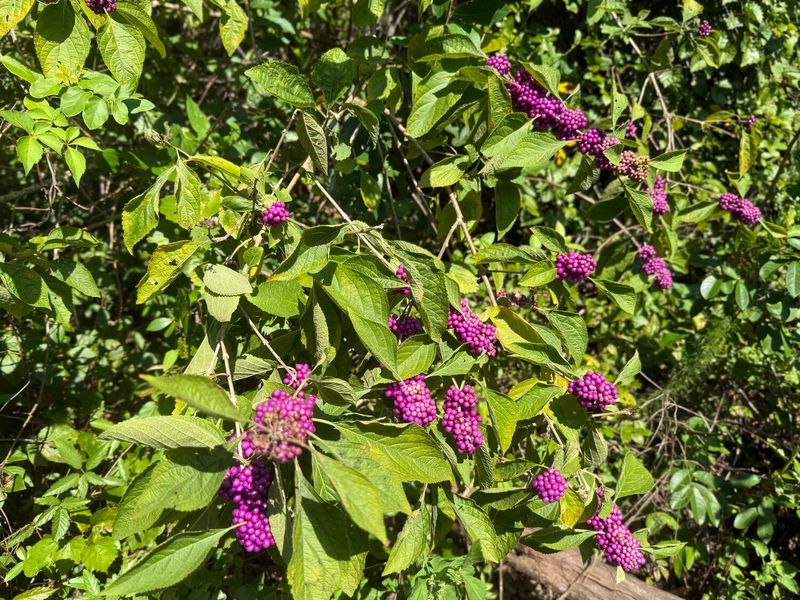
If you have a wooded backyard edge in North Carolina, you already know that spot is prime tick territory. American beautyberry is a native shrub that shows up in conversations about tick control, and for good reason – its leaves contain compounds that showed real repellent activity in laboratory tests.
Before you head to the nursery, though, it helps to know exactly what the research found and what it did not find. The full picture makes beautyberry a smarter addition to your yard, not a smaller one.
Correct the promise before choosing the plant
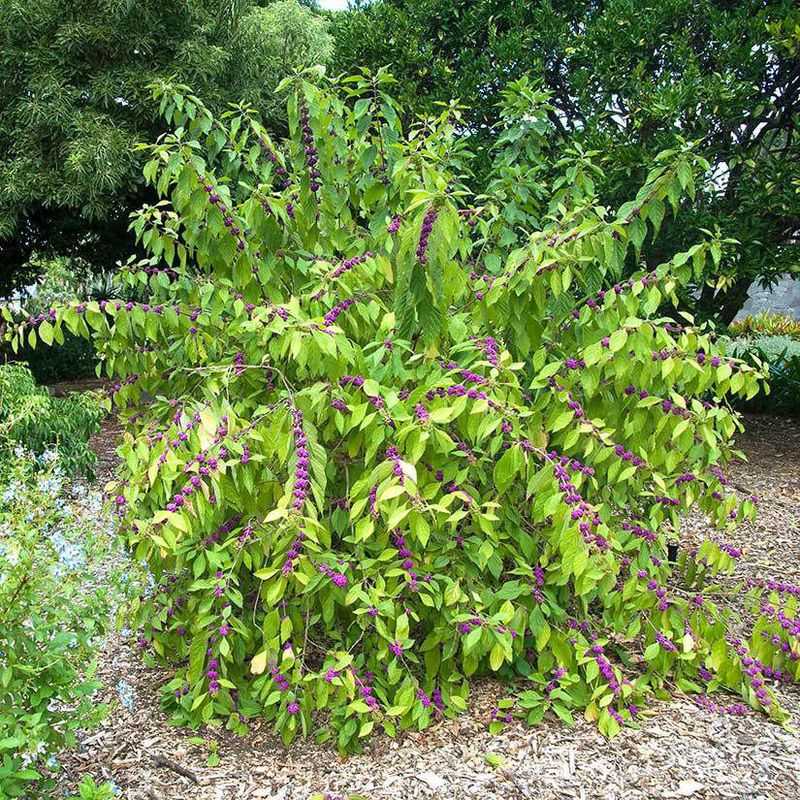
Somewhere between folk wisdom and gardening headlines, American beautyberry picked up a reputation as a shrub that walls ticks out of a yard. That claim goes further than the evidence will support.
University of Maryland Extension experts reviewing plants marketed as tick repellents found no scientific studies showing that simply having particular plants in a landscape repels ticks. A shrub, however promising its chemistry, is not a fence.
The more useful question is this: can American beautyberry contribute to an attractive, managed lawn-to-woods transition while its laboratory findings add a limited layer of support to a broader plan? That question has a much more satisfying answer.
Beautyberry is a genuinely worthwhile North Carolina native, and understanding its real strengths makes it easier to use well.
Habitat management does the heaviest lifting when it comes to reducing tick encounters near a wooded edge. Cutting back brush, removing leaf litter, mowing regularly, and keeping play areas away from shaded edges matter more than any single plant choice.
CDC guidance on preventing tick bites consistently points to personal protection, tick checks after outdoor time, and veterinarian-approved pet prevention as the proven first line of defense. Beautyberry can be part of a layered plan, but it works best when it is not asked to carry the whole load.
American beautyberry fits a North Carolina landscape
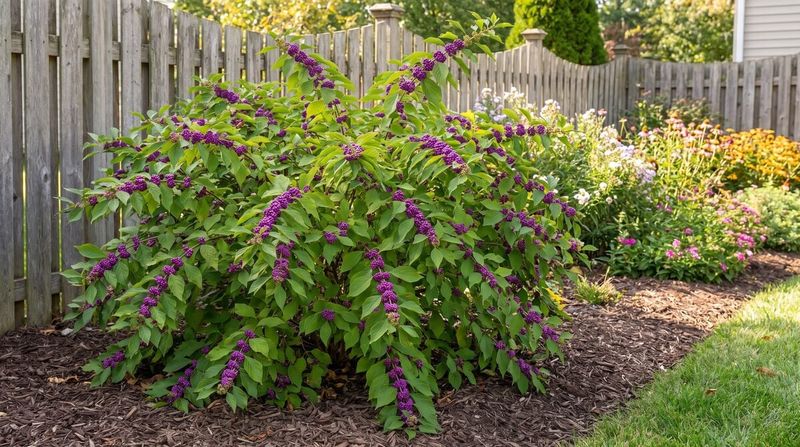
American beautyberry, known botanically as Callicarpa americana, grows wild across North Carolina’s Piedmont, Coastal Plain, and mountains. NC State Extension’s plant profile describes it as native throughout the state and across much of the Southeast, from Florida to eastern Texas.
That native range means it is already adapted to the soils, humidity, and seasonal swings that challenge many landscape plants.
Mature plants typically reach 3 to 8 feet tall and spread 3 to 6 feet wide. Full sun to partial shade both work well, and the shrub performs best in well-drained soil.
Its deciduous habit means it drops its leaves each fall, and its naturally open, arching form sets it apart from dense evergreen shrubs. Those arching branches give it a relaxed, informal look that suits a yard edge far better than a clipped hedge would.
That open form is worth noting honestly. Beautyberry will not function as a year-round visual screen or privacy wall.
Branches spread outward rather than filling in tightly, and the plant is bare through winter. For homeowners picturing a solid green barrier between yard and woods, a different species or a combination of plants would be needed.
What beautyberry does offer is a graceful, seasonal transition plant with documented native credentials, strong wildlife value, and leaf chemistry that earned it a serious look from researchers studying tick repellents. Horticultural suitability and tick-repellent chemistry are separate qualities, and beautyberry has both in different, honest measures.
What the beautyberry tick research actually tested
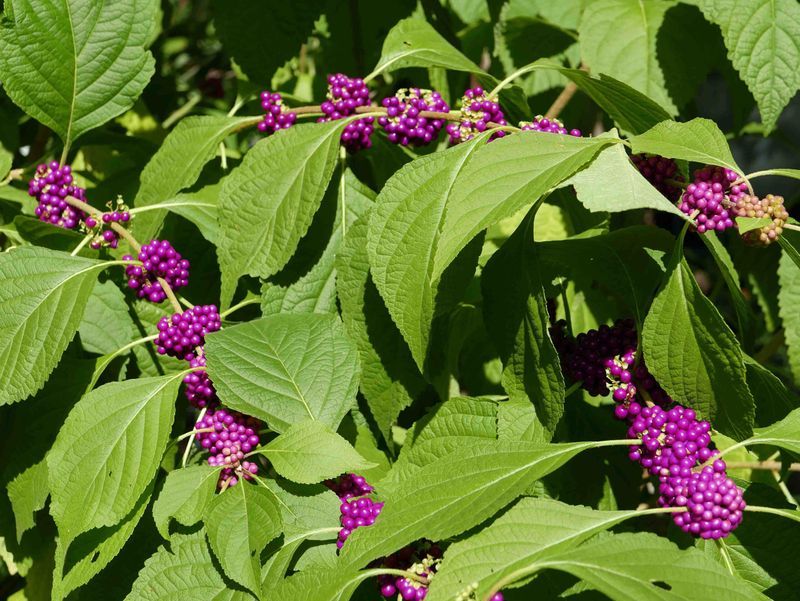
Two compounds extracted from beautyberry leaves, callicarpenal and intermedeol, are the center of the tick-repellent story. USDA Agricultural Research Service scientists identified these compounds and tested them against tick nymphs in controlled laboratory bioassays.
The method involved applying isolated compounds to treated cloth at measured concentrations, then observing tick behavior. That is a meaningful finding, but it describes what happened in a lab, not what happens in a residential yard.
No intact beautyberry shrub, planted hedge, or residential yard was part of the research. The peer-reviewed 2007 study published in Experimental and Applied Acarology reported that callicarpenal and intermedeol repelled 98% and 96% of blacklegged tick nymphs, respectively, at one tested concentration.
Results against lone star tick nymphs at the same rate were substantially lower. The findings were species-specific and concentration-dependent, not a blanket result across all ticks.
Lone star ticks are widely distributed through the South and carry real health significance in North Carolina. A study of North Carolina outdoor workers found lone star ticks accounted for more than 90% of submitted ticks in two study years, though CDC tick distribution data makes clear that species composition varies by region, habitat, and season.
That outdoor-worker sample reflects a specific population in specific years and should not be read as the expected tick pressure in every North Carolina backyard. What the beautyberry research does establish is that the plant’s leaf chemistry is worth taking seriously as a subject of further study, while the gap between a lab compound and a living landscape plant remains real and significant.
Place beautyberry on the managed side of the edge
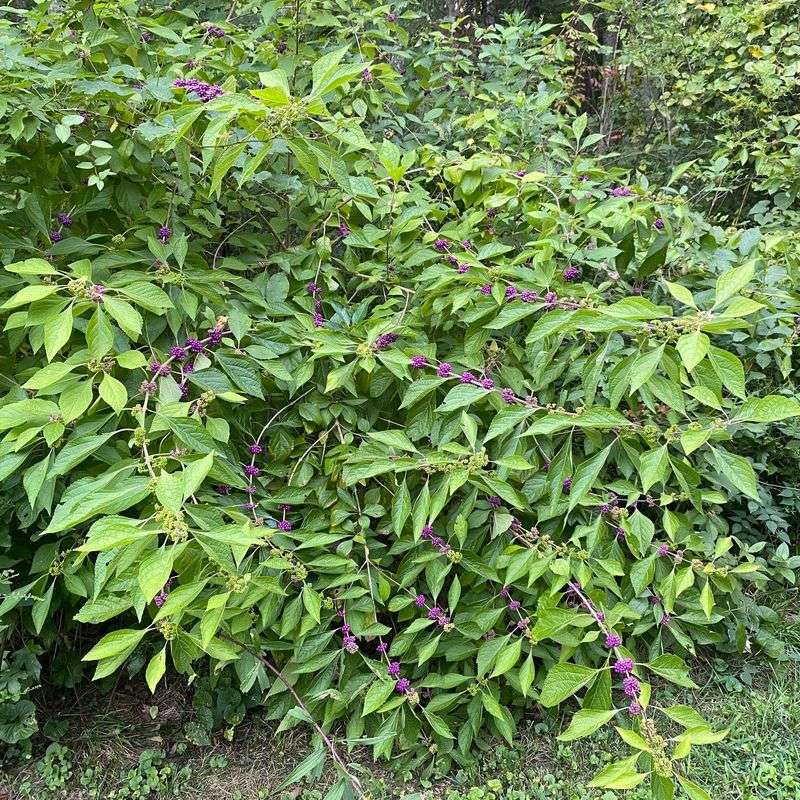
Placement matters as much as plant selection when a wooded edge is involved. Beautyberry belongs on the lawn or maintained-yard side of the woods transition, not tucked into a dense, shaded brush strip directly beside a patio, play area, or path.
University of Maine Cooperative Extension tick management guidance consistently emphasizes reducing shade, moisture, brush, and leaf litter near activity areas. Planting into an unmanaged strip can work against that goal.
A single specimen or a loose grouping of two or three plants creates an informal transition that marks the boundary without creating dense cover. Keep enough space between plants and around their lower branches for sunlight to reach the ground and for air to move through.
Removing accumulated leaf litter beneath the shrubs is a regular maintenance step that matters, since moist, shaded leaf litter is exactly the kind of microhabitat ticks prefer.
CDC prevention recommendations advise keeping recreational spaces, playgrounds, decks, and patios as far from brushy or wooded edges as the yard allows. Beautyberry planted at a sensible distance from those activity zones adds native character and a seasonal focal point without pushing the shrubby edge closer to where family members spend time.
NC State Extension notes that the plant’s arching branches can extend outward enough to need occasional pruning where they overhang paths, so factoring that spread into the initial placement saves work later. A well-placed beautyberry marks the managed edge; a poorly placed one blurs it.
Build an open, maintained transition

A roughly 3-foot-wide strip of wood chips, mulch, or gravel between the mowed lawn and the wooded edge is one of the most consistently recommended physical steps in tick habitat management. CDC yard-management guidance points to this kind of transition strip as a way to create a drier boundary and a visual reminder to avoid wandering into the brushy edge.
The strip does not stop ticks from crossing, and that distinction matters. Ticks can still move across mulch, arrive on deer, ride in on rodents, or hitch a ride on pets and people walking through.
University of Maine Extension tick landscape management recommendations pair the transition strip with regular mowing, removal of tall grass and weeds, and clearing leaf litter from lawn areas. Keeping grass short and sunlight reaching the soil surface reduces the cool, damp conditions that tick nymphs prefer.
Woodpiles, brush piles, and other rodent shelter near the house are worth managing too, since rodents are important tick hosts.
URI TickEncounter yard protection resources reinforce that no single action eliminates tick pressure. University of Missouri Extension tick control guidance describes a layered approach combining habitat modification, targeted treatments where appropriate, and personal protection.
Beautyberry fits naturally into the habitat layer of that plan, planted on the maintained yard side of the mulch strip where it adds structure and seasonal interest without recreating the brushy, shaded edge it is meant to help define. The strip, the mowing, and the plant placement work together rather than relying on any one piece to carry the full weight.
Enjoy seasonal color and wildlife value
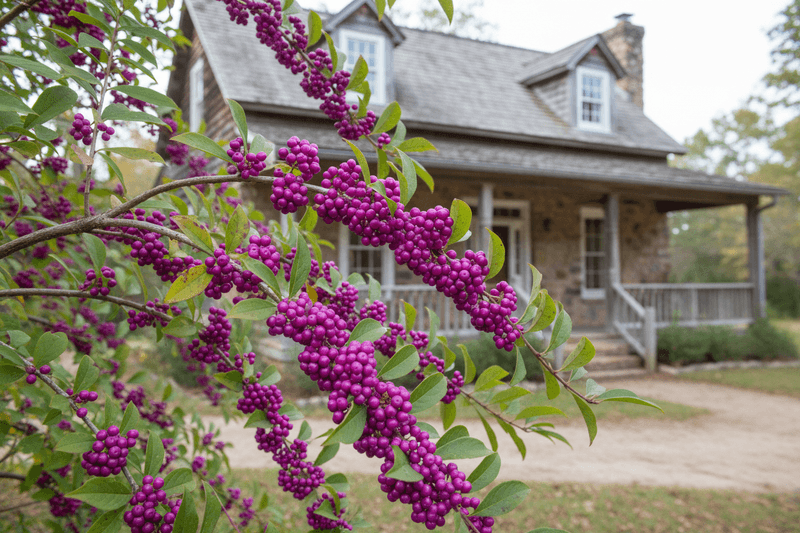
Purple berry clusters are the feature that stops people in their tracks when they first see American beautyberry in late summer. NC State Extension describes the berries as appearing in showy clusters from roughly August through October, with color ranging from bright purple to pink or white depending on cultivar.
Few native shrubs produce anything quite as vivid at that time of year, which makes beautyberry a genuinely distinctive garden plant independent of any tick-related discussion.
Songbirds and small mammals feed on the berries through fall, giving the shrub legitimate wildlife credentials. NC State Extension’s landscaping-for-wildlife guidance highlights native fruiting shrubs as important food sources for birds during fall migration.
That wildlife value is real and worth celebrating, but it should be kept separate from the tick-management conversation. Deer, rodents, and other animals that visit yards for food or cover are also tick hosts, so attracting wildlife can complicate tick pressure even as it enriches the yard ecologically.
Mississippi State University Extension describes beautyberry as an open, arching shrub rather than a dense evergreen screen, which matches what NC homeowners should expect. Late-winter pruning keeps the plant manageable and actually encourages better fruiting, since flowers and berries form on new growth each season.
Avoid shearing during the fruiting window if the berry display and wildlife feeding are part of the goal. Cutting back substantially in late winter, then stepping back and letting the shrub do its thing through summer and fall, is the low-effort maintenance rhythm that suits most yards well.
Pair the planting with proven precautions
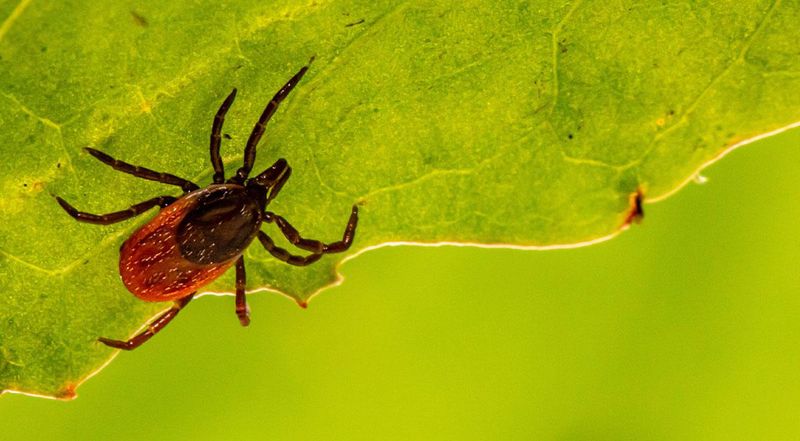
Beautyberry earns a place in a North Carolina yard on its own merits, but it does not change the personal protection checklist. CDC tick prevention guidance recommends EPA-registered repellents applied to exposed skin, permethrin-treated clothing and gear for extended outdoor time, and a full tick check after any time spent near wooded or brushy edges.
For families with pets, veterinarian-approved tick prevention products are part of the same plan. None of those steps become optional because a native shrub with interesting leaf chemistry is growing nearby.
A maintained beautyberry planting, a clean mulch transition strip, regular mowing, and reduced leaf litter all reduce conditions that favor ticks near the yard edge. Extension experts are clear that landscape changes can make an edge less hospitable, but they cannot create a tick-free zone.
Ticks arrive on animals, blow in on wind, and travel on clothing, so the yard side of the equation is only part of the picture.
A well-chosen native shrub at the right spot in the yard, backed by a realistic understanding of what it can and cannot do, is a genuinely useful addition. Beautyberry brings seasonal color in August through October, supports birds and small mammals through fall, and carries leaf chemistry that researchers found worth studying.
Plant it where it belongs, manage the edge around it, and keep the repellent in the cabinet for every trip into the brush. The shrub adds character to the boundary; the precautions protect the people crossing it.