

If you have ever watched fireflies blink along a dark tree line at dusk, you know how much that simple moment can mean. Many North Carolina homeowners want those lights back in their yards, and some are turning to a native shrub called southern wax myrtle as a starting point.
Wax myrtle will not bring fireflies back on its own, but it can help build the kind of sheltered, leafy edge that supports the habitat conditions fireflies need. Understanding what this shrub can and cannot do is the practical first step.
Wax Myrtle Can Anchor a Suitable Woodland Edge
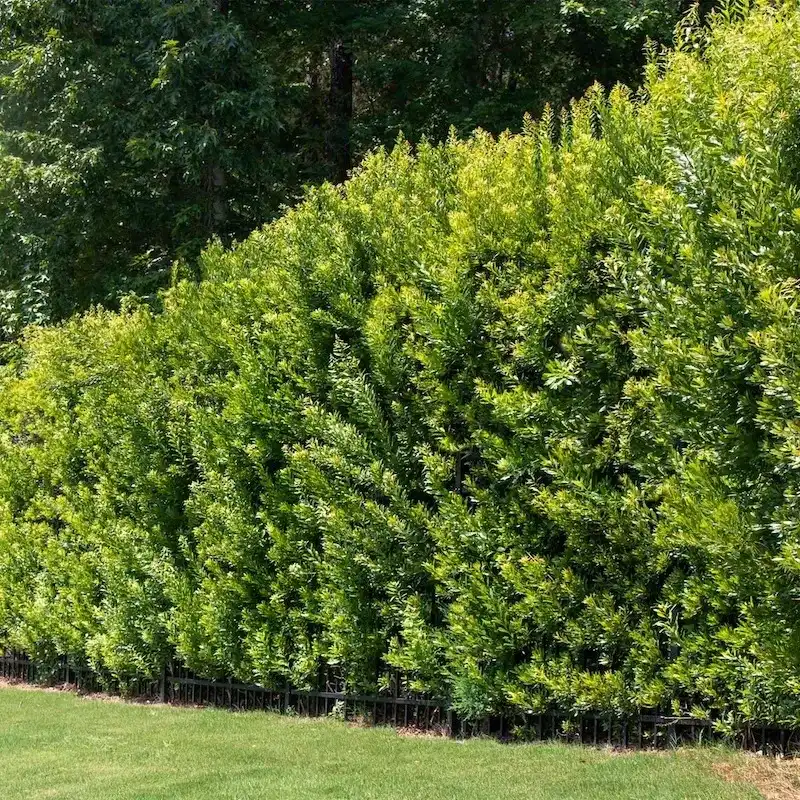
Southern wax myrtle, known botanically as Morella cerifera, is a fast-growing native shrub that earns its place along suitable woodland edges across much of eastern North Carolina. NC State Extension’s plant profile describes it as tolerant of full sun, partial shade, and dappled light, comfortable in moist soil and occasional flooding, and capable of handling stretches of dryness as well.
That combination of flexibility makes it a practical choice for the kind of transitional strip between lawn and naturalized vegetation where firefly habitat can develop over time.
The shrub grows with a dense, multi-stemmed form that provides year-round or semi-evergreen screening and cover. At maturity it can reach roughly 20 to 25 feet tall and 8 to 10 feet wide, although many homeowners maintain it smaller through selective pruning.
That density is genuinely useful: it creates physical shelter at the edge, moderates wind and light penetration, and gives the ground beneath it a more protected feel than an open, sun-blasted bed would have.
Its wildlife value beyond firefly habitat is well documented. Flowers support pollinators during the blooming period, the foliage hosts the red-banded hairstreak butterfly as a larval host plant, and the waxy blue-gray berries feed birds through fall and winter.
Those are real, observable benefits backed by extension research. What the available evidence does not show is that wax myrtle acts as a species-specific attractant for fireflies.
NC State’s Extension Gardener Handbook supports its use as a native habitat plant, but its firefly value is structural and indirect rather than a proven draw.
Planting it along an appropriate eastern North Carolina edge is a reasonable habitat-building decision. Just go in with clear expectations: the shrub contributes structure and cover, and the rest of the habitat work depends on what surrounds it.
Fireflies Need Habitat Through Every Life Stage
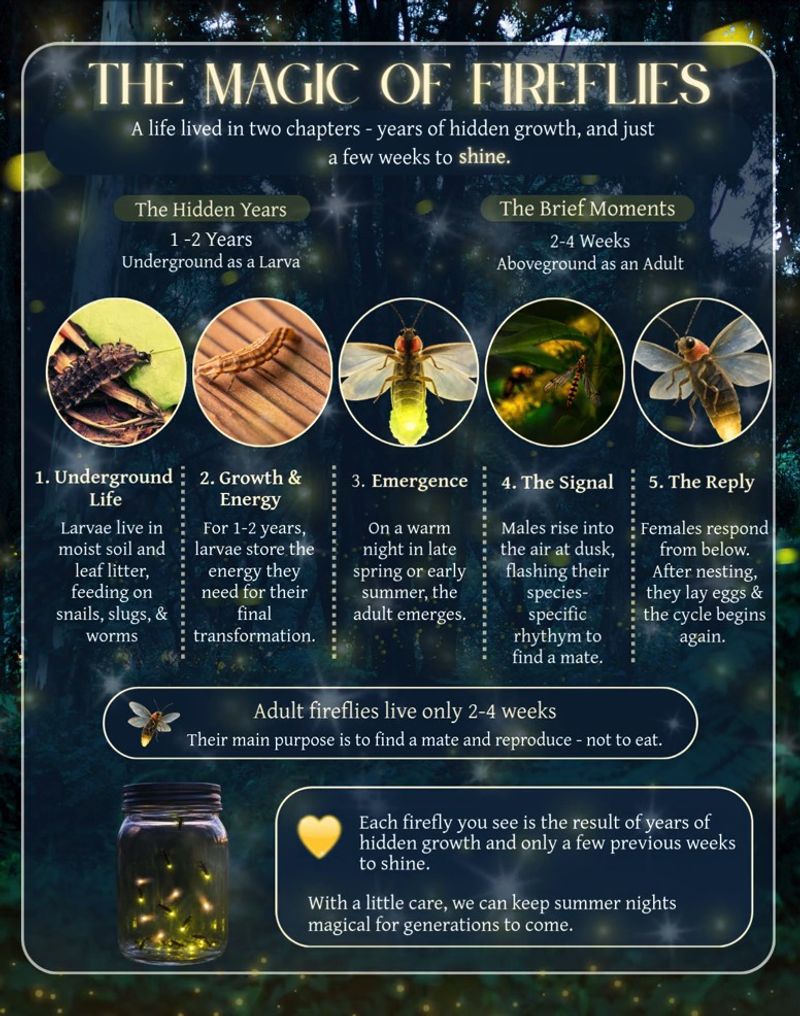
Watching fireflies flash above a summer lawn is only the most visible moment in a life cycle that spends most of its time underground, in leaf litter, or tucked into rotting wood. Adult fireflies live for only a few weeks, but larvae can spend one to two years developing in the ground layer before they ever produce a single flash.
That long hidden phase is where habitat quality actually matters most.
Firefly Atlas’s life history overview explains that eggs are laid in moist soil, moss, leaf litter, or rotting wood near the ground. After hatching, larvae hunt actively for prey, including snails, slugs, and other small ground-dwelling organisms.
Pupae then need protected, suitable ground-level sites to complete development before adults emerge. Each of those stages requires specific conditions that a single shrub simply cannot provide on its own.
One common misconception is that fireflies feed on the shrub itself. Larvae are predators of small soil-dwelling prey, not plant eaters.
NC State researchers studying firefly behavior note that adult diets vary by species; some consume nectar or other insects, and some adults may not feed at all. Wax myrtle’s foliage and fruit do not serve as firefly food, and the shrub’s documented role is structural, providing cover and shade that can help maintain the ground conditions the larvae need.
The practical takeaway is that buying and planting a wax myrtle does not complete the habitat picture. For the shrub to contribute meaningfully, the ground beneath and around it needs to stay relatively undisturbed, moist enough for soil-dwelling prey to survive, and covered with enough leaf litter or organic debris to shelter eggs, larvae, and pupae through their development.
The shrub creates a canopy over that ground layer; the ground layer itself has to be protected separately.
Choose the Right Site for the Shrub
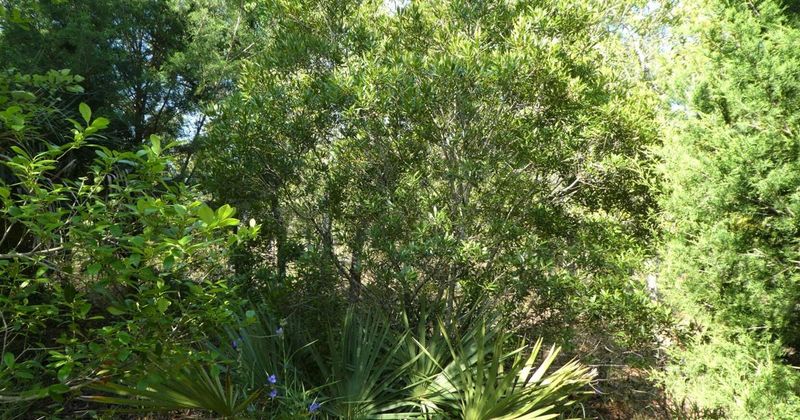
Placement matters more than most gardeners expect with wax myrtle. The shrub performs best and contributes the most to habitat when it goes into a spot that already has some of the right conditions, rather than a spot where you hope the shrub will create them from scratch.
A wooded edge, pond margin, damp bank, or the transition between a maintained lawn and a naturalized back corner are all reasonable starting points.
NC State’s plant profile for Morella cerifera recommends approximately 6 to 12 feet of planting space per shrub and notes that it prefers well-drained, often acidic soil while tolerating moist conditions and occasional flooding. Full sun to partial shade both work, and dappled light under a canopy is fine.
Those tolerances align well with the kind of edge habitat that also tends to have existing leaf accumulation, moisture, and multiple vegetation layers nearby.
The strongest North Carolina fit for this shrub is the Coastal Plain and eastern Piedmont. UGA Cooperative Extension’s guide to fireflies reinforces that firefly habitat commonly includes moisture, native vegetation, and layered plant structure rather than any single specimen.
Eastern North Carolina’s combination of humidity, naturally acidic soils, and existing woodland edge habitat makes it a practical match for wax myrtle’s strengths.
Mountain gardeners in North Carolina should approach this differently. Wax myrtle is not listed as a mountain-adapted shrub by NC State, and pushing it into higher elevations, cooler soils, or conditions it was not built for will not produce the habitat benefits described here.
Firefly habitat research makes clear that different species use different conditions. Mountain homeowners are better served by identifying a native shrub matched to local elevation, soil moisture, and existing woodland character, then building from there.
Keep Leaves and Layered Vegetation Beneath It
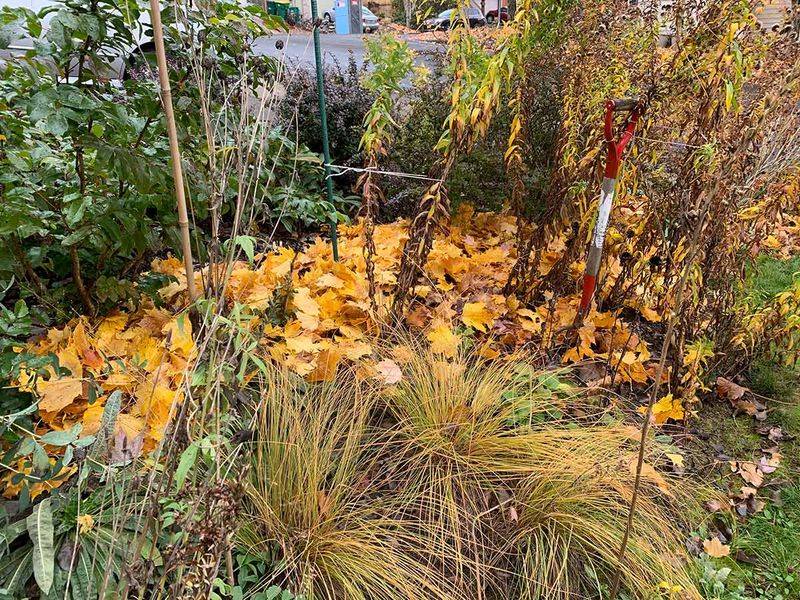
One of the most effective things you can do after planting wax myrtle costs nothing and requires the opposite of effort: stop removing every fallen leaf from the area around it. NC State’s Extension Gardener Handbook specifically identifies fallen leaves as habitat for firefly larvae, and a modest accumulation of leaf litter and plant debris is far more valuable to the ground layer than a clean, freshly mulched bed.
Routinely blowing or bagging all leaves from a shrub border removes the very material that eggs, larvae, and pupae depend on. A shallow, natural layer of leaves, some plant stems left standing through winter, and a small amount of rotting organic matter at the base give the soil organisms that firefly larvae prey on a place to live.
NC State’s guidance on attracting and protecting fireflies backs this up, recommending that homeowners preserve naturalized strips rather than manicured, bare planting beds.
Firefly Atlas notes that larvae can also use moss and rotting wood as shelter and hunting ground. If the area has a few small pieces of decaying wood or a rough, mossy patch, those are worth keeping rather than clearing out.
The goal is a ground layer that feels slightly unkempt by typical lawn standards but is actually doing ecological work.
Pairing wax myrtle with native grasses, low flowering plants, and other shrubs adds the height variation and microhabitat diversity that a single specimen cannot provide. A mix of plant layers gives different firefly species access to the range of conditions they use at different life stages.
The shrub anchors the upper layer; native grasses and low plants fill the middle and ground zones to make the edge genuinely functional rather than just decorative.
Protect the Edge From Light and Chemical Disturbance

Two management habits can quietly undo even a well-planted, well-maintained habitat edge. The first is artificial light.
NC State researchers explain that fireflies rely on precise flash patterns to find mates, and light pollution from porch lights, pathway fixtures, flood lights, and landscape uplighting can disrupt those signals enough to reduce mating success. A dark edge is not just aesthetically pleasing; it is functionally necessary for the courtship behavior that produces the next generation.
Turning off or physically shielding any fixture that points toward the shrub border is one of the most direct actions a homeowner can take. A published firefly conservation review identifies artificial light at night as one of the documented pressures on firefly populations.
You do not have to eliminate all outdoor lighting; redirecting fixtures so they illuminate walkways or structures rather than the naturalized edge is often enough to reduce the interference.
The second disruptive habit is chemical use near the planting. U.S.
Fish and Wildlife Service guidance on firefly conservation advises against broad-spectrum insecticides, routine mosquito spraying, and molluscicides near habitat areas. These treatments do not discriminate between pest species and fireflies or their larval prey.
Snails and slugs, which firefly larvae hunt actively, are directly targeted by molluscicides. Broad-spectrum sprays applied to the lawn or shrub border can reduce the prey population that larvae depend on through their year-plus development period.
North American firefly conservation assessments list pesticide exposure among the pressures contributing to population declines. Skipping unnecessary lawn chemicals near the habitat edge, avoiding routine perimeter spraying for mosquitoes, and choosing targeted spot treatments when pest pressure genuinely requires intervention are all practical steps.
Eliminating these inputs does not guarantee firefly activity, but keeping them in place near the planting actively works against the habitat you are trying to build.
Use Existing Moisture Instead of Chasing a Guarantee

Moisture is one of the clearest common threads across firefly habitats, but chasing it with a shovel and a water feature is not the right starting point. Firefly Atlas documents that different species use damp meadows, wetlands, pond margins, forest floors, and wooded edges, meaning there is no single moisture prescription that fits all fireflies or all yards.
The more useful question is whether your site already has suitable dampness and whether wax myrtle can be positioned to take advantage of it.
A low corner of the yard that stays wet after rain, a slope that drains toward a naturalized strip, or a spot near an existing pond or stream margin are all better starting points than a dry, elevated bed where you plan to irrigate. NC State’s firefly guidance recommends working with naturally damp areas rather than engineering moisture from scratch.
Wax myrtle’s tolerance for moist soil and occasional flooding makes it a practical fit for exactly those spots.
If adding a small water feature seems worthwhile, manage it carefully so it does not become a mosquito breeding site. UGA Cooperative Extension’s firefly habitat guide notes that standing water should be kept moving or changed regularly to avoid creating the conditions mosquitoes prefer.
Water alone cannot guarantee more fireflies, and a shrub planted in dry, frequently disturbed, or compacted soil will not compensate for the lack of ground moisture that larvae and their prey require. Work with what the site offers first, then consider modest additions only if they fit the space safely.
Keep Wax Myrtle Outside the Defensible Space
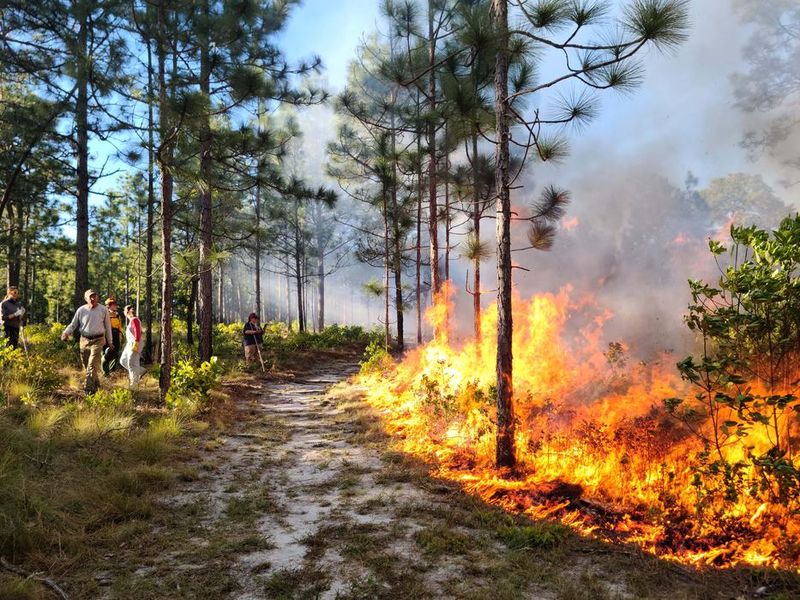
Before placing any wax myrtle on your property, there is a safety consideration that belongs early in the planning process. NC State’s plant profile rates wax myrtle as highly flammable, noting that its aromatic leaves, stems, and branches can make it a fire hazard.
Homeowners should keep it outside the defensible space immediately surrounding the house, particularly in areas near dry pine woodland, open sandy terrain, or any location where wildfire risk is a realistic concern. Placing a highly flammable shrub close to a structure in pursuit of firefly habitat is not a reasonable trade-off.
The good news is that the edge habitat wax myrtle is best suited for, a transition zone along a back property line, a wooded margin, or a naturalized corner well away from the house, is naturally the right distance from the structure anyway. Habitat value and fire safety point in the same direction: plant it at the far edge, not up against the foundation or deck.
Mountain gardeners in western North Carolina sometimes ask whether wax myrtle could help attract blue ghost fireflies, which are among the state’s most striking species. NC Cooperative Extension in Henderson County explains that blue ghosts are associated with dark, mature woodlands, high canopy cover, large rhododendrons and mountain laurels, and deep old leaf litter.
Wax myrtle planted in a typical suburban yard is not a substitute for those conditions, and presenting it as a blue ghost attractant would be misleading.
Firefly Atlas and U.S. Fish and Wildlife Service firefly guidance both note that firefly activity varies substantially from year to year with rainfall, temperature, drought, and seasonal timing.
A homeowner who plants wax myrtle this fall should not expect a measurable change in firefly numbers the following summer. Habitat building is a multi-season process, and year-to-year variation in firefly activity is normal even in well-maintained sites.
Treat the Shrub as One Part of a Firefly-Friendly Edge

Southern wax myrtle earns a place in a thoughtful eastern North Carolina yard, but only when the full picture is in place around it. The shrub’s documented strengths are structural: dense cover, screening, tolerance of variable moisture, and documented value for pollinators, birds, and the red-banded hairstreak.
Those are genuine contributions to a layered habitat edge.
The sequence that gives it the best chance of supporting firefly conditions is straightforward. Choose it only where the region and site fit, place it along a wooded or damp transition rather than a dry open bed, retain the leaf litter and naturalized ground layer beneath it, pair it with native grasses and low plants for height variation, keep the edge dark at night, and stay away from broad-spectrum chemicals near the planting.
Respect the fire-safety guidance and keep it well outside the home’s defensible space. Firefly habitat research consistently points to this combination of conditions rather than any single plant as the foundation for supporting fireflies.
NC State’s practical firefly guidance frames the goal well: reduce disturbance, protect the ground layer, and let native vegetation do its work over time. Wax myrtle is one structural piece of that picture.
A yard where that piece is planted thoughtfully, supported by the right conditions, and left to mature quietly is the kind of place where fireflies have a reasonable chance of finding what they need – not because a single shrub called them in, but because the edge finally gave them somewhere worth staying.