
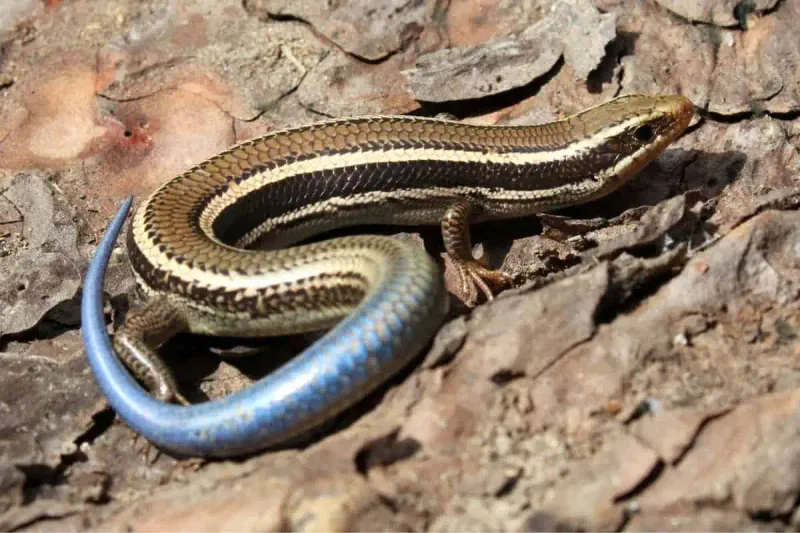
A small lizard with coppery stripes and a flash of blue tail may be slipping through your garden beds right now, and most homeowners never notice it. The western skink is one of California’s native reptiles, and it quietly forages through leaf litter and loose soil for insects and other small invertebrates.
Supporting it costs almost nothing, but a few common yard habits are making your property less welcoming to it without you realizing it.
Meet the western skink hiding in California yards
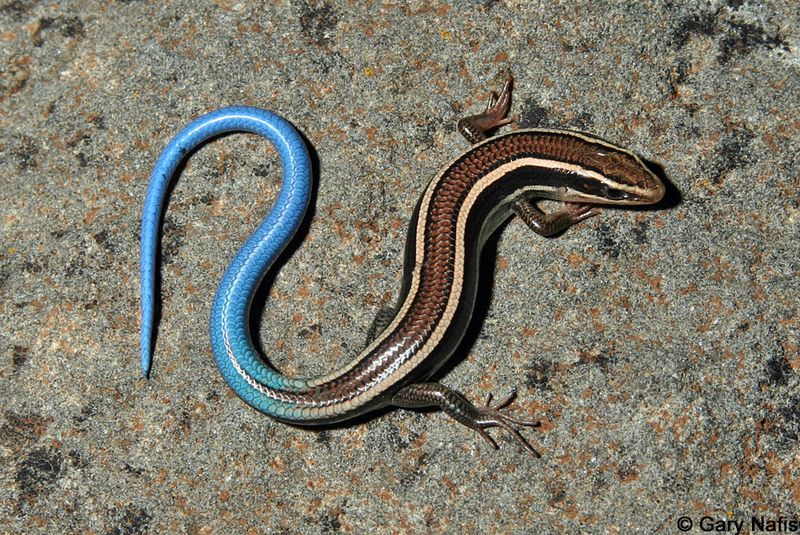
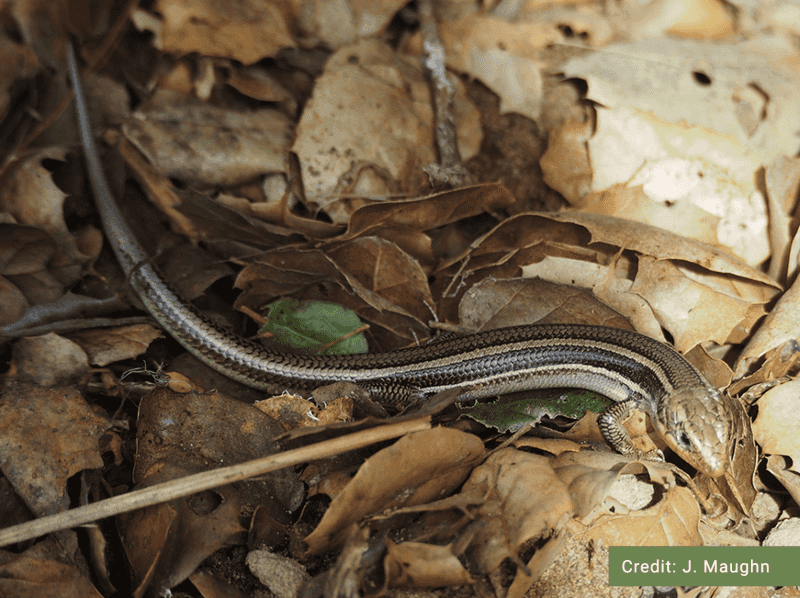
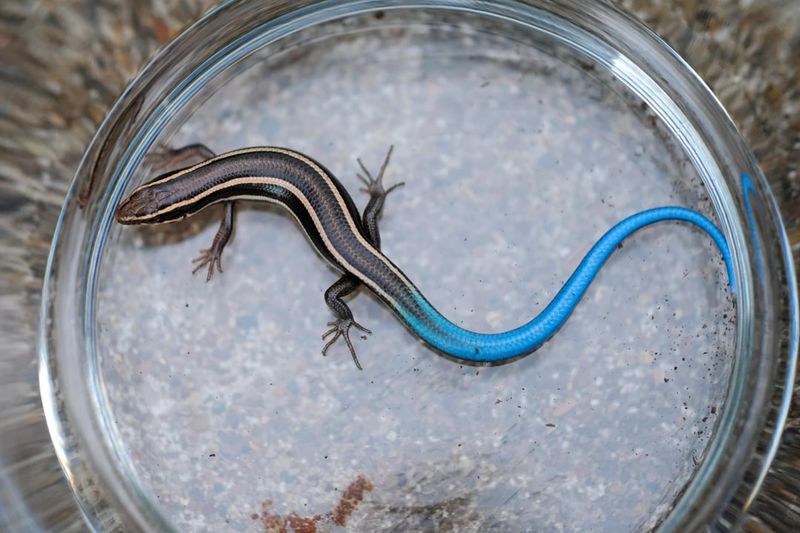
Plestiodon skiltonianus, the western skink, is a sleek, smooth-scaled lizard with a pattern of tan and dark brown stripes running from its snout to its tail. Juveniles typically show a vivid blue tail, but that color alone is not enough to confirm the species.
California Herps notes that Gilbert’s skinks and other California lizards can display similar coloration, so a blue tail is a starting clue, not a definitive ID.
Adults reach roughly five to eight inches in total length and move with a quick, almost serpentine glide that makes them easy to mistake for a small snake. They spend most of their time beneath rocks, bark slabs, rotting logs, woody debris, and surface litter, which is why most gardeners never see one even when a population exists nearby.
The California Department of Fish and Wildlife’s life-history account describes them as secretive, active foragers that favor cover objects and somewhat moist microhabitats.
Their range covers parts of northern California, the Coast Ranges, the southern mountains, and portions of the Sierra Nevada, along with some scattered inland locations. CDFW range data shows that western skinks are not evenly distributed across the state, so not every California homeowner is equally likely to have one nearby.
Other lizard species, including fence lizards and alligator lizards, are more widespread and more commonly seen in suburban yards.
When you do spot one, the right response is to watch it from a short distance and leave it alone. A wild skink is not a garden tool to move around, and California regulates the take and possession of native reptiles.
The best thing you can do for a western skink you discover in your yard is simply let it go about its day.
Its diet makes it a possible garden ally, not a pest-control service
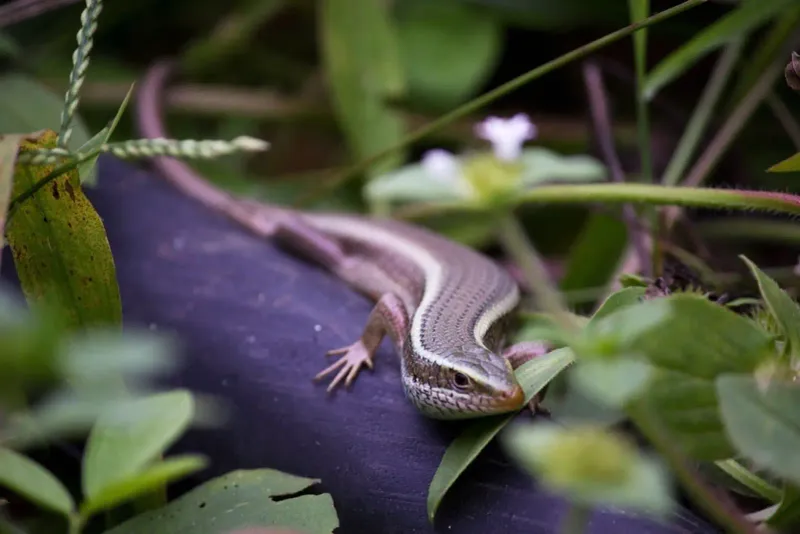
Western skinks are active hunters that work through leaf litter, dense vegetation, grass, and loose soil in search of prey. CDFW’s life-history account documents a broad invertebrate diet that includes adult and larval beetles, insect larvae, caterpillars, moths, grasshoppers, crickets, spiders, centipedes, and sow bugs.
That range of prey is genuinely useful from an ecological standpoint, and it means a western skink foraging near your vegetable beds is probably doing something helpful.
What the same sources do not show is a documented, reliable appetite specifically for European earwigs or the scarab grubs that sometimes feed on plant roots. The CDFW account lists beetle larvae as prey, but it does not establish that western skinks routinely target the particular species most likely to damage seedlings, or that a single skink consumes enough of any pest to measurably protect a crop.
UC IPM notes that California garden lizards generally eat insects and may help with pest control, but that broader observation does not translate to a species-specific guarantee for western skinks in a home garden.
The honest framing is that a western skink may contribute to the diverse predator community in your yard, the same community that includes birds, spiders, ground beetles, and other insect-eating animals. More predator diversity generally supports a more stable garden ecosystem, even when no single species can be credited with controlling a specific outbreak.
Treating western skinks as one part of that larger community is accurate; treating them as a reliable substitute for monitoring or targeted pest management is not.
Diagnose earwigs and grubs before treating them
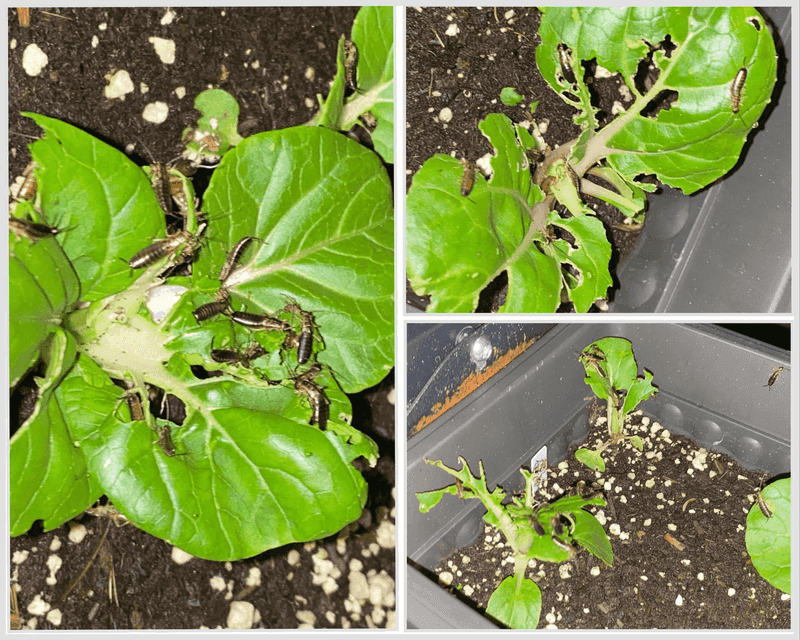
Ragged seedling leaves and missing plant tissue are frustrating, but the cause is not always obvious. Before reaching for any treatment, check the plants at night with a flashlight.
UC IPM’s earwig management guide explains that European earwigs feed on seedlings and soft fruit, but they also actively prey on aphids and insect eggs. Eliminating all earwigs in a bed can actually remove a predator that was keeping other pest populations in check, so confirming that earwigs are the primary source of damage matters before acting.
Grubs are equally misunderstood. The word covers a wide range of beetle larvae, and not all of them feed on plant roots or cause significant harm.
UC ANR’s garden grub overview points out that white grubs in California garden beds often do not require treatment at all, and that finding one in the soil is not itself evidence of root damage.
For turf, UC IPM’s turfgrass monitoring guidance puts the curative treatment threshold at roughly six white grubs per square foot, and even then recommends confirming visible turf damage first. That number applies to established lawn, not to vegetable beds or seedling gardens, where root systems are far more sensitive and thresholds have not been established in the same way.
UC IPM’s lawn insect resource reinforces that insecticides are infrequently needed in most vigorous California turf, which underscores how often a wait-and-see approach is appropriate.
A practical diagnostic sequence starts with the injury itself. Look for the irregular, scalloped leaf edges that earwigs leave, check for wilting that traces back to root damage rather than drought stress, and examine the soil around affected seedlings before concluding that any pest is responsible.
Nonchemical responses worth trying first include reducing excessive surface moisture near vulnerable beds, clearing unnecessary hiding spots such as dense mulch piles or boards right next to plants, and setting rolled newspaper traps or oil-filled containers at night to capture earwigs. Match the response to what you actually find.
Build a small, fire-conscious habitat pocket

Knowing that western skinks use rocks, bark slabs, woody debris, and surface litter as cover gives homeowners a practical starting point. A modest habitat pocket, two or three flat rocks, a short section of weathered log, a thin layer of leaf litter, and some low native grass or ground cover, can provide the kind of microhabitat the species is documented to use.
CDFW’s western skink account notes that the species is most common in open or early-successional areas and generally avoids heavy brush and dense forest, so the goal is a sunny, relatively open edge with nearby cover, not a permanently shaded or overgrown corner.
California Herps’ skink identification resource confirms that western skinks routinely shelter under surface objects and forage through litter, vegetation, and loose soil. That behavior is the basis for recommending cover features, but it is an inference, not a controlled experiment.
A habitat pocket may support skink activity in your yard; it cannot guarantee that one will appear or stay.
USGS observations on western skinks in Southern California describe the species as secretive and associated with grassy habitat, and note that habitat fragmentation is a concern. A connected, undisturbed corner of the yard is more likely to support wildlife use than a frequently disturbed area near a high-traffic path or routine maintenance zone.
Place the pocket away from doors, walkways, vegetable beds that need regular access, and routine cleanup zones. Keep it compact and manageable rather than sprawling.
A small, intentional feature that you can maintain safely is far more useful than a large area that becomes a maintenance problem or a fire hazard. The feature should complement your yard’s other needs, not compete with them.
Use pesticides only when monitoring justifies them
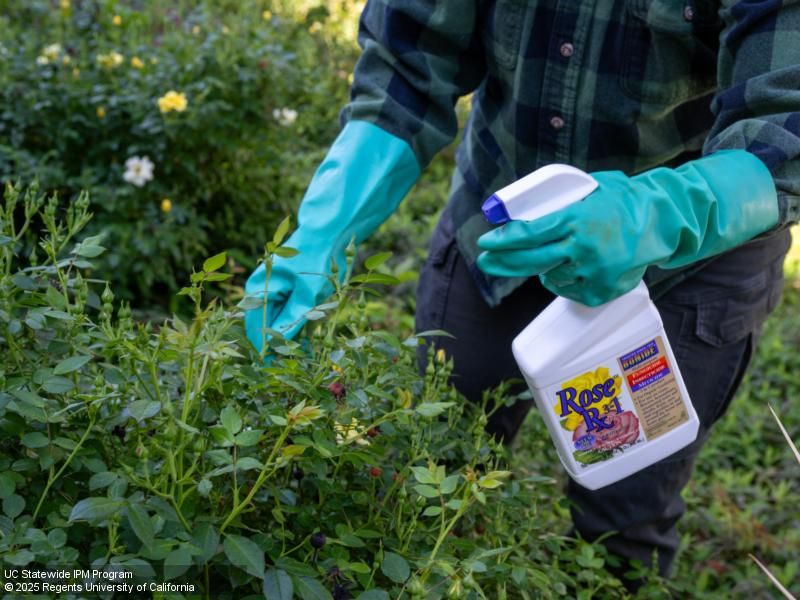
Pesticide decisions work best when they follow from actual evidence of a problem at a level that justifies treatment. Spraying a whole yard because you spotted a few earwigs near a seedling bed skips the monitoring step that integrated pest management is built around.
Confirm the pest, estimate the population or damage level, and treat only the affected area when treatment is genuinely warranted.
EPA guidance on reducing pesticide impacts on wildlife recommends using pesticides only when needed, treating only affected areas, following the product label carefully, and adopting landscape practices that reduce overall pesticide demand. That framework protects more than just lizards.
It also reduces unnecessary chemical exposure for soil invertebrates, pollinators, and the broader predator community that includes birds and spiders.
EPA’s ecological risk assessment framework specifically recognizes dietary and other exposure routes for terrestrial reptiles, meaning that a lizard foraging through treated soil or consuming pesticide-exposed prey can accumulate chemical exposure even without direct contact. That does not mean every pesticide application will harm a skink, but it is a reason to avoid broad-spectrum treatments when a targeted or nonchemical option is available.
Reducing unnecessary pesticide use is not the same as skipping pest management. UC IPM’s earwig guidance notes that insecticides are rarely needed outdoors when cultural controls and trapping are applied correctly.
Western skinks are not a substitute for those tools. The point is to match the response to the confirmed problem, use the least disruptive effective option, and leave broader-spectrum treatments for situations where monitoring shows they are actually necessary.
Defensible space limits where habitat can go
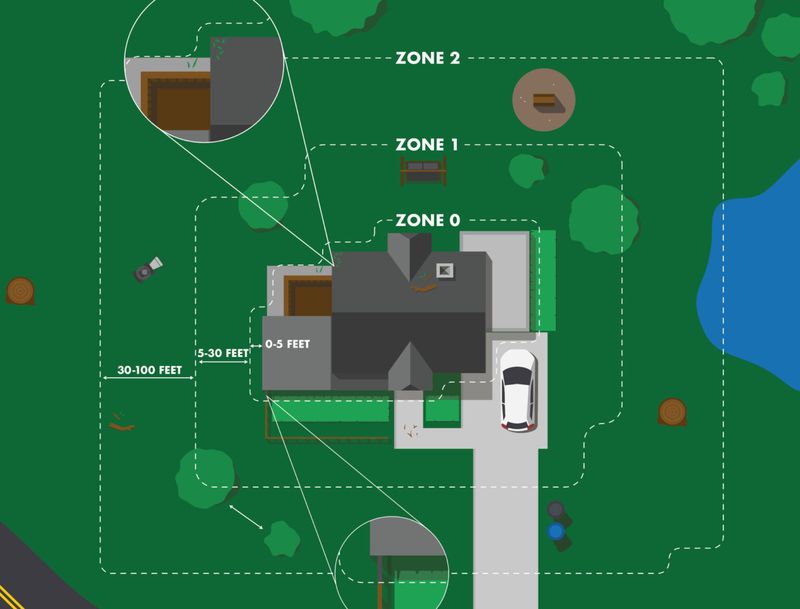
Flat rocks and woody debris provide cover for western skinks, but those same materials can become fuel or ignition points in a wildfire. The two goals, supporting native wildlife and maintaining fire safety, are not incompatible, but they require placing habitat features thoughtfully rather than right against your house or fence.
CAL FIRE’s defensible space guidance calls for removing dead vegetation, dry leaves, needles, and combustible debris from the first five feet around structures, which CAL FIRE calls Zone 0 or the ember-resistant zone. Logs, loose leaf litter, and dense ground cover do not belong in that area, regardless of their wildlife value.
Local fire rules in some communities, particularly in the wildland-urban interface, may be stricter than the state baseline, so checking with your local fire department or municipality before adding any cover feature is a reasonable step.
UC ANR’s fire network guidance on mulch notes that organic mulches vary in combustibility and that placement relative to structures matters significantly. The same logic applies to the leaf litter and woody debris that might otherwise form a habitat pocket.
A few flat rocks, which are non-combustible, carry less fire risk than a pile of dried bark or accumulated litter.
CDFW’s account of western skink habitat preferences indicates the species favors open or early-successional areas over dense brush, which actually aligns reasonably well with defensible-space landscaping. A habitat pocket placed in the middle of a yard, away from the house, deck, propane tank, and roofline, can satisfy both goals.
Keep access to the area clear, keep the feature compact, and treat it as one part of a managed yard rather than an unmonitored debris pile.
Leave wild skinks where you find them
Spotting a western skink under a rock or near a garden bed is a good sign for your yard’s ecological health, and the right response is to watch it rather than touch it. Lizards may bite when handled roughly, and even a well-intentioned grab can cause the animal stress or physical injury.
UC IPM’s lizard guidance advises leaving lizards where they are and moving people or pets away from the area if necessary, rather than moving the animal.
California Fish and Game Code generally prohibits taking or possessing native reptiles without authorization, and “take” covers capturing, handling, and relocating as well as killing. That means moving a skink from one part of your yard to another, or from your yard to a neighbor’s, is not a legally simple act.
Wild animals released into unfamiliar locations also face stress, predation risk, and competition from established residents.
Purchasing a western skink to install in a garden is not a legal or practical option either. CDFW’s scientific collecting permit program and native reptile captive propagation permits govern the circumstances under which collecting, possession, rehabilitation, and propagation of native reptiles are allowed.
Those permits exist for researchers and licensed facilities, not for homeowners who want a garden lizard. If a skink turns up near children or a curious pet, calmly move the people or animals indoors or to another part of the yard and let the skink leave on its own schedule.
Support the predator community without expecting a miracle
Putting this all together looks less like a project and more like a set of small decisions. Identify the lizard carefully before assuming it is a western skink, because other species share similar markings.
Confirm whether earwigs or grubs are actually damaging your seedlings before treating, because both can be present without causing meaningful harm. UC IPM’s earwig resource and CDFW’s western skink account together make the case for observation before intervention.
Where CAL FIRE’s defensible space rules allow it, keep a modest habitat pocket with a few rocks and limited woody debris in an open, sunny part of the yard away from structures. Avoid unnecessary broad-spectrum pesticide applications, and follow EPA’s guidance on reducing pesticide impacts on wildlife by treating only confirmed problems in affected areas.
A western skink may eat some of the invertebrates moving through your garden, contributing in a modest, unquantified way to the natural predator community that also includes birds, spiders, and ground beetles.
No single skink will protect a vegetable bed or eliminate a pest outbreak, and no source has measured how much pest suppression this species provides in a home garden. What you can offer is a yard where one has a reason to stay: cover to shelter under, open ground to forage through, and fewer unnecessary chemical disruptions.
That is a reasonable goal, and a worthwhile one even without a guaranteed outcome.