
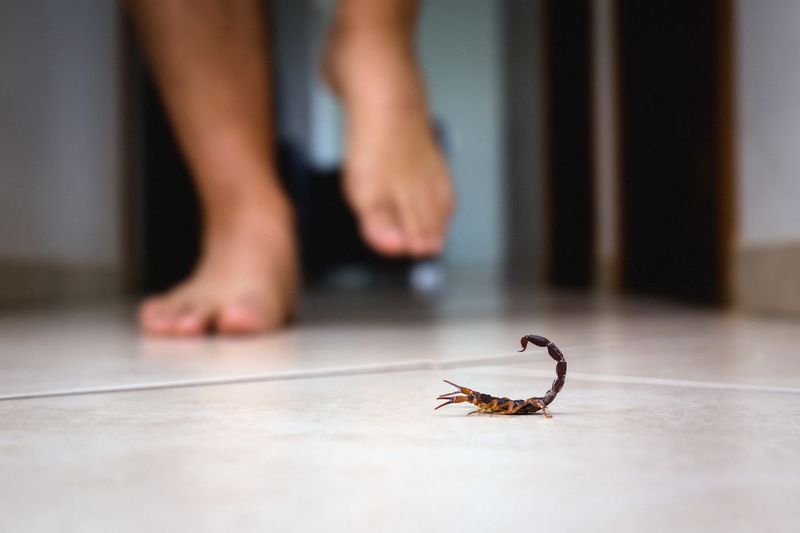
Every summer, Texas homeowners start spotting scorpions in places they really did not expect – inside a shoe, along a baseboard, or crossing the bathroom floor after midnight. These sightings tend to cluster during the hottest and driest stretch of the year, roughly July into August, though the pattern is not the same for every home or every part of the state.
Knowing what drives scorpion movement during hot weather gives you a real head start on keeping them outside where they belong.
Hot, dry July and August can bring more Texas scorpion sightings
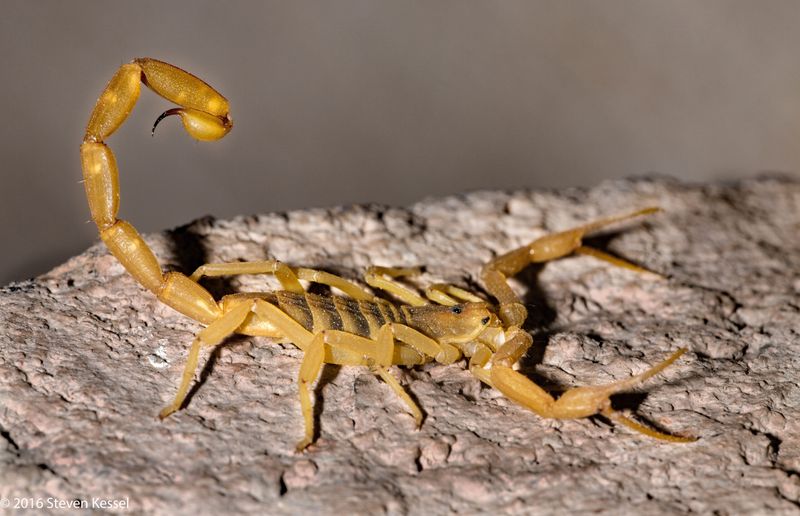
Texas scorpions are active year-round, but sightings tend to cluster during the hottest and driest months. Texas A&M veterinary guidance describes sightings as peaking during the hottest and driest months, typically from July to August.
That window gives homeowners a useful heads-up, not a guaranteed indoor invasion, but a reasonable time to tighten up around the house.
The scorpion most likely to show up near your home is the striped bark scorpion, Centruroides vittatus. It is the only scorpion species found throughout the entire state of Texas.
While Texas is home to roughly 18 recognized scorpion species, the striped bark scorpion is the one most commonly associated with human dwellings, appearing on walls, trees, fallen logs, dead vegetation, and debris piles in yards across the state.
Unlike burrowing species, the striped bark scorpion is an active forager. Texas A&M AgriLife Extension notes that it climbs readily, which partly explains why it turns up in attics, on walls, and in places homeowners do not expect.
Regional differences matter too: species composition in West Texas and the Big Bend area differs from Central Texas or the Gulf Coast, so the hot-weather pattern described here applies most directly to areas where the striped bark scorpion is common.
Framing July and August as a broad preparation window rather than a universal alarm is the most accurate way to approach the season. Local weather, nearby shelter, and how well a structure is sealed all shape whether sightings increase at a particular home.
The goal is to use this seasonal pattern as a prompt to act, not as a reason to panic.
Field evidence does not show a single August switch
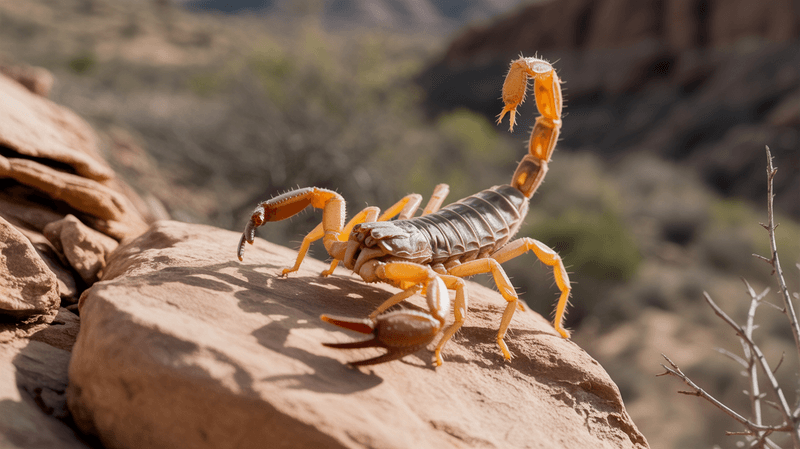
One of the most persistent myths about Texas scorpions is that something specific happens in late August to send them indoors. Field research tells a more complicated story.
A Texas Parks and Wildlife study on scorpion ecology and seasonality found that adult striped bark scorpions were most active in July during the study periods examined, while juveniles were most active in August during one of the study years. The pattern varied by life stage, year, and study site.
The researcher concluded that activity levels may depend on environmental factors beyond any single trigger like mating season. In other words, the data points to a broad warm-season pattern shaped by local conditions, not a statewide behavioral switch that flips on a specific date.
What looks like an August surge at one property could reflect a July peak at another just a few miles away.
Practically speaking, this matters because it means no calendar date reliably predicts when scorpions will become a concern at your home. Heat, dryness, available shelter, prey populations, and the specific species present in your area all play a role.
Treating July and August as a general window to prepare, rather than waiting for a late-August trigger that may or may not arrive, puts homeowners in a better position than trying to react to a single expected date.
The field evidence is also a reminder that localized study results should not be stretched into statewide rules. Conditions in the Hill Country differ from those in the Panhandle or along the Gulf Coast, and scorpion behavior reflects those differences.
A broad seasonal awareness is more useful than false precision about when exactly activity will peak.
Extreme heat can make cooler indoor areas favorable
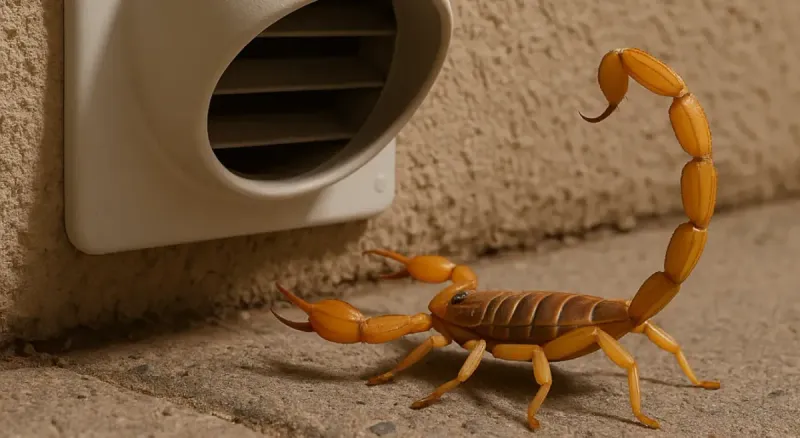
Scorpions are nocturnal animals, spending daylight hours tucked under bark, rocks, or debris and becoming active after dark. Part of what drives their nighttime movement is temperature and water balance.
Managing both is easier for a scorpion in the cool of the evening than during a Texas afternoon when surface temperatures can be brutal.
During periods of extreme heat, the situation can push some scorpions toward indoor spaces. Texas A&M AgriLife Extension specifically describes scorpions moving from overheated attics into cooler living areas during hot weather.
That is a documented pattern, but it is worth stating clearly: a cooler indoor space can offer a more favorable refuge during extreme heat, but air conditioning itself is not acting as a lure that draws scorpions from far away.
A Texas A&M report on hot and dry summer conditions also notes that scorpions may seek more hospitable conditions during extreme heat and drought. Temperature regulation, water balance, shelter quality, and prey availability all factor in.
Presenting water-seeking as the single explanation oversimplifies what is actually a combination of environmental pressures.
Many scorpions never enter a building at all. Outdoor populations remain active under rocks, bark, logs, and dense vegetation even during the hottest weeks.
Whether a scorpion ends up inside a home depends heavily on how much suitable outdoor shelter exists nearby and how many gaps or cracks the building offers as entry points. The heat mechanism is real, but local habitat and structural access are what translate that pressure into an indoor encounter at a specific address.
Outdoor habitat and structural openings shape indoor encounters
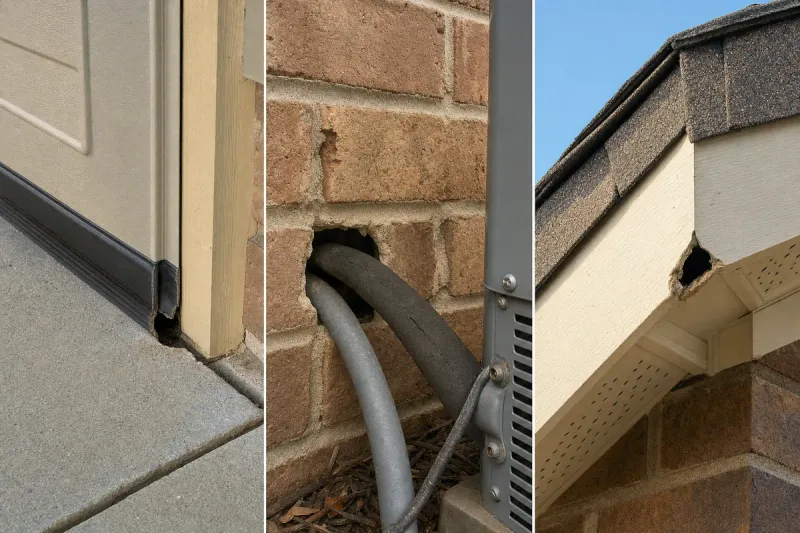
Two homes sitting side by side can have completely different scorpion experiences during the same hot summer. The difference usually comes down to what is in the yard and how the structure is built or maintained.
Scorpions need shelter during the day, and a yard full of good hiding spots puts them close to the house.
Common outdoor harborage includes rocks, stacked boards, bricks, logs, piles of debris, and dead vegetation. Texas A&M AgriLife Extension identifies these as typical resting sites for the striped bark scorpion, which is an active forager rather than a burrowing species.
Shrubs growing close to the foundation and tree branches that overhang or touch the roof can also provide climbing access directly to the structure.
Once a scorpion reaches the exterior, the building itself determines whether it stays outside or ends up inside. Loose-fitting doors and windows, torn or ill-fitting screens, cracks around roof eaves, gaps where pipes or conduit enter the wall, and unprotected weep holes in brick or stone veneer are all possible entry routes.
Weep holes, in particular, are often overlooked – they are deliberately left open in brick construction for moisture drainage but can serve as a ready-made doorway for a scorpion.
Habitat, building design, and access points work together rather than separately. A well-sealed home surrounded by bare, debris-free ground has far fewer opportunities for an indoor encounter than a home with dense foundation plantings, a woodpile against the wall, and gaps under the door.
Scorpions do not single out one home over another by choice; they follow conditions that favor shelter and foraging, and those conditions are largely within a homeowner’s control.
Clear yard harborage before the next hot stretch
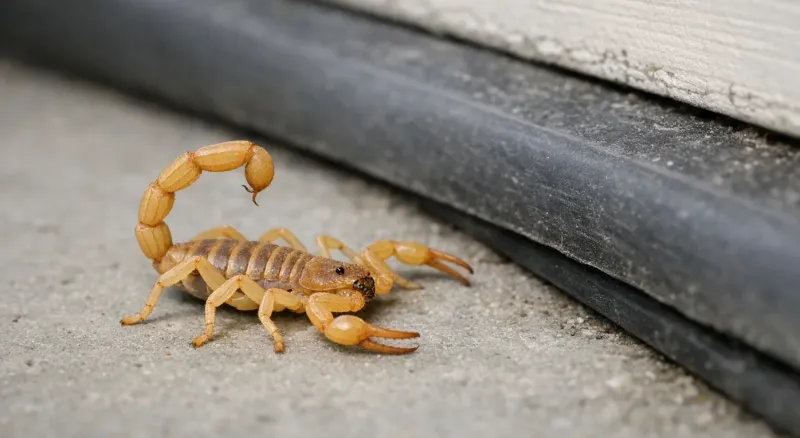
Reducing outdoor harborage is one of the most direct things you can do to lower the odds of a scorpion encounter during hot weather. The goal is to eliminate the daytime hiding spots that keep scorpions close to the house, so start by walking the perimeter and looking at what is sitting near the foundation.
Move boards, stones, bricks, logs, and any stacked debris away from the structure. Clear dead vegetation from garden beds and along fence lines.
Texas A&M AgriLife Extension specifically recommends keeping firewood outdoors and not bringing it inside unless it is going directly onto the fire, since firewood stacks are prime daytime shelter for scorpions and other insects. Even a cord of wood stored against the garage wall can function as a scorpion apartment building through the hottest months.
Overhanging branches deserve attention too. Pruning shrubs and tree limbs away from the roofline removes a climbing route that the striped bark scorpion, which scales trees and walls readily, could otherwise use to reach the attic or upper floors.
Keeping vegetation trimmed back from the exterior walls also reduces the humid, shaded microhabitats that scorpions prefer during daylight hours.
None of these steps will guarantee that scorpions disappear from the property entirely. They live in the surrounding landscape, and some will always be present in Texas yards during the summer.
What clearing harborage does is reduce the density of shelter right next to the house, which lowers the chance that a scorpion resting nearby will end up inside. Think of it as making your home the least convenient option rather than eliminating scorpions from the neighborhood.
Sealing the structure provides a key indoor defense

Clearing the yard addresses harborage, but scorpions that are already near the house still need a physical barrier to stop them from getting in. Sealing the structure is a key indoor defense, and Texas A&M prioritizes exclusion and habitat modification because insecticides alone are difficult to use effectively against scorpions.
Work through the structure methodically. Weather-strip doors and windows that fit loosely, and repair or replace any window or door screens with damage or gaps.
Texas A&M AgriLife Extension recommends sealing cracks around roof eaves and around pipes and conduit where they enter walls. Weep holes in brick or stone veneer should be screened or plugged with a material that still allows moisture to escape but blocks scorpion-sized gaps – purpose-built weep hole covers are available for this.
If pesticides are part of your plan, they must be labeled for their intended use and applied according to the label. The Texas IPM Program notes that pesticides work best as one part of an integrated approach, not as a standalone fix.
Essential oils and home remedies are sometimes mentioned online as scorpion repellents, but no reliable evidence supports them as effective deterrents, and applying any product in ways not specified on its label is both unsafe and counterproductive.
Exclusion work done before the hottest stretch of summer pays dividends through August and beyond. A door with a tight-fitting sweep, sealed pipe penetrations, and screened weep holes does not require repeated applications or ongoing attention the way a pesticide treatment does.
Combined with reduced outdoor harborage, structural sealing addresses the problem at its source rather than reacting after a scorpion has already made it inside.
Check outdoor-stored items and remove scorpions without bare-hand contact
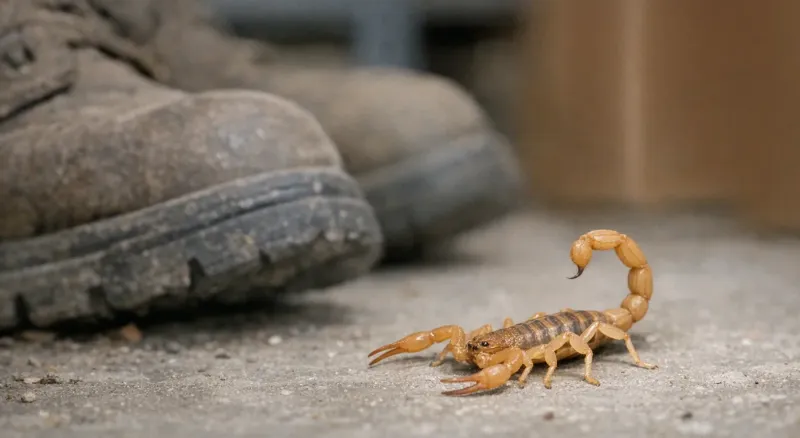
Scorpions are most active after dark, so the hours between sunset and midnight are when encounters are most likely. Building a few habits around that timing can prevent a lot of unpleasant surprises.
The Texas Poison Center Network advises checking footwear and clothing, particularly items that have been stored outdoors or left on the floor near an exterior wall, before putting them on. Shaking out a shoe before slipping your foot in is a sensible precaution, not an indication that scorpions routinely set up residence in laundry or footwear.
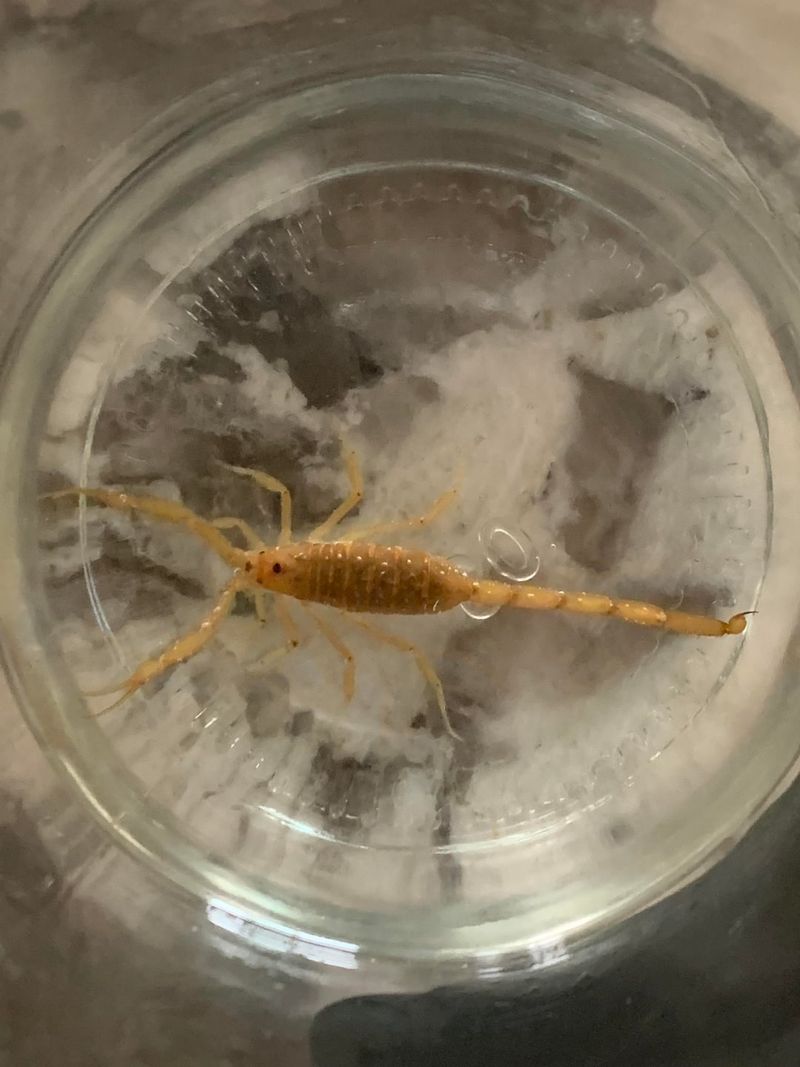
When a scorpion does turn up inside the house, the priority is removing it without touching it. Place a glass jar or similar container over the scorpion and slide a stiff piece of paper or cardboard underneath, then carry the whole assembly outdoors and release it away from the house.
Texas A&M IPM guidance also recommends using leather gloves and long-handled tongs for removal if you prefer to pick the scorpion up directly.
Never handle a scorpion with bare hands. The sting reflex is fast, and even a scorpion that appears sluggish or cornered can deliver a sting quickly.
If removing it yourself is not comfortable, a piece of cardboard slid under a container is the simplest method and requires no special equipment.
Finding one scorpion indoors does not mean there is an infestation. A single sighting most often points to a nearby harborage site or an unsealed entry point rather than a large indoor population.
Treat it as a prompt to check the exterior for gaps and clear any debris that may be sitting close to the foundation, then monitor over the following nights to see if additional sightings occur.
Treat a sting promptly and prepare for weather, not a date
Most scorpion stings in Texas produce localized pain, burning, and swelling. Reactions vary by species and by the individual person, so the same sting that causes minor discomfort for one person may produce a stronger response for another.
Texas A&M describes most Texas scorpion stings as producing moderate reactions, but allergic responses are possible, and scorpions in this state should not be treated as harmless.
For a typical sting, wash the area with soap and water and apply a cool compress to reduce pain and swelling. The Texas Poison Center Network is available 24 hours a day at 1-800-222-1222 and can guide you through next steps based on the specific situation.
Anyone who develops difficulty breathing, hives, or a spreading rash after a sting should go to emergency care immediately rather than waiting to see if symptoms resolve on their own.
Children and older adults may be more sensitive to sting effects, so err toward calling the Poison Center early if either group is stung. Keep the number saved in your phone before you need it, not after.
Pulling back to the bigger picture: hot, dry conditions from July into August may increase the likelihood of seeing scorpions around or inside a Texas home, but local weather, species, nearby habitat, and how well the structure is sealed all determine what actually happens at a specific address. Texas A&M veterinary guidance frames this as a seasonal risk window rather than a guaranteed event, and that framing is worth holding onto.
Clear shelter from around the foundation, trim branches away from the roofline, seal gaps in the exterior, and check outdoor-stored items before the next hot night. The best time to do those things is before a scorpion shows up, not after one already has.