
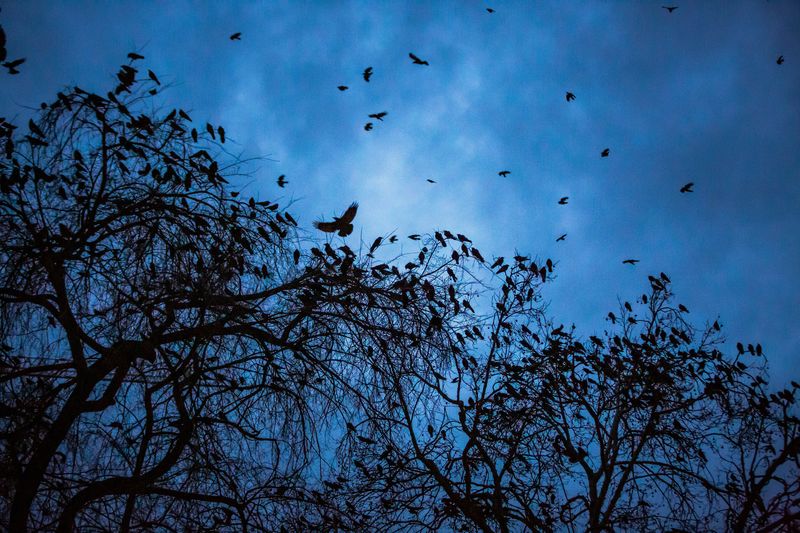
Every evening, across neighborhoods from the Piedmont to the coastal plain, North Carolina homeowners are watching the same thing unfold: a growing crowd of crows circling, calling, and settling into the tallest trees just before dark. It is easy to wonder what the birds are signaling about your yard, your soil, or your lawn.
The short answer is that the flock is almost certainly telling you something much simpler, and far less alarming, than most people assume.
Dusk gatherings usually mark a crow roost
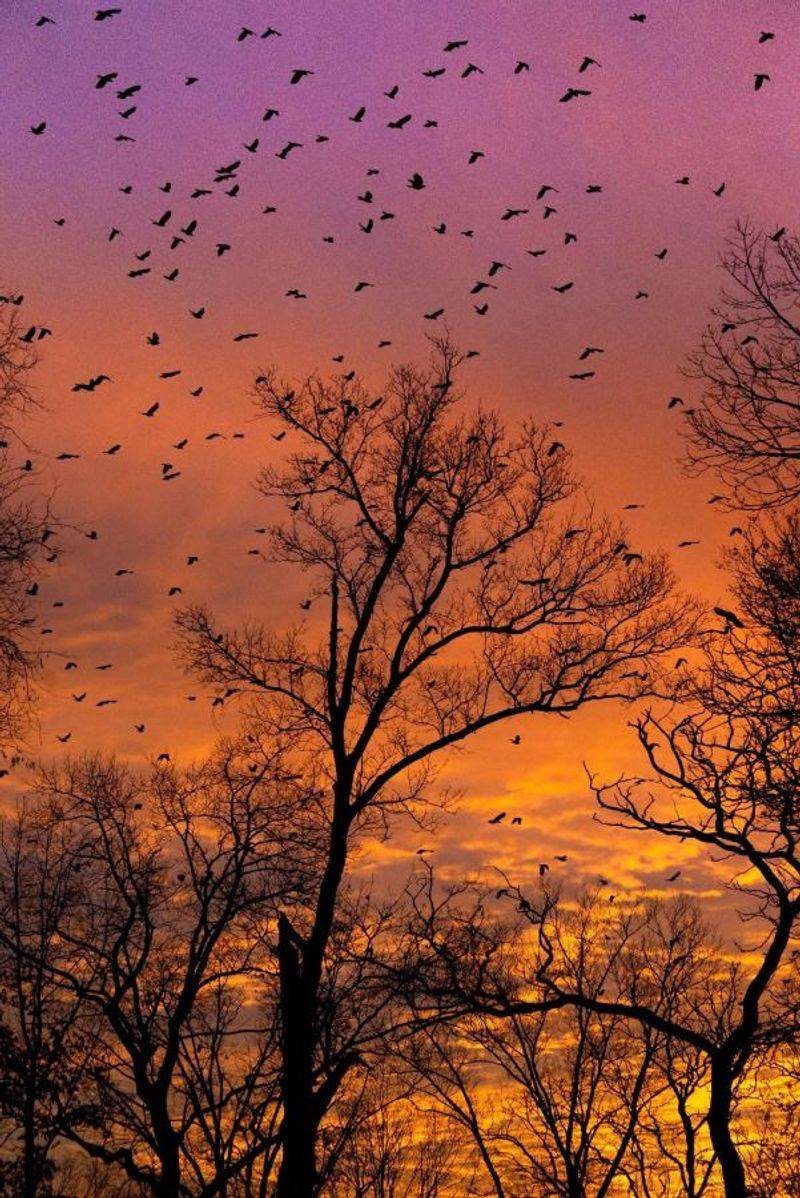
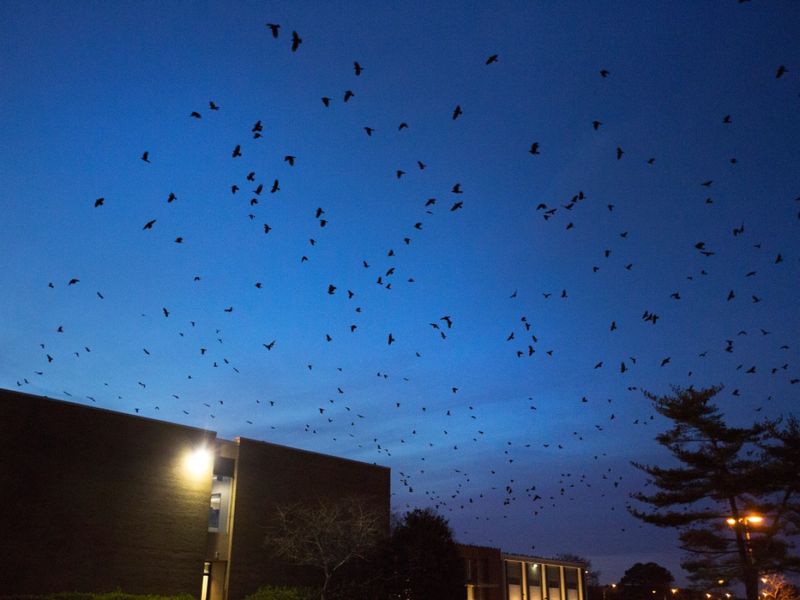
Around sunset, the pattern tends to follow a familiar script. Crows that have been spread across fields, roadsides, and neighborhoods during the day begin moving toward a common area.
They circle overhead, call back and forth, and gradually funnel into a cluster of trees, often spending time socializing and shifting between branches before darkness fully settles in. Cornell Lab’s crow FAQ describes this pre-roost assembly as a normal part of crow social behavior, where birds gather near the intended roost site before committing to their overnight perches.
What you are watching from your yard may actually be two distinct stages. The first is the pre-roost gathering, where crows assemble, call, and socialize, sometimes an hour or two before full dark.
The second is the final move into the actual overnight roost trees. Those two locations are not always the same spot, so the trees in your yard may function as a staging area rather than the place where the birds actually sleep.
None of this behavior signals a problem with your property. Cornell’s American Crow life history makes clear that crows are highly adaptable birds that use a wide range of landscapes, and evening roosting is a routine part of their daily cycle.
The circling, calling, and settling you observe at dusk fits normal crow movement, not a warning about your lawn, your soil, or anything specific going wrong in your yard.
Which crows are gathering in North Carolina?
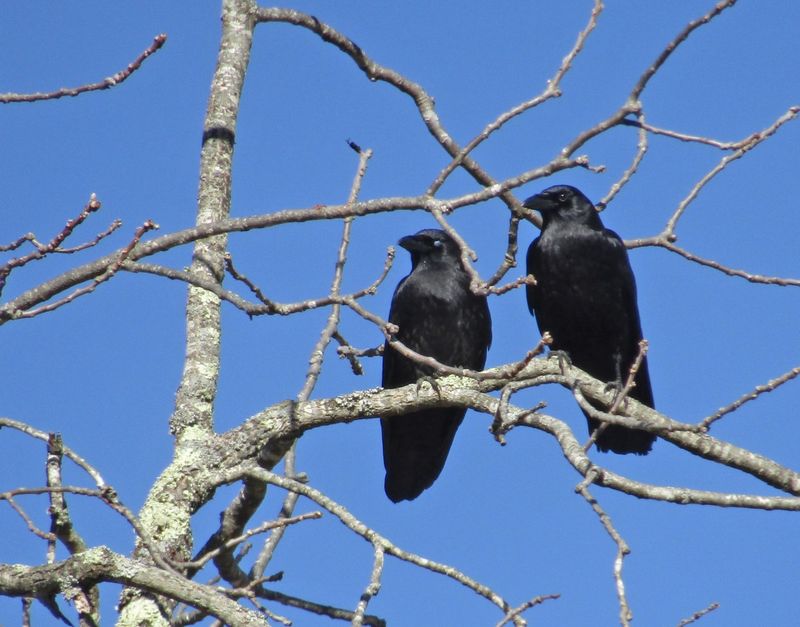
Most crows you see gathering in North Carolina yards are almost certainly American Crows, the large, familiar all-black bird found across the state year-round. That said, a second species, the Fish Crow, also lives here and is especially common in eastern North Carolina along river systems and the coast.
USDA APHIS’s North Carolina bird damage assessment notes that both species occur in the state and can mix together in flocks.
Telling them apart at dusk is genuinely difficult. American Crows are slightly larger, but size is hard to judge when birds are circling overhead or perched in low light.
The most useful difference is vocal: Fish Crows tend to give a nasal, two-note call that sounds something like “uh-uh,” while American Crows produce the classic, deeper caw. Even that distinction gets muddled in a noisy, mixed flock where many birds are calling at once.
All About Birds advises that a distant or dusk photograph is not reliable enough to confirm species, and even experienced birders can be uncertain with a large, active group. For the purposes of understanding why crows are using your trees, the species question matters less than the roosting behavior itself, which is consistent across both birds.
Either way, the gathering reflects the same basic need: elevated structure in a landscape with accessible food nearby.
The trees reveal roosting structure, not a pest diagnosis
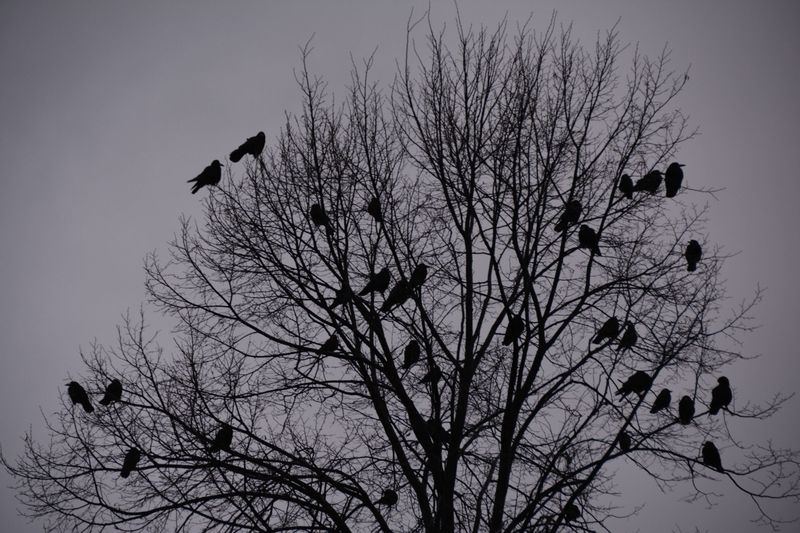
When crows repeatedly choose the same trees evening after evening, the clearest thing that tells you is structural: those trees offer something useful as a perch. Large crowns, substantial height, and sturdy branch networks all make a tree easier to land in, harder for ground predators to approach, and capable of holding many birds at once.
USDA APHIS’s environmental assessment on bird damage management associates crow roosts with taller, larger trees situated near open, food-accessible landscapes, though no single tree trait explains every roost choice.
One study of communal roost sites found that the trees crows actually slept in were not clearly different from nearby trees that went unused, suggesting crows may select a general area or landscape corridor rather than one uniquely special tree. Mrowiec’s thesis on communally roosting American Crows supports this interpretation, indicating that the broader neighborhood context, including open areas and nearby food sources, matters as much as any individual tree’s characteristics.
What the flock does not reveal is a lawn problem, a drainage issue, a tick infestation, or an unusually high mosquito population. Crows are generalist foragers that exploit a wide variety of food and habitat types, and their presence in your trees does not mean your yard is neglected, unhealthy, or suffering from a specific pest pressure.
The trees are serving as elevated roosting structure within a broader landscape that happens to work for these birds, full stop.
Treating crow presence as a pest diagnosis would send most homeowners chasing solutions to problems they do not actually have. The more accurate and useful framing is that your property, or the trees on it, fit into a neighborhood-scale habitat network that crows find structurally convenient.
Food may be beyond the immediate yard
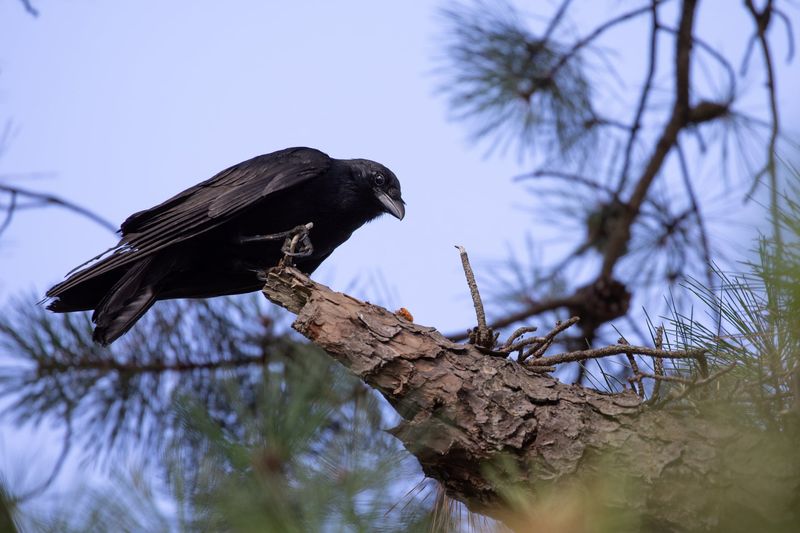
Crows are daytime foragers, and by the time they show up in your trees at dusk, they have likely already spent hours feeding somewhere else entirely. Research by Caccamise, Reed, and colleagues on roosting behavior and group territoriality in American Crows found that birds in that study population could travel several kilometers between their daytime foraging territories and their communal roost.
That finding applies to the specific population studied, but the general pattern holds: the roost trees and the food source do not have to be in the same place.
For North Carolina homeowners, this means the crows settling into your oaks or pines at dusk may have spent the day working a farm field, a landfill edge, a roadside, or a commercial strip several blocks or more away. Cornell’s life history account lists the American Crow’s diet as genuinely broad, covering insects, earthworms, seeds, grain, fruit, carrion, garbage, pet food, and small animals, so the food drawing them to a neighborhood could be almost anything.
The practical upside is that you do not need to diagnose or fix a food problem in your own yard to understand why the birds are there. Your trees may simply be the most convenient elevated perch within flying distance of wherever the actual food supply is located.
Removing a single food attractant from your property may reduce some extra draw, but it is unlikely to dissolve a roost that is anchored to the broader neighborhood landscape.
Season and flock behavior change the interpretation
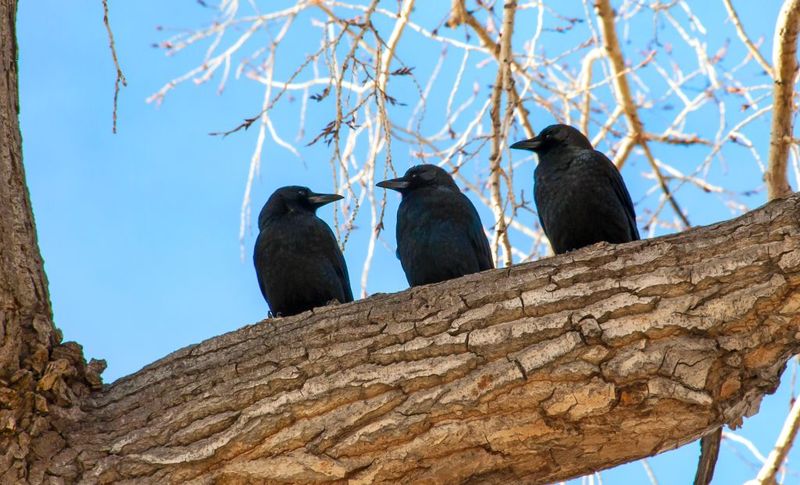
Not every dusk gathering of crows means the same thing, and timing matters a lot. Large communal roosts, the kind that can number in the thousands and draw attention across entire neighborhoods, are most characteristic of fall and winter.
Cornell Lab’s crow FAQ notes that roost numbers generally decline as the breeding season approaches in late winter and early spring, with the biggest aggregations typically occurring in the coldest months.
A small group showing up in your trees during July or August is a different situation. Late-summer gatherings are more likely to involve a family unit, a local foraging flock, or a post-breeding group of birds that have finished nesting and are beginning to move around more loosely.
Cornell’s life history information explains that American Crow families often stay together year-round, and younger birds from earlier broods sometimes help raise subsequent clutches, keeping small groups active through the summer months.
An August sighting in North Carolina is consistent with roosting or pre-roost behavior, but it does not mean a major winter-style communal roost is forming or that the state is experiencing a seasonal peak in crow activity. A handful of birds settling into a backyard tree on a warm evening is a very different event from hundreds of crows converging on a neighborhood grove in January.
Reading the season alongside the flock size gives a much more accurate picture of what is actually happening.
Simple food controls can reduce extra attraction
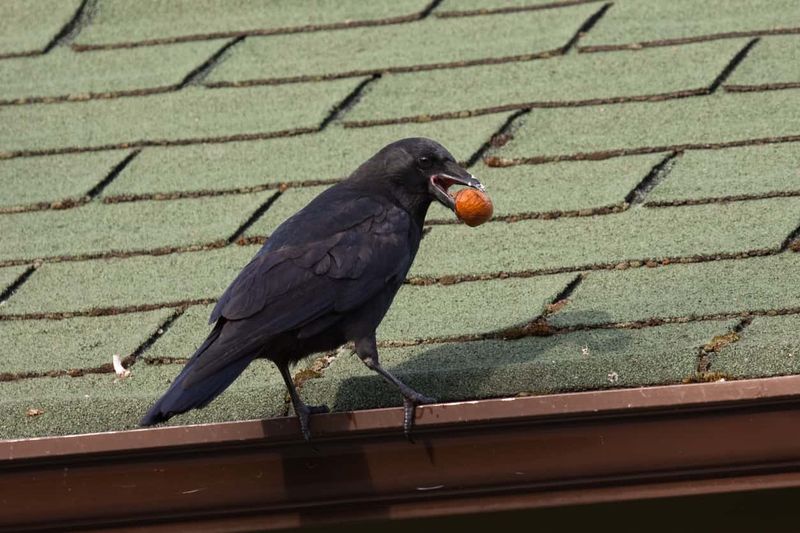
Crows are opportunistic, and certain yard habits make a property more appealing as a foraging stop on the way to or from a roost. Unsecured garbage cans, open compost piles, spilled birdseed under feeders, and pet food left outside are among the most common extra draws.
All About Birds specifically names peanuts, compost, garbage, and pet food as items that can attract crows, so removing or securing those sources is the most straightforward step a homeowner can take.
Bringing pet food bowls inside before dark, using bins with secure lids, and sweeping up spilled seed after feeding sessions are all low-effort habits that remove avoidable food signals without requiring any special equipment or major yard changes. These steps address what you can control without assuming the crow flock is feeding in your yard at all.
For homeowners who want to go further, NC State Extension’s wildlife chapter mentions pruning or thinning branches as one site-specific option that may discourage bird roosting in certain situations. Effectiveness varies depending on the species, the tree, and how much suitable structure remains nearby after pruning.
Thinning a single tree rarely eliminates a roost if the surrounding neighborhood still offers plenty of comparable perches, so this approach works best as part of a broader habitat management plan rather than a standalone fix.
Realistic expectations matter here. These measures can reduce avoidable attraction and make your specific yard slightly less convenient, but they are unlikely to dissolve a roost that is supported by the wider neighborhood landscape and food resources well beyond your property line.
Handle droppings and serious nuisances carefully
Seeing crows perched overhead on a given evening is not, by itself, a health concern. The risk situation that warrants real caution is different: it involves substantial accumulations of droppings being disturbed in a way that sends dried, contaminated dust into the air.
CDC and NIOSH guidance on histoplasmosis prevention focuses specifically on scenarios where contaminated bird or bat droppings are disturbed during excavation, demolition, or heavy cleanup, not on ordinary outdoor observation of birds in trees.
If droppings have built up to the point where cleanup is necessary, wet the material thoroughly before disturbing it to keep dust from becoming airborne. Use appropriate gloves and respiratory protection during the work, and consider consulting a professional for unusually large accumulations rather than attempting a major cleanup without guidance.
NIOSH’s worker guidance on histoplasmosis outlines protective measures in more detail for situations involving significant disturbance of contaminated material.
For nuisance management beyond droppings, the first step is always nonlethal. Removing food attractants, adjusting lighting, and modifying the site are reasonable starting points.
NC State Extension recommends consulting wildlife authorities or a qualified professional before making significant changes to trees or pursuing active control measures.
Poison, shooting, trapping, pyrotechnics, and disturbance of active nests can harm nontarget wildlife and may require authorization under state or federal rules. The Migratory Bird Treaty Act extends protections to American Crows and Fish Crows, and certain control actions may be restricted or require a permit.
Verify current federal and North Carolina regulations and speak with wildlife authorities before attempting any control action beyond basic habitat and food-source management.
What the flock tells you—and what it does not
The most useful takeaway from a dusk crow gathering is straightforward: your trees, or those nearby, provide elevated roosting structure within a landscape that also offers accessible food somewhere in the broader area. Cornell Lab’s crow FAQ and USDA APHIS’s environmental assessment both point to elevated structure and nearby food access as the core factors in roost site use.
The sighting does not diagnose ticks, confirm a mosquito problem, indicate wet soil, flag poor drainage, or mean your yard is neglected or unusually pest-rich. Crows are generalists that exploit a wide range of landscapes, and their choice of your trees reflects habitat geometry more than any specific condition of your lawn or garden.
A tolerable roost, one that produces modest noise and minimal droppings, generally warrants nothing more than removing avoidable food attractants and keeping an eye on things. A genuinely disruptive situation, with heavy accumulations or persistent noise affecting daily life, is worth addressing through nonlethal steps first, then professional guidance if needed.
NC State Extension recommends consulting wildlife authorities before altering trees or pursuing active control. Most crow roosts shift on their own over time, following food availability and seasonal changes, so patience combined with sensible yard habits is often the most effective strategy of all.