
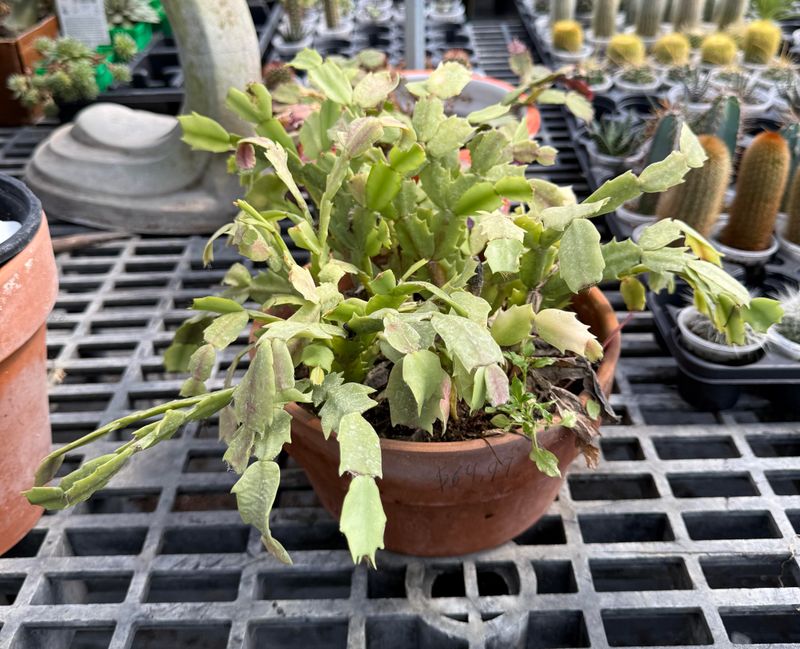
Something looks off about your Christmas cactus right now, and it happened fast. The flattened green segments that looked healthy a few weeks ago are now washed out, faded, or almost yellowish, and you are not sure whether to water more, move it, or just wait.
Late summer is actually a prime time for this problem, and the cause is usually hiding in plain sight – too much intense light, often made worse by Southern heat. Catching this early gives you a real chance to steady the plant before things get worse.
Pale segments often signal too much late-summer light
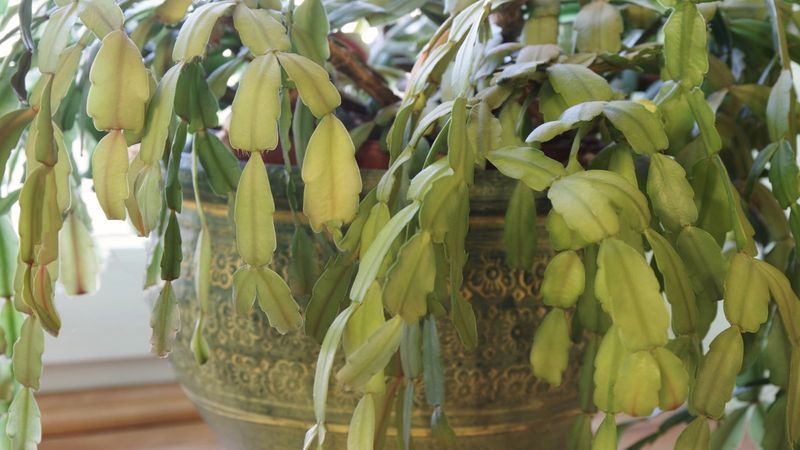
When the flattened stem segments on your Christmas cactus start losing their deep green color and shift toward pale green or yellow, the timing and location of that change matter more than the color itself. Those structures are not true leaves – they are phylloclades, flattened stem segments that do all the work leaves normally would.
Calling them leaves is an easy shorthand, but thinking of them as stems helps explain why intense light hits them so hard.
Excessive direct light, often intensified by summer heat, is the strongest explanation when fading appears in late summer. University of Minnesota Extension guidance on holiday cacti specifically notes that too much sunlight can cause pale green branches, drought, and sunburn on these plants.
The pattern often shows up after a plant moves outdoors for the summer, gets placed near a south- or west-facing window, or lands on a hot patio where reflected heat and direct afternoon rays combine.
That said, excessive light is not the only possible explanation. Drought, root damage, waterlogged soil, rot, disease, and nutrient problems can all produce pale or off-color segments.
The goal right now is to read the full picture before changing anything. Acting on the right cause early – before the plant progresses to scorched patches, wilting, segment drop, or collapse – gives you the clearest path to steadying it.
Why a rainforest cactus fades in harsh sun
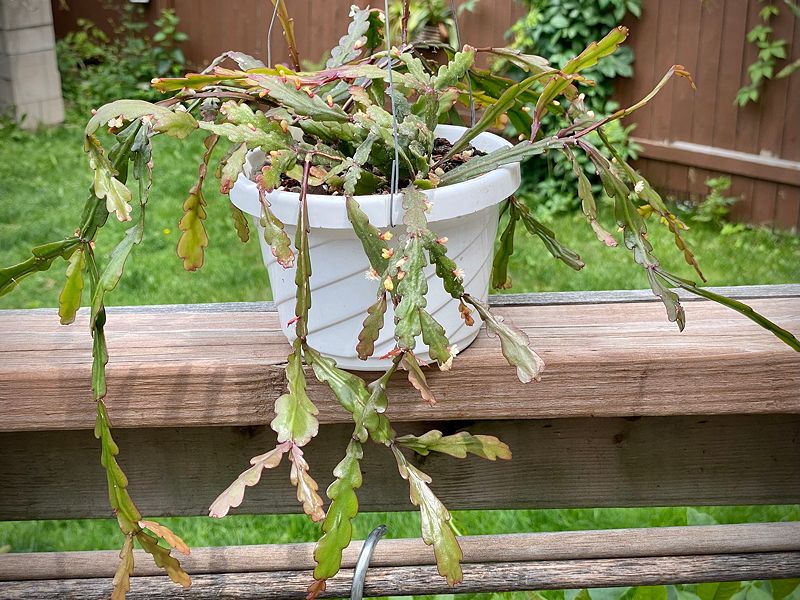
Despite the word “cactus” in its name, this plant has nothing in common with the desert species most people picture. UT Gardens at the University of Tennessee explains that holiday cacti are rainforest epiphytes – plants that grow on tree branches in humid tropical forests, anchored in organic debris rather than soil, with their roots exposed to moving air and filtered canopy light.
Their entire biology is built around soft, indirect brightness and good drainage, not the prolonged, baking sun of an open patio.
The flat stem segments that give the plant its distinctive look are adapted to capture gentle, shifting light from above. When a Christmas cactus suddenly faces hours of direct summer sun through a south- or west-facing window, or sits on a concrete patio that radiates stored heat, those segments have no built-in defense.
Strong light can break down chlorophyll faster than the plant can replace it, producing faded, bleached, or yellowed tissue on the exposed side.
Heat compounds the problem by accelerating water loss and stressing the root system, but the clearest direct link is between excessive light intensity and pale or sunburned segments. Temperature alone does not reliably explain the color change.
University of Maryland Extension’s resource on excess light for indoor plants confirms that too much light is a recognized stressor that produces visible color changes in plants adapted to lower-light conditions. Knowing this origin story makes the fix more obvious: get the light back to filtered, and the plant is back in familiar territory.
Does the color pattern support sun stress?
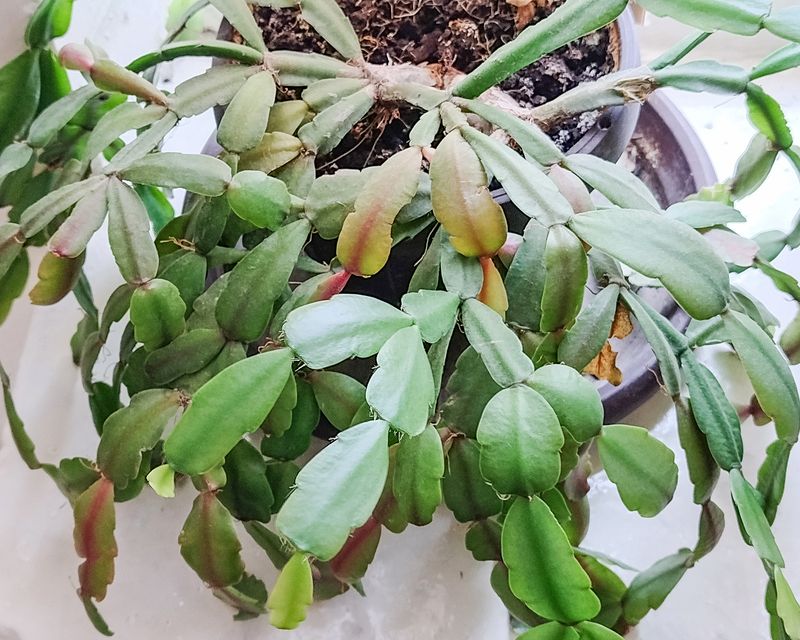
Before moving the plant or adjusting water, spend a few minutes reading where and how the color change is showing up. Fading that appears primarily on the side of the segments facing the light source, or that developed soon after the plant moved to a brighter or hotter spot, lines up well with light stress.
Maryland Extension’s excess-light guidance supports this pattern as a recognizable response to overexposure in shade-adapted plants.
A different set of signs points away from light stress and toward something more serious. If the segments look pale and limp while the potting mix is still wet or soggy, that combination suggests root damage rather than sun exposure.
University of Massachusetts Amherst’s commercial production guide for holiday cacti identifies gray-green foliage, wilting, branch drop, and dark mushy roots as indicators of root or stem rot. Black, wet, or slimy lesions on the segments themselves point more strongly toward disease or rot than toward sun bleaching.
Uniform paleness across the whole plant, with no clear connection to light direction or a recent location change, does not reliably point to any single cause. General fading alone cannot establish a nutrient deficiency.
Illinois Extension’s chlorosis resource notes that interveinal yellowing – where the tissue between leaf veins fades while the veins themselves stay greener – is a more specific clue for potential nutrient issues than overall color loss. Even then, it is a clue to investigate further, not a confirmed diagnosis.
Matching the symptom pattern to the right cause keeps the response proportionate and avoids making things worse.
Move the plant into bright filtered light
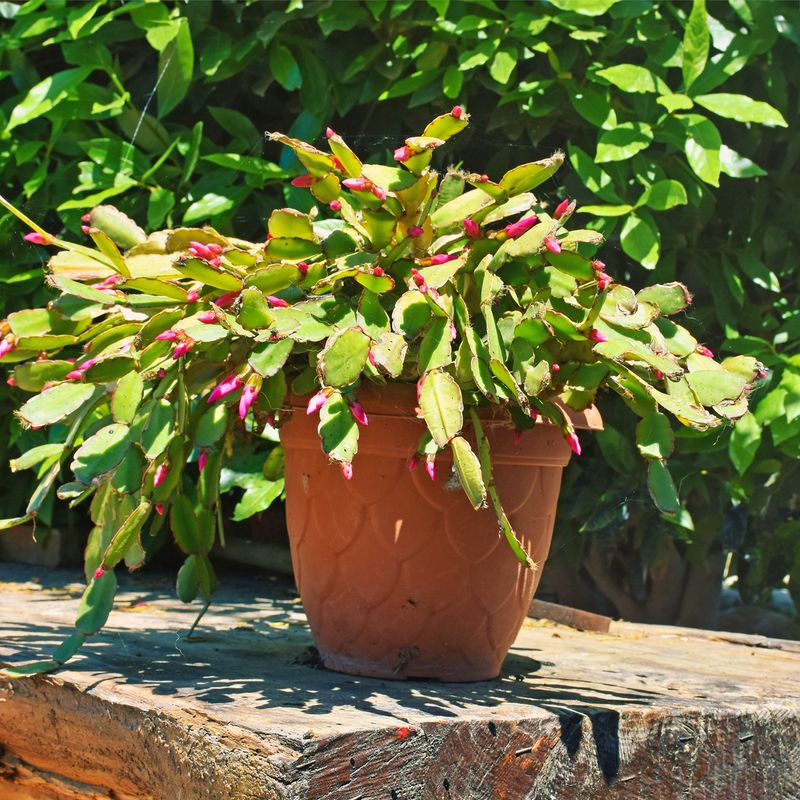
Once light stress looks like the most likely explanation, the first move is straightforward: get the plant out of direct intense sun and into bright filtered light. A screened porch, a spot under a shade tree with moving light, or an east-facing window that gets gentle morning sun and stays cool in the afternoon are all reasonable targets.
University of Minnesota Extension recommends part shade for outdoor summer placement and specifically warns against overexposure to sunlight.
For gardeners in Florida and Texas, the outdoor environment adds layers of risk that go beyond simple sun angle. Hot concrete patios, stucco walls, and reflective pavement can push temperatures at plant level well above air temperature even in a partially shaded spot.
UF/IFAS Bay County Extension specifically advises protecting holiday cactus from full summer sun in Florida, and Texas A&M AgriLife Extension likewise recommends shade during summer for this plant. Moving it to the north side of the house under a porch overhang, or hanging it in a spot with good airflow and no direct afternoon rays, addresses both the light and the reflected-heat problem.
Filtered light stops additional stress from piling on, but it does not instantly reverse segments that have already faded or bleached. Damaged tissue generally does not regain its original color.
The goal of the move is to protect what is still healthy and give the plant stable conditions to push out new growth. Watch the firm, darker segments and any new tips that emerge – those tell you more about the plant’s direction than the faded ones do.
Water the potting mix instead of following a calendar
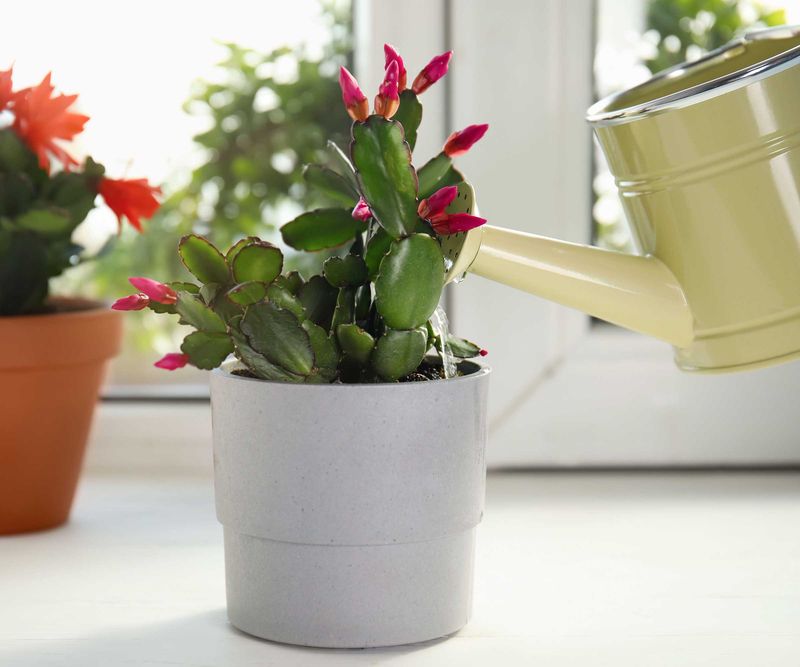
Pale color can make it tempting to reach for the watering can right away, but thirst is not the automatic explanation for faded segments. Check the potting mix first.
Press a finger about an inch into the mix near the edge of the pot. If it still feels damp, hold off.
UT Gardens recommends watering thoroughly when the surface begins to dry during the active growing season, then letting excess water drain completely before the pot goes back to its spot.
Holiday cacti are not desert plants, and treating them like one during summer is a common mistake. They generally need more regular moisture during active spring and summer growth than they do after blooming or during the fall bud-setting period.
University of Connecticut Extension’s holiday cacti fact sheet reinforces that these plants should not dry out completely or stay waterlogged. Both extremes cause problems.
Extension recommendations vary slightly in their wording – some say keep the mix moderately moist, others say let the surface dry between waterings – but the consistent rule across sources is thorough drainage and avoidance of both prolonged dryness and saturated soil. University of Wisconsin Extension’s holiday cactus guide and UF/IFAS’s Christmas cactus preparation page both emphasize that the pot should never sit in standing water.
Empty the saucer after each watering session and choose a mix that drains freely so roots get both moisture and air.
Wet soil changes the rescue plan
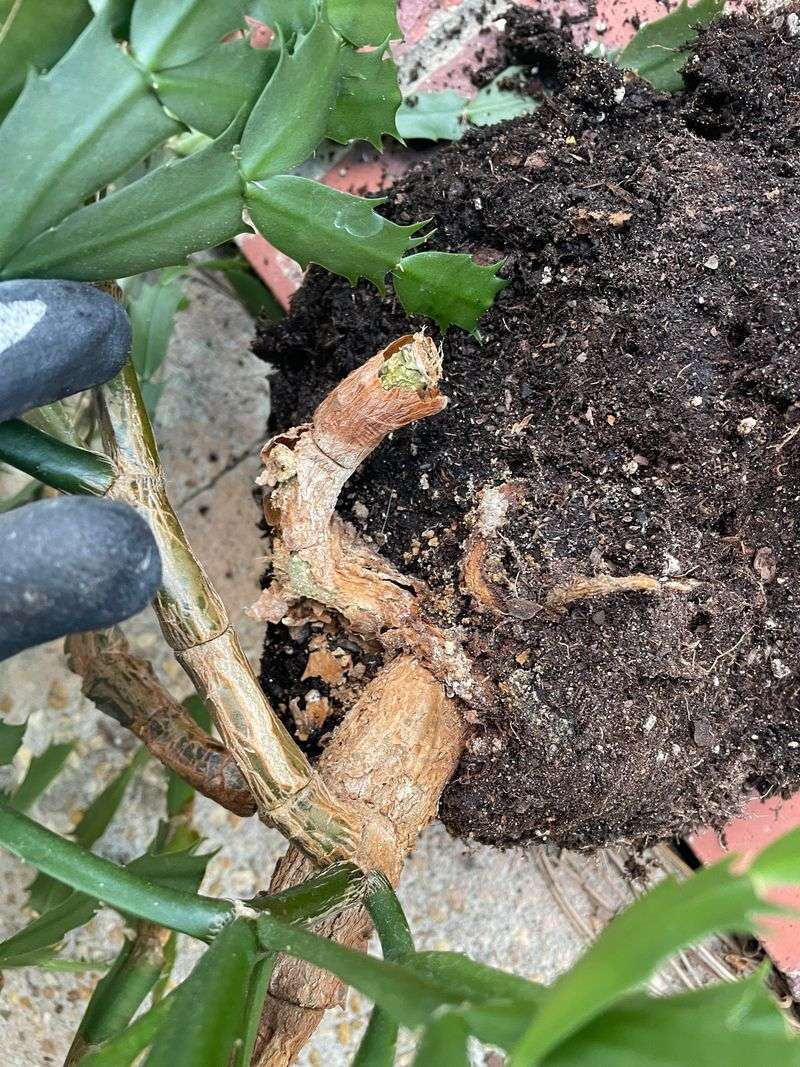
Sometimes the potting mix stays wet for days after watering, or the plant looks pale and limp even though you have not let it dry out. That combination is a signal to shift focus from light adjustment to root health.
University of Minnesota Extension notes that gray-green foliage, wilting, branch drop, and dark mushy roots are stronger indicators of root or stem rot than of sun stress. If you see any of those signs alongside persistently wet soil, carefully slide the root ball out and look at the roots directly.
Healthy roots are firm and light-colored. Roots that are dark, soft, and smell off have begun to rot, and that damage limits the plant’s ability to take up water and nutrients regardless of how the light or watering schedule is adjusted.
UMass Amherst’s commercial production guide identifies poor drainage and overwatering as primary contributors to root rot in holiday cacti. Trimming away clearly rotted roots, repotting into fresh, well-draining mix, and improving drainage are the appropriate next steps – not more fertilizer or heavier watering.
Fertilizer deserves a separate note here. Feeding during active growth can be appropriate, and a half-strength balanced houseplant fertilizer applied according to label directions is a commonly recommended approach.
But general paleness alone does not establish a nutrient deficiency, and overfertilizing can damage the fine root system further. UT Gardens advises fertilizing only during the growing season and following product directions carefully.
If the roots are compromised, fix the drainage problem first – feeding a plant that cannot absorb nutrients does not help and may make root stress worse.
Late summer sets up the next indoor and blooming phase
Recovery from light stress and preparation for winter blooming are two separate tasks, and it helps to keep them straight. The immediate priority is stable filtered light and balanced moisture.
The seasonal priority, which starts becoming relevant as nights cool in late summer and early fall, is getting the plant positioned for flower-bud development.
Outdoor plants need to come inside before nighttime temperatures approach 50 degrees Fahrenheit. UF/IFAS Bay County Extension and University of Connecticut Extension both support that threshold as a practical guideline for home gardeners.
Some extension sources put the lower tolerance closer to 40 degrees Fahrenheit, but 50 degrees is the more conservative and safer cutoff, especially for plants already under stress. Where practical, avoid abrupt swings in temperature or light when moving the plant – a sudden shift from a warm porch to a cool, dim indoor corner can add stress on top of what the plant is already managing.
Once the plant is indoors and stable, flower-bud formation becomes the next focus. Iowa State University Extension’s holiday cacti guide explains that buds are typically triggered by cooler night temperatures in the range of 55 to 65 degrees Fahrenheit combined with roughly 12 to 14 hours of uninterrupted darkness each night.
Iowa State’s FAQ on bloom failure also warns that once buds form, abrupt changes in location, temperature, or light can trigger bud drop. These conditions support flowering – they do not reverse sun-bleached tissue, so do not confuse bud-setting care with treatment for pale segments.
Plants sold as Christmas cactus may actually be Thanksgiving cactus, Easter cactus, or a hybrid. Segment shape and bloom timing differ among these, though their care requirements overlap closely.
If your plant bloomed unusually early or late last year, that detail can help you identify which type you have and plan accordingly.
Judge recovery by new growth, not instant color
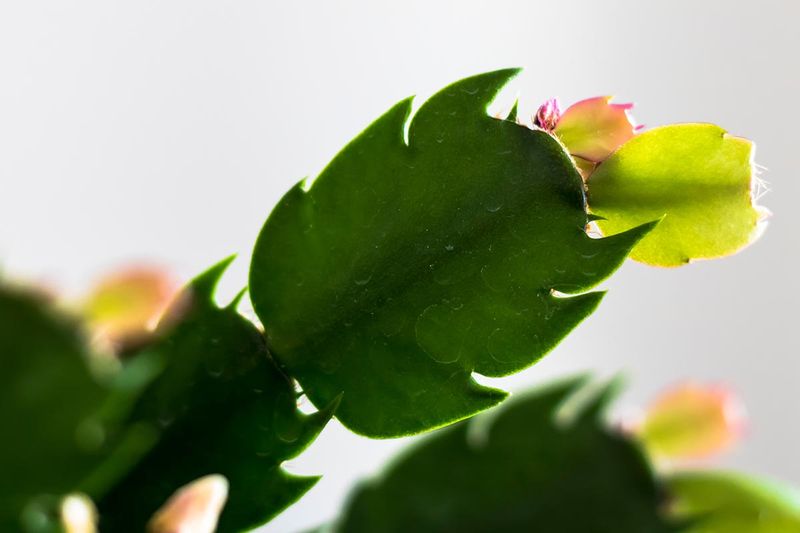
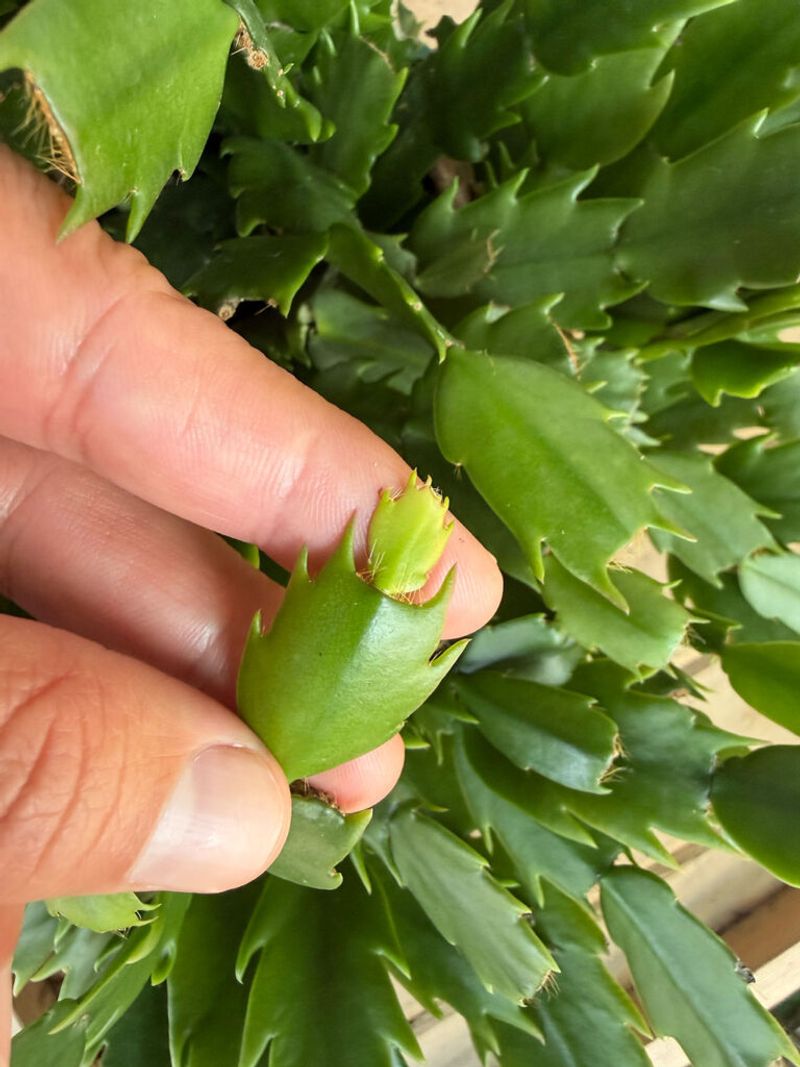
Faded segments that have already lost their color are not a reliable gauge of whether the plant is improving. Damaged tissue generally stays pale or discolored even after conditions improve.
The more useful signal is what happens at the growing tips over the next few weeks. Firm, normally colored new segments pushing out from healthy tissue mean the plant has stabilized and is moving forward.
University of Minnesota Extension supports monitoring overall plant health and growth rather than expecting immediate color reversal after correcting conditions.
The practical decision path from here is straightforward. Reduce harsh light by moving the plant to filtered brightness.
Check the potting mix before watering and make sure drainage is working. If the plant is pale and limp in wet soil, inspect the roots and address drainage before anything else.
Skip Epsom salt, heavy fertilizer doses, and other additives unless the symptom pattern gives you a specific reason to use them – Maryland Extension’s excess-light guidance reinforces that correcting the light environment is the first and most direct response to this type of stress.
Excessive summer light, often worsened by Southern heat, is the leading explanation for pale segments in this seasonal scenario – but the full symptom picture always determines whether a different problem needs attention first. A plant that gets filtered light, balanced moisture, good drainage, and a smooth indoor transition before cold nights arrive is in a genuinely good position.
The faded segments tell the story of last month; the new growth tells you where things are headed.