
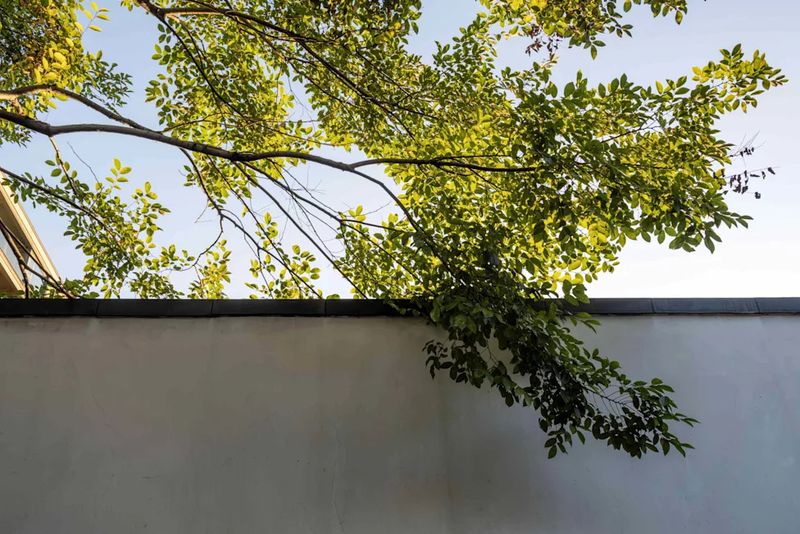
Many California homeowners have stood in their backyard staring at a neighbor’s tree branches creeping over the fence, wondering if they have any right to cut them. The short answer is generally yes, but the law puts real limits on what you can do and where you can do it.
Getting those limits wrong can turn a simple yard chore into a costly legal dispute. Understanding exactly what California allows, and what it does not, can save you from a problem far worse than the branches themselves.
California allows limited trimming from your side
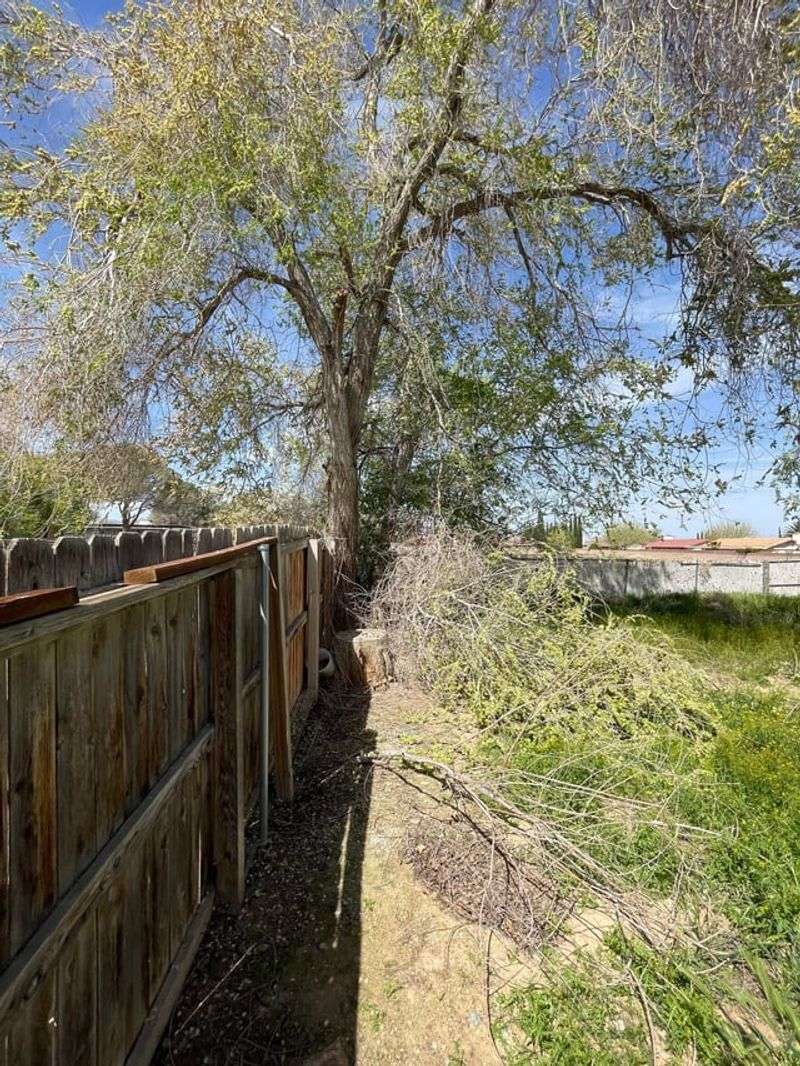
California courts have long recognized that a property owner may remove the portions of a neighboring tree’s branches that extend onto the owner’s land. That right, however, is a limited one.
Booska v. Patel, a California Court of Appeal decision, made clear that the trimming privilege is not unlimited and that ordinary negligence principles can apply when the work injures the neighbor’s tree.
The boundary is the key. You may cut the branches that hang over onto your property, but only up to the actual legal property line.
Cutting beyond that line, even by a few inches, puts you into the neighbor’s side of the property without authorization, which creates a separate legal problem entirely.
The right also does not extend to removing the tree, cutting its trunk, or performing work that seriously injures or kills it. An earlier decision, Bonde v.
Bishop, recognized that overhanging branches can constitute a nuisance, which helped establish the self-help trimming concept, but neither case gives a homeowner a blank check to do whatever the job seems to require.
Think of the right this way: you can reclaim your airspace, but you cannot reach into your neighbor’s. The catch, as many homeowners find out too late, is that staying on the right side of the line requires knowing exactly where that line runs, how carefully the cuts are made, and whether any other rules apply before the first branch falls.
The fence may not mark the legal boundary
Most homeowners assume the fence is the property line. That assumption is often wrong, and acting on it before checking can lead to cuts made on the wrong side of the actual legal boundary.
A fence may have been built inside the property, outside it, or in a location based on an old informal agreement that does not match recorded documents.
California law ties tree ownership to the trunk, not the canopy. Under California Civil Code section 834, a tree whose trunk stands wholly on one owner’s land belongs entirely to that owner, even if the roots extend under the neighboring parcel.
That means your neighbor owns the tree completely, and your trimming right is limited to the branches that actually cross onto your side.
The situation changes when the trunk itself straddles the boundary. Civil Code section 833 treats a tree whose trunk stands partly on both parcels as common property of the adjoining owners.
In that case, neither owner can unilaterally remove the tree or materially injure it. The California Court of Appeal applied this principle in Kallis v.
Sones, reinforcing that a boundary-line tree is a shared asset, not one owner’s problem to solve alone.
When you are not certain where the legal boundary runs, review your deed and any recorded documents first. If the line is disputed or the paperwork is unclear, Contra Costa County’s guidance on property lines notes that only a licensed California land surveyor, or a qualified pre-1982 civil engineer, can provide a private survey opinion on a property line.
Consulting a licensed land surveyor or an attorney before cutting is the safer path whenever uncertainty exists.
Trimming does not give you a license to cripple the tree
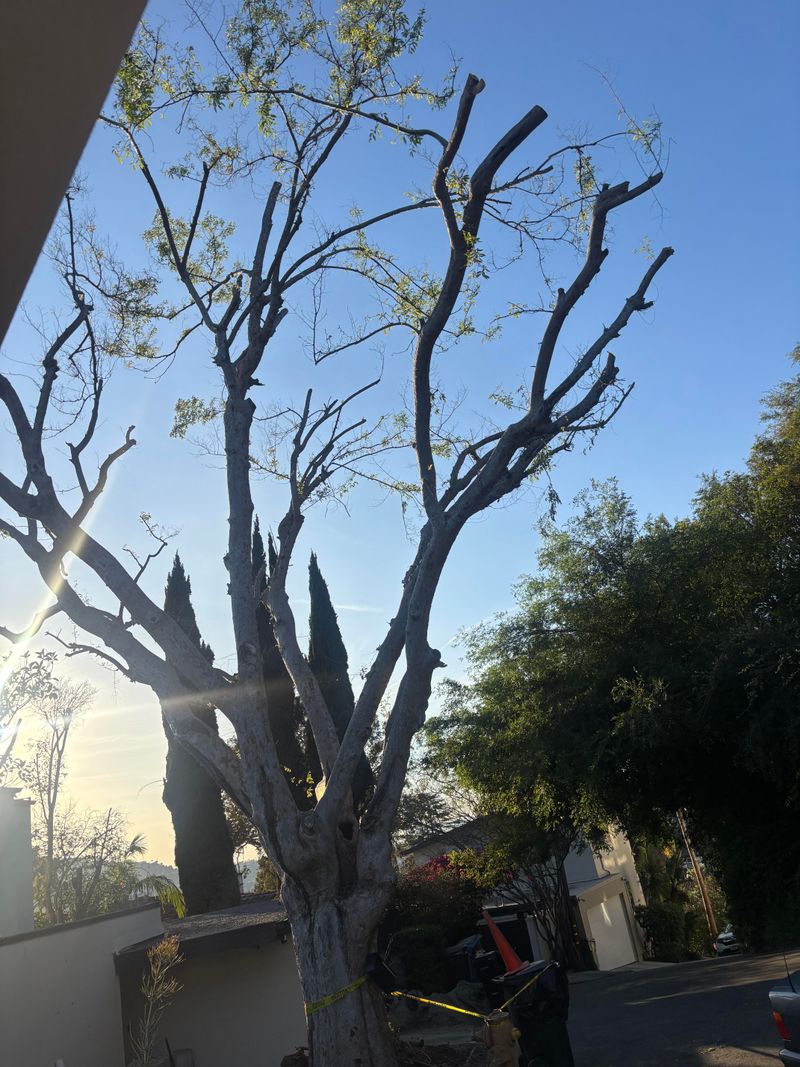
Staying on your side of the property line is necessary, but it is not enough on its own. The way you cut matters just as much as where you cut.
California case law does not treat the trimming privilege as a free pass to perform work that seriously damages or kills the neighbor’s tree.
Booska v. Patel is the clearest example.
In that case, root cutting performed on the neighbor’s property allegedly compromised the tree to the point where removal became necessary. The court declined to recognize an absolute privilege and instead applied ordinary negligence principles to the question of whether the work went too far.
The lesson for homeowners is practical: cuts that compromise the structural integrity of the tree, require its removal, or amount to unreasonable injury can expose you to liability even if the branches you removed were genuinely on your side.
The financial stakes can be significant. California Civil Code section 3346 allows a court to award enhanced damages for wrongful injury to timber or trees, and Code of Civil Procedure section 733 provides a separate basis for a civil action when someone wrongfully injures a tree on another’s land.
Neither statute guarantees a particular outcome, but both signal that California treats deliberate or careless tree injury as more than ordinary property damage.
Not every imperfect cut automatically creates liability. The concern is with work that crosses from reasonable maintenance into unreasonable injury, whether through topping, stripping major limbs, cutting flush to the trunk, or removing so much of the canopy that the tree cannot recover.
When the work is substantial, hiring a qualified arborist is the most reliable way to keep the cuts defensible.
A written plan keeps a neighbor dispute from becoming a trespass dispute
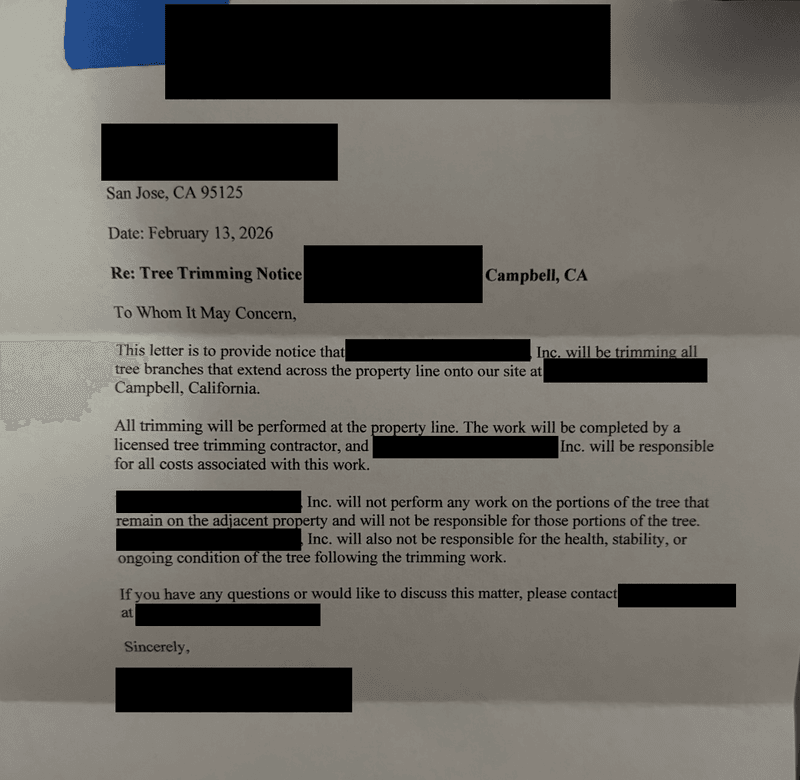
Notifying a neighbor before trimming is not legally required for ordinary work performed entirely from your own property, but skipping that step is one of the most common ways a manageable situation turns into a lasting conflict. A brief heads-up gives the neighbor a chance to raise concerns, flag a disputed boundary, or point out something you may not have noticed, like a recent survey or a local permit requirement.
Put the key facts in writing before work begins. Photograph the overhanging branches from your side, note where the intended cuts will fall relative to the confirmed boundary, and keep a record of any communications with the neighbor.
Guidance published by Palos Verdes Estates recommends communicating your intent, using a professional tree service, and consulting an arborist when tree health may be affected. That kind of documentation becomes useful if a dispute arises later over where cuts were made or whether the tree was harmed.
The one line that cannot be crossed, regardless of documentation, is entering the neighbor’s yard without permission. California Penal Code section 602 includes unauthorized entry and willful injury to timber or trees among its trespass offenses.
Even if you genuinely believe a branch needs to come down, stepping onto the neighbor’s property to make that cut adds a criminal trespass exposure on top of any civil liability for tree damage.
When the boundary is unclear, confirm it before scheduling any work. When the branches are large, elevated, or close to the tree’s main structure, bring in a licensed tree service or ISA Certified Arborist rather than relying on a ladder and a handsaw.
Good records and professional help are not a guarantee against disputes, but they make your position far easier to defend.
Safe pruning protects both the tree and the homeowner
Even when every legal box is checked, the physical work can create a problem of its own. Improper cuts weaken trees, invite disease and pest entry, and can eventually cause the kind of structural failure that leads to property damage or injury claims.
Getting the technique right is not just about the tree’s health; it is also about limiting your exposure if the neighbor later claims the work caused lasting harm.
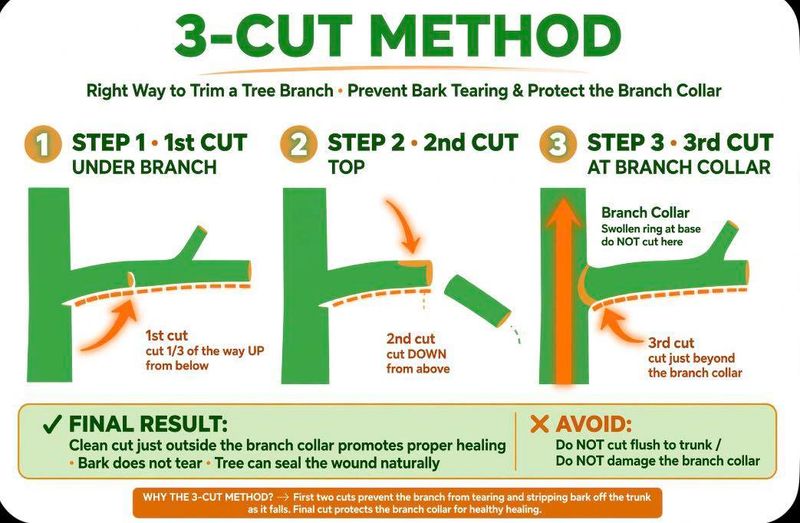
For branches of manageable size, cuts should be made just outside the branch collar and branch bark ridge, not flush against the trunk or parent limb. UC IPM pruning guidance explains how proper cut placement supports the tree’s natural wound-closure process.
For larger limbs, International Society of Arboriculture pruning guidance recommends a three-cut method: an undercut partway through the limb first, then a second cut from above to remove the weight, then a final clean cut just outside the branch collar. Skipping the undercut on heavy limbs allows the weight to tear bark down the trunk before the cut is complete.
Topping, indiscriminate heading cuts, and removing large portions of the canopy just to create a straight visual line at the fence are practices that consistently weaken trees and create lasting structural problems. The ISA also notes that substantial or safety-sensitive tree work should be handled by an ISA Certified Arborist, not attempted as a DIY project with general-purpose tools.
Power lines require a complete stop. The California Public Utilities Commission directs homeowners to call the utility first when trees are near energized lines, and Cal/OSHA regulations prohibit ordinary tree-trimming work within 10 feet of high-voltage energized conductors unless the worker meets specialized requirements.
No property-line dispute is worth the risk of contact with a live line.
Other California rules can stop an otherwise permitted trim

Being on the correct side of the property line does not automatically clear the way to cut. California cities and counties layer their own rules on top of state law, and some of those rules apply even when the branches are entirely on your side of the fence.
Many jurisdictions require permits before any significant pruning of protected trees, including oaks, native species, heritage trees, street trees, or trees preserved as conditions of a development approval. Morgan Hill requires permits for tree removal and pruning in certain situations, and Sacramento’s urban forestry program has its own permit process for tree work affecting the urban forest.
Hayward and Palo Alto each maintain their own protected-tree frameworks as well. Check with your city or county before any substantial pruning, not after.
Western Joshua trees carry a separate layer of protection under the Western Joshua Tree Conservation Act. The California Department of Fish and Wildlife administers a specific permit process for trimming living Joshua trees, available only under limited hazard-management circumstances, as described in CDFW’s Western Joshua tree permitting guidance.
If a Joshua tree’s branches cross your fence line, that permitting framework applies before any cutting begins.
Active bird nests add another layer of concern. California Fish and Game Code section 3503 prohibits taking, possessing, or needlessly destroying a bird’s nest or eggs, and section 3503.5 extends additional protection to birds of prey and their nests.
CDFW guidance on nesting birds recommends avoiding routine vegetation work during the February-through-August period as a practical precaution for many species, but nesting varies by species and location and can occur year-round in some areas. Always inspect branches for active nests before scheduling work, regardless of the time of year.
Check the line, the tree, and the rules before cutting
Before picking up any tool, run through a short decision path. First, identify the actual legal property boundary by reviewing your deed and any recorded documents.
If the line is uncertain or disputed, consult a licensed land surveyor or attorney rather than guessing based on the fence. As Contra Costa County’s property-line guidance explains, only a licensed land surveyor or qualifying civil engineer can provide a private survey opinion on where the line actually falls.
Next, check the trunk. If it stands partly on both parcels, the tree is common property under Civil Code section 833, and unilateral action that materially injures it creates shared-ownership problems beyond the ordinary trimming question.
Stay on your side, limit work to branches that genuinely overhang your property, and avoid cuts that could seriously damage the tree’s structure, keeping Booska v. Patel’s negligence framework in mind.
Do not enter the neighbor’s yard without permission. California Penal Code section 602 treats unauthorized entry and willful injury to trees as trespass offenses, separate from any civil liability for tree damage.
Check your city or county for permit requirements, inspect branches for active nests before cutting, and contact the utility if any lines are nearby. For substantial or hazardous work, hire a qualified arborist.
The self-help trimming right is real, but it rewards careful preparation far more than it rewards speed.