
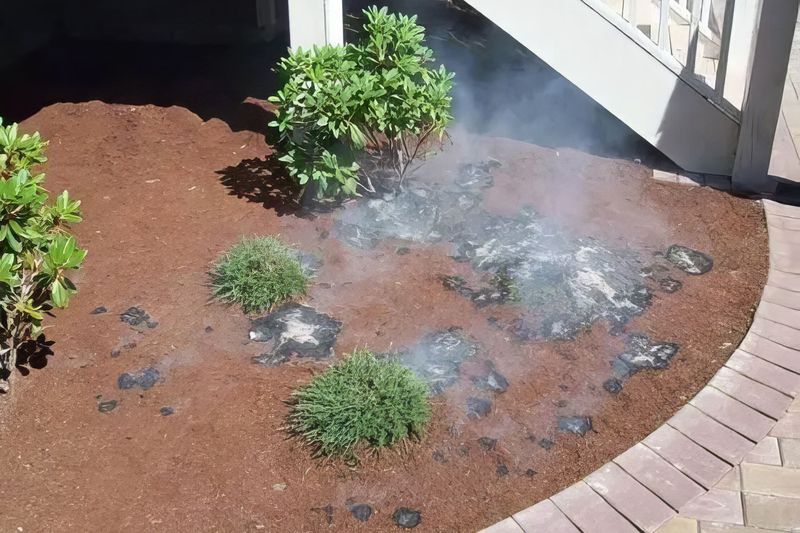
Bark mulch is one of those yard staples most California homeowners never think twice about, but fire officials want that to change. Piled against a house, it can give windblown embers exactly the fuel they need to start a fire at the base of a wall.
The fix is straightforward: swap out what is closest to the structure and manage what is farther away more carefully. This guide explains what the guidance actually says, what to replace bark mulch with, and why the change matters more in some spots than others.
The first five feet changes the mulch decision

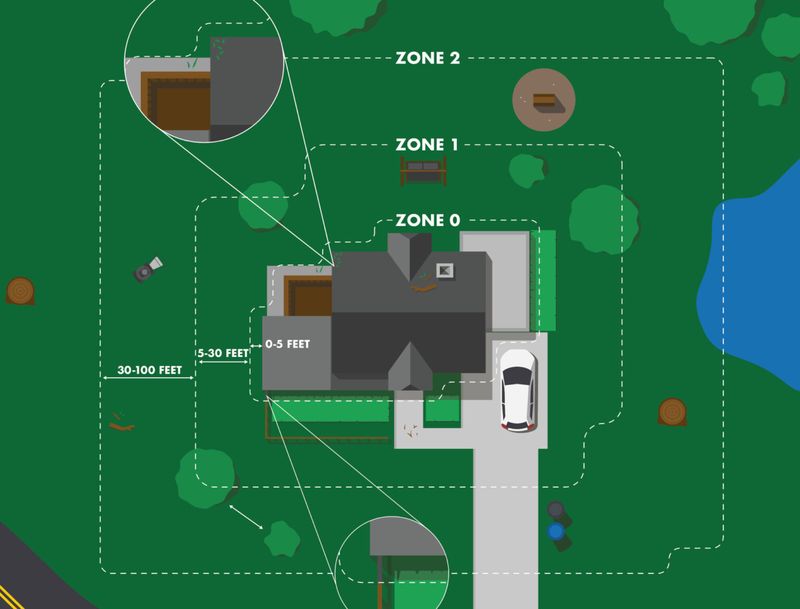
Grab a tape measure and mark five feet out from your house wall, attached deck, porch, or any other structure connected to your home. That strip of ground is what California fire officials call Zone 0, and it carries the clearest, most specific guidance of any part of your yard.
CAL FIRE’s defensible space guidance is direct on this point: no combustible bark or mulch belongs in that zone.
The recommendation does not say your entire yard must be cleared of organic material. Homeowners in foothill communities, hillside neighborhoods, and wildland-interface areas are often surprised to learn the focus is this narrow and this specific.
Bark mulch applied 15 or 20 feet from the house sits in a different management zone with different rules, which this article covers later.
Zone 0 matters because it is where embers tend to collect. Wind pushes firebrands into corners formed by walls, fences, deck edges, and planters, and organic ground cover sitting in those corners gives those embers something to ignite.
Replacing combustible mulch in that five-foot strip with a noncombustible surface breaks the connection between an airborne ember and the building’s base.
California’s Department of Insurance reinforces the same boundary. Safer from Wildfires guidance from the state insurance department identifies a five-foot ember-resistant zone and lists stone and decomposed granite as appropriate surfaces there.
Measuring and acting on that five-foot line is the single most concrete first step any California homeowner in a fire-prone area can take with their landscaping.
Why windblown embers make mulch near the house a concern
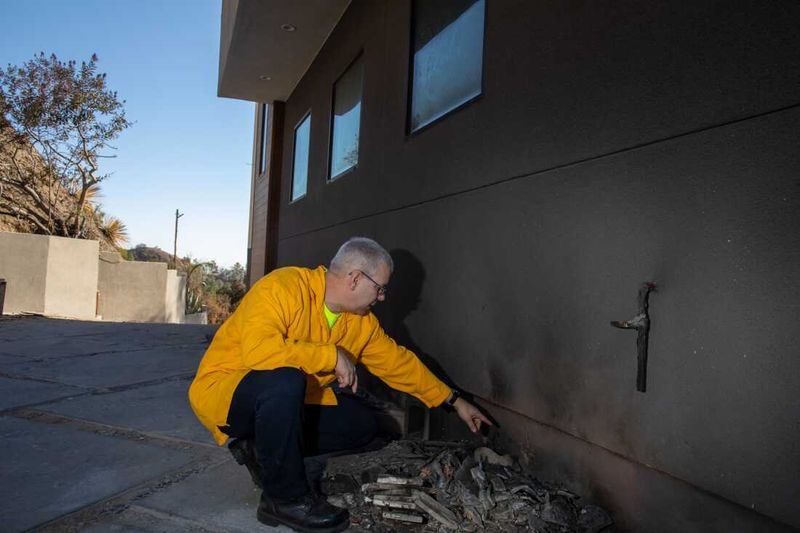
During a wildfire, embers travel ahead of the fire front, sometimes for a mile or more, and they do not land evenly across a yard. They funnel into sheltered spots: the gap between a planter and a wall, the corner of a deck, the narrow channel beside a porch step.
When bark mulch fills those gaps, it gives a settling ember a ready fuel source right at the edge of the building.
A 2025 peer-reviewed study of 10 California landscaping mulches found that all but screened compost could be ignited into smoldering combustion by firebrand piles under the test conditions. Products that were not composted were generally more likely to move from smoldering into open flames.
That distinction matters because smoldering material can persist and spread before anyone notices, and a transition to flaming combustion near a wall or under a deck changes the situation quickly.
Earlier UC ANR testing reached similar conclusions. Research on the combustibility of landscape mulches found that under dry, hot, and windy conditions, all eight tested treatments were combustible.
Shredded western red cedar spread the fastest and produced the most ember activity. Rubber mulch generated the highest temperatures and tallest flames of any material tested, which matters for homeowners who consider it a wood-free alternative.
These are results under specific test conditions, not predictions of exactly how your mulch bed will behave in a real fire. What they do establish is that organic and synthetic mulches are combustible, that material type affects how quickly fire can spread, and that placing any of them directly against a building’s edge adds fuel where embers are most likely to land.
That is the core concern, not a claim that every mulch bed will inevitably catch fire or threaten a structure.
A noncombustible edge creates the immediate swap

Removing bark mulch from the first five feet is only half the job. The space needs to be filled with something that will not give an ember any fuel, and several practical options work well in California yards.
CAL FIRE points homeowners toward gravel, rock, pavers, and concrete for this zone, and the state’s insurance department adds decomposed granite and stone to that list.
Decomposed granite is one of the most popular choices in California because it drains well, stays in place on slopes, and blends naturally with the dry-landscape look common to foothill and inland communities. Coarse gravel or river rock works similarly and can be laid directly on compacted soil or landscape fabric.
Concrete pavers and brick allow for more formal patterns near entries and patios while still meeting the noncombustible standard. Poured concrete is appropriate along foundations and under attached decks where a solid, sealed surface is practical.
The goal of this swap is an ember-resistant perimeter, not a new horticultural ground cover. None of these materials feed plants the way organic mulch does, and that is exactly the point for this narrow strip.
Planting beds that start five or more feet from the structure can still include carefully managed organic mulch, which later sections address.
Think of this as a perimeter project rather than a whole-yard overhaul. A five-foot band of decomposed granite or gravel around the house, deck, and porch is a manageable weekend task for most homeowners.
California’s Safer from Wildfires framework frames this kind of immediate perimeter work as one of the most accessible structural changes a homeowner can make, and it does not require touching the planting beds that give a yard its character.
Clear the five-foot zone beyond the visible bark layer
Pulling up bark mulch from the immediate perimeter is a good start, but stopping there leaves other ignition sources in place. Windblown embers do not care whether the fuel beneath them is bark mulch or a pile of dry oak leaves, and both can ignite under the same conditions.
CAL FIRE’s defensible space checklist goes beyond mulch and calls for removing dry leaves, needles, twigs, dead plants, and other debris from the five-foot zone as a regular maintenance task.
Firewood stacked against the house is a common problem that homeowners overlook. A cord of wood sitting two feet from the siding is far more combustible than a thin layer of bark chips, and it should be relocated at least 30 feet from any structure and uphill if possible.
Combustible containers, recycling bins, cardboard, and similar materials stored along exterior walls all belong in the same category and should be moved.
The five-foot inspection also extends upward. Gutters filled with dry leaves and pine needles are a well-documented ignition point, and embers landing in a clogged gutter can smolder long enough to ignite the roofline.
Decks and porches deserve attention too: debris that collects in the gaps between deck boards or under a raised deck gives embers a sheltered spot with plenty of fuel. Stairs, lattice, and the areas directly beneath decks are part of the same perimeter and need to be kept clear.
Running this inspection seasonally, before fire season peaks in late spring, and again after fall winds carry debris, makes the task manageable. The combination of a noncombustible ground surface and a debris-free perimeter does more to reduce ember risk at the structure’s edge than either step alone.
Organic mulch still has a place beyond Zone 0
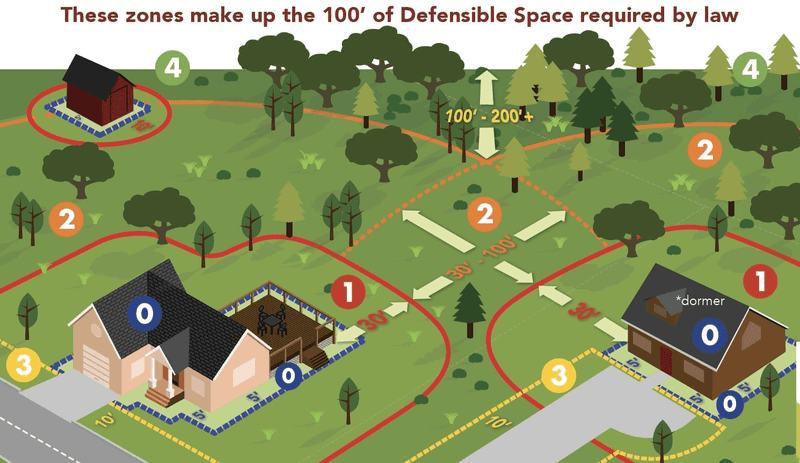
Once you step past the five-foot perimeter, the guidance shifts from a hard rule to managed use. California’s defensible space framework divides the land around a home into distinct zones, and Zone 1 runs approximately 5 to 30 feet from the structure, while Zone 2 extends from approximately 30 to 100 feet.
The exact distances can vary by jurisdiction and site conditions, so local fire district rules should always be confirmed separately.
In those outer zones, organic mulch is not automatically prohibited. UC ANR’s fire-network mulch guidance allows carefully selected combustible mulches in Zones 1 and 2, provided the beds are not laid as a continuous, unbroken fuel path from one end of the yard to the other.
The practical fix is to break planting beds apart with noncombustible features: a gravel path, a concrete stepping-stone strip, a section of rock, or a paved walkway that interrupts any potential fire run through the mulch.
Depth matters too. Updated UC ANR mulch guidance limits combustible mulch to no deeper than four inches in Zones 1 and 2.
A thick, fluffy layer of bark piled six or eight inches deep holds more fuel and can sustain smoldering longer than a shallow, well-maintained bed.
Material choice still matters in these outer zones. Composted wood chips and medium-sized bark chips are generally considered more appropriate than fine or shredded bark, because they tend to spread more slowly in fire tests and smolder rather than flame.
That said, they remain combustible. No organic mulch belongs against the structure itself, and none of the materials used in the outer zones should be described as fireproof.
Regular maintenance, including removing dry debris that accumulates on top of the mulch, keeps these beds from building up additional fuel between seasons.
Rock reduces fire exposure but changes the planting conditions
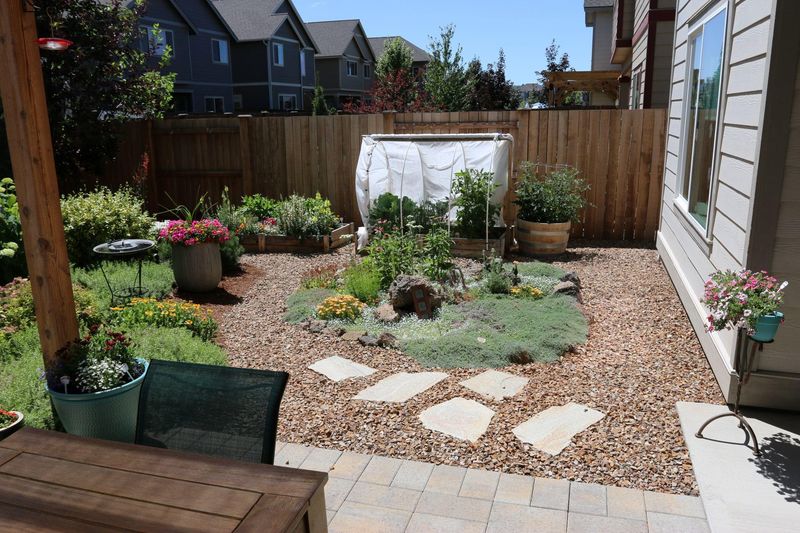
Gravel and rock are the right answer for the immediate perimeter around a structure, but they are not universally good mulch for every plant in a California yard. UC ANR’s fire-network mulch guidance is specific about this: inorganic mulches do not contribute organic matter or nutrients to the soil, and they can hold and radiate heat in a way that stresses plants growing in full sun.
The concern is most acute around trees. UC ANR cautions specifically about using rock mulch around California native oaks, where heat retention near the root zone can cause damage over time.
A valley oak or blue oak that has adapted to cool, organic duff around its roots does not benefit from a ring of gravel baking in July sun. UC Master Gardener guidance from Contra Costa County reinforces that rock mulch choices should account for plant exposure, drainage, and root conditions rather than treating gravel as a one-size solution.
For any plant that does receive organic mulch farther from the structure, keep the material several inches away from the trunk or shrub base. UC ANR guidance on organic mulch application recommends that clearance to reduce decay, pest pressure, and the concentration of combustible material directly at the plant’s base.
Mulch piled against a trunk also creates a moist environment that can harbor disease.
The practical approach is to use noncombustible surfaces where fire safety demands it and to match mulch type to plant needs where organic mulch is permitted. A drought-tolerant California native planted in a gravel border near the house may thrive.
A mature shade tree 25 feet from the structure may be better served by a shallow ring of composted wood chips kept well clear of the trunk, broken by a gravel path before it reaches any other combustible surface.
Several common mulch fixes do not remove the hazard
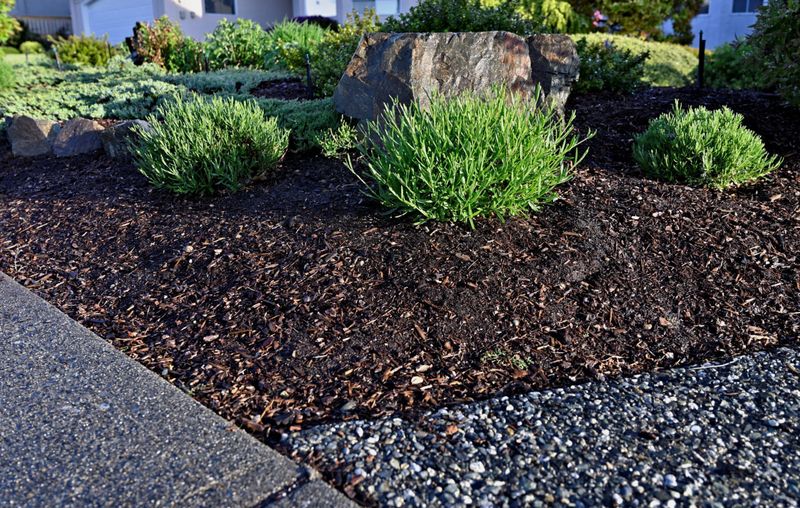
Some homeowners look for a workaround that lets them keep an organic or synthetic mulch right up against the house, and several popular options turn out to be unreliable. Rubber mulch is one of the most common substitutes people reach for because it is not wood.
UC ANR combustibility testing found that rubber mulch produced the highest average temperatures and greatest flame heights of all eight treatments tested. It is synthetic, but it is combustible, and its fire behavior was worse than any wood-based product in that study.
Fire-retardant-treated mulch is another product that sounds like a solution. UC ANR’s testing found that treatment delayed fire spread for roughly five to ten minutes in one test, after which the treated mulch behaved similarly to untreated material.
That brief delay is not a dependable substitute for removing combustible material from the immediate perimeter, and current UC ANR guidance does not recommend relying on treated mulch near a structure.
Watering the mulch bed before fire season or running drip irrigation during a red-flag warning is a strategy that sounds logical but has real limits. UC ANR fire-network mulch guidance notes that wildfire conditions can exhaust or restrict water supplies, drip irrigation may leave dry patches between emitters, and hot, dry, windy weather can dry mulch out before the fire arrives.
Moisture is not a reliable ember barrier under those conditions.
Compost also requires careful framing. A 2025 peer-reviewed California mulch study found that screened compost was the only tested product that did not ignite into smoldering combustion from firebrand piles within the test range.
That is a meaningful finding, but the same study found that every tested product could sustain flames under radiant heating, and the researchers found no clear difference in peak heat-release rate between composted and noncomposted products. Compost is not fireproof, and it does not belong directly against the structure as a substitute for gravel or pavers.
Use the five-foot perimeter as a starting line, not a finish line
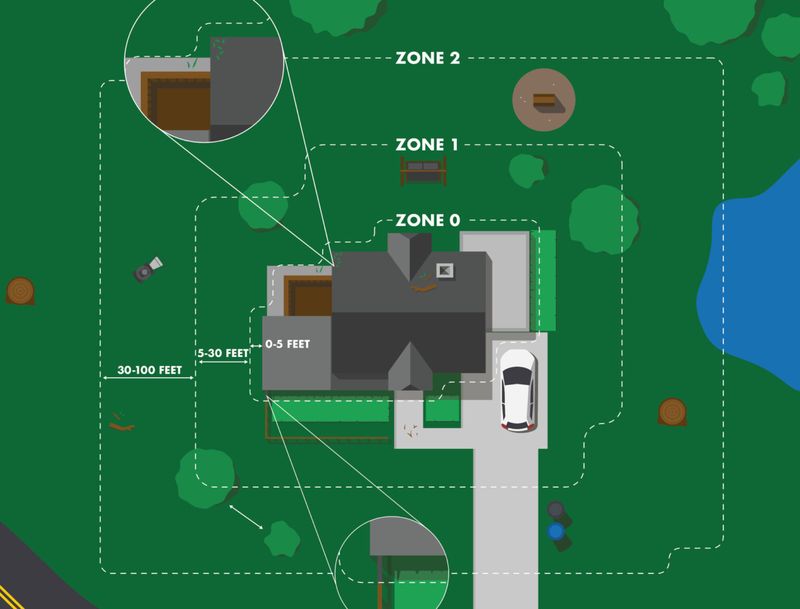
The most useful way to approach this project is as a sequence rather than a single task. Measure the first five feet from every wall, deck, porch, and attached structure.
Remove combustible mulch and accumulated debris from that strip. Install a noncombustible surface such as gravel, decomposed granite, pavers, or concrete.
Then turn attention to the planting beds beyond that perimeter and manage any permitted organic mulch with breaks, a depth limit of four inches, and regular debris removal.
Before treating that sequence as complete, check the rules that apply specifically to your address. California’s defensible space zone requirements already apply in State Responsibility Areas and Very High Fire Hazard Severity Zones, and local governments, fire districts, and counties may impose stricter standards on top of them.
A call to your local fire district or a quick check of county weed-abatement rules can confirm what your property actually requires.
California’s Board of Forestry approved new Zone 0 regulations in 2024, including a prohibition on mulch and wood chips within five feet of a structure, but the Board’s own announcement notes that the package still must complete the remaining legal process before becoming effective statewide. Verify the current status before citing it as binding law.
Mulch removal is a meaningful step, but it is one part of a larger picture. Safer from Wildfires identifies roofs, vents, gutters, decks, fences, windows, and eaves as additional ignition pathways that affect whether a home survives an ember shower.
The five-foot perimeter is where to start, not where the work ends. A yard that has earned a noncombustible edge is more resistant than it was yesterday, and that is a real gain worth building on.