
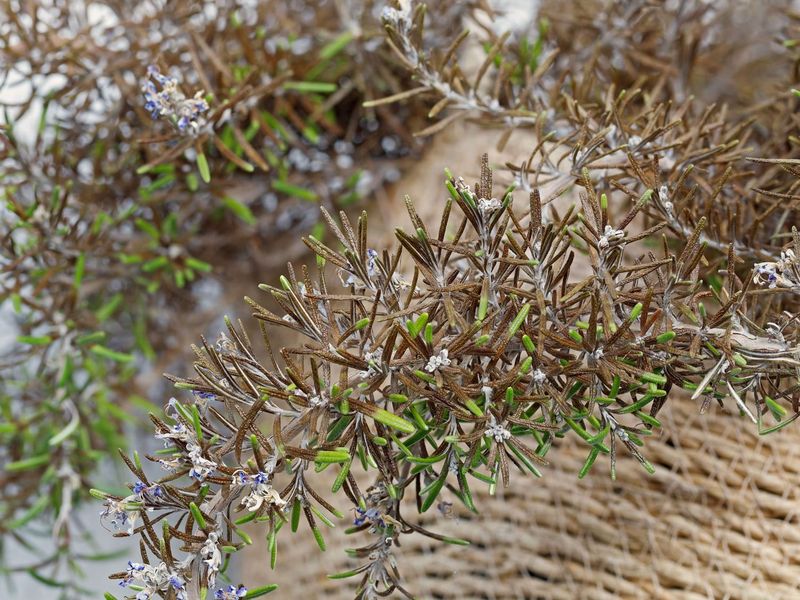
Plenty of California gardeners walk outside one morning and notice that their rosemary looks fine on the outside but has gone brown and bare in the middle. Before you grab the pruning shears or turn on the hose, it helps to know what you are actually looking at.
Brown rosemary centers have several possible causes, and the right response depends entirely on which one you are dealing with.
The brown middle does not identify one problem
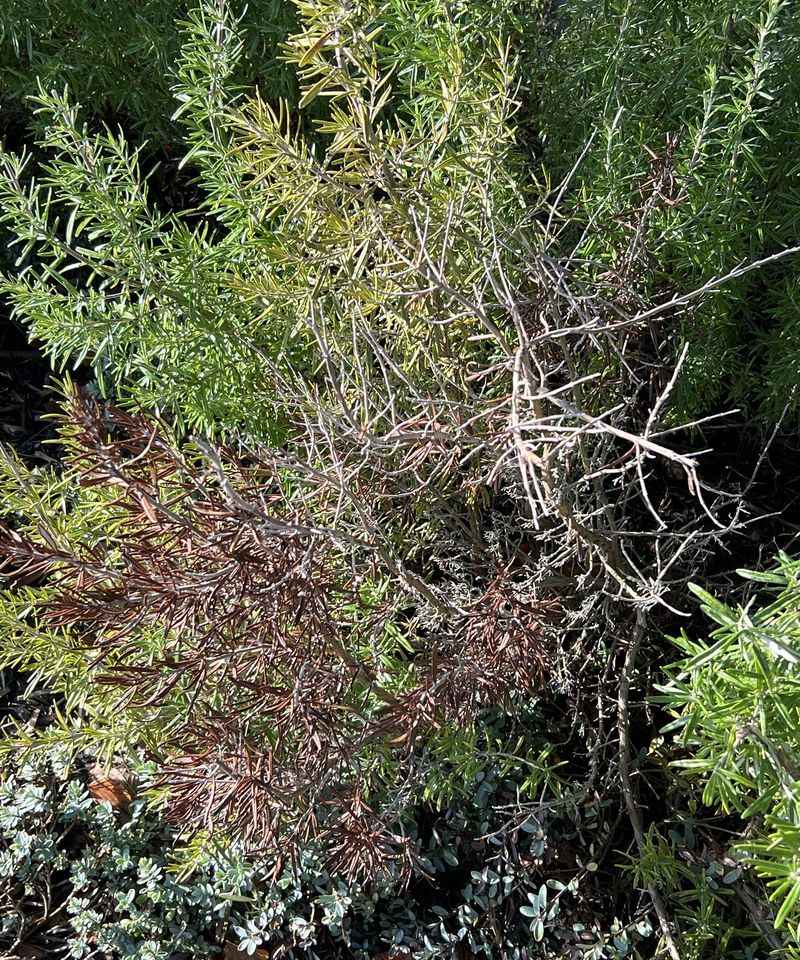
Seeing brown in the center of your rosemary is worth a careful look before you do anything else. The way that browning appears, how quickly it developed, and what the surrounding stems look like will tell you far more than the color alone.
Pulling back the outer branches and spending a few minutes inspecting the plant can save you from a pruning mistake or an unnecessary irrigation change.
A gradual, leafless, woody interior surrounded by healthy green outer stems is a very different situation from browning that showed up quickly, is spreading along branches, or comes with wilting or soft dark tissue near the base. UC Master Gardeners note that rosemary can become bare and woody in the center while outer growth stays vigorous, which is a structural pattern rather than a sign of active decline.
Those two scenarios call for completely different responses.
The same visual description, brown in the middle, can actually reflect several different problems. Ordinary interior woodiness from age and shade, drought stress, excess moisture, poor drainage, root or crown disease, stem cankers, physical breakage, and cold injury can all produce similar-looking results.
UC IPM guidance on Phytophthora root and crown rot and UC IPM information on stem cankers and dieback both describe symptoms that can look like straightforward browning from the outside.
Rapid browning that appears over a few days, dieback that moves from one branch into the main stem, or persistent wilt even when the soil is moist all suggest something beyond a woody center. Extension diagnostic guidance on browning rosemary reinforces that a careful look at the pattern and the surrounding conditions is the right starting point.
Rushing to prune or water without that inspection risks making the underlying problem harder to address.
Why a dense rosemary shrub goes bare inside
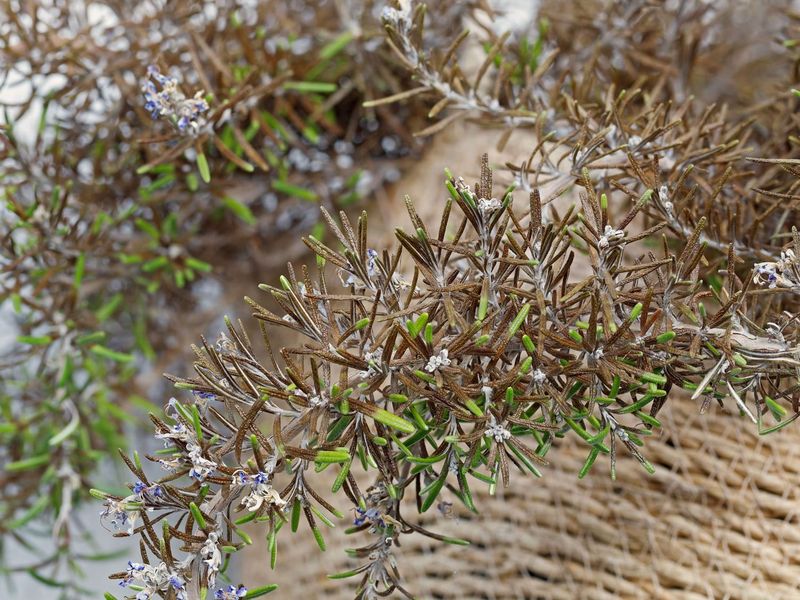
Rosemary grows from the outside in. As the shrub ages and the canopy thickens, the outer stems capture most of the available sunlight while the interior gradually receives less and less.
Leaves on those inner branches eventually drop off because they are not getting enough light to sustain themselves, leaving behind bare, woody stems that look brown and dead even when the plant as a whole is still healthy and growing.
Healthy green growth around the outside of the plant is actually meaningful evidence here. It tells you the root system is working, the plant is taking up water and nutrients, and the outer stems are still actively growing.
UC Master Gardeners specifically describe this pattern of bare, woody stems in the center with leafy growth on the outside as a natural result of the shrub’s aging and density, not as evidence of a watering failure or neglect.
That said, lack of regular light pruning over the years can accelerate how quickly the center goes bare. Skipping maintenance does play a role, though it is not the only factor.
Age, the natural density of the variety, and how much shade the plant receives from nearby structures or other plants all contribute. RHS growing guidance for rosemary notes that annual light trimming helps keep more leafy growth on the plant, though it cannot fully prevent interior woodiness as the plant matures.
Understanding this pattern matters because it shifts the response. A shrub that has simply become woody inside while staying vigorous on the outside is a candidate for selective thinning, which is a limited but appropriate tool.
It is not a plant in crisis, and it does not automatically need more water, fertilizer, or an aggressive renovation.
When selective thinning makes sense
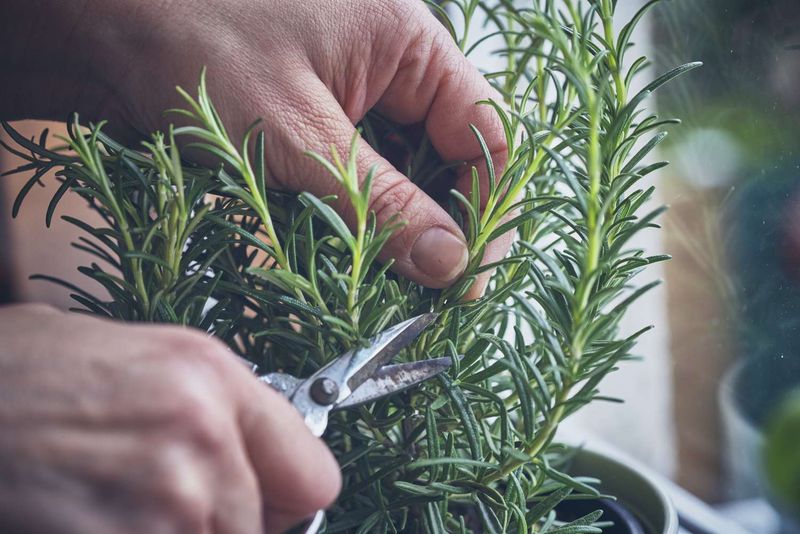
Selective thinning is the right tool when your rosemary has a woody, bare center but the outer stems are still green and actively growing. The goal is to open the interior slightly, improve airflow, and remove the oldest, most crowded stalks, not to reshape the entire plant or force new growth from dead wood.
Going in with a clear, limited objective makes this a manageable task rather than a risky renovation.
Start by identifying two or three of the oldest, thickest interior stalks that have no leafy growth on them. Trace each one back toward the base and look for the nearest point where a healthy side branch or a section with green leaves is growing.
That junction is your cut point. UC Master Gardeners recommend removing selected stalks back to live growth when the center has become bare and woody, rather than shearing the whole plant.
Use clean, sharp bypass pruners and make each cut just above a leafy side branch or a node showing green tissue. Avoid cutting flush to the main crown unless a stalk is completely dead all the way down.
Remove only a few stems per session rather than stripping the interior in one pass. Spacing the work over several months, if the plant is large and dense, puts less stress on the shrub than a single aggressive thinning.
After thinning, step back and look at the plant from a few feet away. The center may look more open, and light can now reach stems that were previously shaded.
Whether those remaining stems push out new leafy growth depends on whether they still carry any green tissue. Thinning can improve the structure of a vigorous shrub, but it does not guarantee that a bare center will fill back in with green leaves.
Setting that expectation before you start keeps the result from feeling like a disappointment.
Why a hard haircut can leave rosemary worse
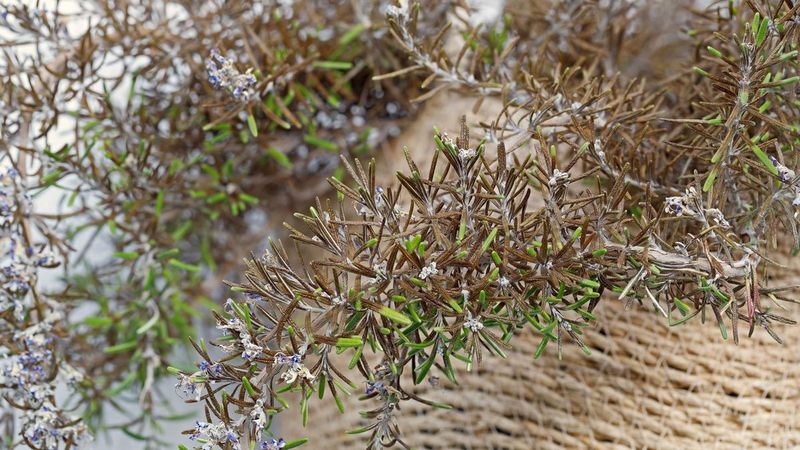
Shearing a rosemary plant all the way back into bare, old wood is one of the most common and damaging responses to a brown center. The instinct to cut everything down and start fresh makes sense for some plants, but rosemary does not generally work that way.
Once you remove all the green tissue and leave only leafless mature stems, the plant has very little to work with.
Both UC Master Gardeners and RHS rosemary growing guidance are consistent on this point: new green growth does not reliably emerge from completely bare, old wood. The RHS specifically advises light annual trimming and notes that old, straggly rosemary often does not recover from heavy pruning.
Cutting deep into leafless stems is more likely to finish off a struggling plant than to revive it.
A severely bare plant, one where the outer stems have also thinned out or where disease has moved through much of the canopy, is a different situation from a woody-centered plant with vigorous outer growth. For a plant that has lost most of its leafy tissue, aggressive pruning removes the last material the plant could use to sustain itself.
Replacement or propagation from healthy cuttings taken from whatever green growth remains is often the more practical path forward.
Taking cuttings is straightforward. Look for stems with green, flexible tips and no signs of disease or canker.
Cut a four- to six-inch section just below a leaf node, strip the lower leaves, and root the cutting in well-draining mix. A new plant grown from a healthy cutting of your original rosemary will establish faster than a severely pruned stump trying to regrow from bare wood.
Check soil and drainage before adding water
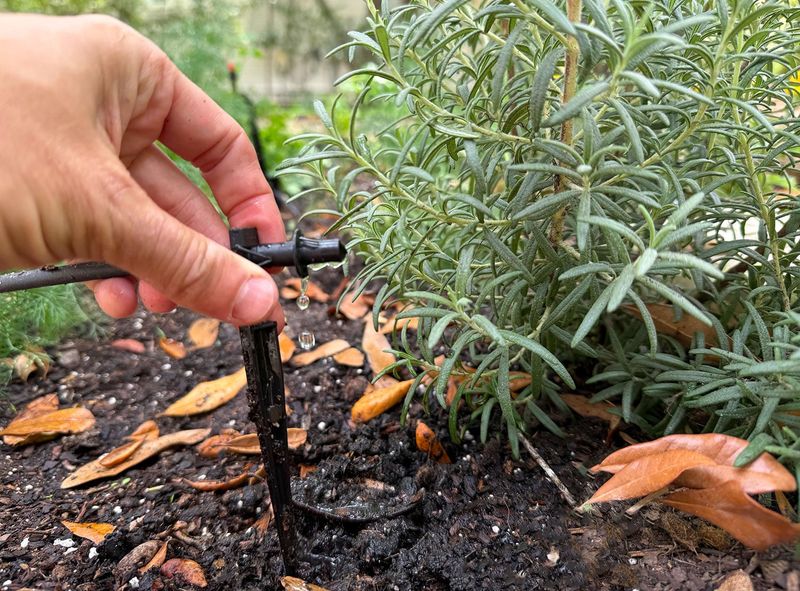
California’s dry climate can push gardeners toward one of two opposite mistakes with rosemary: watering too little in an exposed, sun-baked spot, or watering too much and creating the saturated soil conditions that damage roots. Before you change anything about your irrigation, take a few minutes to check what the soil is actually doing.
Push your finger two to three inches into the ground near the plant and feel whether the soil is dry, moist, or still wet from the last watering.
UC guidance on rosemary care says to let the soil dry between waterings and notes that overwatering can cause brown leaf tips and may indicate root rot. Rosemary needs well-drained soil and does not tolerate sitting in saturated ground.
If the soil near your plant stays wet for days after irrigation, the drainage situation matters as much as the watering frequency.
How much water your rosemary actually needs also depends on its age and location. Sonoma County UC Master Gardeners explain that rosemary becomes drought tolerant after about one year in the ground, though plants in very sunny or exposed locations may benefit from occasional summer irrigation.
Newly planted rosemary is a different story entirely: it needs regular water while its roots establish, and treating a young plant the same as a five-year-old established shrub can stress it significantly.
Check where your sprinkler heads or drip emitters are aimed. Repeated water hitting the crown or lower stems of the plant raises the risk of crown and root problems over time.
Adjust emitters so water reaches the root zone rather than the base of the stem. UC IPM identifies improper irrigation placement and poor drainage as significant risk factors for root and crown rot in landscape plants.
Fertilizer is not a useful tool here either. Established rosemary does not require it, and adding nutrients will not correct a shade, drainage, or irrigation problem.
Warning signs that point beyond old interior wood
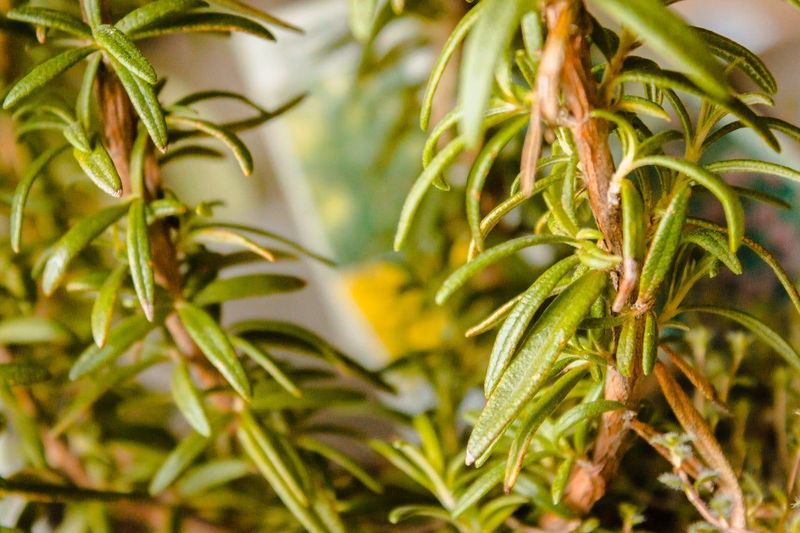
Some rosemary problems look like a woody center at first glance but are actually something more serious. Knowing the specific warning signs that separate ordinary interior aging from active disease or root trouble can prevent you from applying the wrong fix and losing a plant that might have been saved with a different approach.
Rapid browning that appears over a few days rather than gradually over months is one of the clearest signals to pay attention to. So is persistent wilting even when the soil is wet, or browning that moves along individual branches from tip toward the base rather than sitting quietly in the interior.
UC IPM’s resource on Phytophthora root and crown rot describes prolonged wet soil, poor drainage, and irrigation mismanagement as major risk factors, and associates the disease with crown and upper-root tissue that appears darkened or mushy when examined closely.
If you gently scrape or press the tissue at the base of the stem where it meets the soil and find dark, soft, or discolored material, that is a meaningful clue worth acting on. Correcting the irrigation and improving drainage are the first steps, not pruning.
Adding water to a plant already suffering from wet-soil root damage will make the situation worse, and fungicide is not a reliable standalone solution. UC IPM emphasizes that drainage and water management are the foundation of managing Phytophthora, not chemical treatments.
Branch lesions are a separate concern. A sunken, cracked, discolored, or oozing wound on a rosemary stem may indicate a canker.
UC IPM’s guidance on stem cankers and dieback explains that cankers can girdle a branch, cutting off the flow of water and nutrients so that all the foliage above the lesion turns brown. When you find a canker, prune below the visibly affected tissue, cutting into healthy wood, and dispose of the removed material rather than leaving it in the bed or compost.
Extension diagnostic guidance on browning rosemary cautions that fungicide will not necessarily benefit blight-type problems, so focus on removing affected tissue and correcting conditions that favor disease.
Light maintenance may help limit future woodiness
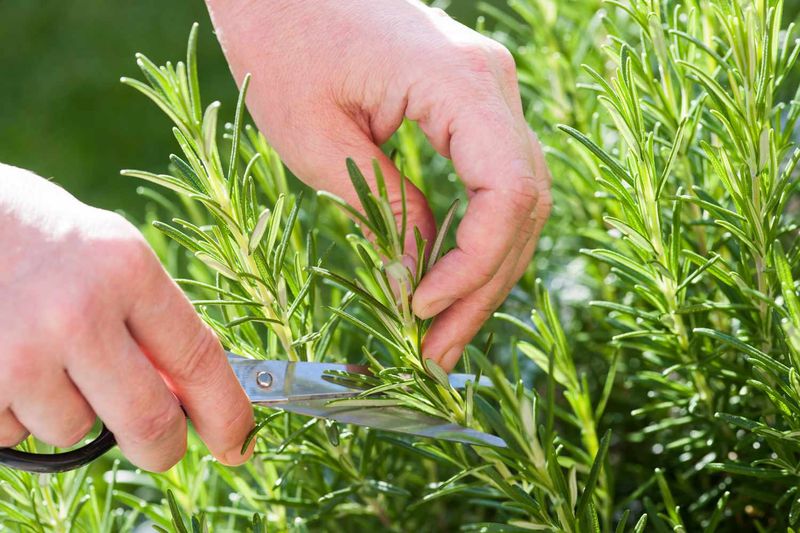
Keeping rosemary from going bare in the center is easier than trying to reverse it after the fact. Light, regular pruning gives the plant its best chance of staying leafy deeper into the canopy, though no maintenance routine can fully prevent interior woodiness as a rosemary shrub ages and thickens.
Setting that realistic expectation upfront keeps the work from feeling like a failure when some woodiness still develops over time.
RHS growing guidance for rosemary recommends trimming lightly after flowering or during active growth rather than waiting until the plant becomes overgrown. Harvesting young stem tips regularly for cooking also encourages the plant to branch and stay leafy, since each tip you remove prompts the stem below it to push out new side growth.
A UC Davis rosemary fact sheet supports regular harvesting of young tips as part of keeping the plant productive and well-branched.
Watering and fertilizing decisions should follow the plant, the soil, and the site rather than a fixed calendar. UC Marin rosemary guidance states that established rosemary does not require fertilizer.
Applying it anyway will not compensate for shade, poor drainage, or aging, and excess fertility can actually encourage lush, soft growth that is more vulnerable to disease. Irrigation timing and frequency should reflect soil moisture, drainage, sun exposure, and whether the plant is newly established or has been in the ground for several years, as Sonoma County UC Master Gardeners note when distinguishing newly planted from established rosemary needs.
Measure success by whether the plant continues to grow, stays structurally sound, and produces healthy leafy stems on the outside. A plant that does all of that, even with some bare wood in the center, is a plant that is doing its job well.
Match the action to the tissue and symptoms
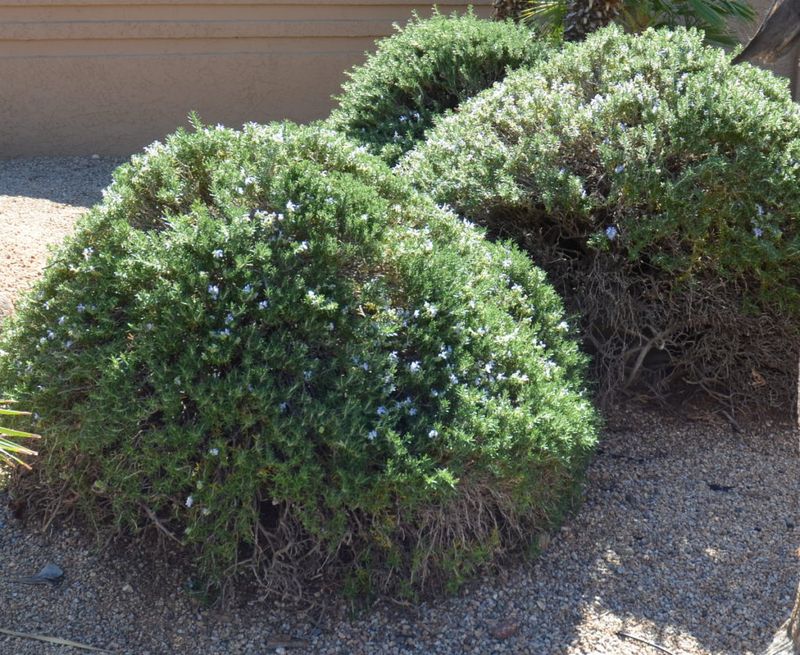
Before reaching for pruning shears or turning on the irrigation, look at the whole picture. UC Master Gardener guidance on rosemary makes a clear distinction between a plant with a woody, shaded interior and one experiencing active decline.
If the outer stems are green and growing and the brown material is old, leafless wood that has been there a while, selective thinning of a few interior stalks back to live leafy growth is a reasonable, limited response.
If the browning appeared quickly, is spreading along branches, involves wilting, or is paired with wet soil or lesions on the stems, the problem is not a woody center. Check soil moisture and drainage first, inspect the crown and upper roots for darkened or soft tissue, and look for canker lesions on branches.
UC IPM root and crown rot resources and UC IPM stem canker guidance both point toward irrigation and drainage correction as the foundation of any response to those problems.
Some rosemary plants need reshaping more than rescuing. A severely bare or diseased plant may not respond to aggressive pruning, and replacement or propagation from healthy cuttings is sometimes the more honest next step.
A rosemary that is still vigorous and green on the outside simply needs a thoughtful trim, not a dramatic intervention.