
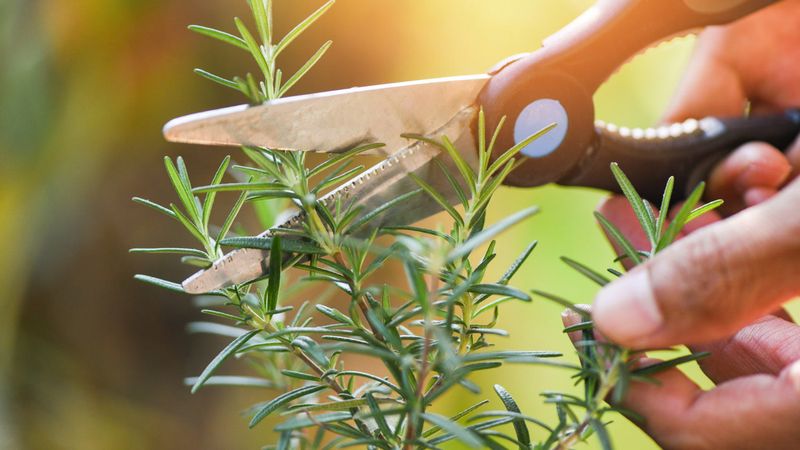
Rosemary is one of the most forgiving plants you can grow in a California yard, but a lot of gardeners watch their once-lush shrubs slowly turn into a tangle of bare, brittle sticks and wonder what went wrong. The answer is usually not about water or fertilizer.
A simple, repeated pruning habit, started early and kept up over time, is the best-supported practice for keeping rosemary fuller and greener as it ages.
Some Woodiness Is Normal for Rosemary
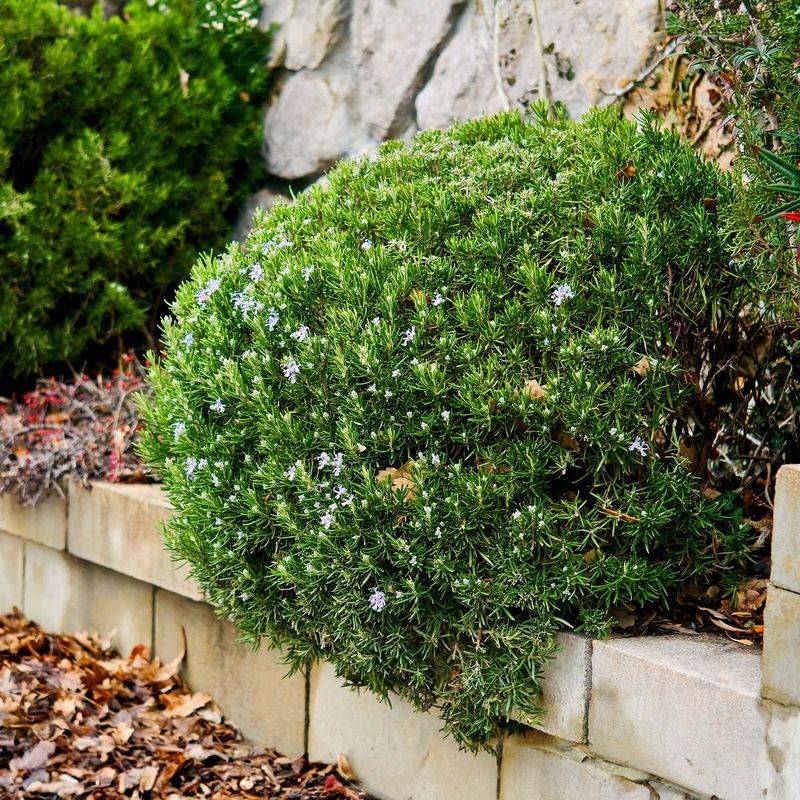
Rosemary is not a soft-stemmed herb that stays perpetually green from root to tip. UC Master Gardeners in Sonoma County classify it as a woody perennial or evergreen subshrub, which means forming woody lower stems is simply part of how the plant matures.
Seeing some brown, bark-covered wood at the base of an older plant is not automatically a sign that something went wrong.
The concern worth paying attention to is a different picture entirely. Long, arching branches that are bare for most of their length, a brittle hollow center with almost no green, sparse foliage concentrated only at the tips, and a plant that has lost its dense rounded or spreading outline, those are the signs that the plant’s productive leafy framework is shrinking.
At that point, the plant is not just aging naturally; it is losing the green growth it needs to stay useful and attractive.
UC Master Gardeners in Santa Clara County note that rosemary prefers full sun and well-drained soil, and that it is a woody plant by nature. Understanding that distinction matters before reaching for any tool or remedy.
The goal of regular pruning is not to turn rosemary into something it is not, permanently herbaceous and stem-free. The real goal is to preserve as much green, branching growth as possible for as long as possible, while accepting that some mature wood at the base is a normal part of the plant’s life cycle.
Framing the problem correctly changes how you approach care. You are not correcting a mistake or reversing damage when you prune.
You are working with the plant’s natural growth pattern to encourage it to keep producing leafy, branched stems rather than long bare ones.
Regular Light Tip Pruning Supports Fuller Growth
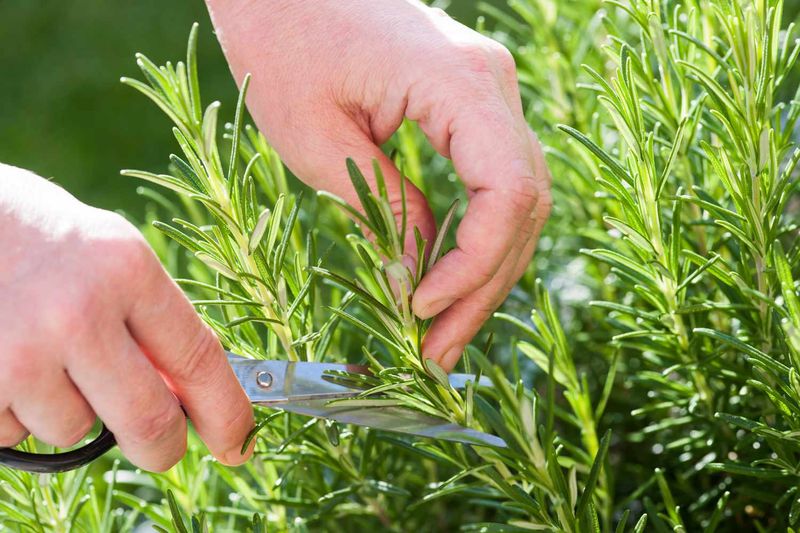
The maintenance habit with the strongest backing in university extension guidance is straightforward: trim the leafy green ends of rosemary regularly, rather than waiting until the plant looks unruly. UC IPM’s cultural tips for rosemary recommend regular harvesting or pruning specifically because it encourages new growth.
When you cut a green tip, the stem tends to branch at or near that point, producing two or more shorter stems where one long one existed before.
That branching response is what builds density over time. A plant that gets light tip cuts several times a year develops a tighter, leafier framework.
A plant that goes years without any trimming sends its energy into extending long branches, and those branches gradually become bare and woody along most of their length as the foliage retreats toward the tips. By the time the bare sections are obvious, there are fewer good places left to make a useful cut.
UC IPM’s rosemary plant guide advises pinching or trimming tips on young plants to encourage bushiness, and continuing with light cuts on mature plants to maintain shape. UC Master Gardeners in Sacramento County similarly recommend pruning rosemary tips while plants are young and continuing the practice on older plants.
Harvesting sprigs for cooking counts as pruning when done consistently. Regularly snipping the longest leafy branch tips for the kitchen gives the plant essentially the same maintenance benefit as shaping it with shears, as long as you are cutting into green growth and doing it often enough to keep up with the plant’s extension.
The key word is regular. One big cutback every few years does not replicate the branching effect of frequent, light harvesting throughout the growing season.
Cut Into Green Growth, Not Bare Wood
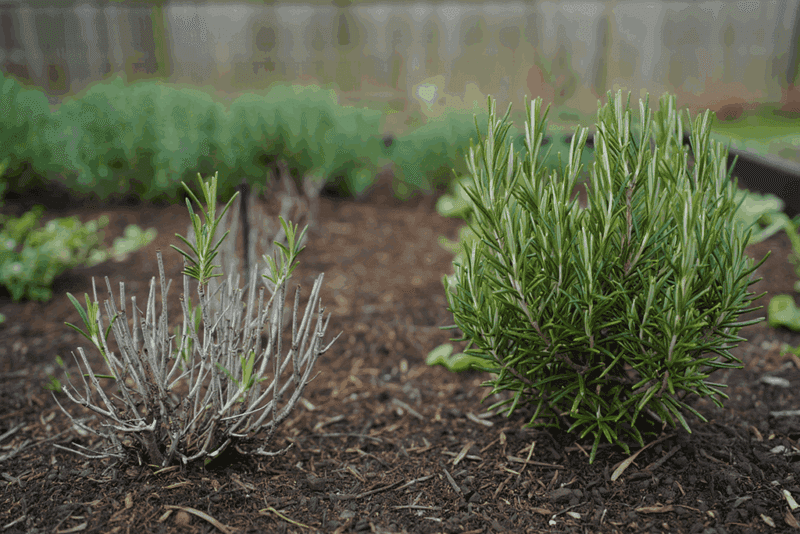
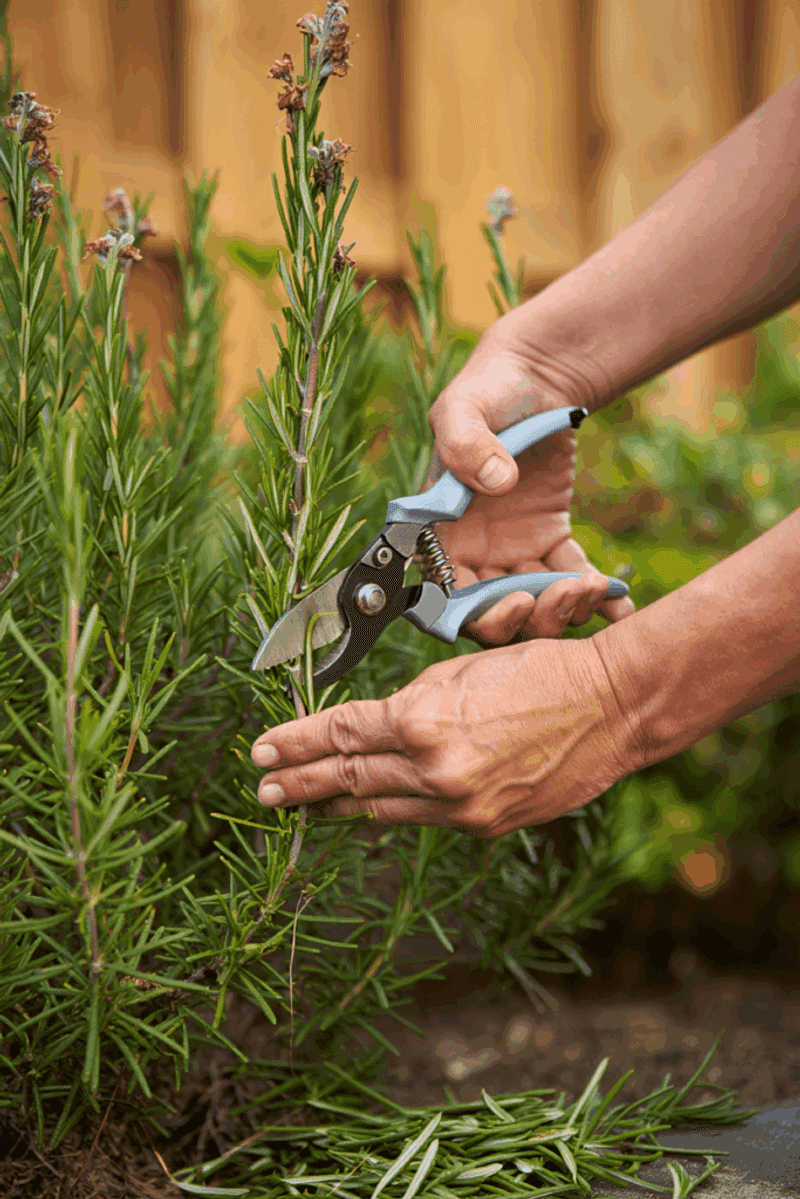
Knowing where exactly to place each cut makes a significant practical difference. The rule to follow is simple: shorten a leafy branch back into a section that still has green foliage below the cut.
When you do that, the remaining stem has living tissue and leaf nodes from which new side shoots can emerge. The plant has a good chance of filling back in around that cut point.
A cut that lands in a thick, leafless section of old wood is a different situation entirely. UC Master Gardeners in Sonoma County are direct on this point: rosemary stems should not be cut hard into thick bare wood.
UC Master Gardeners in San Luis Obispo add that new green growth does not develop reliably from woody stalks. That means a cut made too far back into a bare section may leave a permanent stub with nothing to fill it in, rather than a branching response.
For young plants, the technique is even simpler. Pinch or snip just the soft growing tip of each branch, a few inches at most.
Do this across the whole plant as it develops and it will naturally branch into a denser shape before bare lower stems become a problem. UC IPM’s rosemary guide recommends this tip-pinching approach specifically for encouraging bushiness in younger plants.
On a mature plant, look at each branch individually rather than shearing the whole surface at once. Find where the leafy green growth transitions to thinner, still-green stem, and make your cut there or slightly into the green-stemmed zone.
Avoid running shears across the entire plant indiscriminately, because that approach often sends cuts into bare wood on the inner branches where the foliage is sparse. Selective cuts, made with attention to where green tissue actually exists, give the plant the best chance to respond well.
Small, Repeated Cuts Protect the Leafy Framework
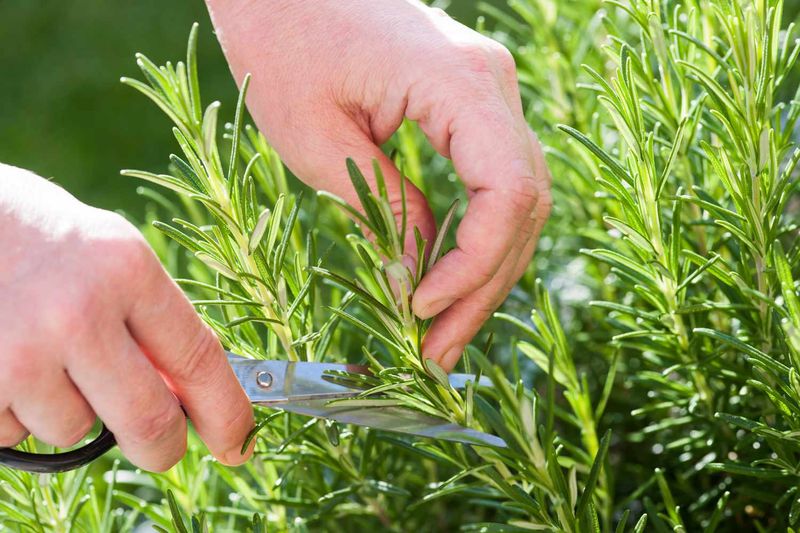
Frequency matters as much as technique. Making small cuts several times throughout the year keeps the plant’s leafy framework intact, while waiting until the plant looks seriously overgrown before acting often means removing too much at once or cutting into sections that cannot recover.
Think of it as regular upkeep rather than an occasional event.
A conservative guideline used by several UC extension programs is to remove no more than about one-third of the plant at any single session. UC Master Gardeners in San Luis Obispo County apply this one-third limit specifically to rosemary, and UC Master Gardeners in Contra Costa County offer the same one-third guideline as a general rule for healthy plants.
Treating it as a rough upper boundary rather than a precise formula is sensible, since every plant, climate, and situation differs.
Starting the habit on a young plant is far easier than trying to restore an old one. UC Master Gardeners in Sacramento County recommend beginning tip pruning while the plant is still developing, so the branching framework builds from the start.
An established plant that has been trimmed lightly and regularly will have many more green, productive stems to work with than one that was left alone for years and then cut back hard.
Practically speaking, a good rhythm might mean trimming the longest, most extended branches every month or two during active growth periods, harvesting sprigs for cooking whenever the plant produces long new shoots, and doing a light shaping pass after flowering. None of those sessions needs to be dramatic.
The cumulative effect of many small cuts over time is what preserves the plant’s density, not a single aggressive pruning session.
Time Pruning Around Flowering and Local Conditions
Timing a pruning session well depends more on your plant and your local climate than on a single statewide calendar date. California’s coastal, inland valley, and desert climates differ enough that “prune now” is not useful advice without knowing where you are and what your plant is currently doing.
For gardeners who want to preserve the flowering display, the clearest guidance is to prune after the main bloom period or once flowers have faded. UC Master Gardeners in Sacramento County recommend pruning rosemary after its main bloom period, which in many parts of California falls in late winter through spring.
The Royal Horticultural Society similarly recommends light annual trimming after flowering to maintain shape without cutting off developing buds.
When flowers are not a priority, light shaping can be more flexible. UC Master Gardeners in San Luis Obispo County note that the best time to prune is generally when the plant is actively growing and can recover, which in most California climates means avoiding the coldest or driest stress periods rather than following a fixed date.
UC IPM’s rosemary cultural guide distinguishes between planting zones including the North Coast, South Coast, interior valleys, and desert valleys, underscoring that regional conditions shape what a plant is doing at any given time. Watch your own plant.
If it is actively producing new green tips, that is a good signal that a light trim will be well tolerated. If it is stressed by heat, drought, or recent transplanting, hold off and let it stabilize first.
An Already Leggy Plant Needs Selective Renovation
A rosemary plant that already has a bare, brittle center and leafy growth only at the outermost tips presents a different challenge than a young plant being shaped for the first time. Selective renovation can help in some cases, but the realistic outcome depends on how much productive green growth is left.
If the plant still has healthy leafy branches coming from a bare center, one useful approach is to remove some of the most unproductive stems at their base entirely. UC Master Gardener guidance on rosemary care describes selectively removing old or crowded stems to open the plant and allow remaining productive branches more light and airflow.
This is renovation, not a promise that the removed stems will resprout. The aim is to redirect the plant’s energy into the branches that are already green and leafy.
When most of the plant consists of thick, leafless, brittle wood with very little green remaining, the honest answer is that pruning is unlikely to reverse the situation. The Royal Horticultural Society states plainly that old, straggly rosemary generally does not recover from heavy pruning and is usually best replaced.
University of Arizona extension guidance adds that rosemary is not a good candidate for severe rejuvenation cuts, because thick older stems without foliage may not initiate new shoots.
UC Master Gardeners in Sonoma County recommend propagating rosemary from nonflowering cuttings as a practical path forward when a plant is past the point of useful renovation. Taking cuttings from the healthiest green tips of the existing plant, rooting them, and growing a new plant gives you a younger, more manageable rosemary without the bare-wood problem.
Replacement or propagation is not a failure; for a severely bare plant, it is simply the more reliable option.
Water and Fertilizer Are Separate Health Questions

When rosemary starts looking sparse or woody, two common instincts are to water it more or give it fertilizer. Neither addresses the actual issue, and both can create new problems if applied incorrectly.
Established rosemary is drought tolerant and generally needs little irrigation once its root system is developed. UC IPM’s rosemary care guidance confirms that established plants need minimal water, while newly planted rosemary does need regular irrigation while roots are getting established.
The distinction matters. Overwatering a plant that does not need it, or placing it in soil with poor drainage, creates conditions that can cause root and crown rot rather than lusher growth.
UC IPM’s guidance on Phytophthora root and crown rot identifies overwatering and poor drainage as primary contributors to that disease, which can kill rosemary from the roots up.
Fertilizer is a similarly poor substitute for pruning when it comes to managing plant form. UC Master Gardener rosemary guidance notes that established rosemary generally needs no routine fertilizer.
The plant is well adapted to lean, well-drained soils and does not require regular feeding to stay healthy. UC IPM’s guidance on fertilizing woody plants warns that excessive fertilizer can promote weak, excessive growth and may injure roots or cause foliage burn.
Pushing a plant with unnecessary nutrients does not produce the compact, branched shape that regular pruning builds over time.
Neither extra water nor fertilizer treats normal mature wood or compensates for the branching response that only comes from making cuts in the right places. They are separate health considerations with their own appropriate uses, not replacements for the pruning habit that keeps rosemary’s green framework intact.
California Placement Adds a Fire-Safety Responsibility

Rosemary’s drought tolerance makes it a popular choice for water-wise California landscapes, but drought tolerance and fire resistance are not the same quality. Confusing the two can lead to poor placement decisions in areas where wildfire risk is a real concern.
UC fire-scaping guidance and related UC fire-safe landscaping resources identify rosemary as a plant that can ignite readily because of its aromatic oils and the dry material that accumulates in its interior. A plant with a lot of dead, dry inner stems, exactly the kind of buildup that results from years without pruning, adds to that concern.
Pruning to maintain a fuller, less cluttered plant can reduce the amount of dry accumulated material, but shaping rosemary for appearance does not replace the broader fire-safety maintenance that California homeowners in wildland-interface areas are responsible for.
CAL FIRE’s defensible space guidelines require removing dead and dry vegetation, maintaining separation between shrubs and trees, and following local requirements that may be stricter than state minimums. Those rules apply regardless of how well-pruned your rosemary looks.
Gardeners in fire-prone settings should treat plant placement, spacing between shrubs, and regular removal of dead material as obligations that sit alongside, not inside, their regular pruning routine.
For homeowners in lower-risk areas, this section is less urgent but still worth knowing. Rosemary is a useful, beautiful plant for California yards, and managing it well includes understanding what it actually is, an aromatic, oil-rich woody shrub, rather than assuming its water-wise reputation extends to fire safety.
Start With the Next Green Tip
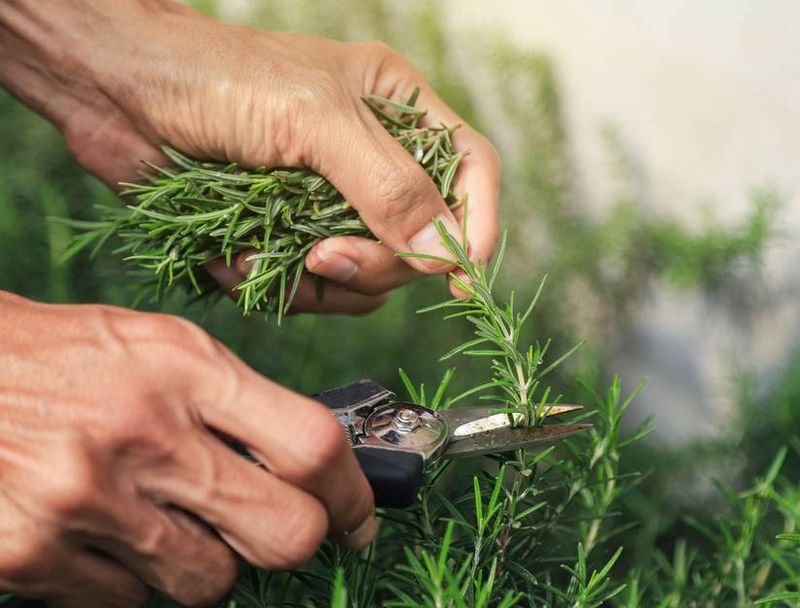
Getting started does not require a full plan or a perfect day. Find a branch on your rosemary that has extended beyond the plant’s general outline and still has leafy green growth along its length.
Make a light cut back into that green section, leaving foliage below the cut, and move on to the next branch. That is the whole technique.
UC IPM’s rosemary guidance recommends trimming sprigs from the longest branch tips as a simple, repeatable starting point. Do not try to reshape the entire plant in one session.
Make a few cuts, step back, and let the plant show you how it responds over the following weeks before cutting again.
Skip the bare, thick, inner stems. UC Master Gardeners in Sonoma County are clear that those sections are unlikely to produce new growth, and forcing cuts there does more harm than good.
Work only where green tissue exists, and repeat the practice across multiple sessions through the growing season.
Regular light pruning can help rosemary stay fuller and greener over time, but some mature wood at the base remains part of the plant’s normal life cycle, and timing should always reflect what your local climate and your specific plant are actually doing. A rosemary that gets consistent, thoughtful attention from an early age will simply have more green to work with, for longer, than one that is left alone and then cut back in frustration.