
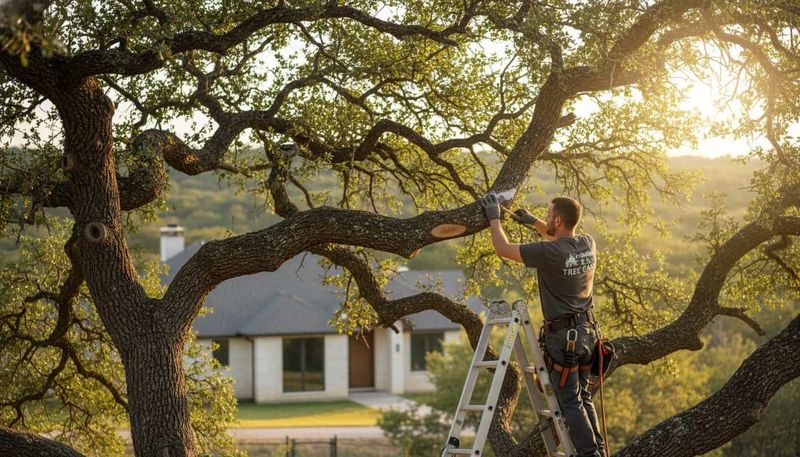
Seeing your oak drop leaves, turn brown, or look generally rough during a Central Texas heat wave can make the urge to grab the pruning saw almost irresistible. Before you make a single cut, though, there are two separate problems worth understanding: what extreme heat does to a tree, and how oak wilt actually spreads.
Getting those two things mixed up is exactly how well-meaning homeowners end up making a stressed tree worse.
A heat warning is not an oak-wilt warning
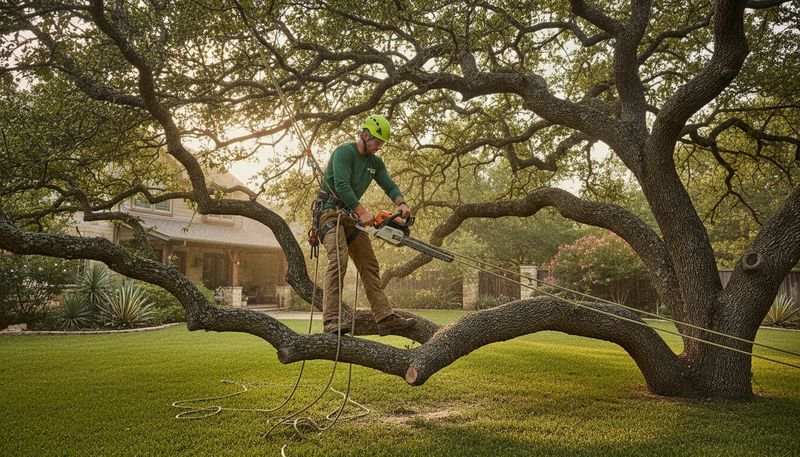
When the National Weather Service issues a heat warning, the alert is aimed squarely at people. NWS non-precipitation advisory definitions are based on dangerous heat-index conditions for humans, not on any measure of tree stress, beetle activity, or fungal spread.
A heat warning tells you to stay cool and hydrated – it says nothing about whether your oak is infected, whether sap-feeding beetles are active, or whether a fresh cut would lead to disease.
That distinction matters because the two concerns – summer heat stress and oak-wilt risk – operate on different timelines and through different mechanisms. Oak wilt is caused by the fungus Bretziella fagacearum, and its spread depends on pathogen sources, fresh wounds, sap-feeding beetle vectors, and underground root connections among neighboring trees.
Texas A&M Forest Service oak-wilt guidance identifies the roughly February-through-June window as the period of highest routine transmission risk, when beetle and fungal-mat activity peaks – not the hottest weeks of July and August.
High summer temperatures can actually reduce fungal-mat and beetle activity, which lowers the immediate oak-wilt transmission risk compared with spring. That does not make summer a good time to prune.
Texas A&M Forest Service stress guidance specifically advises avoiding unnecessary pruning when a tree is already stressed, because cutting removes living canopy and can hinder recovery. The useful rule is straightforward: postpone nonessential pruning when an oak is heat- or drought-stressed, and evaluate oak-wilt risk separately by considering the season, local disease presence, wound exposure, and root connections – not by the day’s heat index.
Why pruning can worsen heat stress
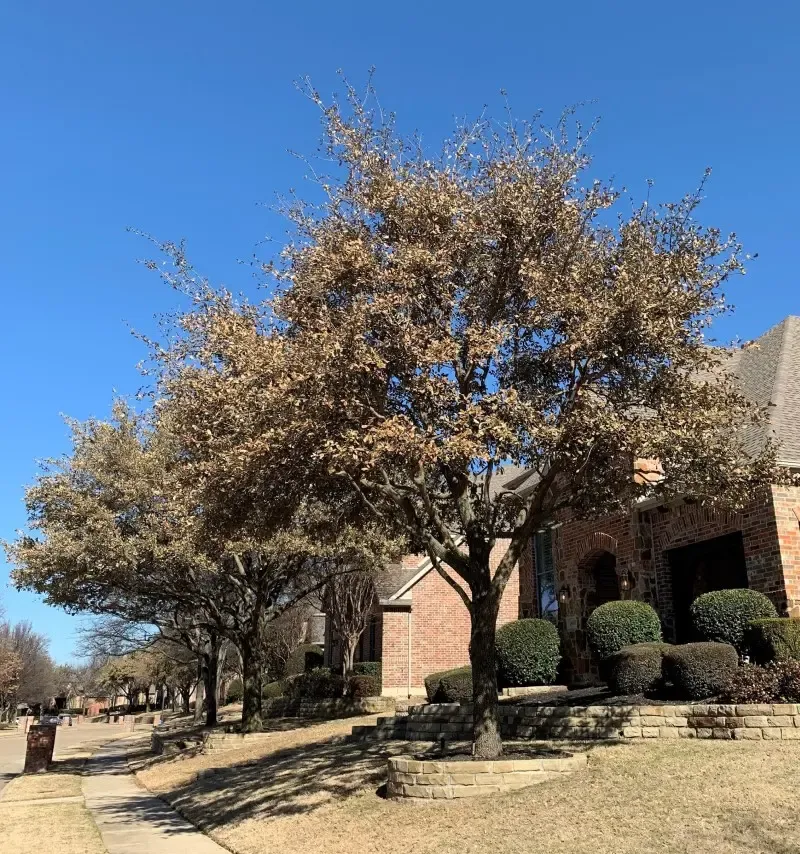
An oak’s leaves are solar panels. Every branch and leaf cluster removed during extreme heat is photosynthetic capacity the tree can no longer use to produce the sugars it needs for root maintenance, wound repair, and general survival.
Removing canopy during drought or high heat reduces the tree’s ability to recover from the stress it is already experiencing – which is the opposite of what most homeowners intend when they reach for the pruning saw.
There is a second, less obvious problem: sunscald. Limbs that have spent years shaded by neighboring branches are not conditioned to handle direct sun exposure.
Cutting away the canopy around them suddenly leaves that bark exposed to intense Texas summer radiation, and the tissue can be damaged before the tree has any chance to acclimate. Extension guidance on drought and extreme heat notes that heat and water deficit together can produce wilting, browning, early leaf drop, reduced growth, and branch dieback – all of which look alarming and can tempt a homeowner into pruning as a fix.
Pruning does not correct heat or drought stress. A tree dropping leaves in August is often doing exactly what it should: shedding load to survive.
Cutting off additional live wood during that process adds physiological demand at the worst possible moment. Texas A&M Forest Service recommends minimizing pruning during periods of drought and excessive heat for this reason.
When a canopy looks messy or thin during a heat wave, the right first move is assessment and root-zone support – not reshaping.
Oak-wilt risk follows wounds, vectors, and the calendar
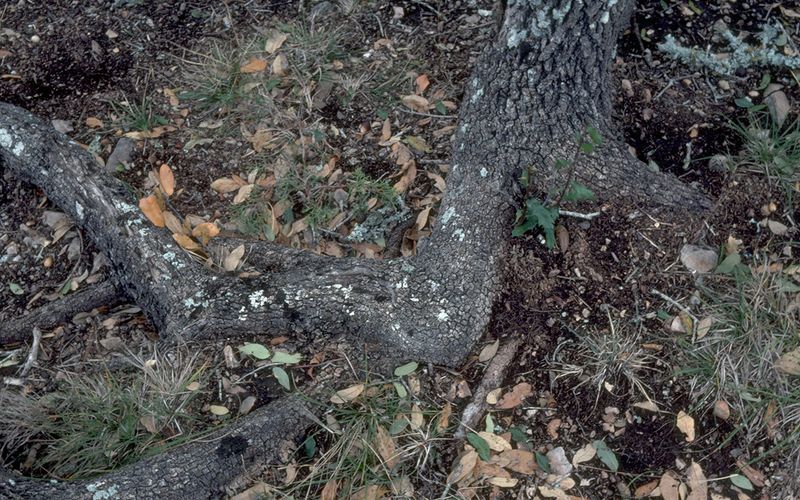
Oak wilt does not appear because the weather is hot. The fungus Bretziella fagacearum needs three things to establish an infection: a source of the pathogen, a fresh wound on a susceptible oak, and either a sap-feeding beetle vector or a direct root connection to an already-infected tree.
Texas A&M Forest Service explains both pathways clearly – aboveground beetle transmission and belowground root-graft spread – and notes that live oaks are especially vulnerable to neighborhood-scale losses because they commonly grow in interconnected groups sharing root systems.
Not all oaks face the same level of risk. Texas Oak Wilt Partnership species information identifies Texas red oak, Shumard oak, blackjack oak, and water oak as highly susceptible, while live oaks have intermediate susceptibility but can suffer extensive neighborhood losses through connected roots.
White oaks are generally more tolerant, though not immune. A fresh pruning cut alone does not guarantee infection; the pathogen must actually be present and reach that wound, usually through a contaminated beetle or an existing infection center nearby.
The calendar matters enormously for routine pruning decisions. Texas Oak Wilt pruning guidelines recommend avoiding unnecessary oak wounding from February 1 through June 30 for Central Texas, when sap-feeding beetles and fungal mats are most active.
Texas A&M’s Plant Disease Handbook uses a somewhat narrower window of February 15 through June 15 and notes that timing shifts by region – earlier in South Texas, later in the Panhandle. Late fall and winter, particularly January, represent the safest routine pruning period.
Oak wilt management guidance confirms that high summer temperatures generally reduce beetle and fungal-mat activity, though that reduced transmission risk does not make summer an ideal pruning window for other reasons covered earlier.
Diagnose a declining oak before reaching for the saw
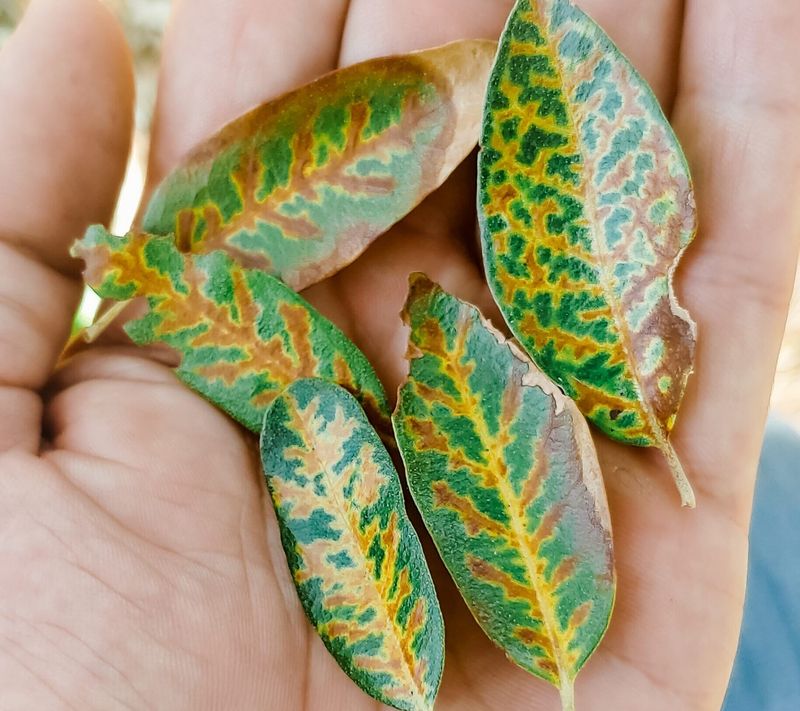
Brown leaves on a Central Texas oak in August do not confirm oak wilt. Heat, drought, lightning strikes, herbicide drift, soil salt accumulation, construction damage to roots, and several other diseases can produce symptoms that look nearly identical to oak wilt from a distance.
Removing a tree – or aggressively pruning it – based only on leaf color or canopy thinning risks destroying a tree that might have recovered with better watering and time.
One symptom that points more specifically toward live-oak oak wilt is veinal necrosis: a yellowing or browning of the leaf tissue along or between the veins, while the veins themselves may remain green at first or turn brown. Texas Oak Wilt identification guidance describes this pattern as a more characteristic sign in live oaks, though visual inspection alone cannot confirm the disease.
Even experienced arborists typically recommend laboratory confirmation before making irreversible decisions about a tree’s fate.
Texas Oak Wilt FAQ guidance on pruning reinforces that misidentification is a real risk, and that diagnosis based solely on brown leaves or dieback can lead to unnecessary removal. When symptoms seem suspicious – especially if multiple trees in a connected group are declining simultaneously – contact a Texas A&M Forest Service forester, a county Extension agent, a certified arborist, or the Texas Plant Disease Diagnostic Laboratory for a proper assessment.
The cost of a professional consultation is far lower than the cost of losing a healthy tree to a misread heat response.
Support the root zone while the heat persists
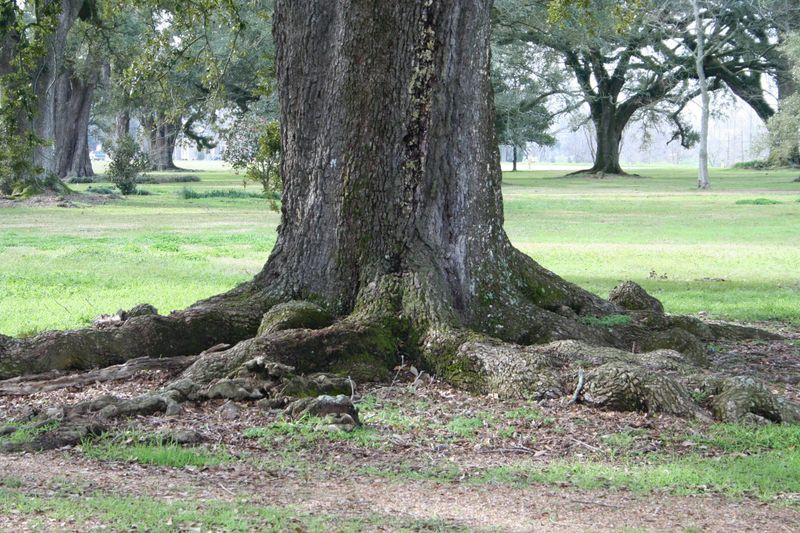
When pruning is off the table, there is still meaningful work to do. The most productive thing a homeowner can do for a heat-stressed oak is focus on the root zone – because that is where the tree’s water and nutrient uptake happens, and that is where summer damage quietly accumulates.
Cooperative Extension drought and heat guidance notes that oak roots commonly extend well beyond the canopy edge, so watering only at the trunk base misses a large portion of the active root system.
Check soil moisture before watering rather than assuming the tree needs more because its leaves look stressed. Leaf wilting and browning during extreme heat can occur even when soil moisture is adequate, and chronic overwatering of an already-saturated root zone creates its own problems, including root rot and oxygen deprivation.
When the soil genuinely is dry, water deeply and broadly – covering the area from roughly two feet out from the trunk to beyond the canopy drip line – then allow the soil to partially dry before watering again. Shallow, frequent watering encourages surface roots that are more vulnerable to heat and drought.
Mulch is one of the most effective tools available. A two-to-four-inch layer of organic mulch spread across the root zone helps retain soil moisture, moderate soil temperature, and reduce competition from grass and weeds.
Keep mulch pulled back a few inches from the trunk itself to avoid trapping moisture against the bark, which can encourage decay. These steps – deep watering, soil moisture checks, and proper mulching – give the tree what it actually needs during a heat event and reduce the temptation to prune as a substitute for real care.
Remove immediate hazards without turning them into a trim
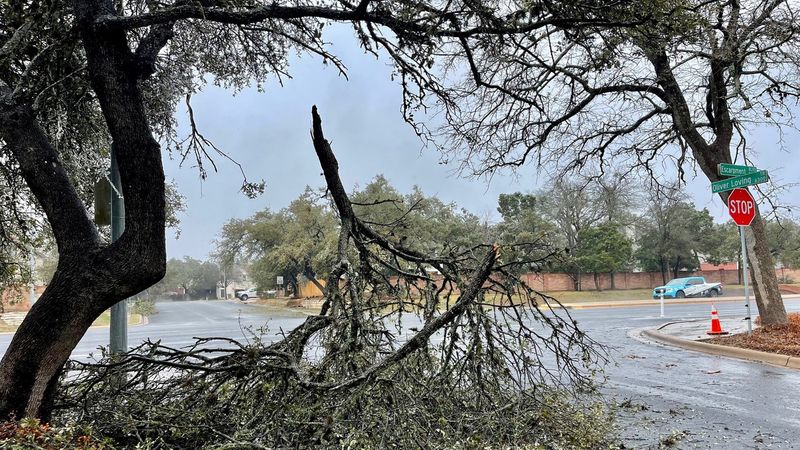
Safety work and cosmetic pruning are not the same thing, and the rules for each are different. A limb resting on a roof, blocking an emergency exit, hanging dangerously after a storm, or in contact with a utility line cannot wait for an ideal pruning calendar.
Those situations call for prompt action – but the goal is removing the specific hazard, not reshaping the tree while you have the equipment out. Texas Oak Wilt storm and hazard guidance is explicit: make only the cuts necessary to address the immediate danger.
In Central Texas oak-wilt areas, every fresh oak wound needs to be painted immediately after cutting – not at the end of the job, but after each individual cut. Texas Oak Wilt pruning prevention guidelines describe the sequence as: make one cut, apply wound paint, then move to the next cut.
The purpose of the paint is to discourage contaminated sap-feeding beetles from visiting the exposed sapwood. Wound paint does not cure oak wilt, does not prevent root transmission, and does not make unnecessary cuts safe – but it is a meaningful risk-reduction step when a cut is unavoidable.
Large limbs, elevated work, storm-damaged trees with compromised structure, and anything near utility lines belong to a qualified arborist. ISA guidance on managing tree hazards is clear that homeowners should not attempt to climb trees or operate chainsaws near power lines, and ISA pruning of mature trees guidance reinforces that heavy pruning of live tissue should be avoided on weak or stressed trees.
During extreme heat, the physical risks to the person doing the work are also elevated – another reason to call a professional rather than pushing through a difficult job yourself.
Schedule routine pruning for late fall or winter
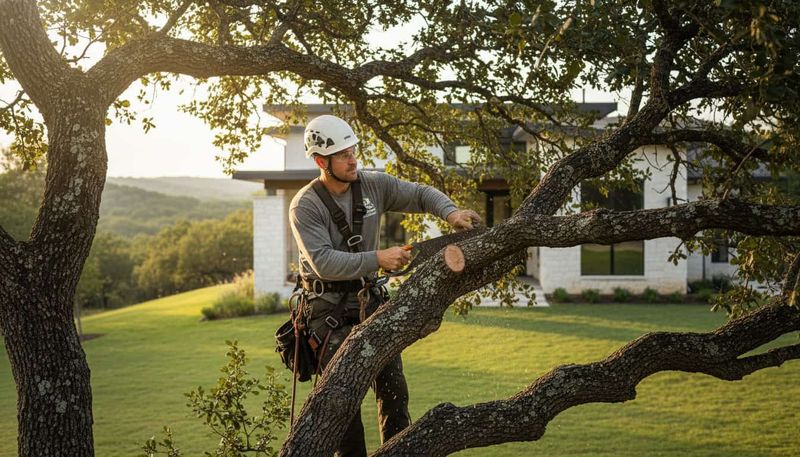
Routine pruning – the kind meant to improve structure, remove crossing branches, or shape a canopy – belongs in late fall or winter for Central Texas oaks. Texas Oak Wilt pruning guidelines describe late fall as the best period and January as a particularly low-risk month, when beetle activity is minimal and fungal mats on infected red oaks are less likely to be producing spores.
The conservative no-pruning window for Central Texas runs from February 1 through June 30, though as noted earlier, the precise boundaries vary by region and information source. Once you are past June and into the summer months, oak-wilt transmission risk from beetle vectors is generally lower, but the tree-stress concerns from section two still apply – so late fall and winter remain the practical sweet spot.
How you cut matters as much as when. ISA guidance on proper pruning cuts directs pruners to cut just outside the branch collar – the slightly swollen area where a branch meets the trunk or a larger limb – and to avoid both flush cuts that remove the collar and stubs that leave dead wood protruding.
Texas A&M AgriLife Extension pruning technique guidance echoes this and recommends against removing large portions of the canopy at once, particularly on a tree that is already weak or recovering from stress.
Clean your tools between trees as a basic precaution against spreading other fungal or bacterial diseases. TxDOT oak-wilt guidance recommends Lysol or 70% rubbing alcohol for tool disinfection and cautions against bleach because of its corrosive effects on metal.
Other Texas sources reference bleach solutions as well, so following the product label and current arboricultural recommendations is the safest approach. Keep in mind that tool-to-tree transmission is considered a much less significant oak-wilt pathway than beetle vectors and interconnected roots – cleaning tools is a sensible precaution, not a substitute for correct timing.
Oak wilt management guidance keeps the emphasis squarely on wound timing and immediate painting as the primary protective steps.
Use a pause-and-assess decision rule
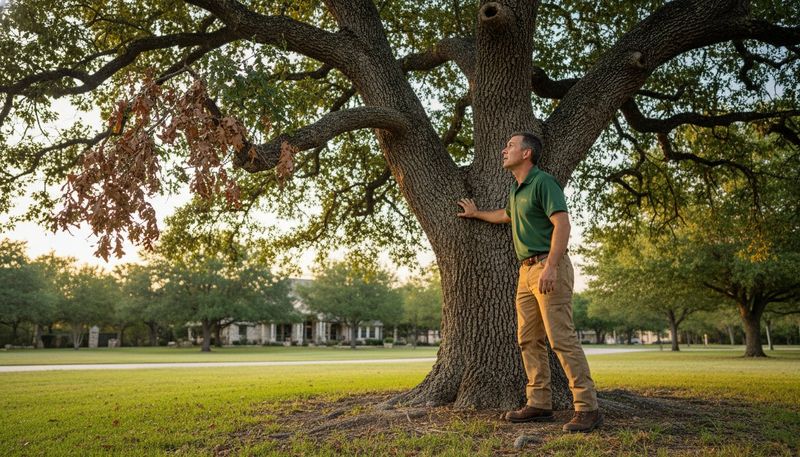
When a heat-stressed oak looks its worst, the most protective response is usually to pause before cutting anything. Leave nonhazardous brown or drooping growth alone, check and support the root zone with deep watering and mulch, and investigate any symptoms that seem unusual or are spreading to neighboring trees rather than guessing at a cause.
Texas A&M Forest Service advises against unnecessary pruning of already-stressed trees, and that advice applies whether the stressor is heat, drought, or both.
Any cuts that cannot be avoided – genuine safety hazards – require immediate wound painting in oak-wilt areas, one cut at a time. Dangerous or complex work belongs to a qualified arborist, not a homeowner on a ladder in triple-digit heat.
Schedule routine structural or cosmetic pruning for late fall or winter, when beetle activity is lowest and the tree is not already carrying a heat burden. Texas Oak Wilt pruning guidelines and oak wilt management guidance both point to the same conclusion: timing and wound management are the practical levers homeowners control.
Heat stress makes unnecessary pruning a poor choice for the tree’s recovery, while oak-wilt risk depends chiefly on seasonal wound timing, pathogen presence nearby, beetle activity, and connected root systems – not on the temperature reading outside your window.