
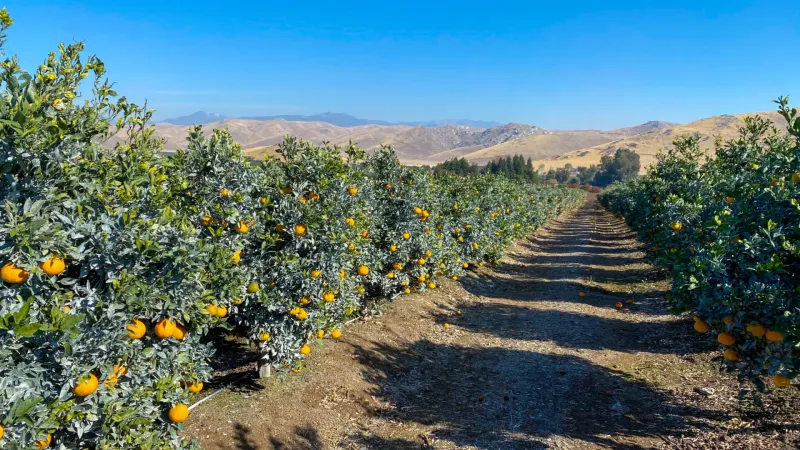
Your citrus tree looks fine in August – full canopy, deep green leaves, no obvious signs of trouble. But that healthy appearance can mask a quiet problem happening right at the roots, where developing fruit is losing its chance to size up properly.
California’s long, warm growing season means your tree is still working hard through September and October, and cutting back water too soon can cost you smaller, lower-quality fruit at harvest. Getting this one task right now is simpler than it sounds, and it makes a real difference in what you pull off the tree.
A healthy August canopy can hide a fruit-size problem
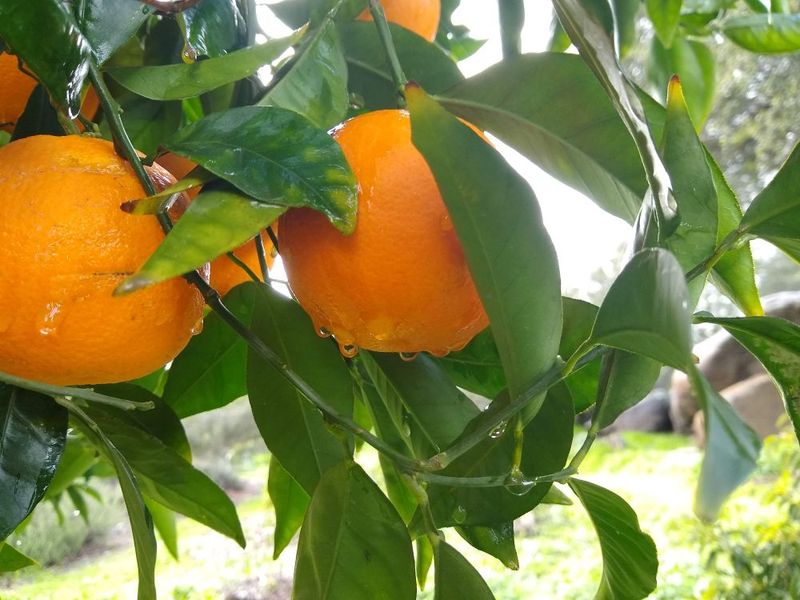
Citrus trees are good at looking fine even when they are not. A full, dark green canopy in August can give homeowners the impression that everything is on track, but the canopy is the last place a water shortage shows up.
By the time leaves start to curl or drop, the developing fruit has already been under pressure for some time.
UC Cooperative Extension Ventura County guidance on small fruit identifies July through October as an important window for citrus fruit-size development and warns that homeowners and growers alike can reduce irrigation too aggressively as temperatures begin to ease – especially during a warmer-than-normal fall. The tree keeps sizing fruit during that stretch, and if root-zone moisture runs low, the fruit pays the price even while the canopy stays green.
The real risk is not a single missed watering. Reducing irrigation too sharply or watering only shallowly across that multi-month window can limit the size, grade, and overall quality of fruit that is already on the tree.
Research on early navel oranges found that late-season water stress reduced yield, large-fruit percentage, grade, and fruit quality – effects that showed up at harvest, not during the stress itself.
This warning does not apply equally to every citrus type or harvest timeline. Lemons flower and set fruit repeatedly throughout the year, while Valencia oranges can carry overlapping crops.
The fruit-size concern is strongest for varieties developing from a spring bloom toward a fall or winter harvest, such as navels and many mandarins. UC Master Gardener guidance confirms that severe stress can increase fruit and flower drop while stress during rapid fruit growth most directly reduces fruit size.
The canopy will not tell you when that threshold has been crossed.
The overlooked task is maintaining root-zone moisture
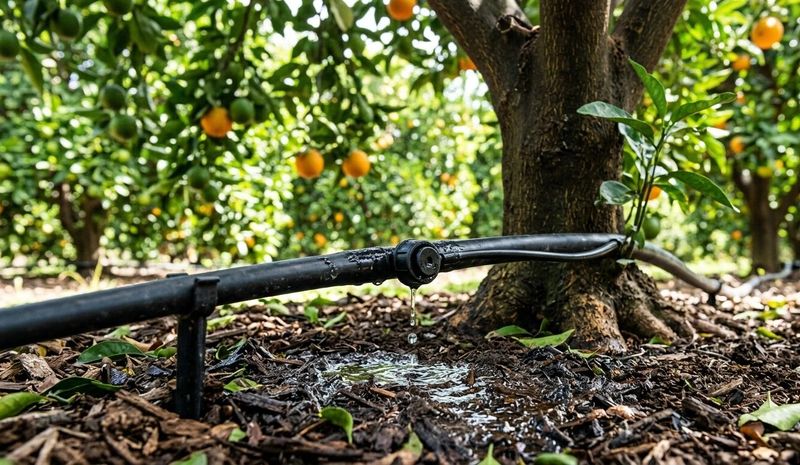
Most homeowners check their citrus tree by looking at it. Leaf color, canopy density, and fruit count are all visible from a few feet away, which makes them the default checkpoints.
The problem is that none of those signals tell you what is happening six inches underground, where the roots that feed and size the fruit are actually working.
The practical answer is to check and maintain moisture in the root zone, not to water on a fixed calendar or wait for the tree to show distress. UC farm advisor guidance on early citrus production makes clear that consistent moisture during late summer and early fall supports fruit sizing, and that pulling irrigation back too early can limit the crop.
The advice is not to water more often by default – it is to water adequately, based on what the soil actually holds.
Research conducted on ‘Beck-Earli’ navel oranges, in which differential irrigation treatments began in August, found that greater water stress generally reduced fruit grade and, in one season, reduced yield by both number and weight while lowering the percentage of large fruit. Some stress levels in that trial also influenced color development or soluble solids, which might sound appealing – but those results came from carefully controlled commercial conditions, not from a homeowner turning off the hose in September.
Intentional droughting is a specialized commercial practice that depends on variety, soil type, timing, tree health, and climate. Attempting it without that context risks fruit drop, smaller fruit, and leaf loss.
The homeowner goal is simply to keep the root zone adequately moist through the fall sizing window, without large swings in either direction.
Deep irrigation reaches the roots instead of the trunk
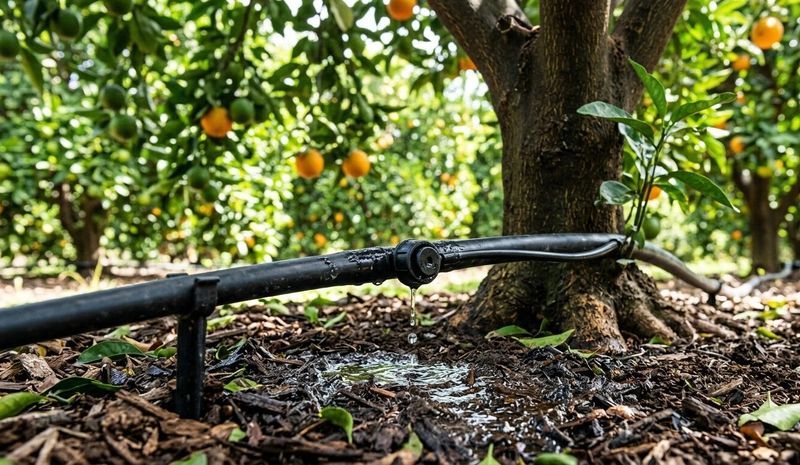
Knowing the root zone needs moisture is only half the task. The other half is getting water to actually reach it.
A quick pass with a hose that wets the top two inches of soil and runs off does not count as irrigation for a mature citrus tree, even if the ground looks dark and damp right after.
UC IPM guidance on estimating irrigation needs recommends sampling soil in multiple places within the root zone to confirm that water is reaching the intended depth and spreading evenly. The goal for established trees is to wet the active root zone beneath the canopy and slightly beyond the drip line – the outer edge of the branch spread – while keeping water away from the trunk.
Citrus roots that sit right against the trunk are not the primary feeding roots, and keeping that area dry reduces disease risk.
Arizona Cooperative Extension guidance on irrigating citrus trees offers a broadly useful reference: allow the soil to dry to approximately 6 inches before irrigating, then wet the soil from near the trunk area out past the drip line to a depth of at least 2 feet. That target depth is a general guide rather than a universal California rule, since soil texture, drainage, and local conditions all affect how water moves through the ground.
Clay soils hold moisture longer and can waterlog if irrigated too frequently; sandy soils drain fast and may need more frequent attention to stay adequately moist.
Young trees and container-grown citrus dry out much faster than established in-ground trees, so they need more frequent checks even if the volume per session is smaller. UC home-garden citrus guidance notes that mature trees often do well with less frequent but thorough irrigation, while UC Master Gardeners Santa Clara County reinforces that container trees need particular attention because their root zone is confined and can shift from moist to bone-dry quickly during warm fall weather.
Slow, patient application – whether by drip, soaker hose, or a hose set to low flow – gives water time to penetrate rather than run off the surface.
Let the soil—not the calendar—set the interval
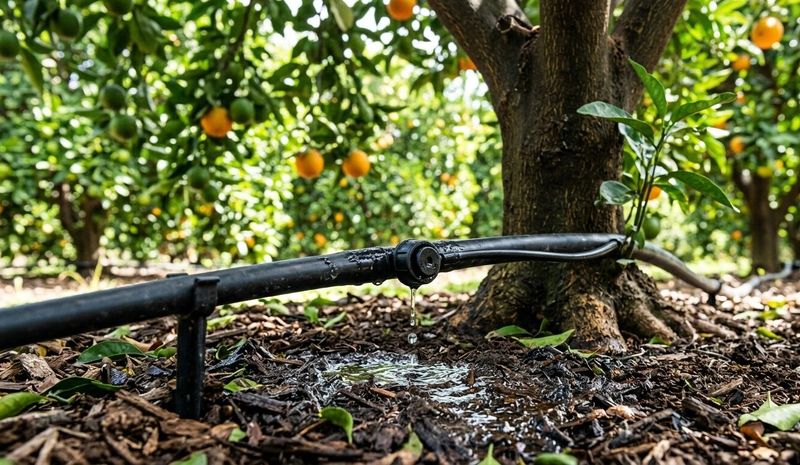
Watering schedules printed on seed packets or posted in gardening forums are starting points, not instructions. The right irrigation interval for your citrus tree depends on your soil, your drainage, your local weather, how big the tree is, whether it is in a container, and how much sun and wind it gets.
Two trees growing ten miles apart in the same county can need water on completely different timelines.
UC IPM’s irrigation-needs guidance recommends checking soil moisture in multiple locations within the root zone rather than relying on a fixed schedule. Push a screwdriver, wooden dowel, or moisture probe into the ground at several points under the canopy.
If it slides in easily and comes out with moist soil clinging to it, the root zone has adequate moisture. If it meets resistance or comes out dry at 6 inches, the tree is ready for water.
Yellow leaves alone cannot tell you which problem you have – overwatered and underwatered citrus can both produce yellowing foliage, so the soil is the reliable diagnostic.
Heat events, dry winds, and a warm September or October can push water demand back up even after the calendar says summer is over. UC Master Gardener Alameda County drought guidance confirms that citrus needs soil moisture during summer and fall to maintain leaves and fruit size, and that stress during rapid fruit growth reduces fruit size.
Reassess your interval after any unusual heat, not just at the start of the season.
Mulch is a practical tool that helps extend the time between waterings. A 3- to 4-inch layer of wood chips or coarse organic material over the root zone reduces evaporation and moderates soil temperature, which matters when fall days stay warm.
UC Master Gardeners Santa Clara County recommends keeping mulch clear of the trunk – generally at least 6 to 12 inches of clearance – to avoid trapping moisture against the bark and creating conditions for rot or disease.
Avoid separate watering problems and misleading fall fixes
Fixing one watering problem by swinging hard in the opposite direction creates a different set of problems. Citrus roots need both moisture and oxygen, and the soil conditions that support healthy roots sit in a narrower range than most homeowners expect.
Understanding the distinct mechanisms behind common issues helps avoid making things worse while trying to correct them.
Shallow or inadequate watering leaves roots dry in the lower part of the root zone. When moisture is insufficient during fruit development, the tree can drop fruit or flowers as a stress response, and the fruit that stays on the tree may size up poorly.
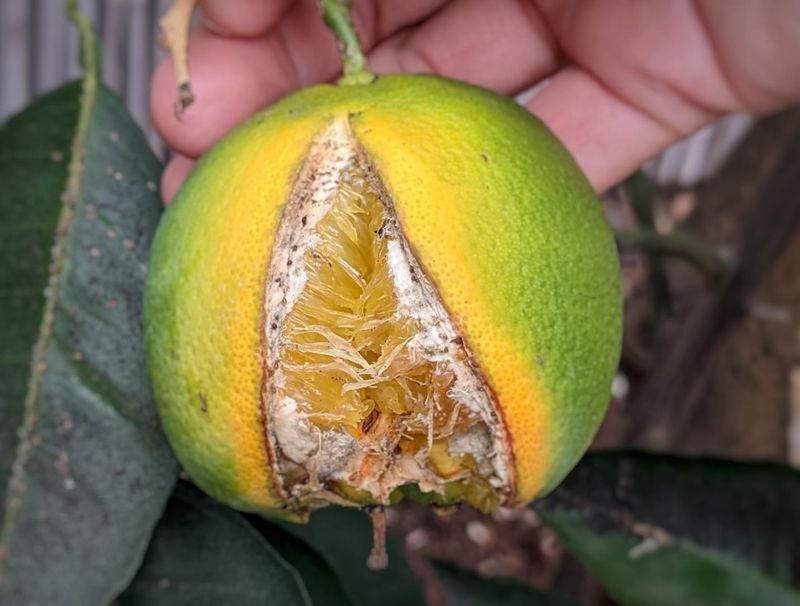
Irregular moisture – long dry stretches followed by heavy watering – is a known contributor to fruit cracking or splitting, because the rind cannot expand fast enough to accommodate the sudden surge in water uptake. UC Cooperative Extension guidance on citrus fruit cracking identifies uneven soil moisture as a contributing factor in that specific problem.
On the other end, prolonged saturation and poor drainage deprive roots of oxygen, which damages root tissue and increases the risk of Phytophthora and other root diseases. UC Master Gardeners Placer County citrus guidance notes that overwatering and poorly drained sites are a significant source of citrus problems in home gardens.
UC IPM’s irrigation guidance reinforces that symptoms of overwatering and underwatering can overlap, making soil checks more reliable than visual diagnosis alone.
Two other responses homeowners reach for in early fall are worth setting aside. Applying nitrogen fertilizer in August or September is not a substitute for correcting irrigation.
UC IPM cultural guidance for citrus and UC Cooperative Extension citrus fertilization guidelines both caution that late-season nitrogen applications can delay fruit coloring, roughen the rind, and stimulate tender new growth that is more vulnerable to pests and frost. Routine fall pruning carries similar risks.
UF/IFAS citrus pruning guidance explains that citrus generally needs little pruning, and cutting healthy growth in late summer or fall can remove leaves that contribute to the tree’s carbohydrate reserves while encouraging a tender flush that is poorly timed for the season ahead.
The next harvest depends on more than one fall decision
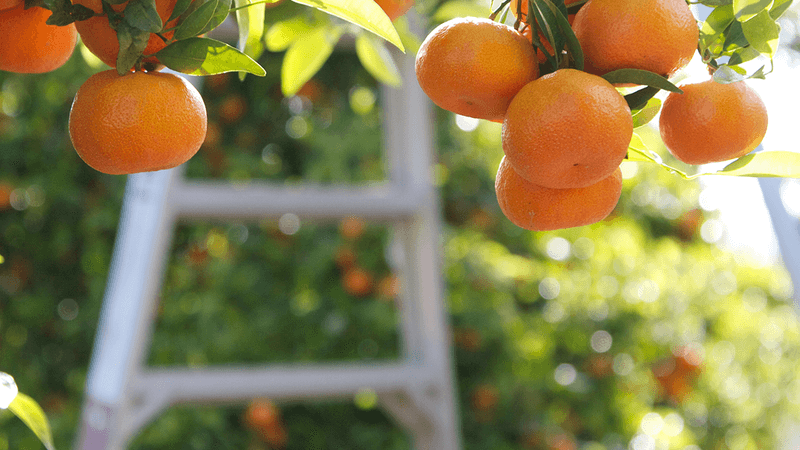
The phrase “next harvest” in the title deserves a closer look, because it means different things depending on which citrus you are growing. California homeowners often have more than one type in the yard, and those types do not follow the same crop calendar.
Most California navel oranges, mandarins, and grapefruit develop from a spring bloom toward a fall, winter, or spring harvest. UC Master Gardener San Luis Obispo County citrus guidance outlines the general harvest windows for common California varieties, showing that timing varies considerably by cultivar.
Lemons are a different case: they can flower and set fruit repeatedly throughout the year, so the concept of a single annual harvest does not apply. Valencia oranges can carry two overlapping crops simultaneously, which means water decisions during fruit development affect both the maturing fruit and the younger fruit sizing up behind it.
Water stress affects citrus differently depending on when it occurs. UC ANR publication on citrus irrigation notes that stress around flowering and fruit set can increase drop of flowers and young fruitlets, while stress during the rapid-growth phase more directly reduces fruit size.
The same irrigation reduction that has little effect during a low-demand period can meaningfully cut fruit size if it happens during active enlargement.
Future flowering and the size of next year’s crop depend on a longer list of factors than fall watering alone. UF/IFAS citrus bloom and production guidance describes how cultivar, crop load, carbohydrate reserves, disease, leaf retention, temperature, and spring conditions all influence flowering.
Some mandarin varieties are prone to alternate bearing, where a heavy crop one year is followed by a lighter one the next. UC research on alternate bearing in citrus and related citrus crop-load research connect that pattern to crop-load effects and carbohydrate competition, not to a single missed fall watering.
Maintaining root-zone moisture protects the fruit currently developing; it supports tree health in ways that may benefit future crops, but it does not override cultivar biology, disease pressure, or spring weather.
Use a simple early-fall citrus check
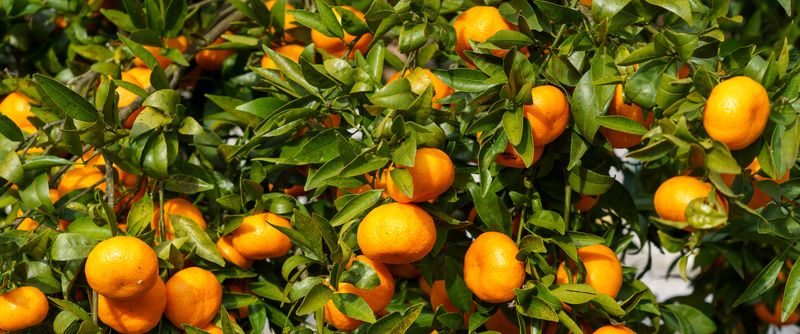
A practical early-fall check does not require tools beyond a screwdriver or wooden dowel and a few minutes of attention. Start by identifying what you are growing and where it falls in its crop cycle, since that sets the stakes for the moisture decisions ahead.
A navel orange carrying developing fruit in September has more to lose from a dry root zone than a lemon that will set new fruit again in a few months.
Work through the root zone by pushing your probe into the soil at three or four points beneath the canopy and slightly beyond the drip line. UC IPM’s irrigation-needs guidance recommends this multi-point approach to confirm that water is reaching depth and spreading evenly.
When the soil needs it, irrigate slowly across the full root zone, keeping water off the trunk. UC home-garden citrus guidance reinforces the importance of thorough, even coverage rather than frequent shallow passes.
Check mulch clearance while you are at it – pull any material that has crept within 6 inches of the trunk.
Container trees and young in-ground trees dry faster than established trees, so they may need attention more often during warm October weather. Sites with poor drainage need a different kind of caution: if water pools or the soil stays wet for days after irrigation, root health is at risk even without adding more water.
While you are inspecting, look at any new fall flush for signs of Asian citrus psyllid – twisted or cupped young leaves, small waxy white tubules along new growth, or sticky honeydew residue. UC IPM’s Asian citrus psyllid resource and the UC ACP identification guide describe what to look for.
Report suspected finds to the California Department of Food and Agriculture rather than reaching for a pesticide. Consistent root-zone moisture is what protects developing fruit quality this season; everything else is maintenance that keeps the tree ready for what comes next.