
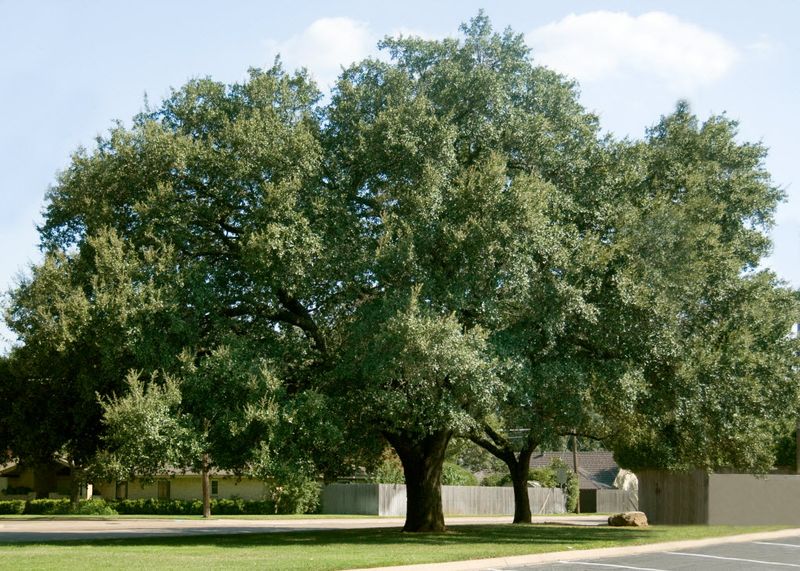
Texas summers are brutal, and if you have ever pressed your hand against a sun-baked patio or watched your grass turn to straw by June, you know the yard needs real help. One tree is quietly earning a reputation in compatible Texas landscapes for its rapid growth, tolerance of alkaline soils, and the deep shade its mature canopy can eventually cast over the spots that heat up the most.
That tree is the Mexican white oak, also called the Monterrey oak or Quercus polymorpha, and fall is the right season to get it in the ground. Getting it planted now starts a long-term shade strategy that can pay off for decades.
Meet the Texas tree behind the long-term shade plan
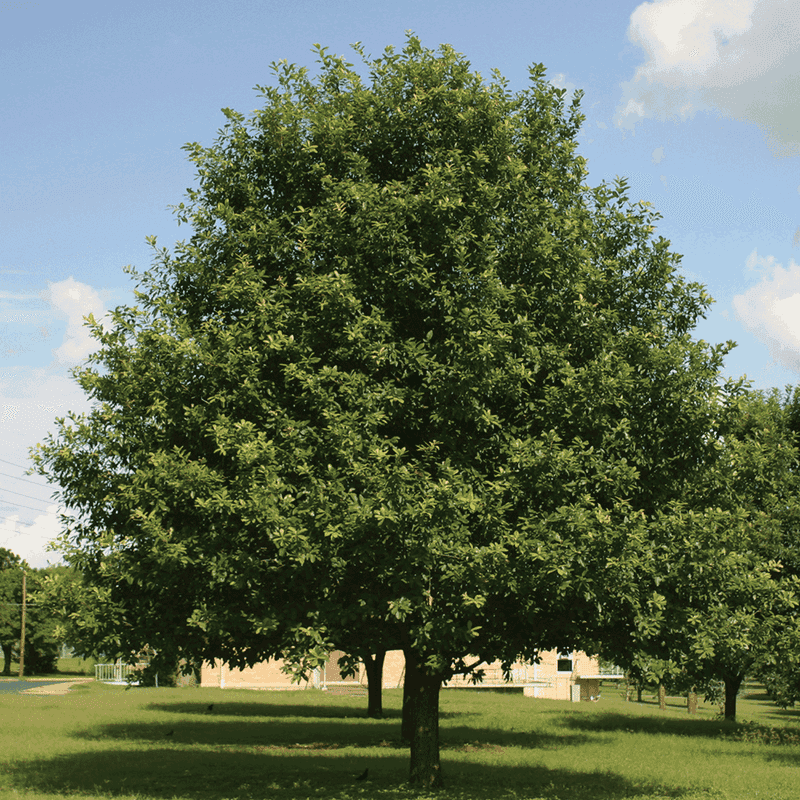
Quercus polymorpha goes by several names, and any of them are worth knowing before you visit a nursery. Mexican white oak, Monterrey oak, and simply “polymorpha” all refer to the same tree, and the Texas A&M Texas Tree Selector classifies it as a medium-sized, rapidly growing species that tolerates drought and alkaline soils and is “rapidly becoming used as an urban landscape tree.” Those traits matter in a state where thin calcareous soils and weeks of triple-digit heat rule out many otherwise appealing trees.
The tree is listed as a Texas native, although its natural U.S. distribution is limited, concentrated in portions of West Texas rather than spread evenly across the state. Widespread planting in Central and South Texas and other compatible areas has made it far more common in the landscape than its native footprint alone would suggest.
That distinction matters when you are evaluating whether a species truly suits your specific region and site rather than just your state.
Its appeal for shade planning comes from the canopy a healthy specimen can develop over time. Leathery, semi-persistent leaves give the tree a substantial look even outside the core growing season, and the spreading crown can eventually cover patios, play areas, driveways, and south- or west-facing windows that absorb the most heat.
Texas A&M Forest Service guidance consistently emphasizes matching a species to the local region, soil, available water, and mature size before planting, and Mexican white oak checks the boxes for many Central and South Texas sites when those factors align.
Calling it a strong candidate is accurate. Calling it the right tree for every Texas yard is not.
The sections that follow will help you decide whether your site qualifies and what it takes to get the tree established.
A cooler shaded space is not the same as a cooler yard
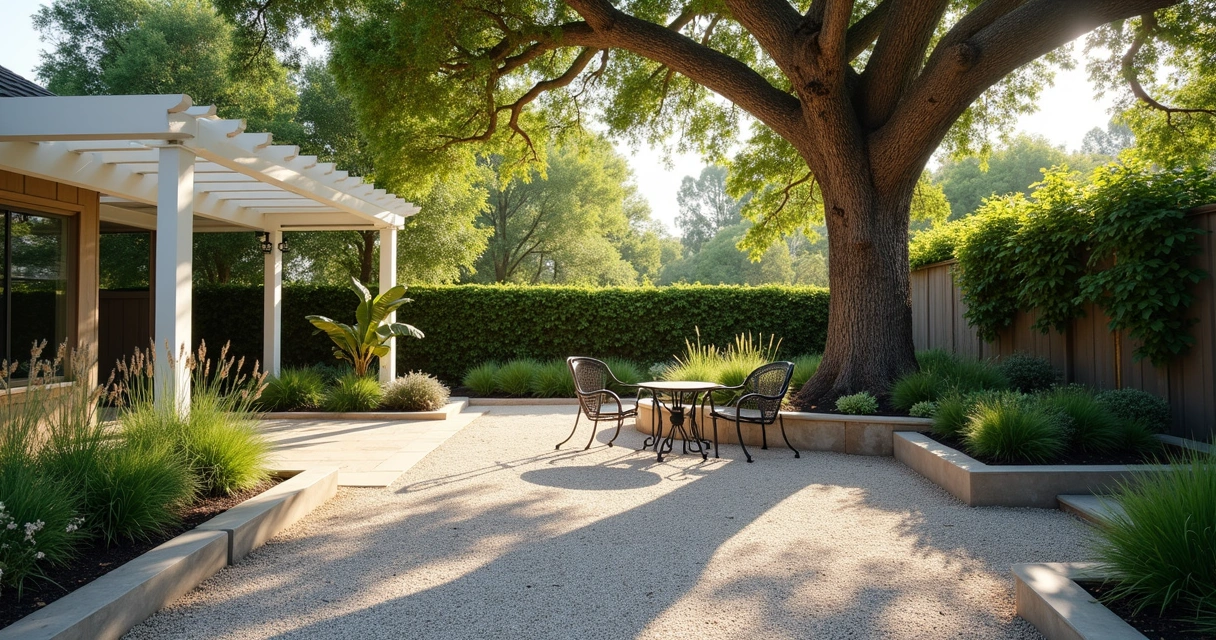
Shade trees cool through two processes: blocking direct solar radiation and releasing water vapor through their leaves, a process called evapotranspiration. Both effects are real and measurable, but they do not work the same way on every surface or in every part of your yard, and the distinction matters before you plant anything.
The most dramatic temperature differences show up on surfaces. Pavement, concrete patios, soil, and roofing materials absorb solar radiation all day and radiate that heat back into the space around them.
EPA research on trees and vegetation documents that shade can reduce surface temperatures substantially, which in turn lowers the radiant heat that people sitting nearby actually feel. A shaded concrete patio can be dramatically cooler to the touch and noticeably more comfortable than the same patio baking in full sun, and that difference is where the “20 degrees cooler” idea comes from.
The effect on ambient outdoor air temperature across an entire yard is more modest. A review of 308 urban-forest studies found that treed areas averaged roughly 3 degrees Fahrenheit cooler than nearby non-green areas in terms of air temperature.
A 2025 Houston study found tree-shaded bus-stop areas were about 5.8 degrees Fahrenheit cooler by wet-bulb globe temperature than unshaded areas, a heat-stress measure that accounts for humidity and radiation. Those are meaningful improvements for human comfort, but they are not the same as a uniform 20-degree drop in your yard’s air temperature.
Extension guidance on shade trees recommends thinking strategically: place trees where they will intercept the sun hitting the surfaces or living spaces that heat up most. A tree shading the west side of your house or a south-facing patio delivers a targeted, practical benefit.
Expecting it to cool the whole yard evenly sets up a disappointment that the tree cannot prevent.
Fall planting starts the shade timeline
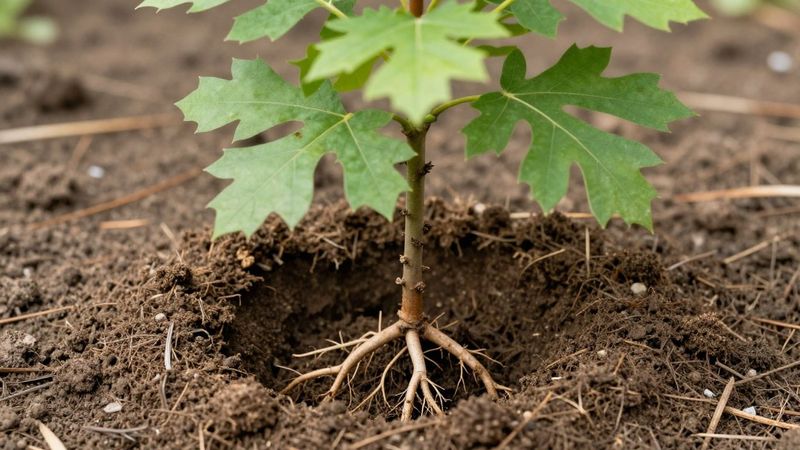
Roots do not take a break just because the air turns cool. When soil temperatures drop in fall and winter, a newly planted tree can push out new root growth without the stress of supporting a full canopy in Texas heat, and that head start is the core reason fall planting makes sense.
Texas A&M Forest Service recommends planting from November through early spring, when cooler conditions allow roots to anchor before the following summer’s demands arrive.
The honest caveat is that fall planting improves establishment prospects without erasing the time a small tree needs to develop real shade. A nursery tree that goes in the ground this November will likely be a modestly larger tree by next July, not a mature specimen with a canopy wide enough to cool a patio.
Texas A&M’s species profile describes the growth rate as rapid relative to other trees in the selector, but no universal annual growth figure is provided, and local conditions including soil depth, water availability, and summer heat load all influence how quickly any individual tree develops.
The right way to frame fall planting is as the beginning of a shade investment, not the guarantee of a shaded yard by next summer. A tree that roots in well this season will be better positioned to push canopy growth in subsequent years than one planted in the heat of spring or summer.
The payoff is real; the timeline just requires patience measured in growing seasons rather than months.
Choose the site for the mature tree
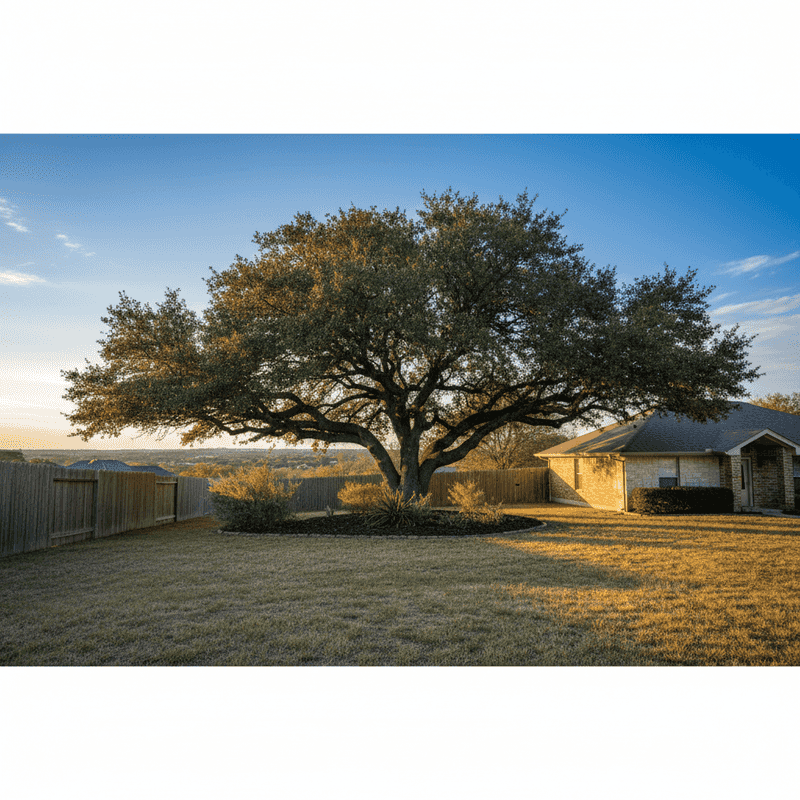
Picking a spot based on where the nursery tree fits right now is one of the most common and costly planting mistakes a homeowner can make. Mexican white oak is classified as a medium-sized tree in the Texas Tree Selector, but an Austin land-management document notes the species can reach approximately 80 feet.
That figure is a planning consideration, not a guarantee for every specimen, but it signals that root spread and canopy width will eventually claim significant space.
Overhead utility lines are a firm constraint. A tree with an 80-foot potential height planted beneath power lines will either be repeatedly disfigured by utility trimming or removed entirely before it matures.
Place the tree far enough from lines that the crown can develop without conflict. The same logic applies to buildings: canopy and root spread need room to expand without pressing against foundations, rooflines, or fences.
Austin’s plant guide advises providing deep soil for this species, and that requirement deserves serious attention. Shallow, compacted, or heavily restricted soil can limit root development even in a tree that is otherwise drought-tolerant once established.
If your yard has thin soil over hardpan, caliche, or heavily compacted fill, investigate the soil depth before committing to a planting location.
Drainage is equally important. Fill the empty planting hole with water before you dig in earnest.
If the water has not drained within 24 hours, that site stays saturated too long for healthy root development, and Texas A&M Forest Service planting guidance recommends choosing another location rather than planting into poorly drained ground. Pavement and sight lines round out the checklist: tree roots can lift and crack concrete over time, so keep adequate distance from driveways, sidewalks, and patios.
Once you have a spot that clears all of these considerations, matching the species to the site’s regional climate and available water is the final confirmation before you plant.
Plant the root ball wide, shallow, and correctly
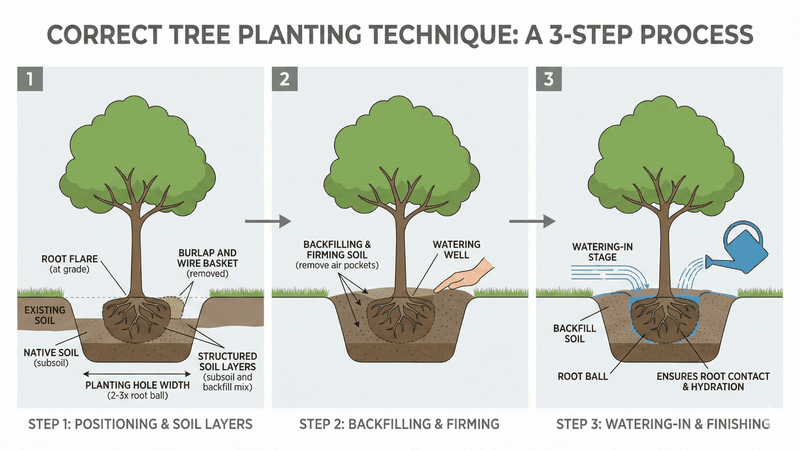
Getting the hole dimensions right is the single most controllable factor in whether a new tree thrives or struggles. Texas A&M Forest Service planting guidance calls for a hole at least twice as wide as the root ball but no deeper than the root ball itself.
Width lets roots spread into loosened soil; depth is the critical constraint, and getting it wrong is surprisingly easy.
Before any soil goes back in the hole, run the drainage test described in the site-selection section above. Pour water in and wait.
If it is still standing after 24 hours, relocate rather than plant, because prolonged saturation around the root zone can kill a tree that would otherwise thrive in well-drained ground.
Set the tree so the root collar, the slight flare where trunk transitions to roots, sits flush with or very slightly above the surrounding grade. Planting too deep is one of the most common causes of slow decline in newly planted trees.
Roots need oxygen, and burying the root collar even a few inches can restrict airflow and trap moisture against the bark. Backfill with the native soil you removed, not amended mix or imported fill, because roots need to transition into surrounding soil to establish effectively.
Tamp the soil lightly to close air pockets without compacting it, and water thoroughly right after planting to settle the soil around the root ball.
Skip fertilizer during the first growing season. Texas A&M advises against it because excess nitrogen can burn tender new roots and actually slow the establishment process rather than accelerate it.
The tree’s energy in year one should go toward anchoring roots, not pushing top growth it cannot yet support.
Water and mulch through the establishment years
Drought tolerance is a long-term characteristic of Mexican white oak, not a property it arrives with on the day you plant it. A newly installed tree in Texas fall and winter still needs consistent supplemental water, and that need continues through at least two full growing seasons before the root system is developed enough to handle extended dry periods on its own.
Texas A&M’s guidance on watering newly planted trees suggests six to eight gallons of water per week per inch of trunk diameter as a general reference point. Use that figure as a starting framework, not a rigid schedule.
Sandy soils drain faster and may need more frequent attention; clay soils hold moisture longer and can stay wet enough between waterings that you skip a session. Rainfall, temperature spikes, and seasonal heat all change the calculus.
The goal is deep, thorough watering that encourages roots to follow moisture downward, rather than frequent light sprinkling that keeps only the surface damp and trains roots to stay shallow.
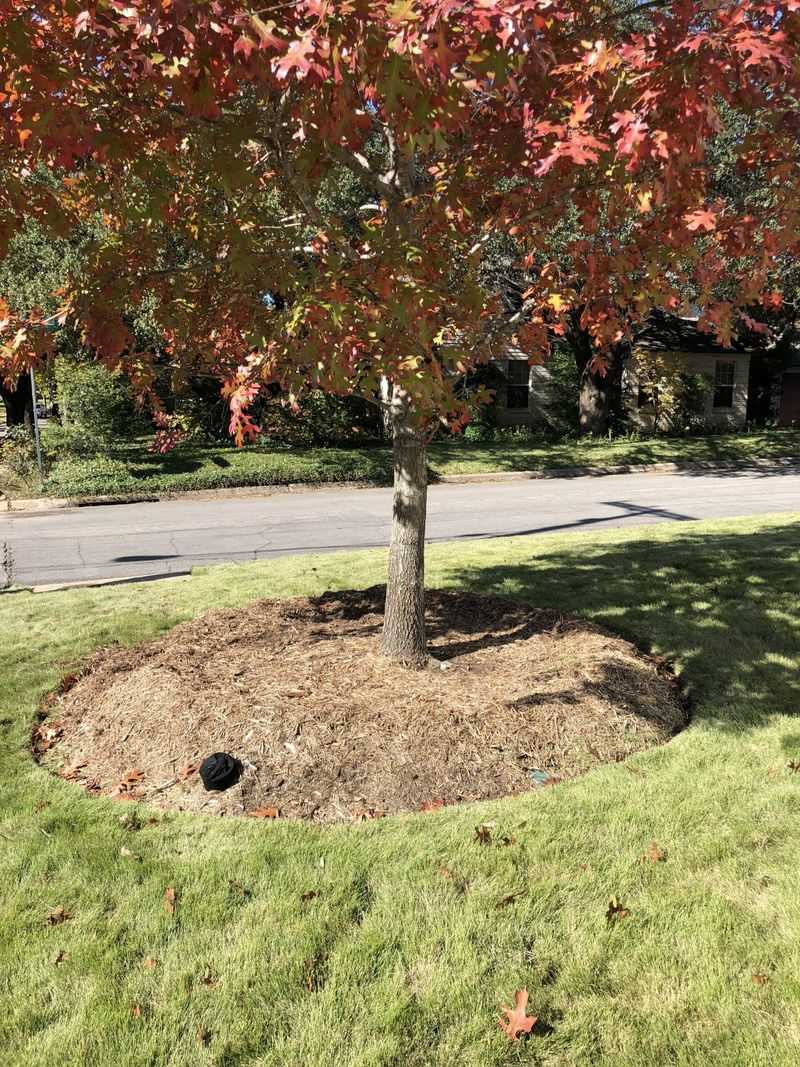
Mulch does a significant amount of work alongside your watering routine. Texas A&M Forest Service planting guidelines and dedicated mulching guidance both recommend applying roughly two to three inches of organic mulch out toward the drip line of the canopy.
Mulch slows moisture evaporation, moderates soil temperature, and suppresses weeds that would otherwise compete with the tree for water and nutrients. The one firm rule: keep mulch pulled back from the trunk and root flare.
Piling mulch against the bark traps moisture, invites rot, and can create conditions for fungal problems that undermine an otherwise healthy tree.
Resist the urge to fertilize during the first growing season. Once the tree has settled through its first full year, a soil test can guide any amendments needed in subsequent seasons.
Account for leaves, pests, and oak-wilt precautions
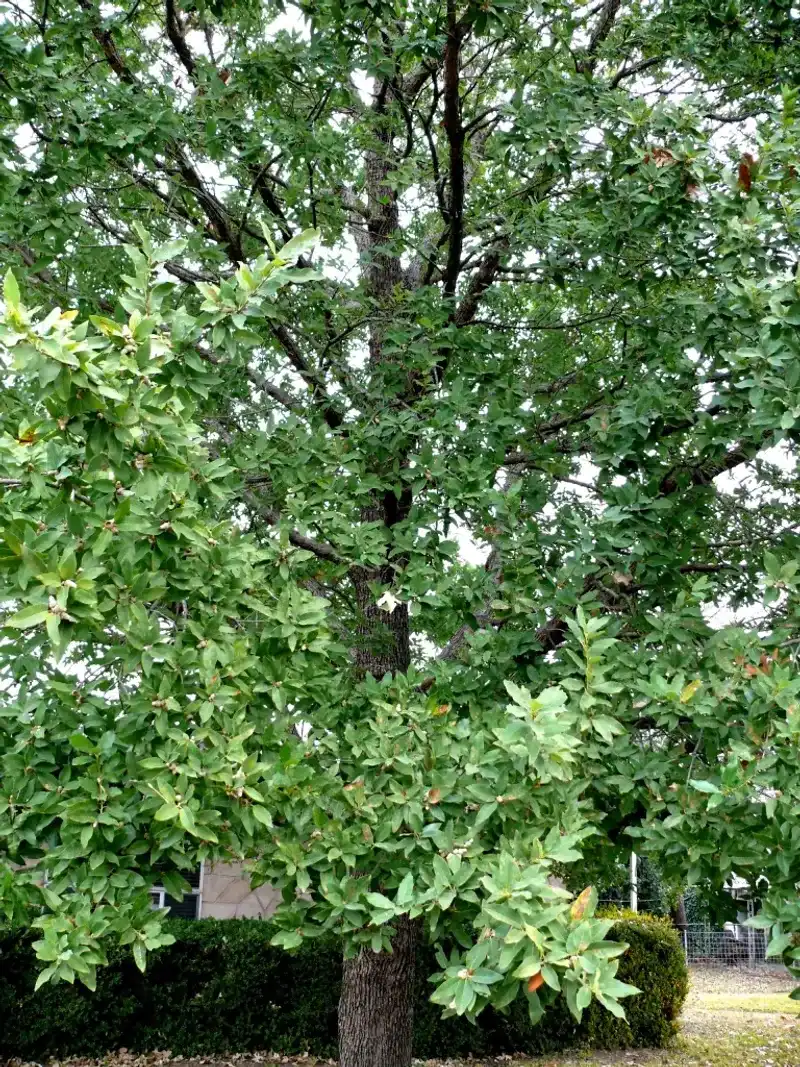
Mexican white oak is listed as deciduous in the Texas Tree Selector, though its behavior in the landscape is a bit more nuanced than a traditional deciduous tree. Austin’s plant guide notes that leathery leaves may persist on the twigs into winter and that the tree tends to shed its old leaves in spring as new growth emerges.
That pattern gives it a longer effective canopy season than many deciduous trees, but it is not evergreen. Expect a period each year when shade is reduced, and plan accordingly if year-round shade coverage is a priority.
Oak wilt is a legitimate concern for any oak planted in Texas, and Mexican white oak deserves a measured assessment. Austin places it among the white-oak-group trees considered least susceptible to oak wilt, which is a meaningful advantage over red-oak-group trees that can die rapidly after infection.
Least susceptible is not the same as immune, however, and basic precautions still apply. Austin’s oak wilt guidance recommends avoiding unnecessary wounds from February through June, when sap beetles that spread the fungus are most active, and sealing any wounds on oaks promptly regardless of season.
On the pest front, the Texas Tree Selector notes that few insect or disease problems are commonly observed, but Austin’s plant guide specifically lists susceptibility to oak phylloxera, a small insect that can cause leaf distortion and galling. That listing is a reason to watch the tree rather than a reason to avoid it, but it does counter any claim that the species is entirely trouble-free.
Monitor new growth in spring when phylloxera activity tends to peak, and consult a certified arborist if you notice unusual leaf damage that does not resolve on its own.
Taken together, these considerations frame Mexican white oak as a tree with manageable care requirements rather than a hands-off planting. Most healthy, well-sited specimens in compatible Texas locations perform without major problems.
Plant for targeted shade and realistic payback
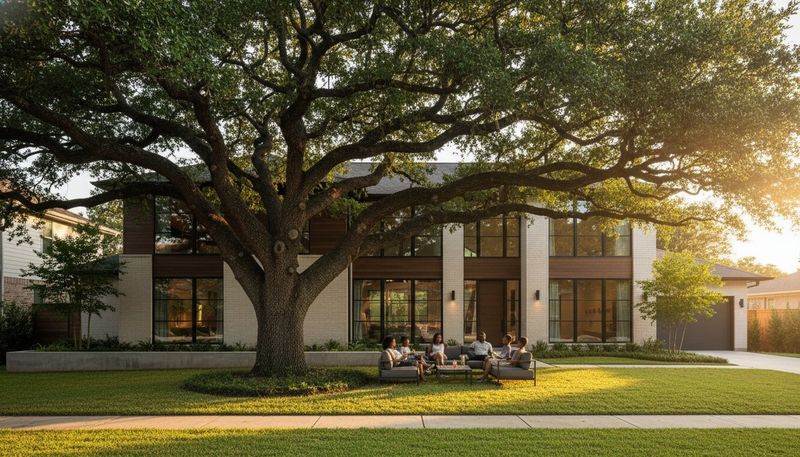
Mexican white oak earns a serious look from Texas homeowners who have the right site for it. A compatible location combines adequate soil depth, good drainage, enough room for a large mature canopy and root spread, distance from overhead utilities and structures, and a regional climate where the species performs well.
Central and South Texas sites that meet those conditions are good candidates; locations with shallow soil, poor drainage, or severe space constraints are not, regardless of how appealing the species sounds.
Placement over a heat-exposed target makes the investment worthwhile. A patio that bakes in afternoon sun, a west-facing wall that radiates heat into the house, a play area that children abandon by 10 a.m. in July, or pavement that stays scorching well into evening are all strong candidates for strategic shade.
EPA guidance on trees and vegetation confirms that shade and evapotranspiration can substantially reduce the heat load on exposed surfaces and the spaces around them, and that targeted benefit is where a well-placed tree delivers its clearest payoff.
Texas A&M’s tree profile and Forest Service siting guidance both support Mexican white oak as a promising landscape option for compatible Texas sites, and fall is the practical window to start. The evidence does not support promising yard-wide 20-degree cooling or a full shading canopy by next summer, but it does support something more durable: a tree that, given the right site, the right planting method, and consistent water during establishment, can grow into one of the most useful features your yard has ever had.