
Wildfire embers can travel more than a mile ahead of a fire and land right next to your house, where a pile of wood chips or a stack of patio cushions can be all they need to ignite. The five feet immediately surrounding your home, known as Zone 0, is a commonly overlooked defensible-space priority that wildfire researchers and CAL FIRE both point to as a high-impact starting place.
Getting this narrow strip right does not mean tearing out your entire landscape. It means knowing what to move, what to replace, and what to check before fire season arrives.
The five feet closest to the house deserves first attention
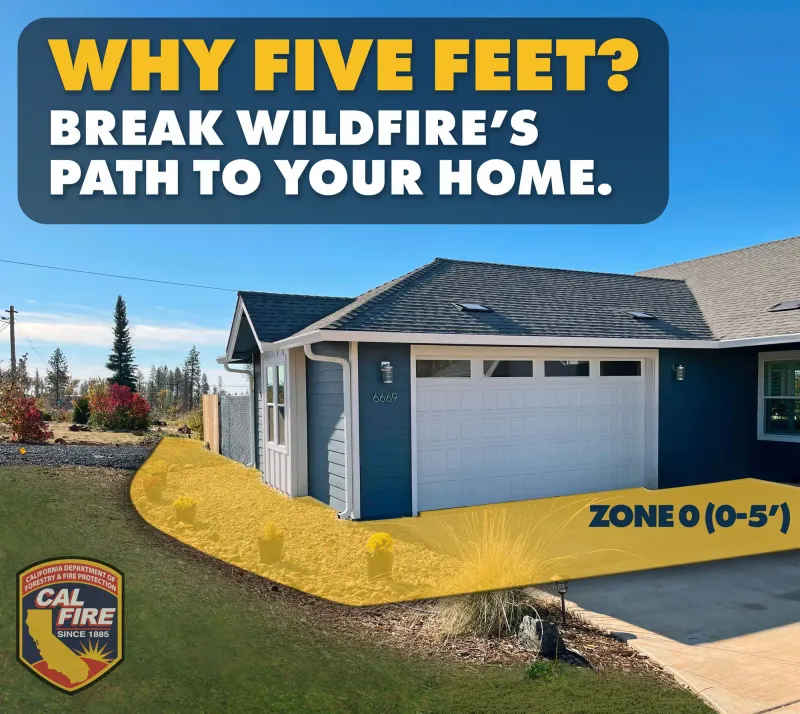
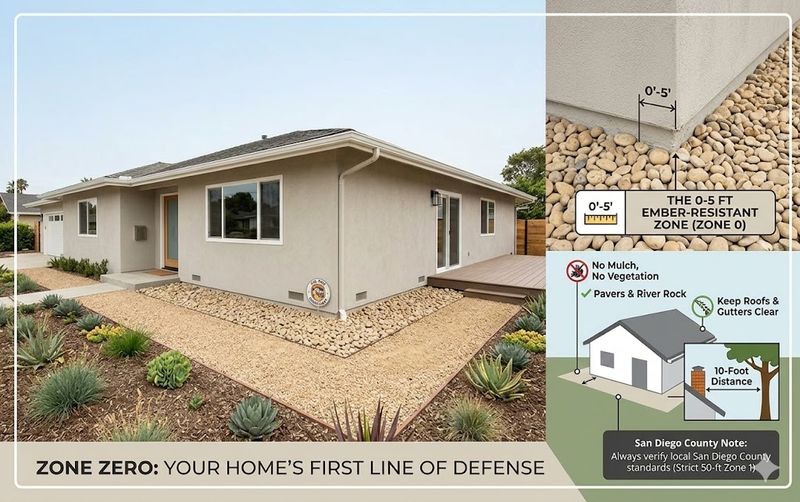
Right against your house is where ember ignition risk concentrates most. Wildfire researchers and CAL FIRE both refer to the first 0-5 feet around a home, attached deck, porch, stairs, or similar structure as Zone 0, sometimes called the immediate zone or ember-resistant zone.
IBHS guidance on Zone 0 explains that windblown embers can ignite mulch, leaves, outdoor furniture, planters, fences, and vegetation in this area, which then exposes the structure itself to flame or radiant heat.
The evidence supports prioritizing this zone before working outward, not because every homeowner is neglecting it, but because the payoff is concentrated. Reducing combustible materials immediately beside the building is among the most practical actions for lowering ember-ignition pathways.
Research on the 2018 Camp Fire found that near-home fuels mattered significantly, while also confirming that fuel modification farther out and ignition-resistant construction both continue to add protection.
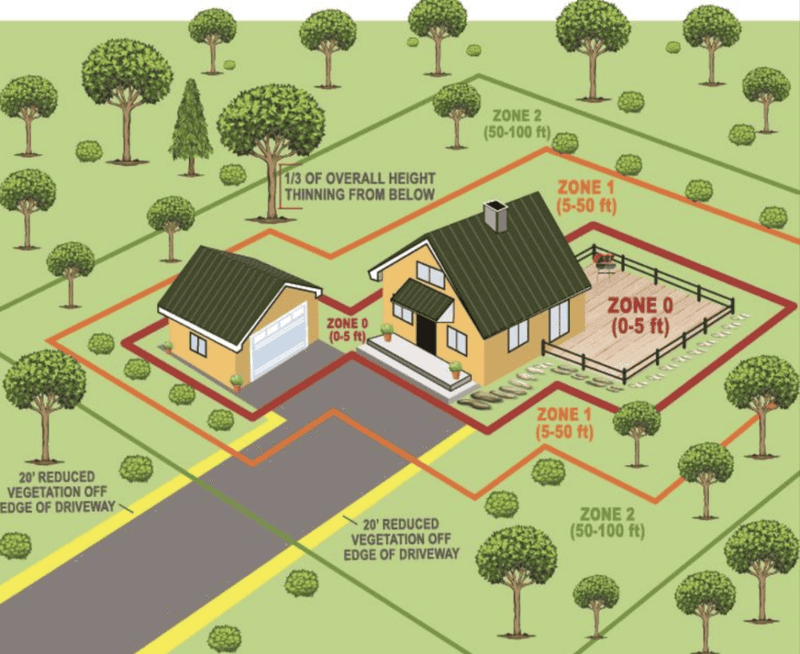
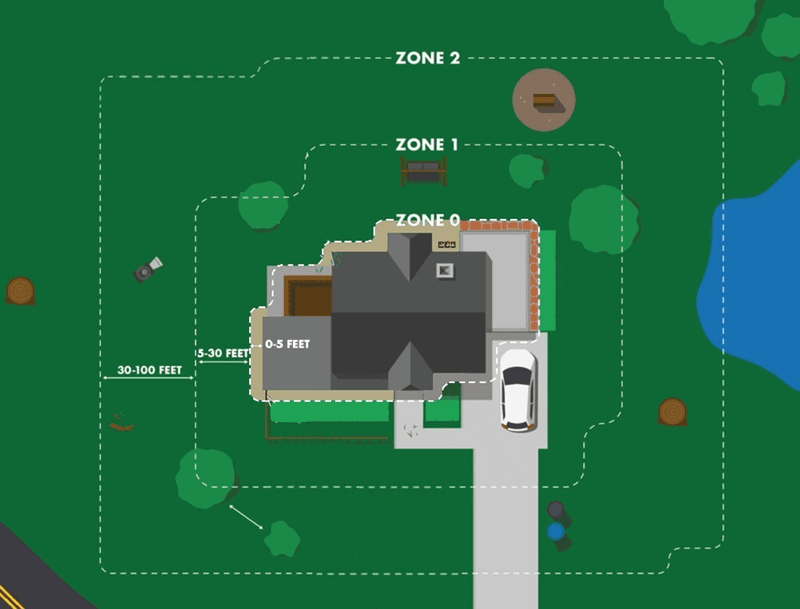
Zone 0 does not operate alone. The broader defensible-space framework moves outward in three layers: Zone 0 covers 0-5 feet, Zone 1 covers 5-30 feet, and Zone 2 covers 30-100 feet or to the property line.
CAL FIRE’s defensible space guidance recommends starting at the house and working outward, treating each zone as a distinct set of tasks rather than one uniform clearing job. Zone 0 is not a guarantee of survival or a fireproof barrier.
It reduces specific ignition pathways, and that reduction is worth the effort of a focused afternoon inspection.
Inspect the house-to-yard edge before clearing farther out
Before touching anything in the middle of the yard, walk the building perimeter with fresh eyes. The inspection sequence that CAL FIRE and the State Fire Marshal both recommend starts at the structure itself and moves outward, surface by surface.
Begin at the roof: check for accumulated leaves, pine needles, and debris in gutters, valleys, and flat sections. A clogged gutter full of dry needles can catch an ember just as readily as a pile of mulch on the ground.
Move to the deck, porch, and stairs next. The California State Fire Marshal’s Model Defensible Space Inspection Guide specifically calls attention to the space beneath combustible decks, where leaves, grass clippings, and debris collect out of sight and dry out through the summer.
If you cannot reach under the deck to clean it, that gap deserves a screen or a solid skirt to block ember entry.
At ground level beside exterior walls, look for: dead leaves and pine needles, dead plants or dried-out shrub branches touching the siding, firewood stacked against the house, wood chips or bark mulch, garbage and recycling bins, outdoor furniture, cushions, boats, vehicles, and other movable combustibles. UC ANR’s defensible space resources frame the goal clearly: relocate or remove anything that can catch an ember and transfer fire to the structure.
Treating this as a prioritized inspection rather than an all-at-once clearing project makes it more manageable. Move the firewood stack first, then address the mulch, then check the gutters.
Each completed item reduces a real ignition pathway, and progress is visible from the first hour of work.
Replace combustible mulch with a maintained noncombustible surface

Wood chips and bark mulch are among the most common ember-catching fuels found right against a house. They look tidy, hold moisture, and suppress weeds well, which is why so many homeowners use them.
The problem is that they also ignite readily when a burning ember lands on them and can smolder for hours before flaming up against siding, a fence, or a deck post.
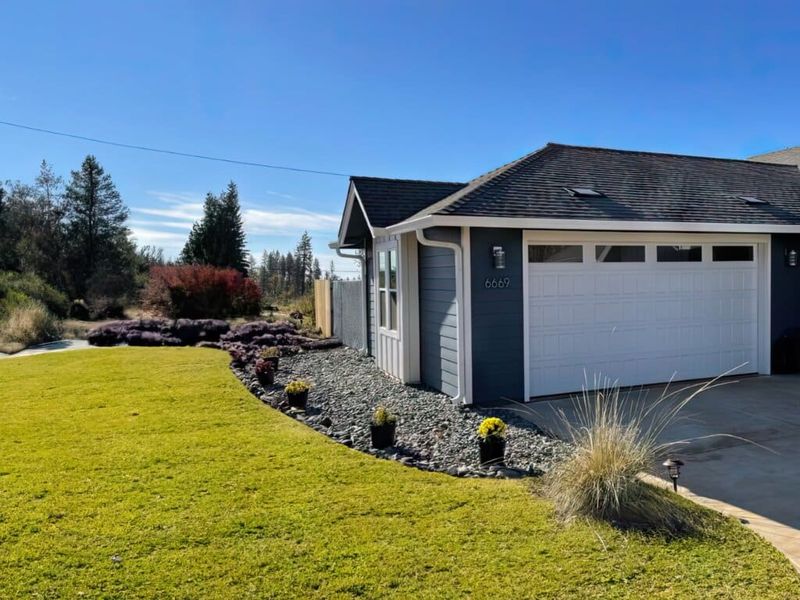
CAL FIRE specifically recommends replacing combustible bark or mulch in Zone 0 with hardscape options such as gravel, pavers, flagstone, or concrete. UC ANR makes the same recommendation, pointing to concrete, gravel, or rock mulch as appropriate surfaces immediately around buildings.
This swap is one of the most direct Zone 0 corrections a homeowner can make in a single weekend.
The correction targets the immediate strip beside the structure, not every mulched bed on the property. Farther out in Zone 1, the guidance shifts toward dead-material removal and fuel spacing rather than a universal mulch ban.
IBHS guidance on noncombustible Zone 0 surfaces reinforces the same principle: create a noncombustible buffer immediately beside the building to interrupt the ember-to-fuel-to-structure pathway.
Maintenance matters after the swap. Gravel and pavers still collect fallen leaves and needles over time, especially under trees or near shrubs.
Plan to rake or blow out that debris regularly through fire season so the noncombustible surface stays clear. A gravel bed covered in dry oak leaves offers much less protection than a clean one.
Break the fire pathways formed by fences, decks, and branches
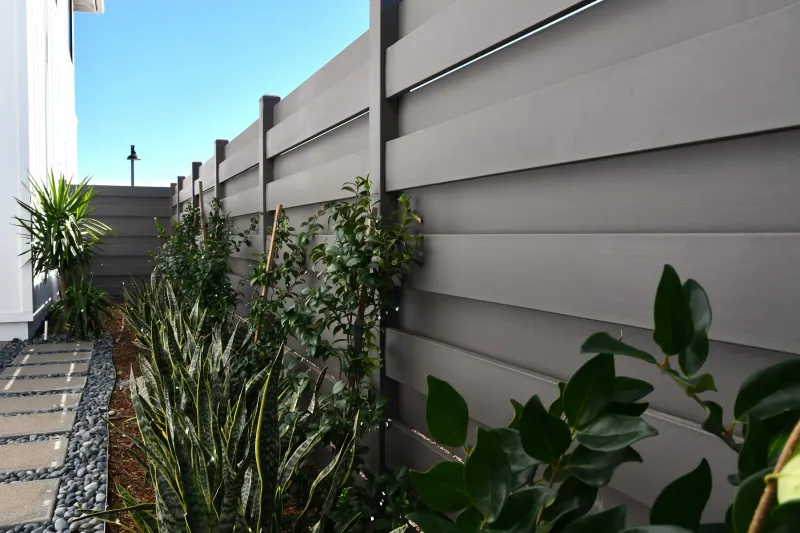
Fences, trellises, arbors, and gates attached directly to a house can act as a runway for fire. A wood fence that runs from the wildland or street all the way to the siding gives flames a continuous fuel path straight to the wall.
CAL FIRE’s defensible space guidance recommends replacing or modifying the section of any combustible fence, gate, trellis, or arbor where it meets the structure, swapping that attachment point for noncombustible materials such as metal, masonry, or concrete block.
Attached decks and stairs deserve the same attention. The space beneath a wood deck is a natural debris trap, and burning embers that slip through deck boards can ignite that accumulated fuel from above.
UC ANR’s defensible space network notes that areas under combustible decks need regular cleaning or physical barriers to prevent ember accumulation. If the deck boards themselves are combustible, the underside is a known vulnerability worth addressing alongside Zone 0 ground-level work.
Overhead branches add a vertical dimension to the problem. The State Fire Marshal’s inspection guide documents clearance standards that include live tree branches at least 10 feet above roofs and decking, branches at least 10 feet from chimneys and stovepipe outlets, and live plants or branches kept at least 5 feet from structure walls and attached decking.
These figures reflect current inspection guidance; confirm which standards apply specifically to your property and local jurisdiction before undertaking tree work.
Each of these connections, fence to wall, deck to ember, branch to roof, represents a pathway that can bring fire closer to the structure than open-ground fuels would. Interrupting even one of them reduces the number of routes an ember or flame front can travel.
Manage living plants without treating every plant as a hazard

A common misreading of Zone 0 guidance is that every plant within five feet of the house must go. That is not what current guidance says, and acting on that misreading can strip the soil unnecessarily, invite erosion, and replace living plants with conditions that favor invasive, highly flammable annual grasses.
The actual focus is on what plants do, not simply whether they exist near the building.
CAL FIRE’s guidance prioritizes removing dead vegetation, combustible mulch, wood chips, and materials that touch siding, eaves, windows, and decks. The hazard is not the plant label but the condition: a plant that has dried out, accumulated dead stems, or grown until it contacts the wall or roof is a problem regardless of what the nursery tag says.
Even plants marketed as lower-combustibility can become a fuel source when they are stressed, drought-dried, or unmaintained.
Separation and dead-material removal are the practical corrections. Keep living plants trimmed back so they do not touch the structure, remove dead stems and branches regularly, avoid combustible mulch beneath them, and prevent any shrub or groundcover from growing tall enough to create a ladder from the ground toward the eaves or a deck railing.
The approved 2026 Zone 0 regulatory framework, announced by the Board of Forestry and Fire Protection after its August 19, 2026 meeting, takes a nested approach rather than a blanket removal rule. Outside specified immediate safety buffers near windows, doors, vents, and attached decks, the framework would allow certain maintained herbaceous plants, groundcovers, lawn, and movable potted plants under specified conditions.
The Board’s regulation summary also indicates that existing trees may remain if maintained to reduce ladder fuels and transmission risk, but no new trees could be planted in Zone 0 once the regulation becomes effective. That is a meaningful distinction: existing trees are not automatically required to be removed.
The practical takeaway is to maintain what you have rather than strip the zone bare. Remove dead material, keep plants trimmed away from the structure, and replace combustible mulch with noncombustible ground cover or hardscape.
That approach serves both fire safety and the living landscape.
Work outward with spacing, erosion control, and safe timing
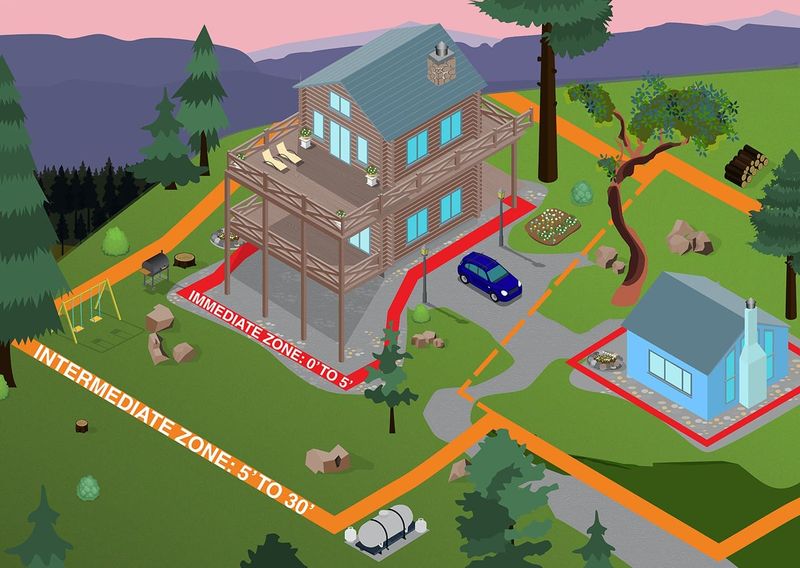
Zone 0 is the starting point, not the whole job. Once the immediate five feet are addressed, the work moves outward into Zone 1 (5-30 feet) and Zone 2 (30-100 feet or to the property line), where the goals and methods shift.
The California Board of Forestry and Fire Protection’s overview of defensible space zones describes Zone 1 as focused on removing dead vegetation and breaking up horizontal and vertical fuel continuity among trees, shrubs, and grasses, not on clearing every living plant.
Zone 2 adds site-dependent spacing and includes guidance to mow annual grass to a maximum height of 4 inches. Slope, wind exposure, vegetation density, and home position all affect how aggressively each zone needs to be treated.
A home at the base of a steep slope, in a drainage, or surrounded by tall dense chaparral needs more generous spacing than a flat suburban lot with maintained lawn. UC ANR’s defensible space guidance advises increased spacing and treatment where these higher-risk site conditions apply.
Excessive clearing creates its own problems. Removing too much ground cover on a slope can trigger erosion during the first winter rain, and bare disturbed soil is an open invitation for invasive annual grasses that are often more flammable than the native plants they replace.
The State Fire Marshal’s inspection guide notes the importance of minimizing soil disturbance and monitoring cleared areas for invasive species establishment.
Timing and equipment choices matter when working with dry vegetation. CAL FIRE advises mowing before 10 a.m., avoiding mowing on hot or windy days, and using string trimmers rather than lawnmowers when clearing dry grass, because mower blades striking rocks or dry stems can generate sparks that ignite the very vegetation you are trying to manage.
These are not optional precautions during fire season; they are the difference between a safe work morning and starting the fire you were trying to prevent.
Pair near-home fuel reduction with home hardening
A well-maintained Zone 0 reduces specific ignition pathways around the base of the structure, but embers do not only land on the ground. They enter homes through attic vents, settle on roofs, slip under eave gaps, land on combustible decks, and press against single-pane windows.
A yard with no combustible mulch and no firewood stacked against the wall still has vulnerability if the building itself has unscreened vents or an aged wood-shake roof.
The State Fire Marshal’s guidance on building in the wildland addresses those structural vulnerabilities directly. Fire-resistant vents with fine mesh screening, ignition-resistant roofing, multi-pane or tempered windows, noncombustible or fire-resistant siding, and protected eave assemblies all reduce the ways embers can enter or ignite the structure, even when the surrounding landscape is well maintained.
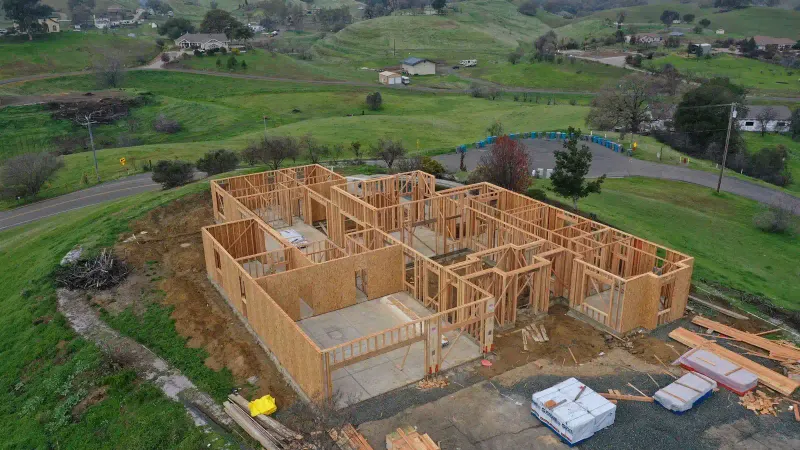
California’s wildland hazard building codes set minimum standards for new construction and some retrofit projects in high fire hazard areas, but older homes built before those standards were in place often have vent screens, roof materials, and deck assemblies that fall short of current ember-resistant design. Checking those components is a natural complement to Zone 0 work.
IBHS research on home ignition pathways reinforces the point that landscape management and building hardening address different but overlapping risks. Treating them as a package rather than alternatives gives a home the best chance of reducing ignition pathways from multiple directions.
Clearing the yard and leaving a vulnerable vent open is an incomplete answer, and hardening the house while ignoring combustible mulch against the foundation is equally incomplete.
Check which Zone 0 rules apply before making regulated changes
Before assuming a specific set of Zone 0 rules applies to your property, verify the current requirements for your location. California’s regulatory landscape shifted in 2026.
The Board of Forestry and Fire Protection announced after its August 19, 2026 meeting that it had approved a Zone 0 regulatory package, but the Board’s own announcement stated that the package still required Office of Administrative Law review and publication by the California Secretary of State before becoming enforceable law. That administrative process was pending as of the August 19 announcement; homeowners should check current sources to confirm whether and when the regulation took effect.
Geographic scope also matters. The approved framework is not a universal California rule.
It covers State Responsibility Areas and Very High Fire Hazard Severity Zones within Local Responsibility Areas, which means a meaningful portion of California properties are within its reach, but not every parcel automatically falls under it. The State Fire Marshal’s Fire Hazard Severity Zone map and resources can help you identify your property’s designation, which is the first step in understanding which state standards may apply.
Local governments add another layer. Cities, counties, and fire protection districts can impose requirements that are stricter than state minimums or that address local conditions not covered by state rules.
The Board’s Zone 0 regulation summary acknowledges this layered structure. Your local fire department, fire protection district, or building official is the right contact for current, property-specific requirements.
Practical Zone 0 improvements such as removing combustible mulch, clearing debris from gutters, relocating firewood, and cleaning under decks do not typically require a permit. Structural modifications to fences, decks, or vents may involve building permits or local approvals.
Confirming those thresholds before starting work prevents surprises and keeps the project moving forward.
Start with the five feet you can inspect today
A useful place to begin is the area you can walk in fifteen minutes: the perimeter of your house, one careful circuit, looking for anything combustible within arm’s reach of the walls, deck, stairs, and eaves. Remove or relocate dry leaves, dead stems, wood chips, firewood, and any outdoor items that could catch an ember.
That single walk produces real, measurable progress. CAL FIRE’s defensible space guidance frames this as the right starting point before addressing any other zone.
From there, replace combustible mulch with gravel or pavers, inspect attached fences and deck connections for combustible material at the attachment point, check overhead branches against the clearance standards that apply to your property, and note any vent screens or roof areas that may need attention as part of a home hardening follow-up. UC ANR’s defensible space resources and the State Fire Marshal’s building-in-the-wildland guidance both support treating landscape work and structural improvements as a connected set of actions rather than separate projects.
Zone 0 is a priority step for reducing ember-ignition pathways, not a promise of survival and not a reason to erase a living landscape. Confirm current local requirements before undertaking any regulated changes.
The five feet closest to your house is a practical place to start, and starting there today puts the most consequential ground between you and fire season.