
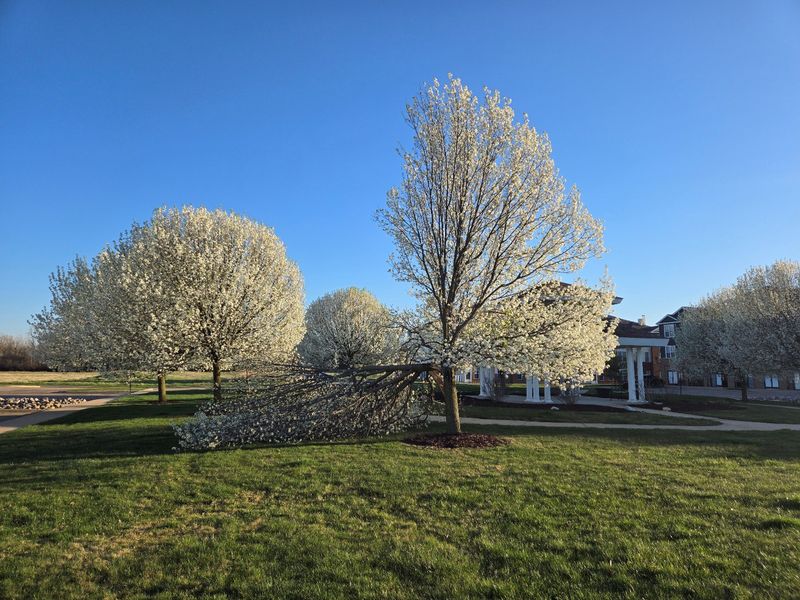
Bradford pear trees became a fixture in Texas neighborhoods for good reasons, but a growing number of homeowners are taking a second look at what they planted. Structural problems, storm damage risk, and ecological concerns are pushing gardeners and extension experts alike to rethink this once-beloved tree.
The real question is not whether to replace it, but what to plant in its place that actually fits your yard.
Bradford pear is the likely tree behind the replacement discussion
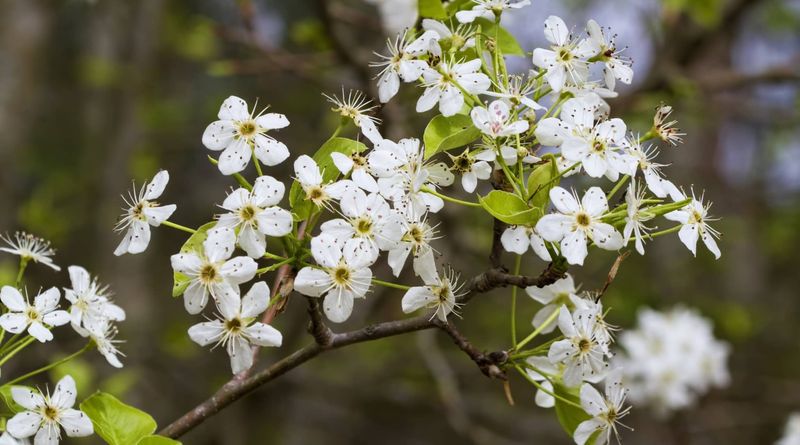
Bradford pear is almost certainly the tree at the center of the replacement conversation you have been hearing. Technically a cultivar of Callery pear (Pyrus calleryana), it became one of the most widely planted ornamental trees in American suburbs over the past several decades.
NC State Extension’s profile of Callery pear cultivars notes that Bradford was selected specifically for its fast growth, tidy symmetrical crown, white spring flowers, and vivid fall color, all traits that made it an easy sell at nurseries and a reliable choice for builders finishing out new subdivisions.
That said, no reviewed authoritative source documents a statewide homeowner replacement movement in Texas. What extension services, invasive-species programs, and arborists do consistently recommend is reconsidering or replacing Bradford and related Callery pear cultivars for structural and ecological reasons.
The distinction matters: expert advice points in a clear direction, but that is different from a measured trend in consumer behavior.
Bradford is one cultivar within the broader Callery pear group, and other cultivars can share its weaknesses. Understanding that distinction helps explain why the replacement case applies to the group rather than to a single variety.
The practical question this article tries to answer is straightforward: if your Bradford pear’s liabilities outweigh its benefits, which site-appropriate tree can fill its role? No single species wins that answer for every Texas yard, and the sections ahead will explain why site, region, and intended function have to guide the choice.
Its tidy appearance explains why people planted it
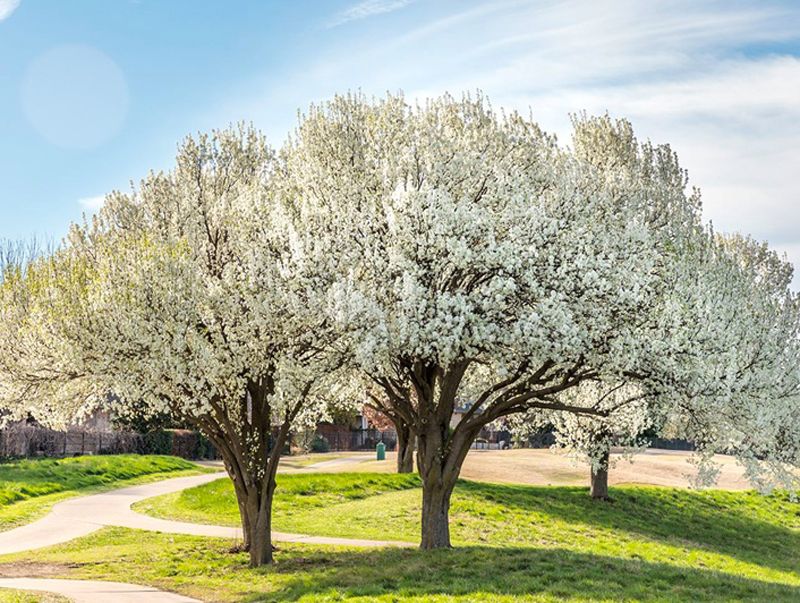
Walk through almost any Texas subdivision developed between the 1970s and early 2000s and you will find Bradford pear in the front yards. The appeal was never hard to understand.
The tree grew fast, often adding several feet per year when young, and it filled a landscape bed quickly without requiring much coaxing. UF/IFAS Extension’s profile of Bradford Callery pear describes the tree as tolerant of drought, soil compaction, alkaline soils, and even wet soils, a combination that covers a wide range of difficult Texas planting conditions.
Spring brought a reliable flush of white flowers that covered the entire canopy before the leaves fully opened, giving homeowners a showy ornamental display at a time when few other trees were blooming. Fall color followed, with leaves turning red, orange, or purple before dropping.
Those two seasonal performances, framed by a neat pyramidal shape that required little corrective pruning when young, made Bradford pear genuinely attractive for buyers who wanted a fast-maturing landscape tree with ornamental value.
Builders and landscapers leaned on it because it tolerated the compacted, disturbed soils common on new construction sites where better-adapted native trees sometimes struggle to establish. NC State Extension confirms that the tree can perform well in difficult urban sites before its structural problems emerge.
That early reliability is exactly why so many homeowners ended up with one, and it is worth acknowledging before explaining why the long-term picture looks different.
Weak branch unions create the long-term structural problem
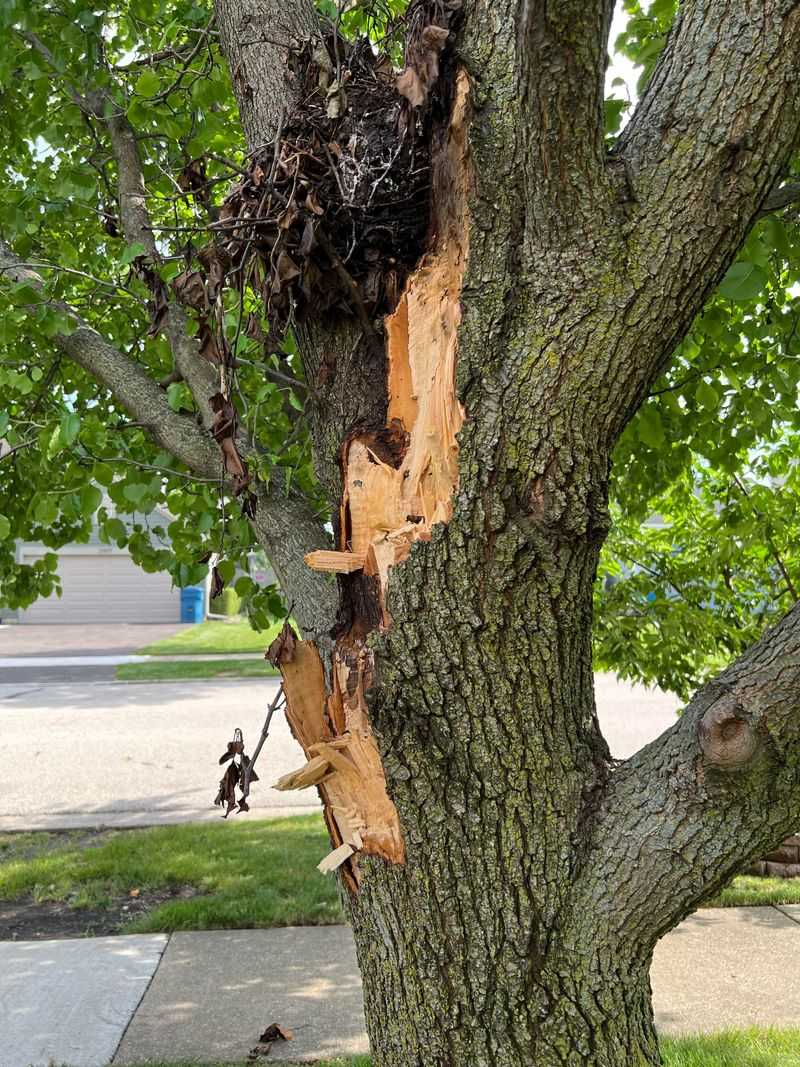
The same fast growth and tightly packed upright branches that gave Bradford pear its neat pyramidal shape in youth become a liability as the tree ages. Multiple large branches arise from nearly the same point on the trunk, competing for space and forming what arborists call included bark, a condition where bark tissue gets trapped between the branch and trunk rather than forming a strong wood-to-wood connection.
NC State Extension describes Bradford pear as prone to splitting and breakage, especially as trees mature and the competing scaffold branches grow heavier.
Wind, ice, and summer storms accelerate the problem. A branch that looks healthy can fail suddenly when a strong front pushes through, and in Texas that can mean anything from a Gulf Coast tropical system to a spring derecho or a winter ice event.
The failure is rarely a clean break at a small twig. More often, a major scaffold limb tears away from the trunk, sometimes taking a significant portion of the canopy with it and leaving the remaining structure even more vulnerable to the next storm.
Unpleasant-smelling flowers and a relatively short useful lifespan round out the case against the tree. Most Bradford pears begin showing serious structural decline within 15 to 25 years, which means trees planted during the subdivision boom of the 1980s and 1990s are now entering or past that window.
UF/IFAS Extension notes that topping the tree does not fix the underlying union problem and can actually introduce decay and create new structural hazards. Individual performance does vary with site conditions and early training, but the structural risk is inherent to how the cultivar grows, not simply a consequence of poor care.
The broader Callery pear group can spread beyond the yard
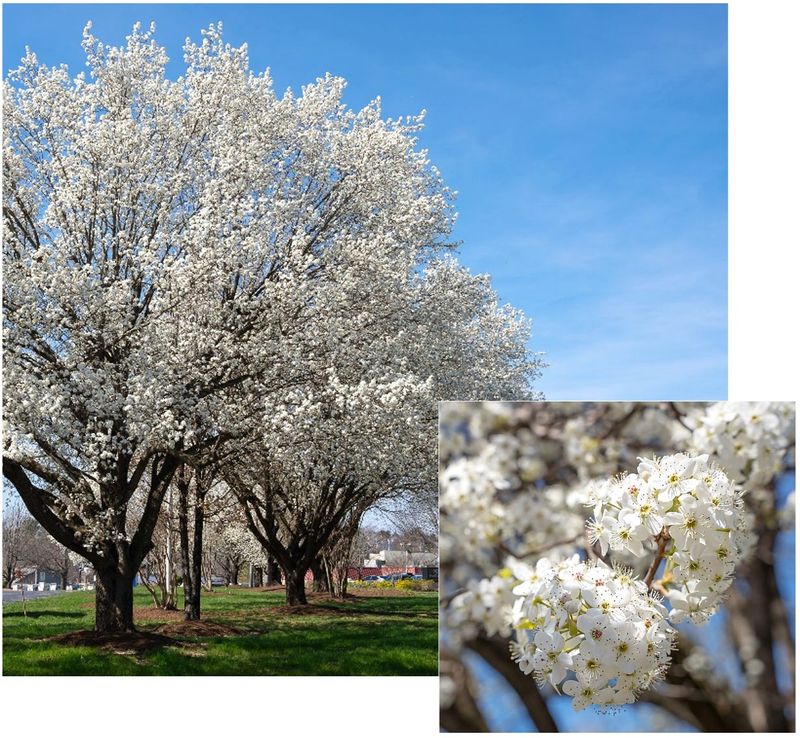
A common reassurance passed around at nurseries and neighborhood forums is that Bradford pear is sterile and cannot spread. That claim is incomplete in a way that matters.
A lone Bradford clone generally has limited ability to self-pollinate, so a yard with only one Bradford tree produces relatively little viable fruit. The problem arises when different Callery pear cultivars grow near each other.
Alabama Cooperative Extension’s guide to Callery pear history and control explains that cross-pollination between cultivars produces viable seed, and that seed is dispersed efficiently by birds that eat the small fruit.
Those seeds germinate readily in roadsides, fence lines, forest edges, and disturbed ground. The resulting seedlings often develop thorns absent in the parent cultivars and can grow aggressively enough to form dense thickets that crowd out native shrubs and wildflowers.
Vegetative sprouting from cut stumps adds another pathway for spread if removal is not handled carefully.
Texas Invasives lists Callery pear, including Bradford and related cultivars, as an invasive plant in Texas, reporting that escaped trees can displace native vegetation and form persistent thickets spread by bird-dispersed seed and vegetative growth. The invasive concern applies to the broader Callery pear group, not exclusively to Bradford.
Choosing a different cultivar does not automatically eliminate the ecological risk if that cultivar can still cross-pollinate with Bradford or other Callery varieties in the neighborhood. NC State Extension reinforces that cultivar differences within the Callery pear group do not remove the shared invasive-spread concern, which is why the entire group warrants reconsideration rather than a simple cultivar swap.
Choose the replacement by site, region, and purpose
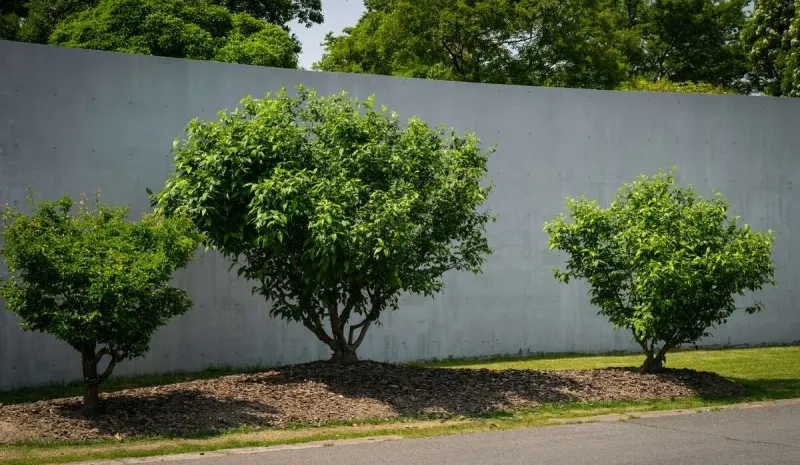
Before selecting any replacement tree, the most useful thing a homeowner can do is audit the planting site rather than simply pick a species that sounds appealing. Texas spans multiple climate zones, soil types, and rainfall patterns, and a tree that thrives in the sandy loam of East Texas may perform poorly in the alkaline clay of the Hill Country or the shallow coastal soils near Houston.
Region is the first filter, not an afterthought.
After region, mature size is the most important variable. Measure the available canopy space above and root space below before committing to a species.
Check for overhead utilities, nearby structures, driveways, and drainage patterns. A tree sold as a small specimen at the nursery can become a 70-foot canopy in a generation, and removing it later costs far more than choosing correctly at the start.
Soil drainage deserves its own check: a site that stays saturated after rain rules out species that need well-drained conditions, regardless of how drought-tolerant they are once established.
Sun exposure, irrigation availability, storm exposure, and the tree’s intended function, whether shade, spring flowers, wildlife habitat, or privacy screening, all narrow the field further. The Texas A&M Earth-Kind Plant Selector allows homeowners to filter by region, mature size, sun, soil, heat tolerance, and drought tolerance, making it a practical starting point for screening candidates against actual site conditions.
The Texas Tree Planting Guide from Texas A&M AgriLife Extension provides additional species guidance organized by regional suitability. The Texas Tested, Texas Tough program from Texas A&M Forest Service lists species and family lines evaluated for Texas conditions, which can help narrow choices further once the site constraints are clear.
No single tree wins every category, and the right-tree-right-place principle is more reliable than any statewide recommendation.
Mexican plum can replace the small flowering-tree function
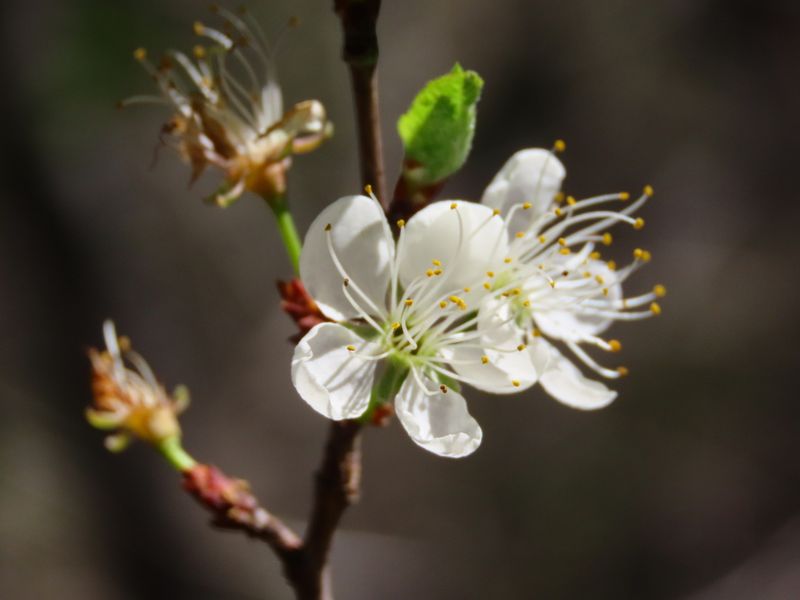
Homeowners looking for a smaller flowering tree to fill the ornamental role Bradford pear once played have a native option worth considering: Mexican plum. Texas A&M’s Mexican plum profile describes the tree as reaching roughly 25 feet at maturity, flowering white before the leaves emerge in March, and producing late-summer fruit that attracts wildlife.
Texas A&M also characterizes it as a drought-hardy landscape tree, a meaningful attribute in a state where summer water restrictions are common.
The strongest fit for Mexican plum is East and Central Texas, where its natural range aligns with moist slopes, creek bottoms, fencerows, and canyon edges. Gardeners in those regions with a site that offers reasonably well-drained soil and some moisture retention during dry spells will get the best results.
Pushing the species into drier, more alkaline West Texas sites or the intense coastal humidity of the upper Gulf Coast requires more caution and site-specific judgment.
The tree’s crown is shorter and more irregular than Bradford pear’s symmetrical pyramid, so the visual result will be different. Fruit drop is a real consideration for sites near patios, walkways, or driveways, though that same fruit is valuable for birds and small mammals.
Texas Invasives lists Mexican plum among the native alternatives to Callery pear, alongside Texas crabapple, green hawthorn, and anacua, reinforcing its legitimacy as a regionally appropriate choice. Mexican plum is not a perfect visual duplicate of Bradford pear, and it should not be sold as one, but for a homeowner in the right region who wants a native, wildlife-friendly flowering tree at a manageable scale, it is a genuinely defensible replacement.
Cedar elm belongs in a spacious shade-tree site
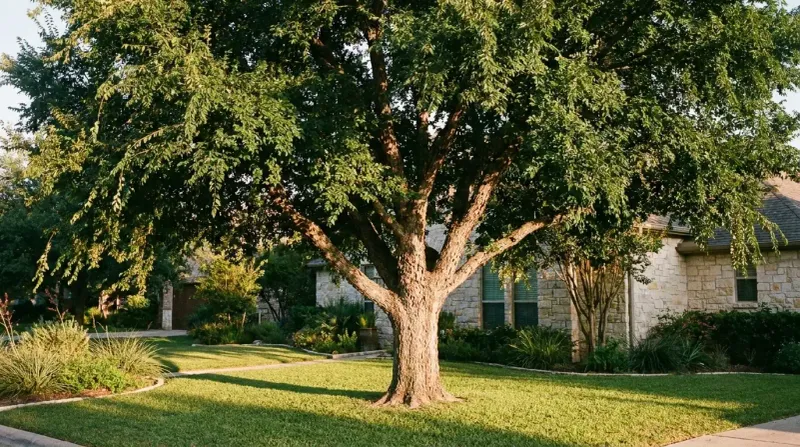
Cedar elm is a different solution than Mexican plum, aimed at a different problem. Where Mexican plum fills a smaller ornamental role, cedar elm is a large, long-lived native shade tree suited to yards with genuine room to grow.
Texas A&M Forest Service describes cedar elm as capable of reaching roughly 70 feet tall and 40 feet wide at maturity, with a lifespan exceeding 100 years and solid drought tolerance once established. Those dimensions make it a genuinely impressive shade provider, but they also rule it out for narrow planting strips, small urban lots, locations near power lines, and sites within falling distance of structures.
Before planting a cedar elm, measure the available space honestly. A 40-foot canopy spread needs root room to match, and roots from a large tree will eventually explore far beyond the drip line.
The tree is deciduous and drops small leaves in fall, which some homeowners prefer to manage rather than deal with the larger debris from Bradford pear branch failures.
Cedar elm is also part of the Texas Tested, Texas Tough program, which selects and evaluates trees for improved performance under Texas conditions. That program’s survival and performance data apply specifically to tested family lines grown through the program, not automatically to every cedar elm sold at a retail nursery under the same common name.
Asking a nursery whether their stock comes from a tested source is a reasonable question. For the right site, cedar elm offers something Bradford pear never could: a native tree with deep roots in the Texas landscape, structural integrity, and a lifespan measured in generations rather than decades.
Replace and plant with a safety-first plan
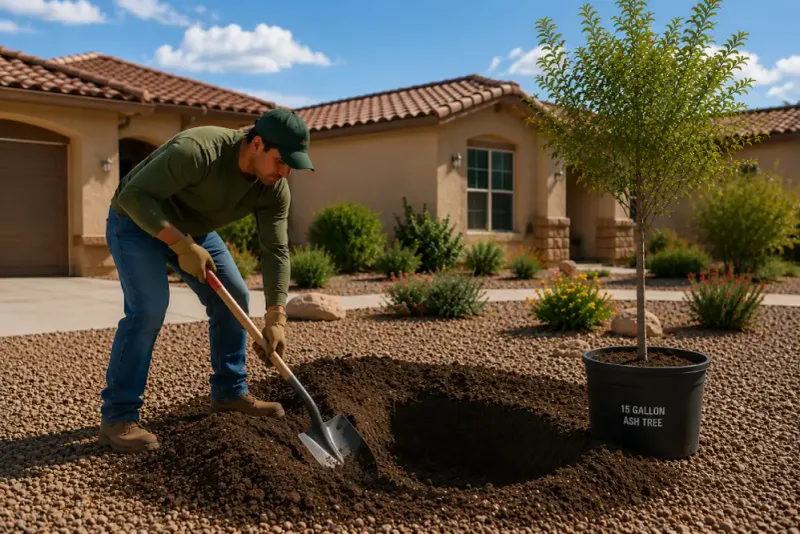
Removing a mature Bradford pear is not a weekend project to approach casually. Trees near buildings, fences, or overhead utilities, and any tree large enough to require a chainsaw for the main trunk, should be evaluated by a certified arborist before any cutting begins.
An arborist can assess structural risk, recommend whether removal or corrective pruning is the better path, and handle the work safely. Topping the tree is not a fix.
Extension guidance consistently warns that topping creates decay entry points and new structural hazards that often make the tree more dangerous than before.
Once the site is clear, timing and technique matter more than most homeowners expect. Texas A&M Forest Service’s planting guidance recommends the November-through-early-spring window when temperatures are cooler and many trees are dormant, giving roots time to establish before the heat of summer arrives.
Before digging, fill the intended hole with water and check that it drains within 24 hours. A site that stays saturated longer than that can kill a tree’s roots regardless of the species chosen.
Dig the hole at least twice as wide as the root ball but no deeper. Set the root collar flush with or slightly above grade, because planting too deeply is one of the most common causes of long-term tree failure.
Backfill with the native soil you removed rather than adding amendments to the planting hole. Apply 2 to 3 inches of mulch over the root zone, spreading it outward from the trunk but keeping it several inches away from the bark itself.
Piling mulch against the trunk traps moisture and invites disease and pests.
Newly planted trees need consistent establishment watering even when the mature species is drought-tolerant. Texas A&M Forest Service’s watering guide for newly planted trees suggests a starting rule of 2 to 4 gallons per inch of trunk diameter per watering, using the higher end in summer, with frequency adjusted for rainfall, soil type, and heat.
Plan to water regularly for at least the first two years. Protect the young tree from deer browsing and string-trimmer damage with a wire cage or trunk guard where those risks are present.
The better choice depends on what the yard needs
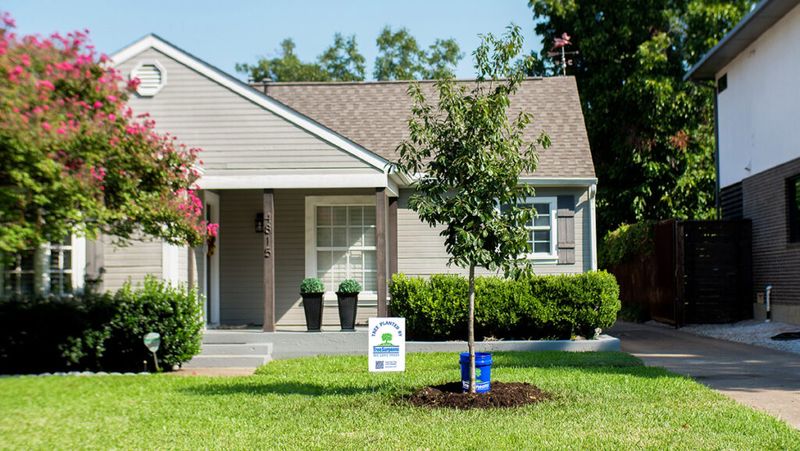
Replacement makes sense when Bradford pear’s structural risk or ecological liabilities outweigh its ornamental benefits at your specific site. A tree that has already begun splitting, that sits near a structure or utility line, or that is contributing to Callery pear spread in your area is a reasonable candidate for removal.
One that is young, structurally sound, and isolated from other Callery cultivars may warrant a longer evaluation before acting.
When you do replace it, match the successor to what the site actually needs. Mexican plum fits a smaller flowering-tree role in East and Central Texas with suitable drainage and soil moisture.
Cedar elm fits a large shaded yard with room for a 70-foot canopy and deep roots. Live oak, bur oak, and other locally adapted species serve different purposes still, and the Earth-Kind Plant Selector remains the most practical tool for filtering candidates against your actual region and site.
Successful establishment, not the species label on the nursery tag, determines whether a replacement tree delivers on its promise. A well-chosen, properly planted, and carefully watered native tree will outperform a poorly sited one every time.
The goal is a tree that fits the yard it grows in, not just one that sounds tougher than what it replaced.