
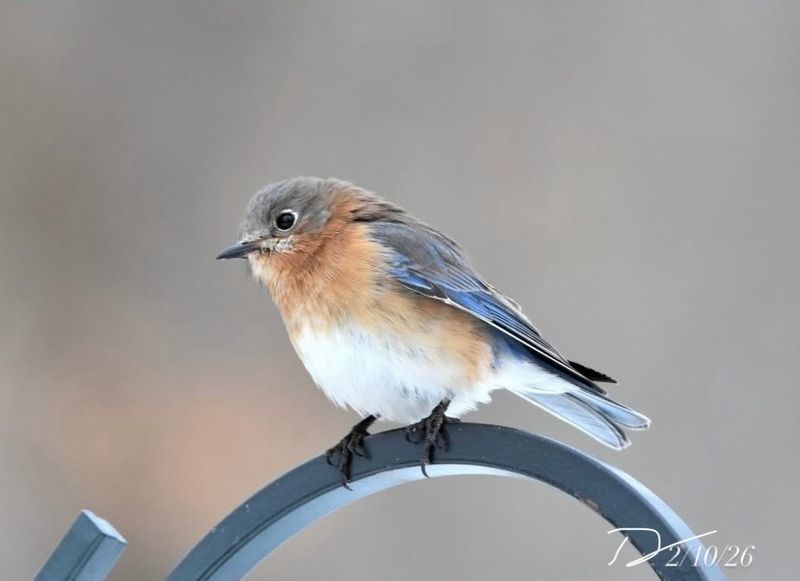
Eastern Bluebirds are one of the most recognizable birds in Texas, and if your yard has the right conditions, you may have a real shot at seeing them hunt insects across your lawn. These birds do eat grasshoppers, along with crickets, beetles, and other ground-dwelling bugs that can cause headaches for Central Texas gardeners.
The habits covered here will help you make your yard more useful to bluebirds, though the honest truth is that no single change guarantees the birds will show up or that your grasshopper troubles will disappear.
Eastern Bluebirds suit some Central Texas yards—but they are not grasshopper exterminators
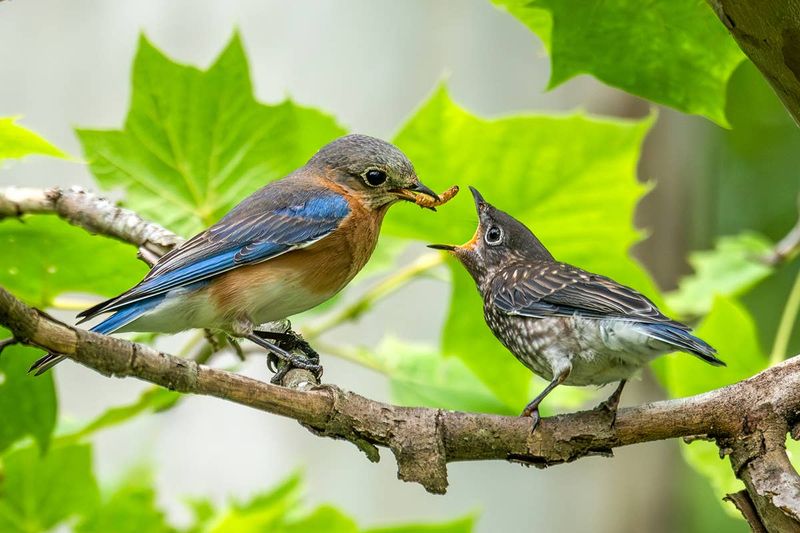
Texas Parks and Wildlife Department places the Eastern Bluebird squarely in the eastern half of Texas as a breeding bird, and Central Texas falls within that range. These birds show up in open woodland, along roadsides, in orchards, and on farmland, and they can move into suburban and urban settings when the habitat suits them.
That last part matters a lot: suitable habitat is the deciding factor, not proximity to a neighborhood or the presence of a nest box.
Bluebirds are perch-and-pounce hunters. A bird will sit on a fence post or low branch, scan the ground below, then drop down to snatch an insect before returning to its perch.
Cornell Lab of Ornithology confirms that their diet shifts with the season, leaning heavily on insects during warm months and adding berries and fruit when bugs are harder to find. Grasshoppers, crickets, beetles, caterpillars, and spiders are all fair game.
Yes, bluebirds eat grasshoppers. That fact is well supported.
What the evidence does not support is the idea that a few backyard changes will bring bluebirds reliably to every Central Texas yard or that the birds will work through a grasshopper infestation the way a pesticide might. Broader research on bird-based pest suppression finds that results vary by crop, pest type, bird community, and local conditions, and those studies concern whole bird communities on agricultural land, not a single species in a home garden.
The realistic and still genuinely useful promise is this: if your yard already has semi-open character, making it more bluebird-friendly may increase the chances you see one foraging there, and a foraging bluebird will eat grasshoppers among other prey. That is a worthwhile goal for any Central Texas gardener who wants a more ecologically active yard.
Treat fewer grasshoppers as a possible side benefit, not a guaranteed outcome.
Shape the yard for bluebirds that hunt from the ground
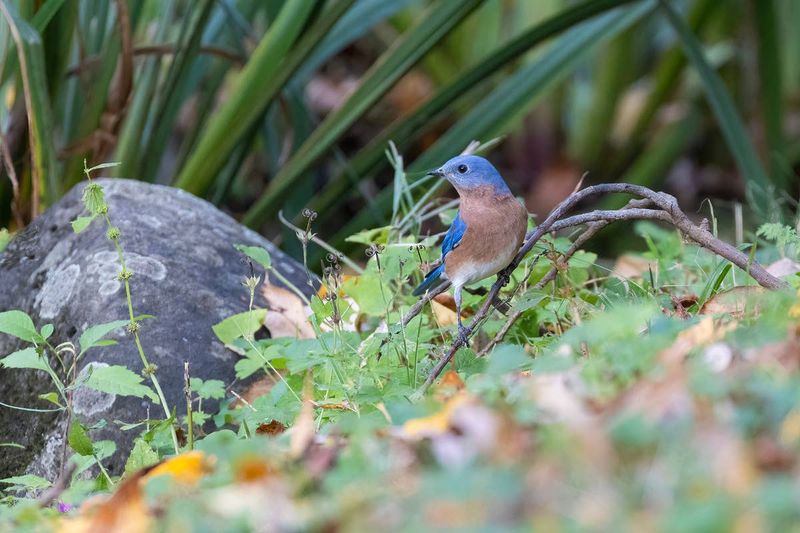
Before buying any equipment, look at what your yard already offers. Bluebirds strongly prefer open areas where they can see the ground clearly from an elevated spot.
Texas Parks and Wildlife bluebird guidance describes their preferred setting as sunny openings with nearby trees and several perch sites, and it specifically warns against brushy locations and heavy woods. A densely landscaped yard dominated by shrubs or a canopy that blocks sight lines to the ground is simply not what these birds are looking for.
Open lawn, a meadow-style patch with short or sparse ground cover, or even a mowed area near a garden bed can all serve as foraging ground. The key is that a bird needs to see from a perch down to the surface where insects live.
USDA Forest Service life history data confirms that bluebirds rely on elevated perches to locate prey on or near the ground, so retaining or adding fence posts, small dead snags, or simple wooden stakes near open areas gives them the vantage points they need. A perch does not have to be fancy; a four-foot wooden stake driven into the edge of a lawn patch works fine.
Native plants contribute to the system, but not by independently pulling bluebirds in. Texas Parks and Wildlife habitat resources describe native plants as the best way to supply food for birds because they support the insects, berries, cover, and seasonal food that make a yard genuinely functional.
Species like Texas persimmon, yaupon holly, and native bunch grasses can add insect habitat and late-season berries without closing off the open foraging space bluebirds need.
TPWD Wildscapes guidance reinforces that food, water, and shelter working together create functional habitat, not any single plant. Think of native plantings as building the insect community that feeds bluebirds rather than as a direct lure.
An open patch with a perch post and a ring of native grasses along the edge is a more honest bluebird invitation than a yard full of plants with no clear sight lines. Penn State Extension bluebird habitat guidance adds that perches near open foraging areas are among the most practical improvements a landowner can make.
A nest box helps most when you place it in suitable habitat
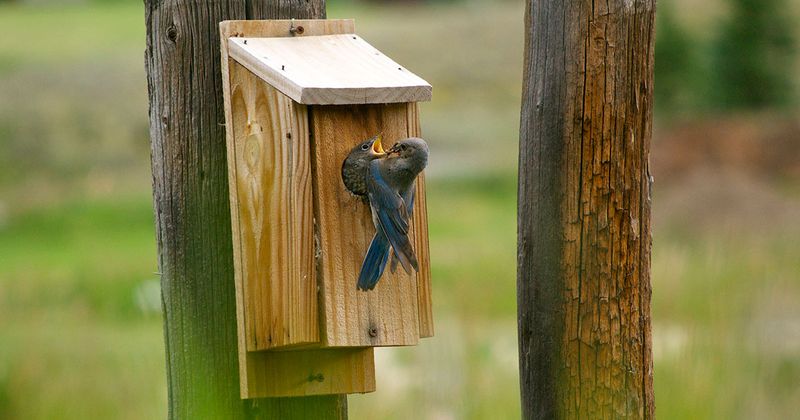
Natural tree cavities are scarcer in many Central Texas neighborhoods than they once were, and a well-designed nest box can partially fill that gap. The word “partially” carries real weight here.
A box placed in a yard that already offers open foraging space, nearby perches, and reasonable separation from dense brush gives bluebirds something genuinely useful. A box placed in a shaded, brushy, or heavily wooded yard mostly offers a cavity that other species will claim instead.
NestWatch nest box placement guidance specifies an open field, lawn, orchard, or other semi-open setting, a mounting height of roughly three to six feet, and a 1.5-inch round entrance hole sized for Eastern Bluebirds. That entrance dimension matters because a larger hole admits European Starlings, which are aggressive competitors for cavities.
Get the hole size right before installing anything.
TPWD bluebird publications recommend placing boxes in sunny openings with nearby trees and at least a few perch sites, and they advise steering clear of brushy locations, heavy woods, and areas where House Sparrows are concentrated. House Sparrows are non-native, highly aggressive toward bluebirds, and a persistent problem in many Central Texas neighborhoods.
Placing a box near bird feeders or dense ornamental plantings where House Sparrows congregate often means the box will go to the wrong tenant.
Do not attach a decorative perch to the entrance hole. Texas guidance is direct on this point: perches make the box more accessible to House Sparrows and other competitors without benefiting bluebirds, which do not need them to enter a correctly sized hole.
A smooth pole, a correct entrance hole, and an open surrounding area are the three things that most determine whether a box is genuinely useful to bluebirds rather than simply a structure in the yard.
Manage the box so predators and competitors do not decide the outcome
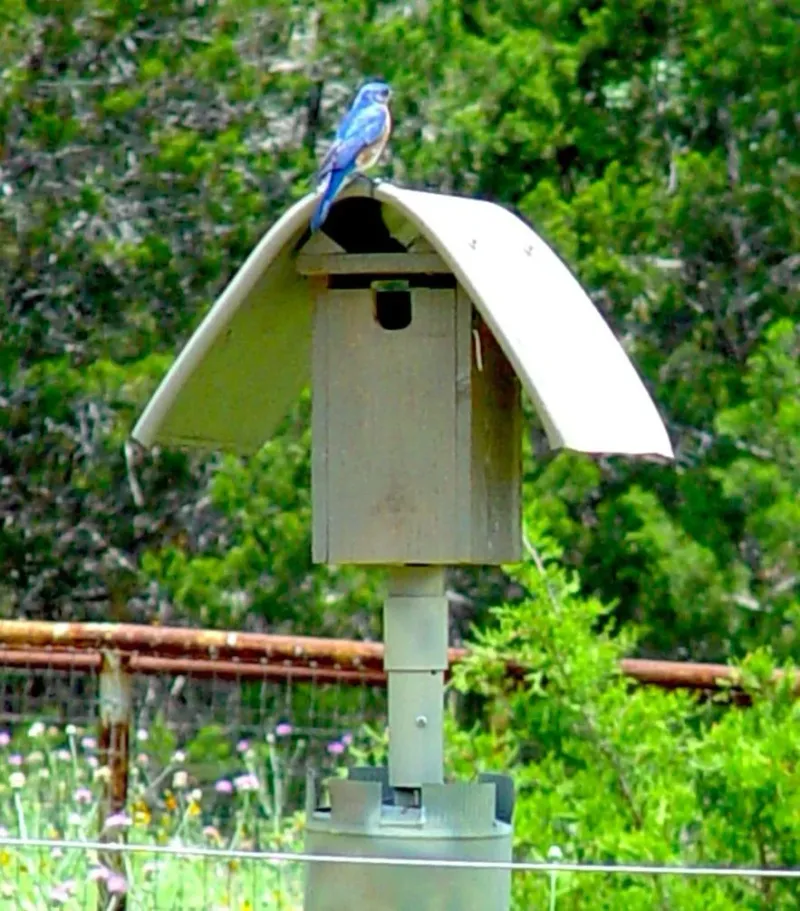
Putting up a nest box is the beginning of a commitment, not the end of one. A box that cannot be inspected and cleaned is a liability.
Mount yours where you can reach it comfortably, open the side or top panel, and check the contents every week or two during the nesting season. Monitoring lets you catch problems early, remove old nesting material after a brood fledges, and notice if a predator has been active nearby.
Snakes and raccoons are the most common nest-box predators in Central Texas. NestWatch predator guidance recommends mounting the box on a smooth metal pole and adding a cylindrical or cone-style baffle below the box.
A wooden post driven into the ground offers easy climbing access and is not a good mounting option if predators are present in your area. Baffles are inexpensive and make a measurable difference in nest success.
Penn State Extension bluebird management guidance addresses box spacing and competitor management in practical terms. For separate Eastern Bluebird territories, NestWatch recommends roughly 300 feet of spacing between boxes as a minimum.
Some bluebird trail managers place two boxes five to twenty-five feet apart to accommodate both bluebirds and Tree Swallows in the same area, since those species can coexist at close range, but that paired arrangement is not the standard recommendation for a single backyard box.
Competitor management requires knowing which birds you are dealing with. TPWD bluebird guidance is clear that House Sparrows and European Starlings are non-native species and the primary nest-box competitors to address.
Native cavity nesters such as Carolina Wrens, Tufted Titmice, and Carolina Chickadees may also investigate a box, and they are protected birds that should not be disturbed or removed. If a native bird claims the box, consider it a sign that your yard is supporting wildlife, and evaluate whether a second box in a different location might attract bluebirds separately.
Managing for bluebirds does not mean clearing out every other bird; it means reducing the advantage that non-native competitors currently have.
Water and mealworms can support the habitat, but neither replaces it
A reliable water source can make a real difference in a Central Texas yard, especially during the long, hot stretches that stretch from late spring through early fall. TPWD Partners in Flight guidance recommends clean, fresh water as one of the most straightforward ways to support birds, and TPWD habitat resources note that dripping or moving water tends to be more attractive than a still basin.
A small dripper or wiggler attachment on an existing birdbath is an easy addition that costs very little.
Keep the basin shallow, less than about two inches deep at the center, so smaller birds can use it safely. Clean the bath at least twice a week during warm months; algae, droppings, and standing water can contribute to disease spread among birds that share the same source.
If you notice sick or dead birds near your yard, stop providing water temporarily, scrub the bath with a dilute bleach solution, rinse it thoroughly, and refill only after the equipment is clean. TPWD disease advisories recommend this pause-and-clean approach to reduce the risk of spreading illness through congregating birds.
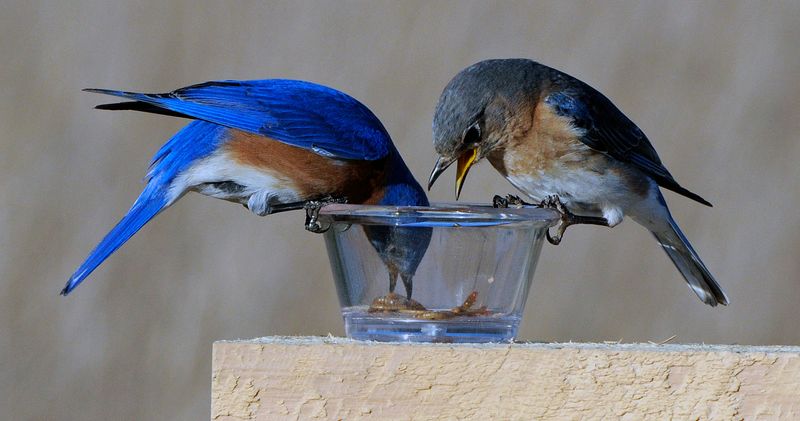
Mealworms attract bluebirds reliably when the birds are already in the area, but they are supplemental food, not a habitat substitute or a complete diet. TPWD bluebird publications describe mealworms as a bluebird favorite while recommending they be offered sparingly.
Audubon Society guidance adds that live mealworms are preferable to freeze-dried ones during the nesting season because nestlings need moisture, and freeze-dried worms do not provide it. Offer a small amount in a shallow dish rather than a large pile, and clean the dish regularly.
TPWD feeder hygiene advisories apply to mealworm dishes just as they do to seed feeders: wet or contaminated food creates disease risk, and any equipment that birds share needs regular attention.
Let bluebirds be one part of a measured grasshopper response
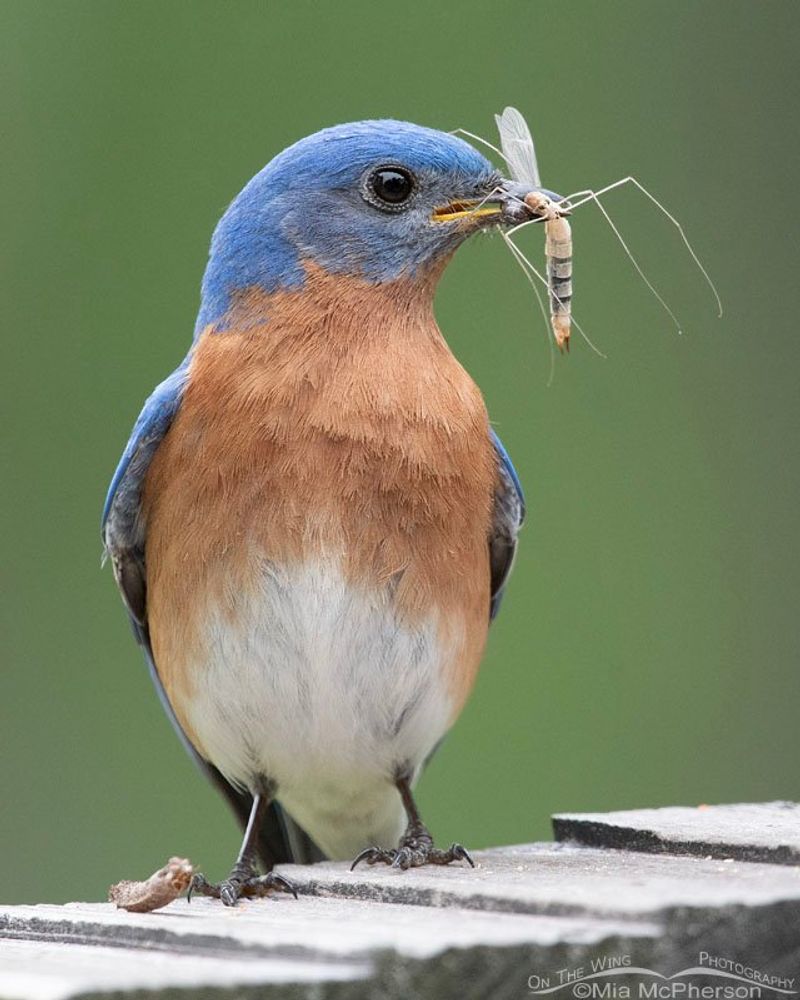
Bluebirds foraging through your yard may pick off grasshoppers along with the beetles, caterpillars, and spiders they encounter. That is a genuine ecological benefit worth welcoming.
What it is not is a pest-control strategy you can count on when grasshoppers are actively chewing through a vegetable bed or ornamental border. Research on bird-based pest suppression in agricultural settings shows that effects vary by crop, pest, and the full bird community present, and those findings do not translate directly to a single bird species managing grasshoppers in a home garden.
Texas A&M AgriLife Extension grasshopper guidance treats the problem as a monitoring and management issue involving multiple harmful species. When damage is genuinely severe, they recommend identifying the pest, assessing the population size, and choosing the least-disruptive control option that fits the situation.
That may mean tolerating low numbers, using row covers to protect specific plants, or applying a targeted treatment in a limited area.
Avoid spraying insecticides broadly across areas where bluebirds hunt. TPWD bluebird publications specifically advise against pesticide use where bluebirds forage, and TPWD bluebird habitat guidance reinforces that pesticides can reduce prey availability and expose birds to chemical residues.
A yard treated with broad-spectrum insecticides becomes a less useful foraging area, which works directly against the habitat improvements described in earlier sections.
The practical balance looks like this: maintain the open, insect-rich habitat that bluebirds prefer, tolerate moderate insect activity as part of a functioning ecosystem, and respond to serious grasshopper damage with targeted management rather than yard-wide spraying. TPWD habitat resources frame the goal well: native insects are part of the food web, and protecting plants should not mean removing every insect from the yard.
Bluebirds fit best into a yard that treats insects as a resource to manage thoughtfully rather than a problem to eliminate entirely.
Improve the yard first, then measure success realistically
A practical sequence for any Central Texas yard starts with what you already have. Preserve or create an open foraging area with short ground cover and clear sight lines.
Add one or two safe perches, a fence post or wooden stake near the open patch, where a bird can scan from above. Build up native plantings along the edges to support insects and berries without closing off the open space that makes the yard useful.
TPWD Eastern Bluebird species guidance confirms that these habitat elements together define the settings where bluebirds actually show up.
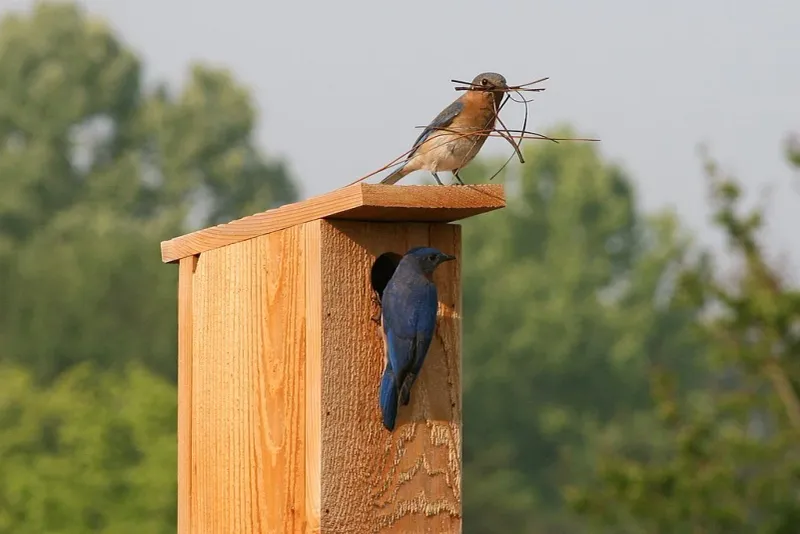
If the surrounding habitat is reasonably suitable, add a correctly designed and properly mounted nest box, no entrance perch, correct hole size, predator baffle included. Provide clean water in a shallow basin if you can maintain it consistently.
Skip the broad pesticide applications in areas where you want birds to forage, and respond to serious grasshopper damage with targeted management from AgriLife Extension rather than yard-wide spraying.
Measure success by the condition of the yard, not just by whether a bluebird appears on a given afternoon. TPWD habitat resources define a functional wildlife yard as one that provides food, water, and shelter working together, and a yard that meets those criteria is genuinely more valuable to birds whether or not bluebirds claim it in any particular season.
A healthier, more open, insect-supporting Central Texas yard is a real achievement. If a bluebird drops in to hunt grasshoppers along the way, that is the bonus the work was always pointing toward.